
You can train cardio at home with no equipment, in a small room, without a single jump.
The training effect comes from how fast you move and how little you rest, not from how high you leave the floor.
Marching, step ups, low squats and quick footwork will raise your heart rate plenty if you push the pace and keep the rest short.
The rest of this is how to do that without the person downstairs learning your workout schedule.
Can you get a real cardio effect without jumping?
Yes, and the mechanism is not complicated.
Your heart and lungs respond to a sustained demand for oxygen, and impact is only a side effect of how some exercises create that demand.
A staircase makes the point well.
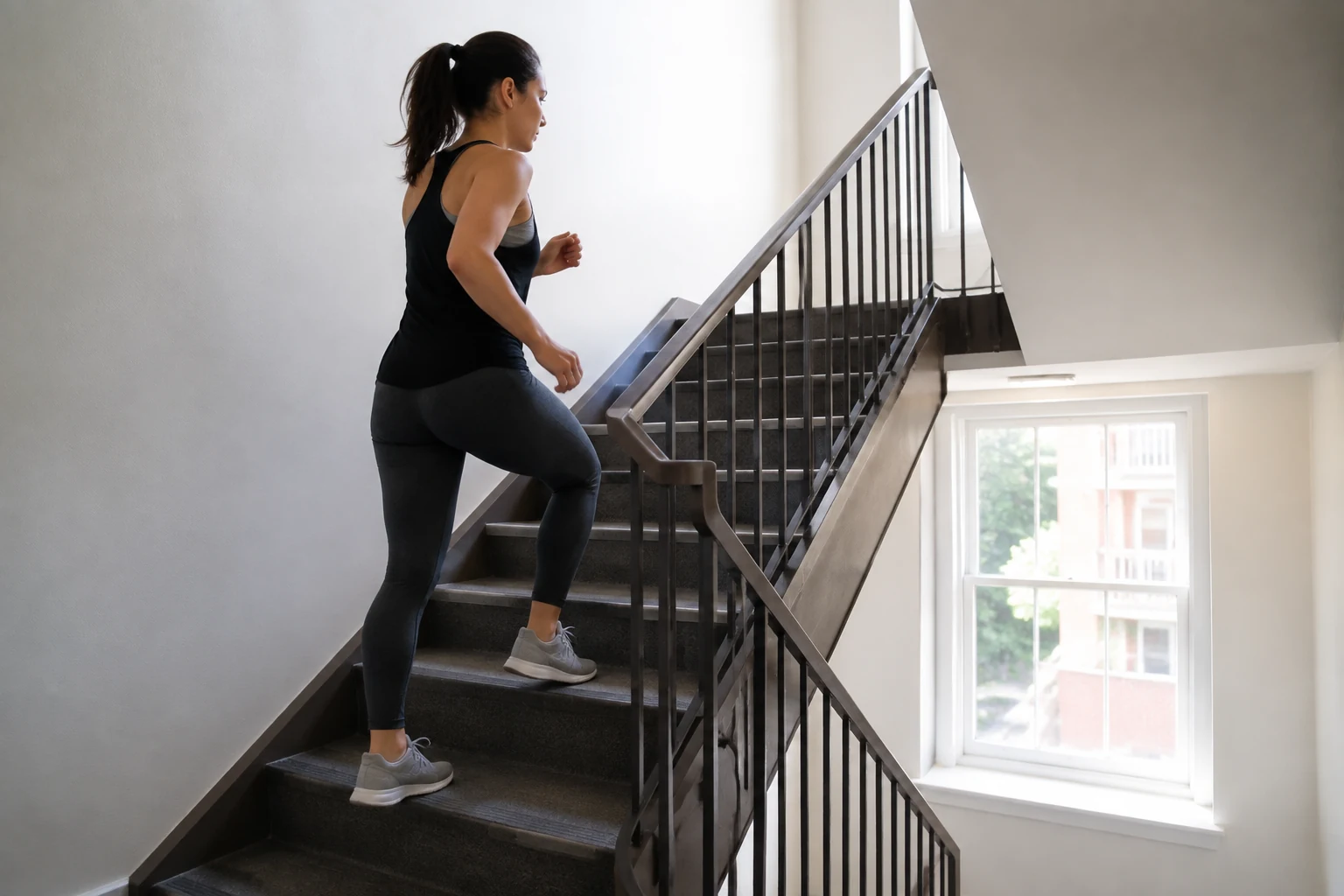
Researchers had sedentary young adults climb a three flight stairwell vigorously three times a day, three days a week, for six weeks, and peak oxygen uptake improved compared with a control group (Jenkins et al., 2019).
Nobody jumped. They walked up stairs quickly.
It is worth staying honest about the size of that study: twelve people per group, young and healthy, and the improvement was real but small in absolute terms.
Treat it as a proof of concept rather than a promise.
The wider point still stands.
Low impact does not mean low intensity, and the two get confused constantly because most beginner workouts happen to be both.
If your building has a staircase, that is the best no equipment cardio tool you own, and our piece on the four flight stair climb explains what a timed climb can and cannot tell you about fitness.
What actually makes the noise downstairs?
Two different problems get lumped together.
Airborne noise is your music and your breathing, and a closed door handles most of it.
Impact noise is the one that causes arguments, because a landing sends energy straight into the floor structure and the ceiling below behaves like a drum skin.
That is why a jump can be almost inaudible in your own room and unbearable one floor down.
Three things cut it.
Stop leaving the floor, so there is no landing to transmit in the first place.
Land through the foot rather than onto it, rolling from the ball of the foot back to the heel with a soft knee, on any move where you do step down hard.
Put something absorbent underneath, which for most people means a folded rug or a thick mat rather than bare hardwood or laminate.
Position matters more than people expect.
A floor is stiffest close to the walls and most flexible in the middle of the span, so training near a wall usually sends less energy downward than training in the center of the room.
Time of day is the last lever and the cheapest one.
The same session that reads as background movement at seven in the evening reads as a problem at eleven at night, so move the workout before you start rebuilding the floor.
Shoes are worth a thought too, since a cushioned trainer quiets the contact more than a bare foot or a sock on hard flooring.
If the person below you can tell which exercise you are doing, the workout is louder than it needs to be. That is usually a form problem before it is a courtesy problem.
Which quiet moves replace the usual jumping ones?
Almost every popular home cardio move has a version that keeps one foot on the floor.
| Usual move | Quiet version | What keeps the intensity |
|---|---|---|
| Jumping jacks | Step jacks, one foot out at a time | Keep the arms sweeping overhead at full speed |
| Burpees | Squat thrust, step the feet back and in, stand without the jump | Move continuously and do not pause at the top |
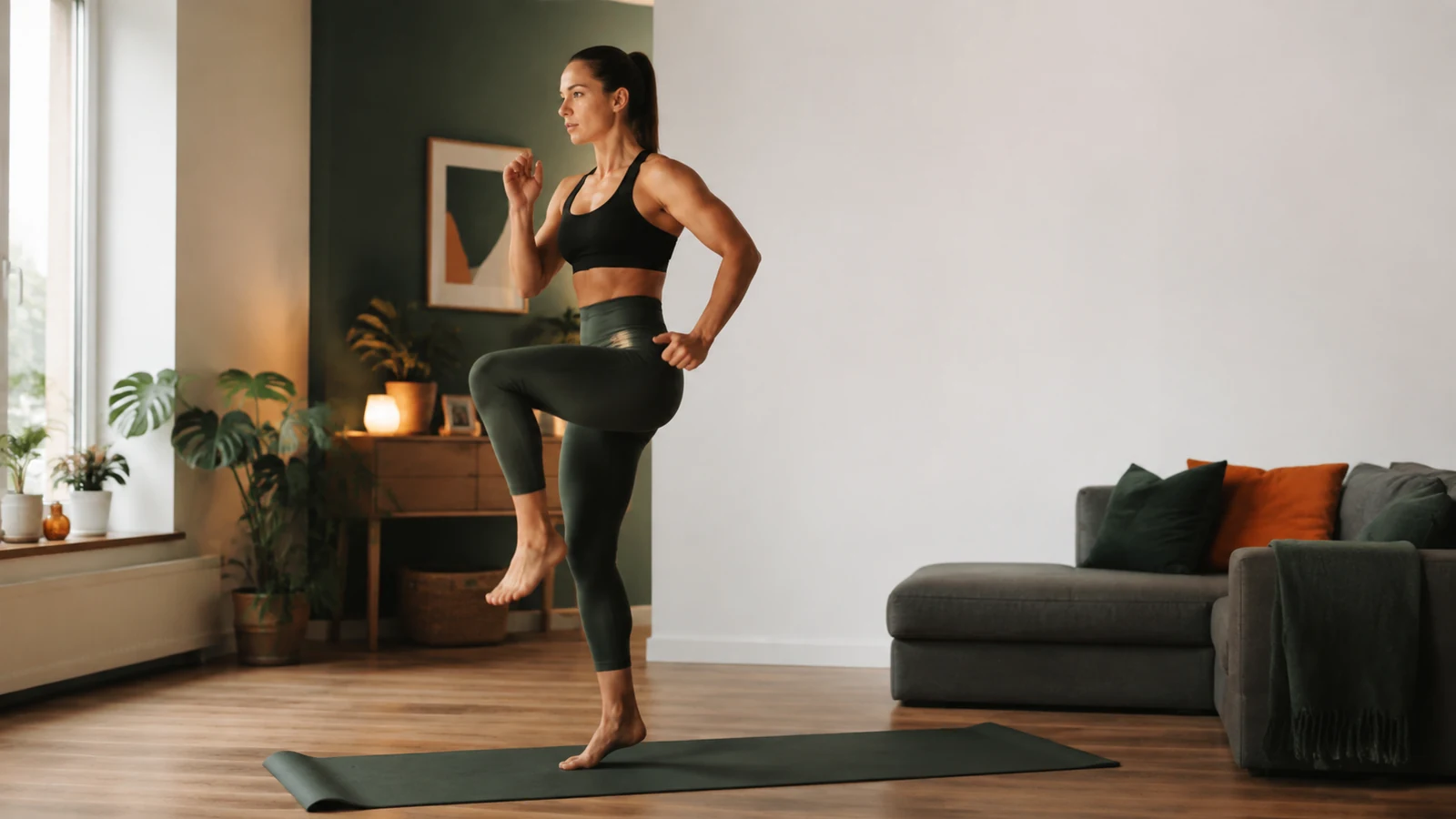
| High knees | Fast march with the knee to hip height | Drive the arms and raise the cadence |
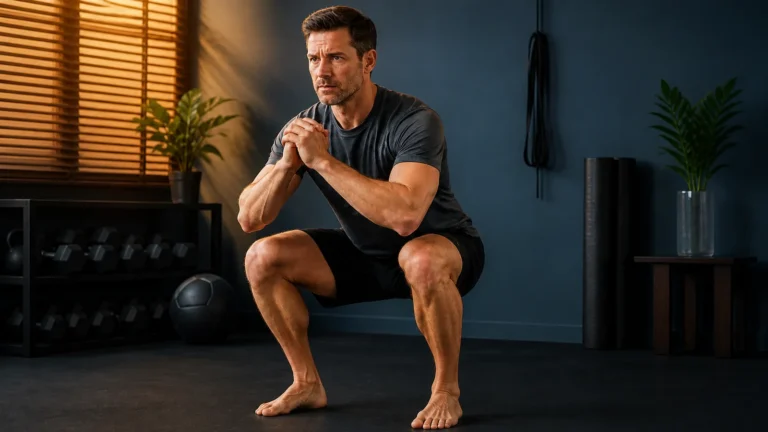
| Jump squats | Tempo squats, three seconds down and fast up | The slow lowering does the work |
| Mountain climbers | Slow mountain climbers or plank shoulder taps | Hold the plank steady instead of racing the feet |
| Skater hops | Lateral step skaters with no hop | Take a longer step and add a low reach toward the floor |
| Box jumps | Step ups onto a stair or a low sturdy step | Alternate the lead leg and hold a steady tempo |
| Jump rope | Rope free footwork with the heels staying low | Fast small foot contacts, arms turning as if holding a rope |
Two more cost nothing and make almost no sound: shadow boxing and stair repeats.
Shadow boxing gets people to a high effort faster than they expect, because the arms fatigue quickly while the legs never stop.
One form cue carries across all of these moves.
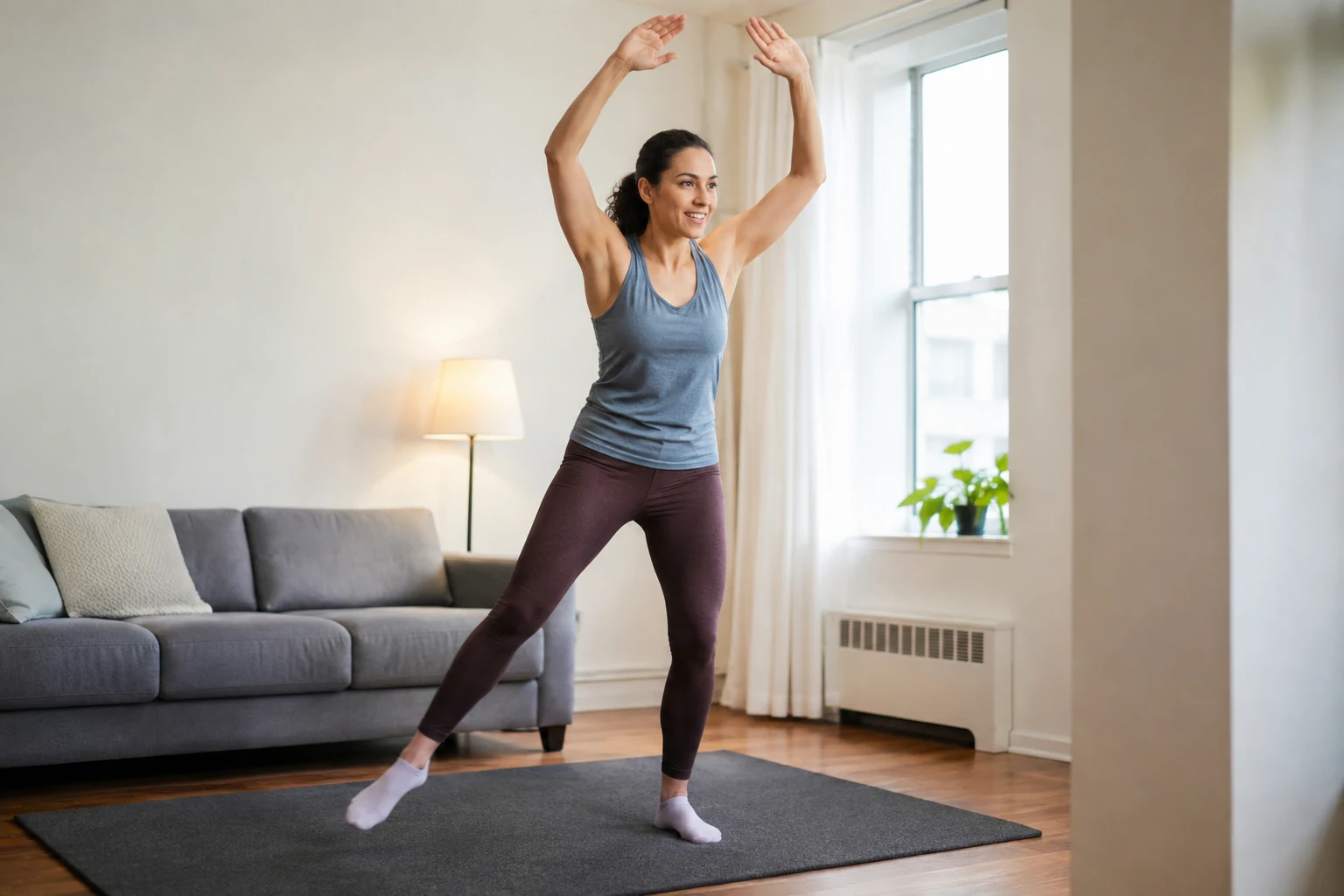
Keep a soft knee and a quiet ankle, and think about pressing the floor away rather than striking it.
People make noise when they let the leg go straight and drop their weight onto a locked joint, which is also how you end up with sore shins.
How hard is hard enough without a heart rate monitor?
Use your voice.
The talk test is the most useful free intensity gauge there is, and it holds up against lab measures.
In one study, the point where speech first became difficult lined up closely with the ventilatory threshold, and the result was consistent on a treadmill and on a bike (Persinger et al., 2004).
In plain terms, the moment talking stops being comfortable is a real physiological line, not a vague feeling.
Pair that with a rating of perceived exertion, which is simply a number from 0 to 10 for how hard the effort feels right now.
| Effort, 0 to 10 | How it feels | What you can say | Where it belongs |
|---|---|---|---|
| 2 to 3 | Easy, you could keep going a long time | Full conversation | Warm up and cool down |
| 4 to 5 | Working, still comfortable | Full sentences with a breath in the middle | Long steady blocks |
| 6 to 7 | Hard, breathing is obvious | Short phrases only | Most work intervals |
| 8 to 9 | Very hard, you want it to end | A word or two | The last round, occasionally |
| 10 | All out | Nothing | Rare, and not on a floor you are trying to keep quiet |
For the session below, aim to sit at 6 or 7 during the work intervals and drop back near 4 by the end of each rest.
If you can still hold a full conversation during a work interval, the pace is too slow.
None of this needs a chest strap or a watch, and the reading you get from your own breathing is more honest than a number you do not know how to interpret.
The common alternative is worse than people think.
Estimating maximum heart rate as 220 minus your age carries a wide margin of error between individuals, so a target zone built on that estimate can be well off for you personally.
Your breathing does not have that problem.
What does a quiet 20 minute session look like?
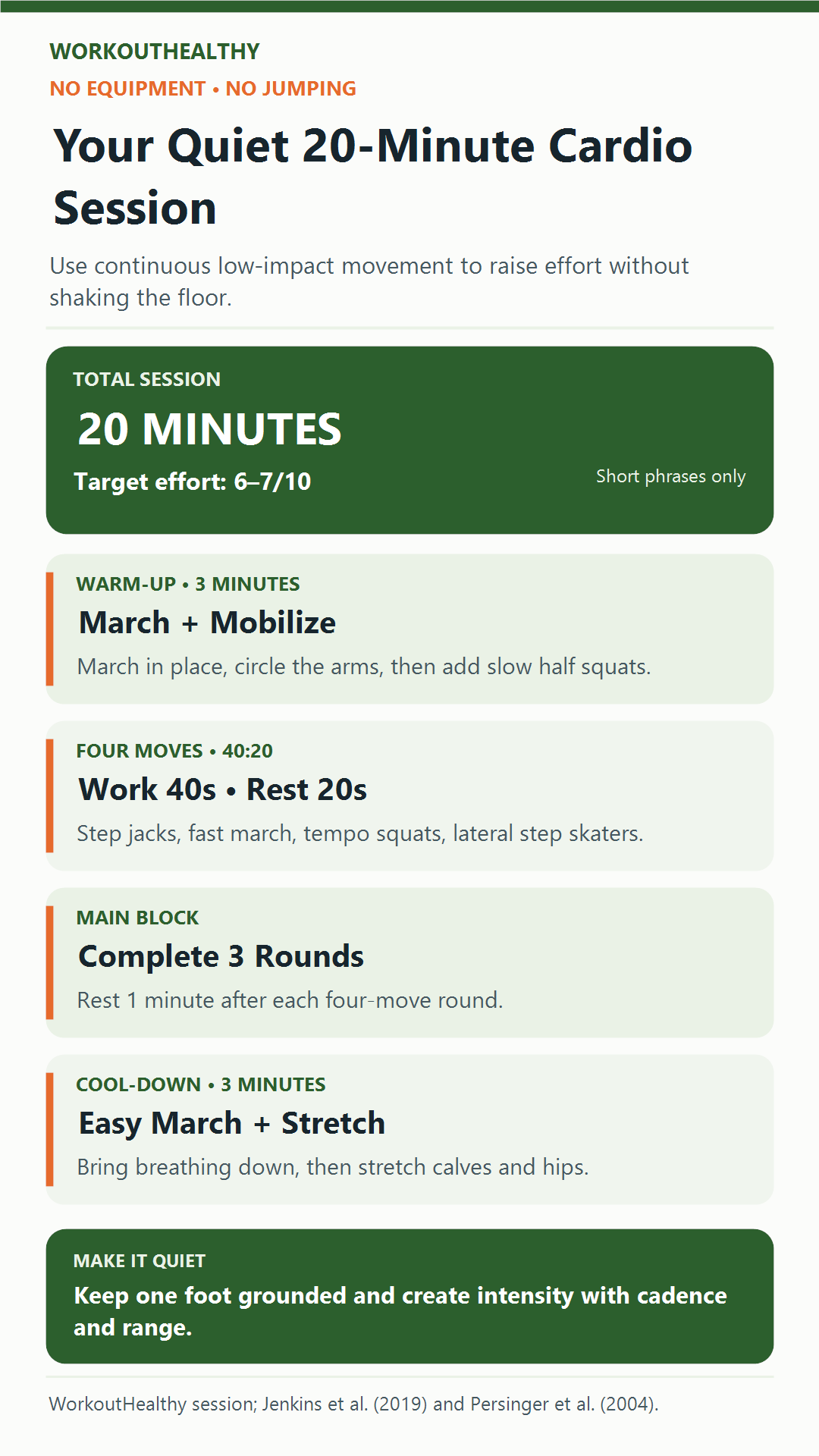
Four moves, three rounds, no jumping, no equipment, and enough floor space to stand with your arms out.
| Block | What you do | Work | Rest |
|---|---|---|---|
| Warm up | March in place, arm circles, slow half squats | 3:00 | none |
| 1 | Step jacks | 0:40 | 0:20 |
| 2 | Fast march with high knees | 0:40 | 0:20 |
| 3 | Tempo squats, slow down and quick up | 0:40 | 0:20 |
| 4 | Lateral step skaters | 0:40 | 1:00 at the end of the round |
| Rounds | Repeat blocks 1 through 4 for three rounds total | 12:00 | included above |
| Cool down | Easy marching, then calf and hip stretches | 3:00 | none |
Total time is about 20 minutes.
The whole thing happens on the balls of your feet, with the heels touching down softly rather than slapping.
If a move sounds loud, slow the foot contact instead of slowing the whole exercise, and let the pace come from the arms.
How do you go from beginner to harder without adding noise?
Change one variable at a time and give each change two weeks.
| Weeks | Work | Rest | Rounds | Target effort |
|---|---|---|---|---|
| 1 to 2 | 0:30 | 0:30 | 2 | 4 to 5 |
| 3 to 4 | 0:40 | 0:20 | 3 | 5 to 6 |
| 5 to 6 | 0:45 | 0:15 | 3 | 6 to 7 |
| 7 to 8 | 0:50 | 0:10 | 4 | 7 to 8 |
After week eight the honest ways to keep progressing are more rounds, a longer session, a fifth move, or a harder version of a move you already do.
A deeper squat and a step up onto a higher stair both qualify, and neither adds impact.
Repeat a week rather than advancing if your form fell apart in the last round or your foot contacts got loud.
The signal that you are ready to move on is simple.
You finish the last round at the target effort, your form in round three looks like your form in round one, and you are recovered enough to hold a conversation about two minutes after you stop.
Consistency beats cleverness here. Two sessions a week you actually do in socks late on a weeknight will outperform a better plan that needs a gym, a free hour and a good mood.
How much cardio actually matters for health?
Less than most people fear, and more than most people do.
Federal guidance for adults is 150 to 300 minutes of moderate intensity aerobic activity a week, or 75 to 150 minutes of vigorous intensity activity, plus muscle strengthening work on two days (Piercy et al., 2018).
The 2018 edition also dropped the old rule that a bout had to last at least ten minutes before it counted.
That change matters at home, because it means a short session on a busy evening still adds to your weekly total.
Two of the 20 minute sessions above, plus ordinary walking, puts most people inside that range without a gym membership.
Walking is quietly doing more of that work than it gets credit for, and our guide to how far to walk each day covers how to set a target you will actually keep.
The observational evidence on daily steps and mortality points the same direction: accumulated movement across the week, not one perfect workout.
Here is where I would set expectations.
No equipment home cardio maintains a base.
It will not make you a fast runner, and it will not build much strength.
The guidelines list muscle strengthening as a separate item for a reason, and no amount of step jacks covers it.
If you want either of those, this is the thing you do on the days you cannot get out, not the whole plan.
The bottom line
Intensity comes from pace and short rest, not from impact.
Use the talk test to find the line, keep your work intervals around 6 or 7 out of 10, and change one variable every two weeks.
Do that two or three times a week in a small room and the person downstairs never needs to know it happened.
Get the next evidence check.
Five practical fitness stories worth your time, every Friday.
One email a week. No product pitches. Unsubscribe in one click.
References
Jenkins, E. M., Nairn, L. N., Skelly, L. E., Little, J. P., & Gibala, M. J. (2019). Do stair climbing exercise “snacks” improve cardiorespiratory fitness? Applied Physiology, Nutrition, and Metabolism, 44(6), 681 to 684. https://doi.org/10.1139/apnm-2018-0675
Persinger, R., Foster, C., Gibson, M., Fater, D. C. W., & Porcari, J. P. (2004). Consistency of the talk test for exercise prescription. Medicine and Science in Sports and Exercise, 36(9), 1632 to 1636. https://journals.lww.com/acsm-msse/Fulltext/2004/09000/Consistency_of_the_Talk_Test_for_Exercise.25.aspx
Piercy, K. L., Troiano, R. P., Ballard, R. M., Carlson, S. A., Fulton, J. E., Galuska, D. A., George, S. M., & Olson, R. D. (2018). The Physical Activity Guidelines for Americans. JAMA, 320(19), 2020 to 2028. https://doi.org/10.1001/jama.2018.14854
Medical disclaimer: This article is for general information only and is not medical advice. If you have an injury, ongoing pain, or a medical condition, talk to a doctor or physical therapist before you change how you train or eat.