
Running with a weighted vest changes the work you do while wearing it, but evidence that regular vest runs make distance runners faster after the vest comes off is limited. A short warm-up study, a loaded 5 km test, and a small six-week trial answer three different questions.
If your goal is a faster unweighted race, start with that distinction. A vest may have a place in a specific program, but the research does not supply a proven percentage of body weight or an eight-week progression for routine runs.
What did weighted-vest running studies actually test?
| Study | People and protocol | Observed outcome | What it cannot prove |
|---|---|---|---|
| Barnes et al., 2015 | 11 well-trained distance runners did six 10-second warm-up strides with or without a vest at 20% of body mass, then removed it. | In the weighted warm-up condition, peak treadmill speed and measured running economy improved shortly afterward. | It was a one-session priming test, not a months-long vest-running program or a 20% training recommendation. |
| Silder et al., 2015 | 27 people ran at a fixed speed on a treadmill with zero, 10%, 20%, and 30% added body-weight load. | Leg stiffness, contact time, vertical ground reaction force, and several joint angles changed acutely. | These mechanics do not measure future injury incidence or faster unweighted racing. |
| Sharp et al., 2022 | 11 current or former collegiate runners did an unweighted and a roughly 2.4 kg loaded 5 km run. | The loaded run was slower by about 4% in that test. | One loaded effort does not tell us whether training with the load later improves performance. |
| Mallett, 2023 | 18 young female athletes were assigned to six weeks of endurance training with or without a vest. | The paper reports relationships among fitness measures and training changes. | Its abstract does not establish a clear between-group running-performance advantage or an injury-rate comparison. |
The most quoted 6% economy figure comes from Barnes and colleagues after the vest was removed. It should not be presented as a gain from doing ordinary runs in a vest.
Likewise, Silder and colleagues measured how runners moved under load; they did not follow them for injuries. More force on a laboratory treadmill is a reason to be thoughtful about loading, not a measured injury probability.
Should you wear one for your running goal?
| Goal | Current evidence-based choice | Where a vest might fit |
|---|---|---|
| Improve an unweighted 5 km or long-distance race | Keep most running specific to the event and use a training plan you can sustain. | Only as a carefully observed experiment; there is no established advantage over ordinary training. |
| Add challenge to an easy day | First consider whether more pace, distance, terrain, or load would crowd out recovery. | A short trial may be reasonable for an experienced, currently healthy runner who can compare the next day’s response. |
| Practice carrying equipment for a loaded event | Include event-specific load and terrain in a plan built for that event. | The vest can resemble the carried load more closely than an unloaded run, though fit and distribution still matter. |
| Get aerobic work while carrying weight | Loaded walking is a distinct option that does not require running with the load. | Choose it for its own purpose rather than assuming it produces identical running adaptations. |
That is the gap between a useful vest and a vest marketed as a shortcut. The research above helps you decide whether your actual goal was studied.
What changes in your stride?
In Silder’s fixed-speed treadmill test, added load increased peak vertical force and ground contact time while runners flexed more at the hip and knee. The force change was smaller than the added load, which illustrates how people altered their mechanics under the test conditions.
Those changes are not automatically injuries or bad form. They also mean a vest run is not identical to an unloaded run at the same pace.
A separate 5 km experiment gives the simplest performance check: the runners were slower while wearing an added 2.4 kg garment. That is an acute result, so it should not be sold as proof for or against long-term adaptation.
How do you choose a vest that fits?
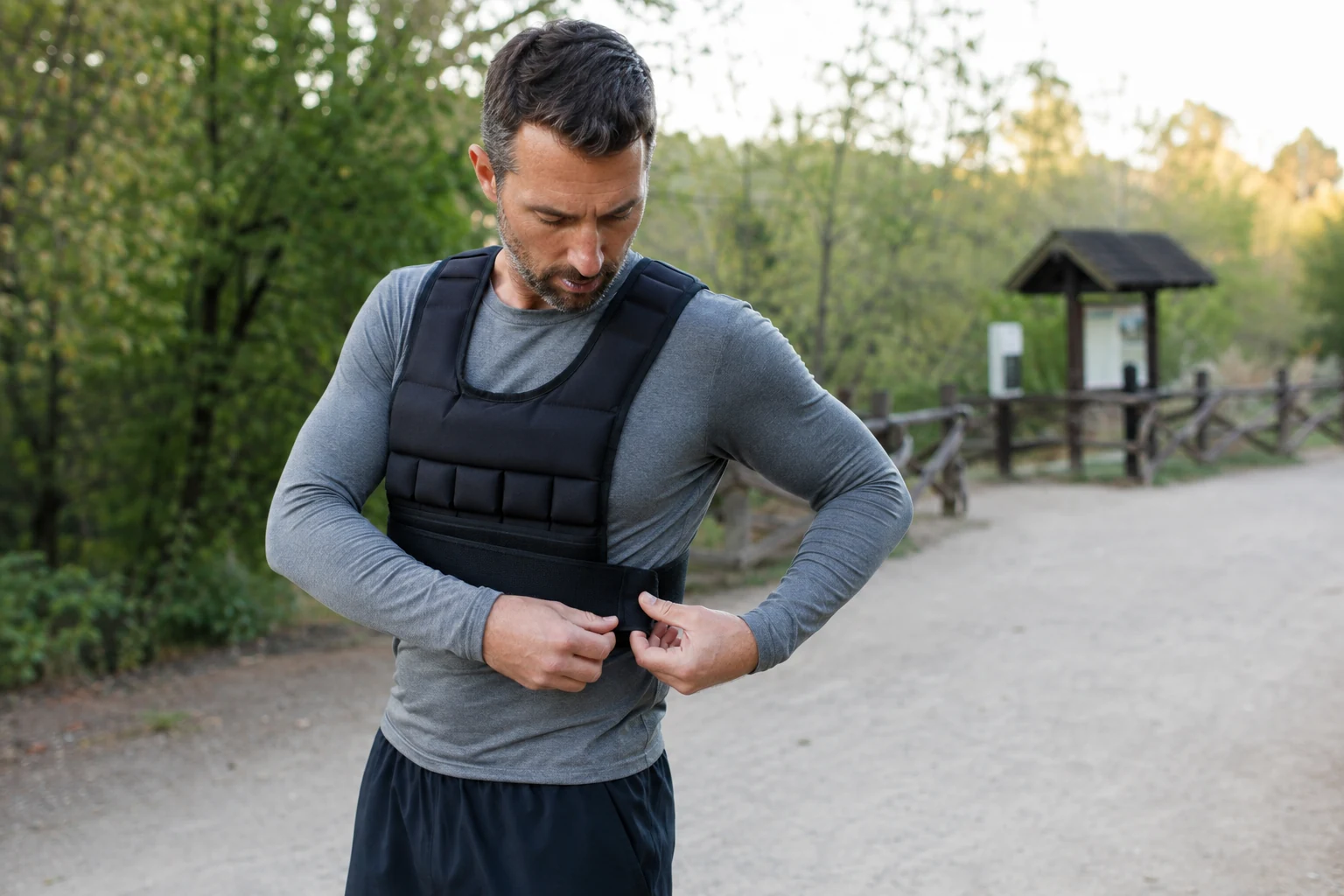
A secure fit matters because a moving vest adds a distraction to every stride. Check that the load stays close to your torso, does not bounce or rub, and allows comfortable breathing and arm motion.
Try walking and a few easy steps before committing to a run. A garment that shifts, causes hot spots, or changes your posture is a poor match even if its advertised weight sounds light.
What would a cautious trial look like?
There is no research-backed universal sequence such as “3% for two weeks, then 5% for four.” The study loads in the evidence table were chosen for specific experiments, not to establish safe starting percentages.
Start by defining one question: for example, whether a brief, easy loaded segment fits your normal week without disturbing the next planned run. Keep the rest of the week as similar as practical so you can interpret your response.
- Begin with a vest walk to check fit, breathing, heat, and any symptoms.
- If you are an experienced runner and the walk feels unremarkable, try a short easy run with a light load rather than adding weight to a long or fast workout.
- Record the load, duration, perceived effort, fit, and how your next run feels; change only one of load or duration at a time.
- Stop if pain develops or your gait changes in a way you cannot comfortably control, and seek individual advice before resuming if symptoms persist.
This is a monitoring framework, not a proven prevention protocol. If you have a current injury, a history of bone stress injury, a condition affecting exercise tolerance, or a pregnancy-related concern, ask an appropriate clinician before adding load.
What can you do instead?
Unweighted hills, structured faster running, and strength work can each serve a different purpose in a runner’s plan. None is a guaranteed safer substitute, and the best choice depends on your goal, training history, and recovery.
Loaded walking is useful when the goal is to practice carrying weight at walking speed; it does not need to be described as a lower-injury-cost version of the same running stimulus. For a walking baseline, see our guide to daily walking distance.
If your normal running is inconsistent, establish a repeatable week before adding another variable. A vest cannot substitute for enough recovery between sessions.
The practical verdict
Running with a weighted vest increases the challenge and changes mechanics while the load is on. The strongest familiar “economy improvement” result concerns a brief loaded warm-up followed by unweighted testing, and small longer-term evidence has not established a general advantage for distance running.
Use a vest only for a clearly stated purpose, choose fit and load conservatively, and judge the next sessions as well as the loaded one. For an unweighted race goal, keep the plan centered on the race demand unless a coach has a specific reason to test otherwise.
Get the next evidence check.
Five practical fitness stories worth your time, every Friday.
One email a week. No product pitches. Unsubscribe in one click.
References
Barnes, K. R., Hopkins, W. G., McGuigan, M. R., & Kilding, A. E. (2015). Warm-up with a weighted vest improves running performance via leg stiffness and running economy. Journal of Science and Medicine in Sport, 18(1), 103-108. https://doi.org/10.1016/j.jsams.2013.12.005
Silder, A., Besier, T., & Delp, S. L. (2015). Running with a load increases leg stiffness. Journal of Biomechanics, 48(6), 1003-1008. https://doi.org/10.1016/j.jbiomech.2015.01.051
Sharp, D. W., et al. (2022). Effects of 2.4 kg of proximal external loading on 5-km running performance. Journal of Strength and Conditioning Research, 36(7), 1833-1838. https://doi.org/10.1519/JSC.0000000000003722
Mallett, G. (2023). Young females’ longitudinal relationship of endurance performance: A partial regression analysis. International Journal of Physical Education, Fitness and Sports, 12(4). https://doi.org/10.54392/ijpefs2345
Medical disclaimer: This article provides general running and exercise information, not medical advice or a personalized training plan. If you have an injury, ongoing pain or a medical condition, talk to a doctor or physical therapist before adding weighted load.