
Mark Kerr helped define an entire era of mixed martial arts before most fans knew the sport by that name.
Long before the UFC became a mainstream fixture, Kerr was one of its most dominant heavyweights.
He won back to back UFC Heavyweight Tournament titles at UFC 14 and UFC 15 in 1997.
His path there started on the wrestling mat. Kerr became a state champion in high school, then an NCAA Division I champion at 190 pounds for Syracuse University in 1992, beating future UFC Hall of Famer Randy Couture along the way. He added a World Cup gold medal and a Pan American Games silver medal. In 2025, the UFC inducted him into its Hall of Fame as part of the Pioneer wing.
His grappling résumé grew just as decorated once he moved into submission wrestling. Kerr won the ADCC World Championship’s most competitive heavyweight division twice, in 1999 and 2000, then added the promotion’s absolute, or open weight, title that same year. He later defeated Brazilian jiu-jitsu legend Mario Sperry in an ADCC Superfight, a matchup the organization stages between its most dominant champions. The ADCC Hall of Fame inducted him as part of its first class in 2022.
His professional fighting record stands at 15 wins and 11 losses. The number does not capture his influence on the sport nearly as well as the era he helped shape, one where wrestling based, high output fighters like Kerr set the template for what modern mixed martial arts would become. Fighters and fans who remember that era still bring his name up when the conversation turns to who first showed what a wrestler with real conditioning could do inside a cage.
What Kerr’s Training Looks Like Now
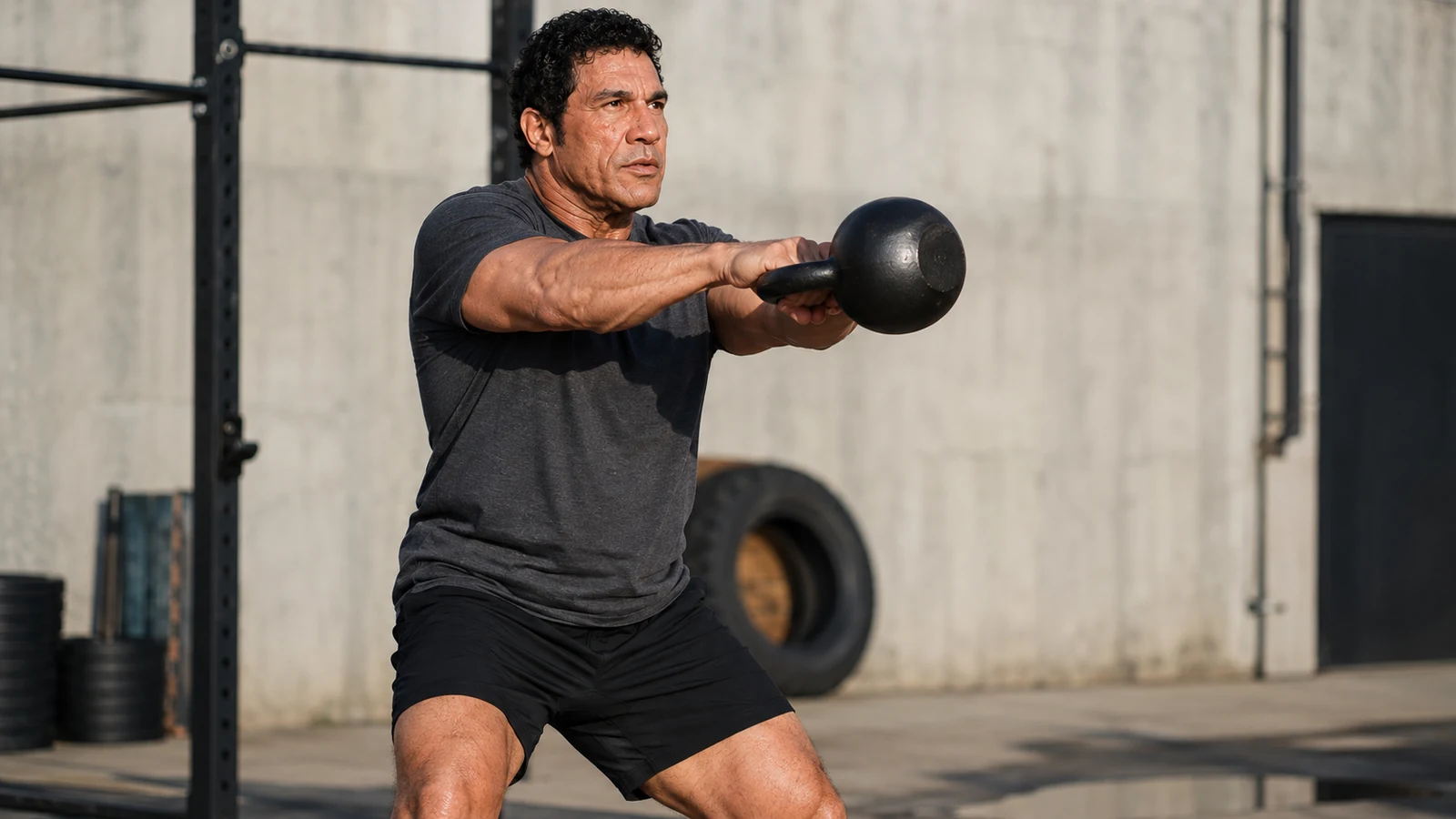
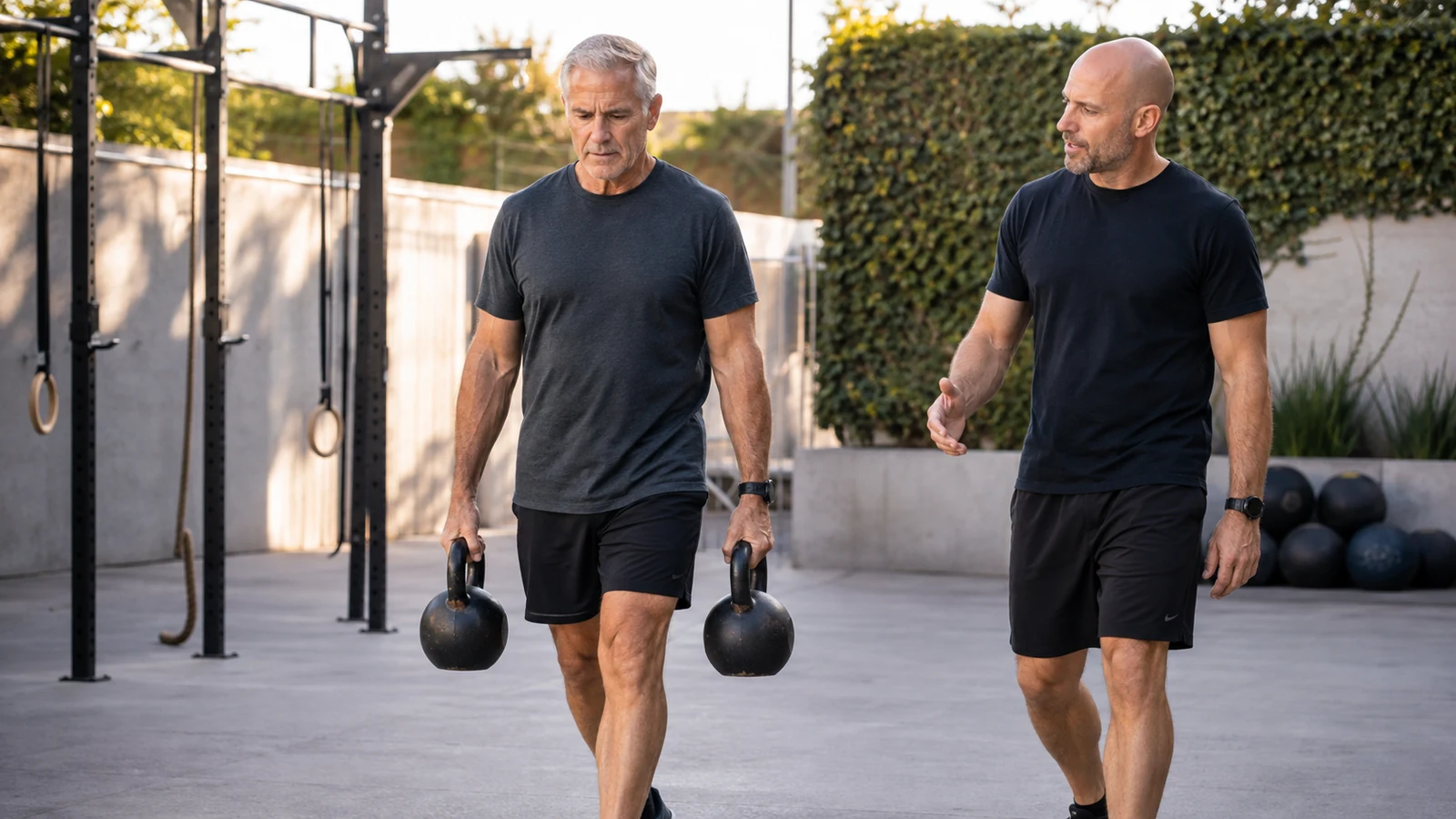
At 56, Kerr is still training, but the goal has changed. His current routine centers on kettlebells, built around mobility, strength, and control rather than the raw output that defined his competitive career.
That shift became especially relevant in 2025, when Kerr got back into fighting shape to help prepare for A24’s film adaptation of his own life story.
The Smashing Machine, released in October 2025, stars Dwayne Johnson as Kerr. Kerr reportedly worked directly with Johnson to help the actor capture his movement and physicality for the role, a process that meant returning to a version of fighting shape himself, even though the goal was choreography and accuracy rather than competition.
Kerr has described the shift in his own words. He has said that everything he did during his competitive career was purposeful, built entirely around performance and winning. Training now serves a different purpose. He has framed it as training for quality of life and longevity rather than output, a distinction that matters more the further a person gets from competitive sport.
Why Kettlebells Fit a Longevity Focused Routine
Kettlebell training has a specific set of qualities that make it well suited to someone shifting away from maximum output training toward something more sustainable.
The movements are typically compound and dynamic, working multiple muscle groups and joints together rather than isolating one at a time.
That mirrors real world movement more closely than a lot of traditional machine based training does, and it matters more as a priority the older a person gets.
Kettlebell movements also tend to train balance and coordination alongside raw strength, since many of the exercises ask the body to control an offset weight through a dynamic range of motion rather than a fixed machine path.
That combination of strength, balance, and coordination is exactly what research on healthy aging tends to emphasize, more so than strength in isolation.
Kettlebell training also demands real grip strength, since the offset weight distribution of a kettlebell forces the hand and forearm to work harder than a similarly loaded dumbbell or barbell would.
For a former wrestler and grappler like Kerr, that carries over directly from decades of gripping an opponent’s body and clothing under real resistance.
The Evidence Behind Kettlebell and Functional Training
Research on kettlebell training backs up its usefulness beyond just anecdotal popularity. A study published in the Journal of Strength and Conditioning Research found that a structured kettlebell program improved measures of strength, power, and aerobic capacity simultaneously, a combination that is harder to achieve through more isolated traditional strength training alone (Manocchia, Spierer, Lufkin, Minichiello, & Castro, 2013).
For someone specifically training for longevity, as Kerr describes doing, the research on resistance training in older adults is directly relevant.
A 2024 systematic review and meta-analysis in the Journal of Functional Morphology and Kinesiology looked at machine based resistance training’s effect on functional capacity in older adults.
It found a significant improvement across the pooled studies, supporting resistance training as a meaningful tool for maintaining independence and physical function with age (Kirk, Steele, & Fisher, 2024).
That specific review focused on machine based training rather than kettlebells directly. The underlying mechanism, progressive resistance training preserving strength and function, applies broadly across training modalities.
Grip strength specifically has become one of the more studied simple predictors of long term health.
A large international study followed more than 140,000 adults across 17 countries. It found grip strength was a strong independent predictor of overall mortality risk, on par with or stronger than some traditional cardiovascular risk markers (Leong et al., 2015). A training approach that builds and maintains grip strength, the way kettlebell work does almost by default, is doing more than it might appear to on the surface.
How This Compares to General Guidance for Aging Athletes
Kerr’s shift from competition focused training to longevity focused training reflects a transition that sports medicine generally recommends for former competitive athletes, particularly those from high impact combat sports.
General guidance for aging athletes emphasizes maintaining strength and mobility over chasing peak output. It also means managing joint health that may carry the wear of a competitive career and building training around sustainability rather than short term performance markers. Kerr’s kettlebell focused routine, built on functional strength and grip work rather than maximum loads, fits that model closely.
The broader lesson applies well beyond former professional fighters. Anyone who trained hard when they were younger and is wondering what training should look like now is facing a version of the same question Kerr answered for himself. The goal does not have to be performance anymore. It can be staying capable, mobile, and strong for the decades ahead.
Common Mistakes People Make Training for Longevity
A few mistakes show up often in people trying to shift their own training toward a longevity focus, especially those coming from a background of harder, more competitive training.
The first is holding onto old training numbers as the standard to chase, rather than adjusting goals to match a changed body and changed priorities.
Chasing a personal best from twenty years ago is a good way to get hurt, not a good way to stay fit.
The second is dropping strength training entirely once competitive goals are gone, in favor of only low intensity activity like walking.
Strength training remains one of the most important tools for maintaining muscle mass, bone density, and functional capacity with age.
The third is neglecting mobility work. A former athlete’s body often carries old injuries and compensations built up over years of competition. Mobility and joint care work becomes more important with age, not less, even though it feels less exciting than lifting heavy.
The fourth is ignoring grip and forearm training, assuming it will simply come along with other lifting.
Grip strength benefits from direct, deliberate training, and kettlebells are one efficient way to get it.
A Practical Way to Build a Longevity Focused Routine
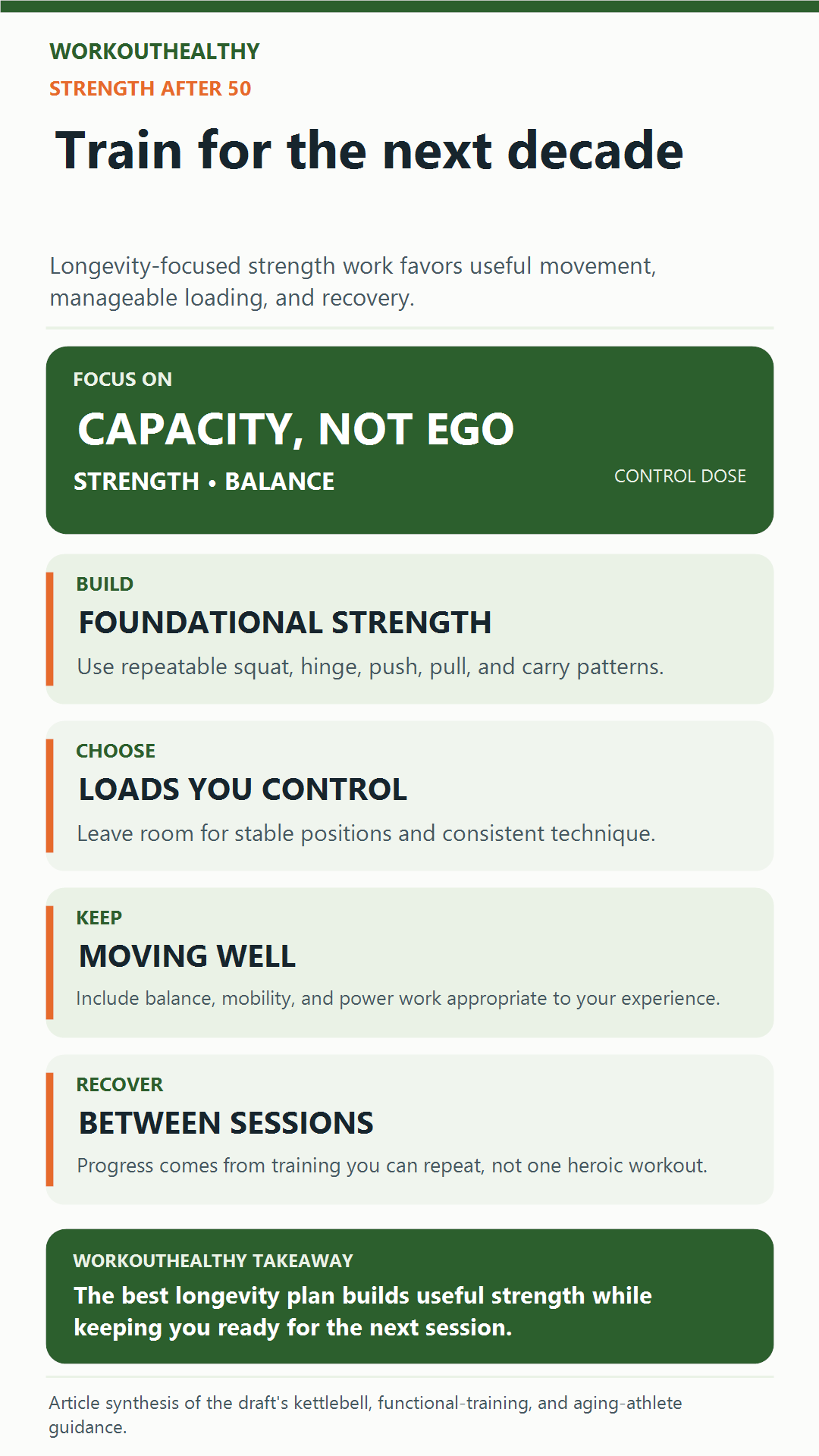
Building the kind of routine Kerr describes does not require a fighting background or a film role.
It starts with a handful of well chosen movements done consistently.
A kettlebell swing, done with proper hip hinge technique, builds power and cardiovascular conditioning together in a single movement.
Goblet squats, holding a kettlebell at chest height while squatting, build lower body strength while reinforcing good posture and core engagement.
Farmer’s carries build grip strength, core stability, and overall total body endurance with almost no learning curve.
The movement is simple: walking while holding a heavy kettlebell or dumbbell in each hand.
Turkish get-ups build shoulder stability, core control, and mobility all at once. This slower, more technical movement takes a person from lying down to standing while holding a kettlebell overhead.
For anyone new to kettlebell training, starting with a lighter weight and working with a qualified coach to learn proper hip hinge and swing mechanics protects against the lower back strain that can come from poor form.
Once the basic movements feel controlled, building consistency across weeks and months matters far more than chasing heavier weights quickly.
Two or three sessions a week is a reasonable starting frequency for most adults building this kind of routine, with at least one rest day between sessions early on.
That schedule allows real recovery while still building the consistency that drives long term progress, the same balance Kerr describes prioritizing now over the harder, higher volume training that defined his competitive career.
References
Manocchia, P., Spierer, D. K., Lufkin, A. K. S., Minichiello, J., & Castro, J. (2013). Transference of kettlebell training to strength, power, and endurance. Journal of Strength and Conditioning Research, 27(2), 477-484. https://doi.org/10.1519/jsc.0b013e31825770fe
Kirk, A., Steele, J., & Fisher, J. P. (2024). Machine-based resistance training improves functional capacity in older adults: A systematic review and meta-analysis. Journal of Functional Morphology and Kinesiology, 9(4), 239. https://doi.org/10.3390/jfmk9040239
Leong, D. P., Teo, K. K., Rangarajan, S., Lopez-Jaramillo, P., Avezum, A., Orlandini, A., et al. (2015). Prognostic value of grip strength: Findings from the Prospective Urban Rural Epidemiology (PURE) study. The Lancet, 386(9990), 266-273. https://doi.org/10.1016/S0140-6736(14)62000-6
This article is for general information and is not personalized medical or fitness advice. Anyone returning to training after a long break, managing old injuries, or starting a new type of exercise like kettlebell training should talk to a doctor first, especially if there is a history of joint, back, or cardiovascular issues.