
Glen Powell became one of Hollywood’s fastest rising leading men after “Top Gun: Maverick” in 2022.
Since then, he has continued building a career around physically demanding roles, including “Twisters” and “Hit Man.”
His physique for “Top Gun: Maverick” got specific attention for how it was built.
Reports on his training describe a focused six to seven week program, not months of gradual bulking.
That short timeline makes his approach a useful case study in what structured, short term training can and cannot realistically achieve.
What Glen Powell’s Top Gun Training Actually Involved
Powell trained with Nick Mitchell, founder of Ultimate Performance, for roughly six to seven weeks ahead of filming.
Sessions ran three to four times a week, capped at about an hour each.
The program had a specific visual target, the film’s shirtless beach volleyball scene.
Mitchell designed the training around what he called “mirror muscles,” the upper body details that actually show up on camera.
That is a different goal than a generic full body bulk aimed at pure size.
Training focused heavily on chest, shoulders, traps, and arms.
It also included the abs and the smaller muscles around the ribs that create visible definition on screen.
Leg training was deliberately minimized, since legs weren’t the visual focus of the scene.
Metabolic conditioning work like sled pushes filled that gap instead.
The split rotated through a few key sessions each week.
One day covered chest, back, traps, and abs.
Another covered arms and shoulders.
A third, added when the schedule allowed, combined strongman style conditioning work with more ab training.
Mitchell also used isometric flexing drills between sets.
That is a bodybuilding technique meant to improve muscle control and definition, not just size.
What Glen Powell and His Trainer Said About the Process
Powell has spoken about one specific exercise that defined the training block, the sled push.
“The sled. It kills you,” he said.
“It’s a full body thing,” he continued. “It prevents you from being the guy who just wants to look good.”
Mitchell, his trainer, described the underlying philosophy behind the program’s structure.
“The eye is drawn to the detail,” he said, explaining why the plan prioritized visible muscle definition over overall mass.
Mitchell also emphasized specificity as the core principle behind the whole approach.
“What are you working towards?” he said. “Have a plan and work that plan as hard and committed as possible.”
Powell has also spoken separately about how his everyday training has changed, outside of the Top Gun specific block.
In a Men’s Health interview, he said he no longer puts himself “through torture” the way he once did.
He described adding Pilates and yoga into his routine, though not purely for the workout itself.
He said it was “a great little social scene,” pointing to community and consistency as real reasons to stick with a type of training, not just the physical results.
That detail matters because it shows his training isn’t only built around short, intense cuts for a role.
A steadier, more varied baseline routine appears to run underneath the occasional intense film specific block.
The Real Science Behind a Short Training Block Like This
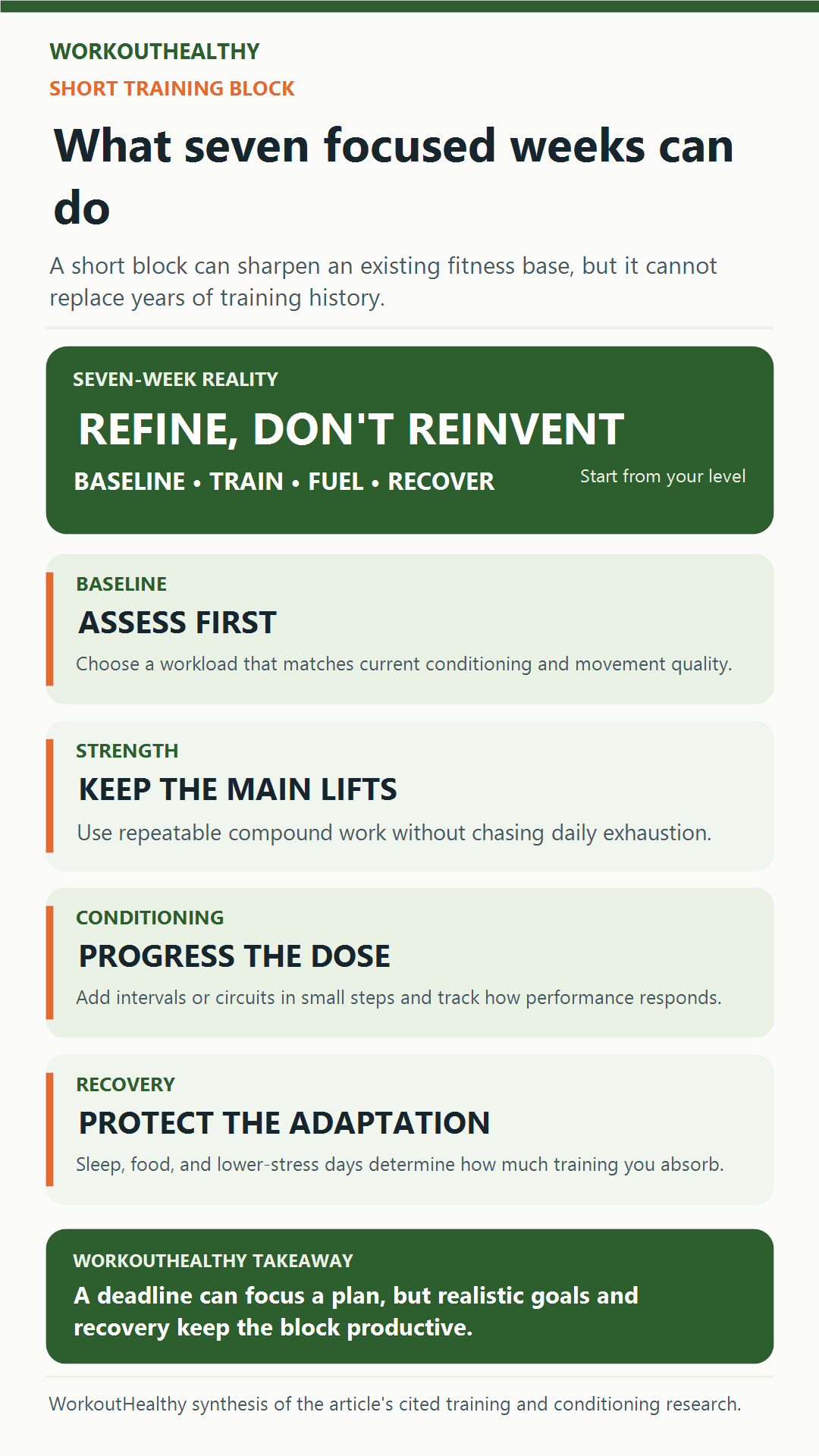
A seven week timeline sounds aggressive, but it lines up with what research on body composition actually supports for someone starting from an already active baseline.
Powell wasn’t untrained before this program.
Building visible muscle definition on an already fit frame in six to seven weeks is a very different task than building muscle from scratch.
It’s a realistic outcome specifically because of that starting point. Explosive, athletic training can add to that base too. Our piece on whether box jumps build muscle looks at how power based movements contribute to visible muscle, not just steady state lifting.
Research on body recomposition, the process of losing fat and building muscle at the same time, points to two consistent requirements.
The first is resistance training at least twice a week.
The second is a high protein diet that supports muscle repair without a severe calorie deficit that would work against it.
Mitchell’s program followed both of those principles directly.
Frequent, targeted resistance sessions were combined with a nutrition plan built around the same goal, rather than treating diet and training as separate problems.
The isometric flexing work Mitchell used between sets deserves its own explanation, since it isn’t standard in most gym routines.
Actively flexing a muscle group under tension, even without added weight, increases how much a lifter can consciously activate that muscle during the working sets that follow.
Bodybuilders have used this technique for decades to improve what’s sometimes called mind muscle connection, the ability to feel and control a specific muscle rather than just moving a weight from point A to point B.
For a role built around visible muscle control in a single scene, that kind of targeted activation work makes practical sense, even though it isn’t necessary for most people’s general fitness goals.
Other short, intense training philosophies take a different route to a similar goal.
Our look at Mike Mentzer’s Heavy Duty training system covers a style built around brief, hard sessions rather than high volume, another example of how varied the paths to visible muscle can be.
How This Compares to What’s Realistic for Most People
Powell’s results came from an intense, professionally coached, short term program built around one specific scene.
That’s a very different situation than most people’s everyday fitness goals.
The visible six pack and defined shoulders that show up in a single scene are the product of temporary conditions.
Those conditions include aggressive short term dieting, professional coaching, and a hard deadline.
Maintaining that exact look year round is neither realistic nor necessary for most people’s actual health goals.
What does transfer is the underlying structure.
Consistent resistance training two or more times a week, adequate protein, and a specific, written plan are available to anyone, not just actors with a studio deadline.
The sled push itself is also broadly accessible.
Many gyms have a sled, and pushing or pulling weight across a short distance is a genuinely effective full body conditioning tool.
It doesn’t require advanced technique to use safely, which makes it a realistic option for most gym goers.
Common Mistakes People Make Chasing a “Movie Physique”
The biggest mistake is trying to copy the exact program without accounting for a different starting point.
Someone new to training needs a very different plan than someone who was already fit going into a seven week block.
A beginner attempting the same intensity and calorie targets risks losing muscle instead of building it, since there isn’t yet enough training history to protect lean mass under a calorie deficit.
A slower build, months rather than weeks, is usually the smarter starting point for anyone new to structured resistance training.
Another common mistake is chasing visible muscle definition through diet alone.
Cutting calories aggressively without enough resistance training strips away the muscle underneath, not just the fat covering it.
That produces a smaller, softer looking body, not the defined look people are usually after.
Some people also try to replicate the extreme short term timeline as an ongoing lifestyle.
A seven week deadline driven cut isn’t sustainable as a permanent state.
Treating it that way often leads to burnout or disordered eating patterns.
Skipping recovery is another frequent issue.
Mitchell’s program used a capped, structured schedule, not unlimited daily training.
Recovery time is part of what allows a program like this to work without injury.

How to Apply This Approach Safely to Your Own Training
Set a specific, realistic goal first.
“Get in shape” is too vague to build a plan around.
“Build visible shoulder and ab definition over eight weeks” gives a program something concrete to target.
Train each major muscle group at least twice a week.
Two to four focused sessions a week, each under an hour, is enough to drive real change when the sessions are well structured.
Prioritize protein intake alongside training.
A higher protein diet supports muscle repair and growth, which matters just as much as the workouts themselves.
Add a sled push or similar full body conditioning tool if it’s available.
It’s demanding, low skill, and effective for both strength and cardiovascular conditioning in one movement.
Avoid an extreme calorie deficit.
Cutting too hard makes it much harder to build or even maintain muscle, which undercuts the entire goal of visible definition.
Build in real rest days.
Powell’s program capped sessions at three to four times a week for a reason.
More isn’t always better once a program is already well structured.
Treat a short, intense block as temporary by design.
Plan a return to a more sustainable, moderate routine afterward, rather than trying to maintain peak conditioning indefinitely.
Layer in mobility work year round, not just during an intense training block.
Powell’s own comments about adding Pilates and yoga suggest this piece runs underneath his more intense, deadline driven training, not separate from it.
Track strength progress directly, not just how a mirror looks on a given day.
Adding weight or reps to the same core lifts over time is a more reliable signal of real progress than daily appearance, which shifts with water weight, lighting, and simple mood.
Get comfortable with a plan that includes an end date and a next phase.
Powell’s seven week block worked partly because everyone involved knew exactly when it would end and what came after it, rather than treating the intensity as an open ended lifestyle.
Consider working with a coach for at least the planning stage, even if you can’t train with one every session.
A single consultation to build a structured plan, the way Mitchell did for Powell, can prevent a lot of wasted weeks compared to training without any specific target at all.
Our guide on whether you need a personal trainer and how to hire one covers what to look for and when hiring a coach is actually worth it.
References
- Ultimate Performance. “How Glen Powell built his 7-week body training for Top Gun: Maverick.”
- Men’s Journal. “Glen Powell Reveals His Love-to-Hate Workout to Get in Leading Man Shape.”
- Johns Hopkins Medicine and Healthline overviews of body recomposition research and requirements.
- Centers for Disease Control and Prevention. Physical Activity Guidelines for Adults.
This article is for general information only and is not medical advice. Aggressive short term training and diet programs are not appropriate for everyone, particularly people new to exercise, managing a medical condition, or with a history of disordered eating. Anyone considering a significant change to their training or diet should talk with a doctor or qualified trainer first.