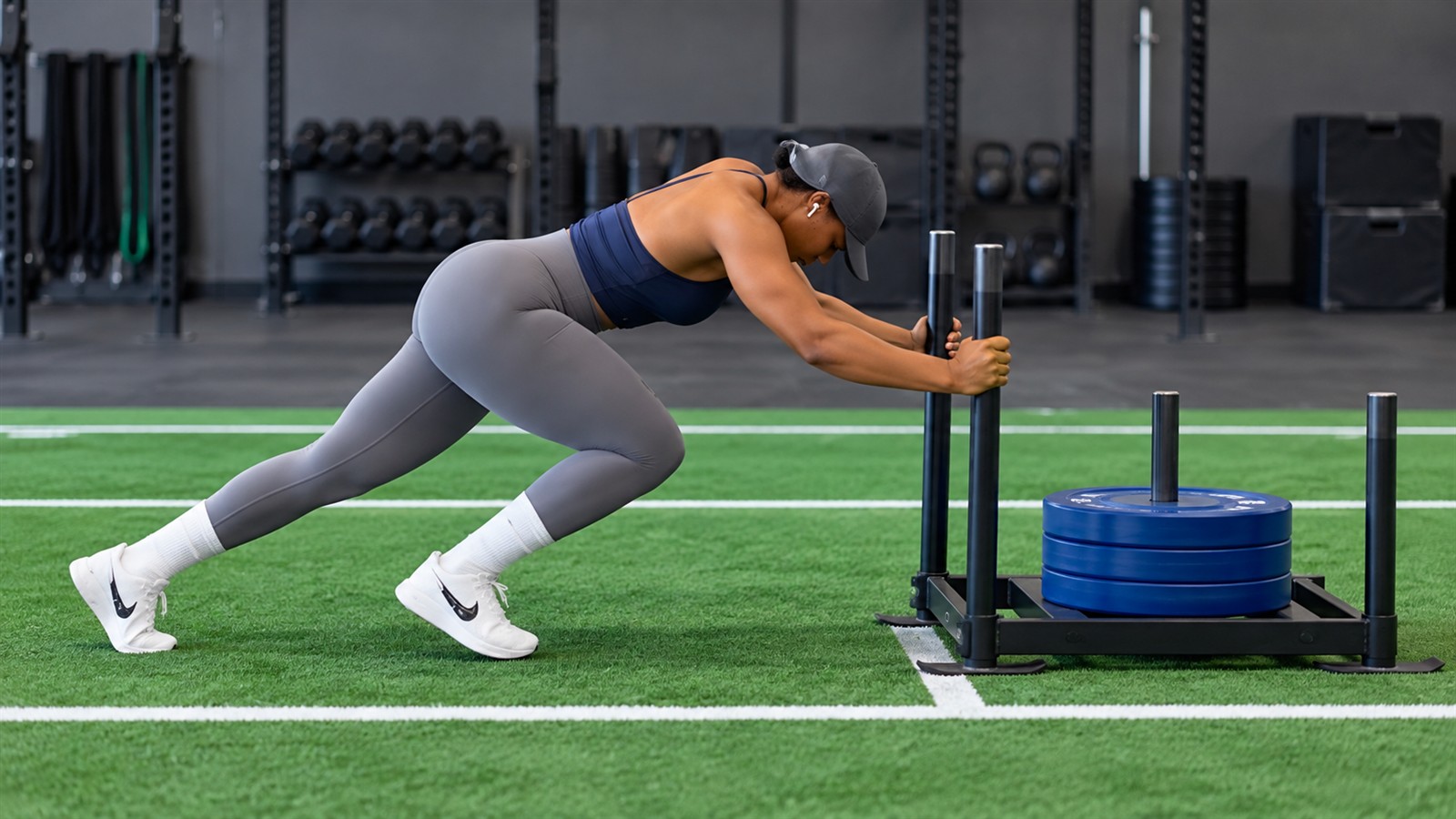

A loaded sled push can turn a short stretch of turf into demanding leg and conditioning work. You lean into the handles, drive through the ground, and repeat steps against resistance. That combination feels very different from a squat or a run. It does not automatically make the sled the best strength exercise, the fastest conditioning method, or a zero-impact choice for every body.
The WorkoutHealthy Facebook post calls the sled a “leg day equalizer,” says it builds speed, explosiveness, and conditioning in less time than a treadmill, and suggests there is zero impact. Those phrases convey how hard a push can feel, but they go beyond what the studies establish. Most research on resisted sled training measures sprint performance in athletes; much of it uses a sled pulled behind a runner, which is not identical to pushing a weighted sled with handles.
Here is the evidence for sled pushing, what the comparison with squats actually measured, and how to use it as a finisher without assuming that the toughest sensation is the best training result.
The Short Answer
Sled pushes are a useful way to challenge the legs and trunk while practicing forceful forward steps. They can raise exertion quickly, especially when the sled is heavy or rests are short. Some direct sled-push studies suggest benefits for short-distance acceleration, but study groups are small and the optimal dose depends on the person and goal.
Do not replace all squats, sprints, or aerobic exercise with sled pushes on the basis of one workout’s burn. A sled does not provide the same movement pattern, loading, or outcome as a back squat. Nor is every push “zero impact”: your feet still strike and push against the ground, and joints and tissues still take force. The absence of a jump or a heavy bar on your back does not mean zero load.
For a general fitness finisher, begin with a load you can move smoothly and control for a short distance. Rest enough to repeat good form. Progress by total distance, load, speed, or recovery time one variable at a time.
What a Sled Push Actually Trains
During a forward push, your hips, knees, and ankles extend repeatedly as you drive the floor backward. The handles create a forward lean and ask the upper body and trunk to transmit force to the sled. Your heart and lungs also respond to the work; a heavy push over even a modest distance can feel intense.
That is a combination of local muscular effort and whole-body demand, not a magical new training category. Whether it behaves more like strength work, acceleration practice, or a conditioning interval depends on sled load, surface friction, distance, speed, and rest. A slow, heavy grind is different from a lighter, faster push.
The number of plates is a poor universal measure of the resistance you experience. Turf, rubber flooring, sled construction, and worn skids change friction. The same plates can move easily on one lane and feel immovable on another. Record the lane, sled, and distance if you want to compare sessions fairly.
For a related look at awkward loads, our sandbag-versus-barbell evidence guide shows why the tool’s feel should not be confused with a proven superiority claim.
What the Sled-Push Studies Found
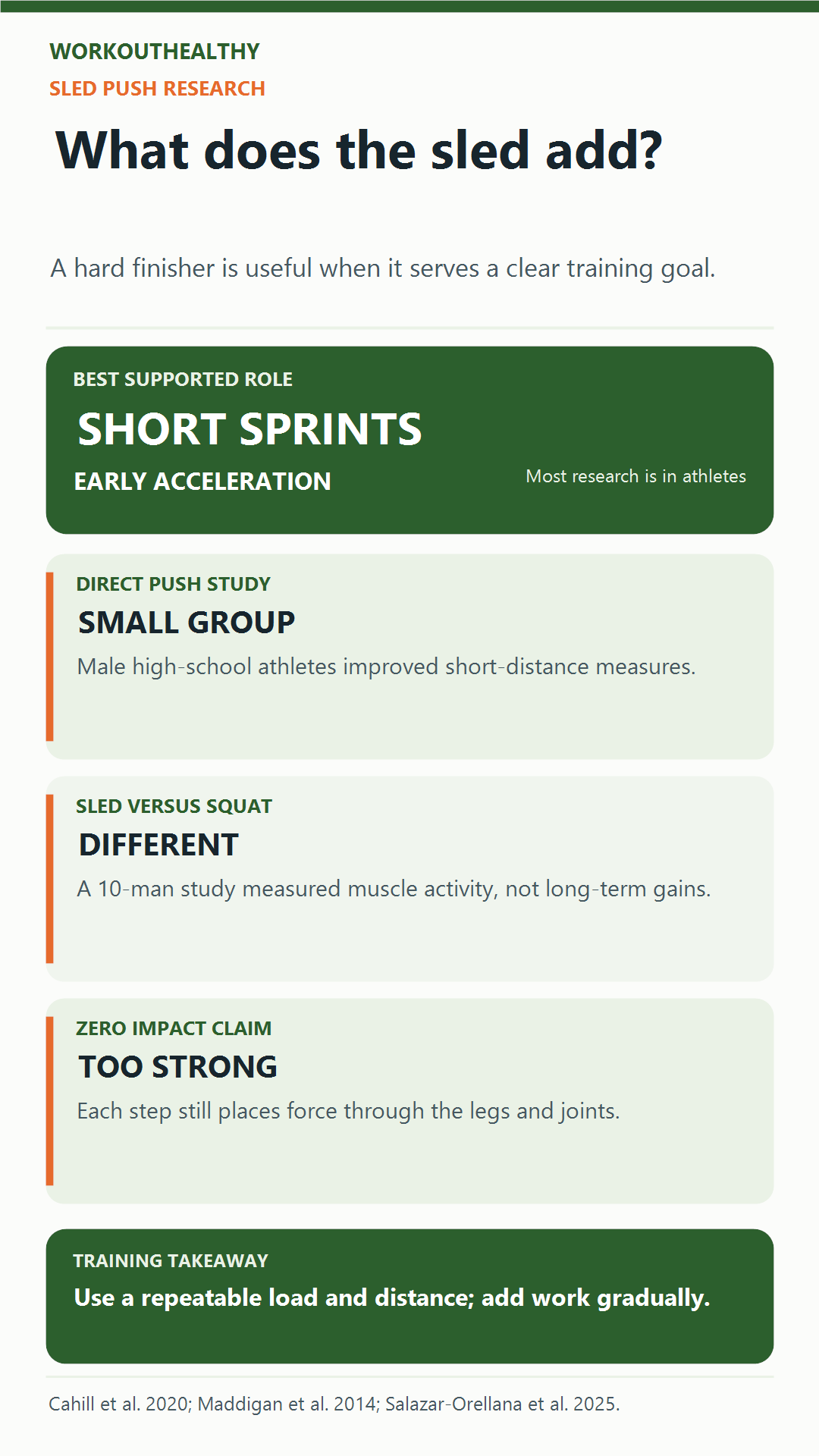
A direct training study in male high-school athletes compared unresisted sprint training with sled pushing at different loads. The authors reported improvements in short-distance sprint measures with resisted pushing and suggested that heavier loads could be useful for acceleration in that group. That is a meaningful athletic outcome, but it is a specific sample, program, and testing context—not proof that any gym member will gain speed from three random finishers.
Another study compared muscle activity during a maximum 20-step sled push and a 10-repetition-maximum back squat in ten resistance-trained men. Both tasks activated leg and trunk muscles, with differences across muscles. The design measured electrical activity during the exercises, not long-term muscle growth or injury outcomes. You cannot read an EMG comparison as a verdict that one exercise is “harder than squats” for every goal.
A larger 2025 review of resisted sled training in team-sport athletes pooled 14 studies with 344 participants. It found improvements in 5- and 10-meter sprint tests, while the pooled 20-meter result was not statistically significant. The review also judged overall risk of bias high. Many included interventions involved sled drags rather than the handle-push shown in the Facebook image, so its conclusions are useful context, not a direct prescription for the gym sled.
The practical interpretation is narrower than “the sled builds everything at once.” A sled can target the forceful early steps of acceleration, and it can make the legs work hard. Whether it is the best choice for your conditioning, sprint mechanics, or maximal strength remains a program-level question.
Sled Pushes Versus Squats and Sprints
Squats let you load a predictable up-and-down pattern and track progress precisely. They are especially useful when the aim is general lower-body strength and progressive resistance. Sled pushes involve repeated horizontal drive and locomotion. They may complement squats because they expose you to a different movement and effort pattern, not because they replace the adaptations from a well-planned squat program.
Unresisted sprinting remains specific to running fast without a sled. A 2018 meta-analysis of resisted sled training found improvements in early acceleration within sled-trained groups, yet could not establish that resisted work was consistently superior to similar training without overload. That review mainly covered towing or pulling the sled. Specificity matters: heavy resistance can change body angle, step timing, and speed.
For a person training for a field sport, that may be a reason to include some sled work alongside ordinary sprints, strength work, and technical practice. For someone seeking general fitness, it may simply be a way to make lower-body training varied and time efficient. Our outdoor track workout guide explains why sprint training deserves a deliberate progression, especially for beginners.
Is a Sled Push “Zero Impact”?
“Zero impact” is not an accurate description. Each step creates ground reaction force, and the muscles, tendons, and joints handle load as you push. What people often mean is that there is no landing from a jump and no heavy bar compressing the shoulders. Those differences may make the sled feel tolerable for some people, but the load on a knee, hip, ankle, or back is not automatically zero.
We also lack strong evidence that sled pushing is injury-proof or universally safer than squats, running, or other exercises. The muscle-activation study did not measure injury rates. Neither a hard workout nor a clean-looking movement can tell you the long-term risk for an individual with pain or a prior injury.
If you have a current injury or a rehabilitation plan, ask a qualified clinician whether sled work belongs in it and how to scale it. In ordinary training, discomfort that rises sharply as the load increases is a reason to reduce the load or stop, not to treat the sled as inherently safe because it lacks a flight phase.
How to Start Without Turning Every Push Into a Test
First, warm up with easy walking and a few comfortable bodyweight movements. Try the unloaded or lightly loaded sled on the intended surface. Set the handles at a height that lets you lean forward without collapsing through the torso. Drive with steady, short steps and maintain control through the whole lane.
A starting session might be two to four short pushes of about 10 to 20 meters, with enough rest that your technique remains similar from one effort to the next. That is a conservative practice example, not a research-proven ideal dose. Increase distance or load gradually only after the current work feels repeatable.
If you want a conditioning finisher, choose a manageable load and keep the movement smooth. If you want acceleration practice, use a load and rest period that still allow purposeful speed. If you want maximal strength, keep your primary strength exercises in the plan rather than expecting a few exhausted sled pushes to do their job.
Our five-minute warm-up guide gives a compact way to prepare when time is tight. A brief warm-up and a controlled first set are more useful than racing into the heaviest plate stack.
How to Progress and Recover
Pick one outcome to track. You might keep the same sled and turf lane and see whether a fixed load takes less time to push a fixed distance. Or keep a steady speed and add a small amount of total work over several weeks. Write down the surface, distance, approximate load, number of pushes, rest, and how difficult the session felt.
Because friction varies, a “200-pound sled push” is not equivalent across gyms. Progress is clearest when the setup is consistent. If a different surface suddenly doubles the difficulty, that is a change in task conditions, not evidence that you lost fitness.
Give hard efforts enough recovery. A finisher that leaves every rep slower and sloppier can train fatigue tolerance, but it is unlikely to be the best way to practice speed. When other leg work is already demanding, a small amount of sled work may be plenty. Adjust the next session if soreness, joint pain, or overall fatigue makes your usual movement quality worse.
The Bottom Line
The sled push earns its place as a versatile lower-body tool: it can challenge forceful steps, raise effort quickly, and offer a change from squats and straight-line sprints. Direct and related research gives a plausible case for short-distance acceleration work, especially in trained athletes, while leaving substantial uncertainty about the best load and broad claims about superiority.
Use it for a clear purpose, start lighter than the viral workout, and compare your progress under similar conditions. Three brutal rounds are optional. A useful training result is measured by what you can repeat and improve, not by how dramatic the last ten yards feel.
Sources and Editorial Notes
- Cahill MJ, et al. Influence of resisted sled-push training on the sprint force-velocity profile of male high-school athletes. Journal of Strength and Conditioning Research. 2020.
- Maddigan ME, et al. Lower-limb and trunk muscle activation with back squats and weighted sled apparatus. Journal of Strength and Conditioning Research. 2014.
- Salazar-Orellana C, et al. Effects of resisted sled training on sprint performance in team sports: a systematic review and meta-analysis. Journal of Bodywork and Movement Therapies. 2025.
- Alcaraz PE, et al. The effectiveness of resisted sled training for sprint performance: a systematic review and meta-analysis. Sports Medicine. 2018.
Training note: This article is educational and does not replace individualized coaching or medical advice. Stop an exercise that provokes concerning pain, dizziness, chest symptoms, or breathing difficulty, and seek appropriate care.