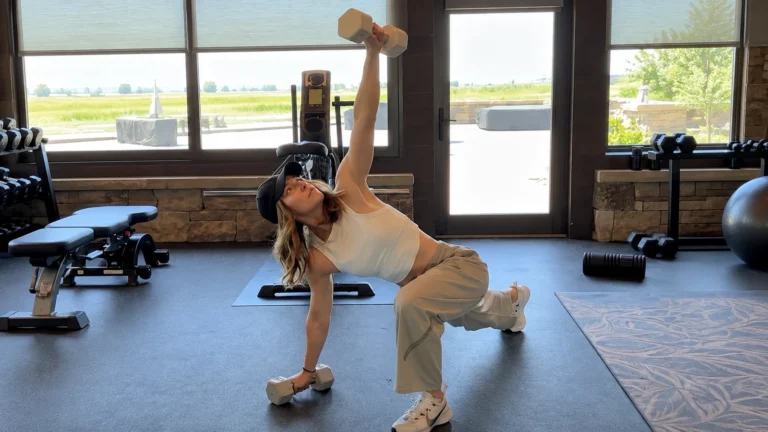

A track workout video promises three things at once.
Speed, fat loss, and better athletic performance, all from one type of session.
That is a big promise for a single training method.
Sprinting is real exercise science, not a myth.
But the research on sprint and track style training is more specific than most videos let on.
This article looks at what studies actually show about sprint training for speed, for fat loss, and for injury risk.
What the Video Claims
The video comes from a channel called Thoroughbredphotography123, also branded online as Thoroughbredfit123.
The name suggests a photography channel, not a coaching or sports science credential.
Its own channel description points to general fitness content, including full body workouts and HIIT sessions.
There is no visible coaching certification, degree, or research background listed.
That does not make the workout wrong.
It just means the claims need outside evidence, not the creator’s word alone.
The video presents a track based session built around sprint repeats.
It frames the workout as a way to build speed, burn fat, and improve athletic performance all at once.
Those are the three claims this article checks against published research.
What Real Research Shows About Sprint Training and Speed
Sprinting is one of the most studied ways to build raw speed.
A major review by Haugen and colleagues looked at how elite sprinters actually train (Haugen et al., 2019).
The review covered decades of training data from top level sprint programs.
It found that speed develops through a mix of methods, not one drill.
Short maximal sprints build top end speed and stride power.
Resisted sprints, like sled pushes, build acceleration strength.
Plyometric work, like bounding, builds the elastic power in tendons and muscles.
Track style repeats, run at or near full speed, are part of that mix.
Sprint practice can improve technique and sprint-specific capacities over time. The review integrates coaching practice and research but does not isolate one neural mechanism for every speed gain.
The review also found that speed gains take real time.
Elite sprinters build speed over years, not weeks.
A single track workout will not turn a beginner into a fast runner overnight.
But repeated sprint sessions, done consistently, do improve sprint speed over time.
That part of the video’s claim holds up well against the evidence.
The same review also looked closely at running mechanics.
Faster sprinters spend less time with each foot touching the ground.
That is called ground contact time.
Shorter ground contact time lets the body apply more force in less time.
Ground contact time is one component of sprint mechanics; trying to shorten it deliberately is not a proven stand-alone way to become faster.
The review also pointed out something coaches often overlook.
Quality sprint work needs long rest between reps.
Full recovery lets each sprint stay close to maximum effort.
Short rest turns a speed session into a fatigue session instead.
That distinction matters for anyone trying to build true top speed.
Sprint speed is not built by one workout. It is built by repeated exposure to near maximal effort, spread across weeks and months of training.
What Real Research Shows About Sprint Training and Fat Loss
Fat loss from sprint work is a separate question from speed gains.
It depends on total energy burned, not just how hard a session feels.
A systematic review by Gist and colleagues looked at sprint interval training and aerobic fitness (Gist et al., 2014).
It found that short, repeated all out sprints improve cardiovascular fitness in a short amount of training time.
That improved fitness supports more calorie burn during future workouts.
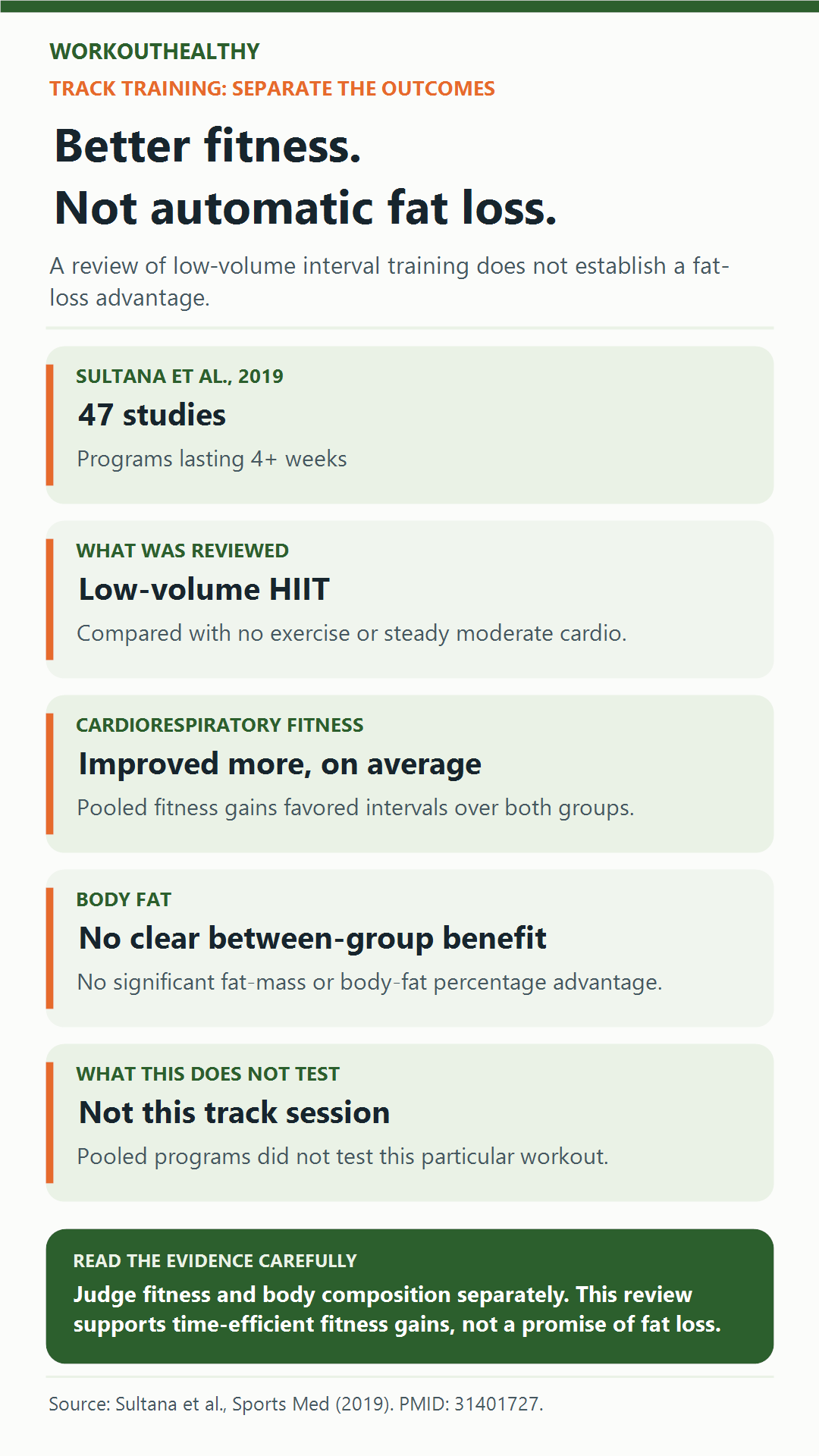
A second review by Sultana and colleagues looked specifically at body composition (Sultana et al., 2019).
This review combined data from many low volume, high intensity training studies.
Across 47 studies, low-volume HIIT did not significantly reduce total fat mass or body-fat percentage compared with non-exercise controls, and it was not superior to moderate-intensity continuous training on those measures (Sultana et al., 2019). The review did find better cardiorespiratory fitness with a lower training volume.
That evidence supports fitness benefits, not a promise that short track intervals efficiently burn enough calories to cause meaningful fat loss on their own. It also does not test the exact session in the source video.
But sprint training alone does not guarantee fat loss.
Total daily calories still matter more than any single workout type.
Body-fat change depends on the broader pattern of energy intake and expenditure, as well as adherence over time. A couple of sprint sessions do not guarantee a calorie deficit or a change in body composition.
The Sultana review also noted that results varied a lot between individual studies.
Some study groups lost more visible fat than others, even on similar programs.
Genetics, starting fitness level, and diet all shape how one person responds compared to another.
Readers comparing training styles for fat loss can also see how losing weight while keeping muscle mass requires more than just cardio choice.
Diet and recovery both shape the final result as much as the workout itself.
What Real Research Shows About Injury Risk in Sprint Training
Sprinting is a high force activity for the hamstring muscles.
A detailed review by Opar and colleagues looked at why hamstring strains happen (Opar et al., 2012).
The review found that hamstring strains are one of the most common injuries in sprint based sports.
They often happen during the late swing phase of a sprint stride.
That is the moment the leg swings forward just before the foot lands.
The hamstring lengthens under very high force at that exact point.
Risk factors include low hamstring strength relative to the quadriceps.
Poor flexibility and prior hamstring injury also raise the risk.
Fatigue late in a session raises risk too.
A separate randomized trial tested a specific prevention exercise (Petersen et al., 2011).
It found that regular eccentric hamstring training cut injury rates significantly in soccer players who sprint often.
That single finding matters a lot for anyone starting track style workouts.
Sprinting is not inherently dangerous.
But it does carry a real, well documented injury risk that beginners often underestimate.
Most hamstring strains in sprinting happen in a split second, right as the leg swings forward and the muscle is asked to slow it down under full force.
The Mechanism
Sprinting recruits fast twitch muscle fibers more than slower forms of cardio.
These fibers produce force quickly but fatigue fast.
Repeated sprint efforts train these fibers to fire in better coordination.
That coordination is a large part of what makes someone look faster over time.
The energy system used during a sprint is mostly anaerobic.
That means it does not rely heavily on oxygen in the moment.
This is different from a steady jog, which relies more on aerobic energy.
After a hard sprint session, the body needs extra oxygen to recover.
This raised oxygen use continues for a period after the workout ends.
It adds a small amount to total calories burned that day.
On the injury side, the mechanism is mechanical, not metabolic.
The hamstring has to decelerate a fast moving leg with high force.
A weak or fatigued hamstring cannot absorb that force safely.
That mismatch between force and capacity is what causes a strain.
Energy for a single sprint comes mostly from stored phosphocreatine in the muscle.
That fuel source runs low after just a few seconds of maximal effort.
It needs several minutes of rest to refill between hard reps.
This is another reason rushed, short rest sprint sessions do not train true top speed well.
Watch the video
What This Evidence Does Not Prove
This research does not prove that any single track workout will build noticeable speed.
The studies involve weeks or months of repeated training, not one session.
It also does not prove that sprinting is the best fat loss method for every person.
Other forms of exercise can produce similar fat loss results.
The body composition data comes from group averages, not individual guarantees.
Some people respond more, and some respond less, than the average shown in a study.
The injury research does not prove that everyone who sprints will get hurt.
It shows a documented risk pattern, not a certainty.
None of these studies were built around this specific video or its exact workout structure.
They studied sprint training broadly, across many programs and populations.
Common Mistakes
A common mistake is sprinting at full effort with no warm up.
Cold muscles are more likely to strain under sprint level force.
Another mistake is skipping strength work for the hamstrings and glutes.
Hamstring strength may be one modifiable factor, but injury risk is multifactorial and cannot be diagnosed from one muscle group alone.
Many beginners also sprint every single day.
The nervous system and muscles need real recovery between hard sprint sessions.
Doing too much volume too soon is another frequent error.
Sprint training should build up gradually, not start at maximum intensity and distance.
Some people also treat every training day as a sprint day.
Mixing training styles, including strength work alongside running, tends to build more complete fitness.
Explosive power work, like the kind covered in research on whether box jumps build muscle, can pair well with sprint training.
Both train fast twitch muscle in different but complementary ways.
Another mistake is cutting rest short between sprint reps to save time.
Short rest makes later sprints slower and sloppier.
That defeats the purpose of a speed focused session.
Some people also run every sprint on tired, sore legs from the day before.
Sprinting on fatigued muscle raises hamstring strain risk noticeably.
Ignoring surface and footwear is another overlooked mistake.
A slick track or worn shoes can change stride mechanics enough to cause injury.
Who Should Be Extra Careful
Anyone with a past hamstring strain should be extra careful with sprint work.
Prior injury is one of the strongest predictors of a repeat injury.
People who are new to running should build a base before sprinting.
Jumping straight into all out sprints without a running background raises risk.
Older adults returning to intense running should also move slowly.
Tendons and connective tissue adapt more slowly than muscle does.
Anyone with knee, hip, or ankle pain should check with a doctor first.
Sprinting places high force through all of these joints.
People managing a chronic condition should also get medical clearance before starting.
High intensity work raises heart rate and blood pressure quickly.
Anyone who has not run hard in a long time should ease back in slowly.
Sudden maximal sprints put unfamiliar stress on tendons and connective tissue.
Pregnant individuals should also get specific medical guidance before sprint training.
The demands of near maximal running are different from most everyday cardio.
A Practical Takeaway
Track style sprint training can build real speed over time.
It can also support fat loss as part of a full routine.
But it works best as one piece of a broader training plan.
Start with a real warm up that includes light jogging and dynamic stretching.
Build sprint volume slowly across several weeks.
There is no single sprint frequency that suits most beginners. Start with controlled accelerations at a tolerable effort, allow recovery, and get individualized coaching or clinical advice when needed.
Add hamstring and glute strength work on separate days.
Rest fully between sprint reps, aiming for several minutes on true maximum effort sprints.

Keep total sprint distance modest at first, then increase it gradually across weeks.
Use easier movement, like daily walking, on recovery days between sprint sessions.
For body-composition goals, choose an activity you can sustain and consider nutrition and overall activity. The cited low-volume interval review did not show a reliable fat-loss advantage.
Other efficient cardio options, like the effort measured in research on calories burned jumping rope, can fill in on non sprint days.
Track workouts are a real, evidence backed training tool.
They are not a shortcut that replaces smart programming and patience.
Want more like this? Subscribe to WorkoutHealthy Insider for practical explanations behind popular fitness claims.
References
Gist, N. H., Fedewa, M. V., Dishman, R. K., & Cureton, K. J. (2014). Sprint interval training effects on aerobic capacity: A systematic review and meta-analysis. Sports Medicine, 44(2), 269 to 279. https://doi.org/10.1007/s40279-013-0115-0
Haugen, T., Seiler, S., Sandbakk, Ø., & Tønnessen, E. (2019). The training and development of elite sprint performance: An integration of scientific and best practice literature. Sports Medicine – Open, 5(1), Article 44. https://doi.org/10.1186/s40798-019-0221-0
Opar, D. A., Williams, M. D., & Shield, A. J. (2012). Hamstring strain injuries: Factors that lead to injury and re-injury. Sports Medicine, 42(3), 209 to 226. https://doi.org/10.2165/11594800-000000000-00000
Petersen, J., Thorborg, K., Nielsen, M. B., Budtz-Jørgensen, E., & Hölmich, P. (2011). Preventive effect of eccentric training on acute hamstring injuries in men’s soccer. The American Journal of Sports Medicine, 39(11), 2296 to 2303. https://doi.org/10.1177/0363546511419277
Sultana, R. N., Sabag, A., Keating, S. E., & Johnson, N. A. (2019). The effect of low volume high intensity interval training on body composition and cardiorespiratory fitness: A systematic review and meta-analysis. Sports Medicine, 49(11), 1687 to 1721. https://doi.org/10.1007/s40279-019-01167-w
This article is for general information only and is not medical advice. If you have an injury, ongoing pain, or a medical condition, talk to a doctor or physical therapist before you change how you train or eat.