

You have 40 minutes, not 60.
The plates are already loaded from the last person. Your first working set is right there.
So you skip the warm-up and go.
Almost every lifter has done this. Most of us have done it more than once.
Here are seven reasons the warm-up survives a time crunch better than almost anything else in your session, plus an honest look at what you can cut when the clock really is against you.
What a Warm-Up Actually Does
The name is literal. Muscle temperature genuinely rises.
But temperature is only part of it.
A review of warm-up strategies in Sports Medicine grouped the effects into temperature related and non temperature related changes (McGowan et al., 2015).
Warmer muscle contracts and relaxes faster. Blood flow increases. Oxygen comes off the blood more readily.
Alongside that, your nervous system starts firing the right muscles in the right order.
Joints move through their range with less resistance.
None of this needs 20 minutes. Most of it happens in the first several minutes of moving.
That is the detail that makes the time argument collapse.
The warm-up most people imagine skipping is a long, elaborate routine they saw online.
The warm-up that actually earns its place is much shorter than that.
Reason 1: Cold Muscle Produces Less Force
This is the part that costs you directly.
A muscle at rest temperature is slower and weaker than the same muscle a few minutes into work.
Rate of force development suffers most, which matters for anything explosive.
The practical version is simple. Your first set is almost always your worst set.
If you skip the warm-up, that bad first set is now a working set.
You just spent a hard set buying the readiness a warm-up would have given you for free.
Watch anyone who trains seriously and you will see this play out.
The weight that felt heavy on set one moves cleanly on set three, with no change in the load.
Nothing got stronger in six minutes. The body simply got ready.
Reason 2: The Performance Gains Are Measurable

This is not just gym folklore.
A systematic review with meta-analysis in the Journal of Strength and Conditioning Research pooled the available studies on warming up and physical performance (Fradkin et al., 2010).
Performance improved in the large majority of the outcomes the researchers examined.
The authors were careful about the limits of that conclusion. Study quality varied, and warm-up protocols differed a lot between trials.
But the direction was consistent, and very few studies found warming up made performance worse.
For a five minute investment, a consistent small gain across every set of the session is a good trade.
Think about it in terms of a training block rather than one workout.
A small edge on every set, three times a week, for three months, is a meaningful amount of extra quality work.
Over a year that difference compounds into a real gap in training volume.
A warm-up is not extra work bolted onto the session. It is the first few sets of the session, done at a weight that does not cost you anything.
Reason 3: It Is Cheap Injury Insurance
This reason gets overstated online, so here is the honest version.
The strongest injury prevention evidence comes from structured warm-up programmes in sport, not from gym lifting.
A cluster randomised trial in the BMJ tested a comprehensive warm-up programme in young female footballers across a full season (Soligard et al., 2008).
Teams using the programme had fewer injuries overall, including fewer severe injuries and fewer overuse injuries.
That is a real result from a well designed trial.
It is also a specific population doing a specific sport with a specific programme.
No one has run an equivalent season long trial on recreational lifters walking into a commercial gym.
So the fair claim is this. Warming up is strongly supported for field sport injury reduction, and it is biologically plausible and low cost for lifting.
It is not a guarantee, and anyone selling it as one is going past the evidence.
What is not controversial is the cost side of the decision.
Five minutes is a very small price for something with plausible upside and no meaningful downside.
Very few training decisions have odds that lopsided.
Reason 4: It Doubles as Technique Practice
Here is the reason most lifters underrate.
Warm-up sets on the bar are free repetitions of the exact movement you are about to load.
Empty bar squats let you feel your bracing before the weight punishes a bad brace.
Light bench sets let you find your leg drive and bar path.
If you are working on a cue, the warm-up is where you rehearse it.
Once the weight is heavy, your attention goes to surviving the set rather than improving it.
The people who make the fastest technical progress tend to treat warm-up sets as practice rather than as a toll to pay.
If you are building a program from scratch, our guide to a complete training program covers where this fits in a week.
Reason 5: It Tells You What Kind of Day You Are Having
You do not actually know how you feel until you move.
Warm-up sets are a diagnostic.
Bar speed at 50 percent tells you a surprising amount about what 85 percent is going to feel like.
A shoulder that talks to you at a light weight is giving you information you need before it is loaded.
Poor sleep, a hard session two days ago, a long drive, a stressful week. All of these show up in the warm-up.
Skip it and your first real read on the day arrives under a heavy bar.
That is the worst possible place to learn that today is not a personal record day.
Writing down how those warm-up sets felt is one of the most useful entries in a training log.
Reason 6: It Switches Your Head Into the Session
You arrived from work, traffic, or a conversation you are still replaying.
Five minutes of deliberate movement is a transition.
It gives your attention somewhere to land before the demanding part starts.
This is not a soft benefit. Attention is what keeps your technique intact under load.
A rushed lifter who jumps straight to a heavy set is usually still mentally somewhere else.
The warm-up also sets the pace for the rest of the hour.
Start rushed and distracted and the whole session tends to stay that way.
Start with five deliberate minutes and the session usually runs tighter, not longer.
Reason 7: Skipping It Rarely Saves the Time You Think
Do the arithmetic.
A tight warm-up is five minutes. That is roughly one set plus rest.
Now consider what skipping it costs.
Your first two working sets underperform, so you either grind them or drop the weight.
You feel stiff, so you take longer rests to feel ready.
Something tweaks, and you spend the next two weeks working around it.
The warm-up is not what is making your session long.
Phone scrolling between sets, wandering to find equipment, and long rest periods you did not plan account for far more time than five minutes of movement.
If time is genuinely the problem, the fix is a tighter session structure. Our piece on circuit training covers one way to compress a workout without cutting the preparation.
The useful warm-up is the one that prepares your next task without becoming another exhausting task.
The Five Minute Warm-Up for a Rushed Session
This is not a routine to memorise. It is a shape.
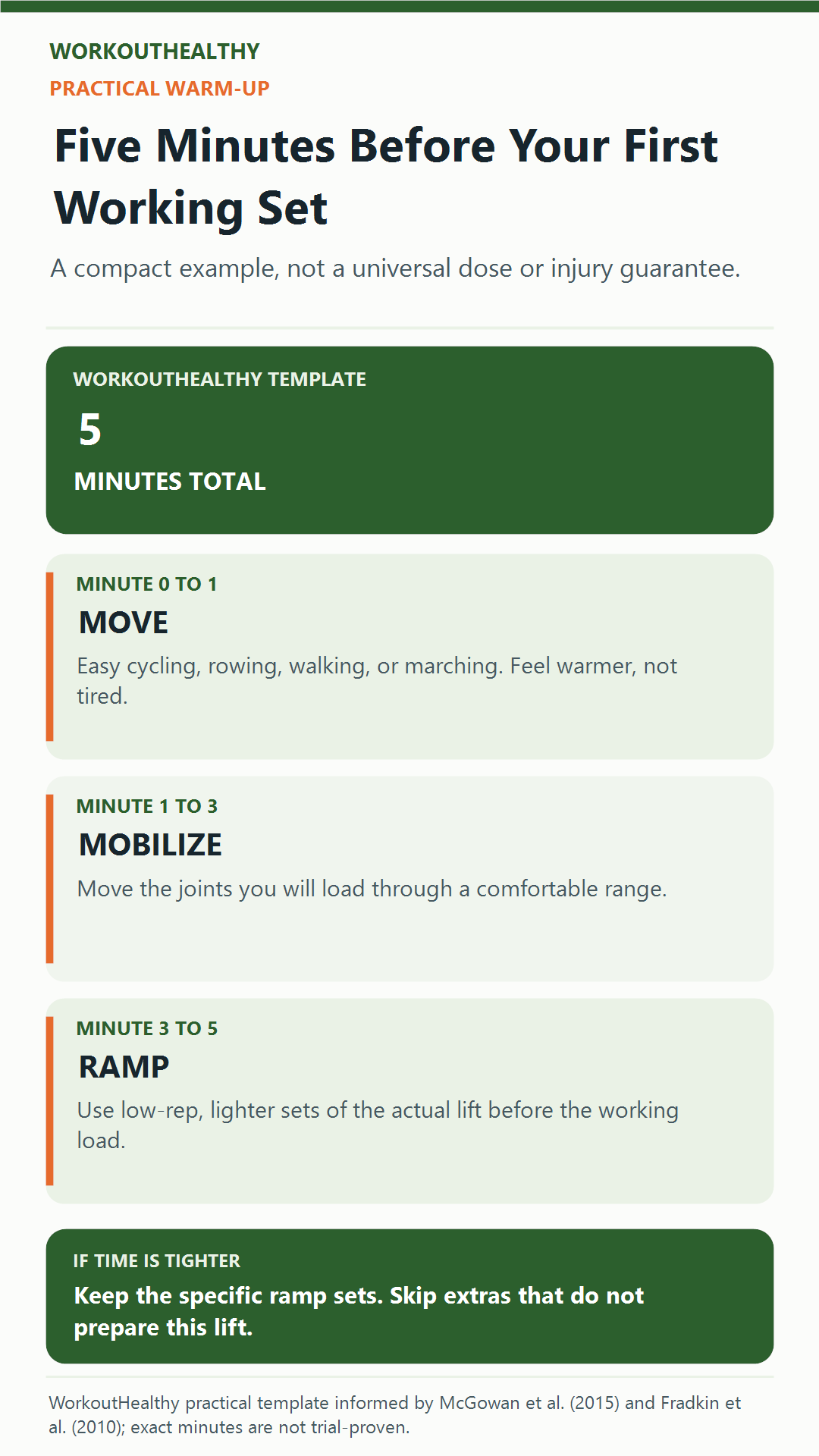
Minute one to two. Raise your general temperature. Bike, row, brisk walk on an incline, or fast marching on the spot. You want to be breathing a little harder and slightly warm, not tired.
Minute two to three. Move the joints you are about to load, through their full range, under control. Hips and ankles before squats. Shoulders and upper back before pressing. Ten slow repetitions each, not thirty.
Minute three to five. Ramp the actual lift. Empty bar, then roughly 50 percent, then 70 percent, then 85 percent, with low repetitions and short rests.
That last part is the non negotiable piece.
Specific warm-up sets on the lift you are about to do deliver more than any amount of general movement.
If you only have two minutes, do the ramp sets and nothing else.
One practical note on the ramp itself.
Keep the repetitions low as the weight climbs. Five at the empty bar, three at 50 percent, two at 70 percent, one at 85 percent is plenty.
The goal is readiness, not fatigue. If your warm-up leaves you tired, it was a workout.
Rest just long enough to breathe between ramp sets and no longer.
What You Can Safely Cut
Plenty of what people call warming up is optional.
Long static stretching before lifting is the first thing to go.
A review in the European Journal of Applied Physiology found that prolonged static stretching before activity can reduce force and power output, particularly when holds are long (Behm & Chaouachi, 2011).
Shorter holds inside a broader warm-up that includes dynamic work appear to blunt that effect.
Still, if you are short on time, long holds are not the best use of your five minutes.
Foam rolling can also go. It is not harmful, but it is not what prepares you to lift heavy.
Long band circuits for their own sake can go too, unless a physiotherapist gave them to you for a reason.
What stays is the ramp.
Raise your temperature, move the relevant joints, and build up to your working weight in a few quick sets.
That is the whole thing. It costs less than one set of squats, and it is the last part of the session you should be cutting.
How long is your warm-up when you are running late? Subscribe to WorkoutHealthy Insider for practical explanations behind popular fitness claims.
References
Behm, D. G., & Chaouachi, A. (2011). A review of the acute effects of static and dynamic stretching on performance. European Journal of Applied Physiology, 111(11), 2633 to 2651. https://doi.org/10.1007/s00421-011-1879-2
Fradkin, A. J., Zazryn, T. R., & Smoliga, J. M. (2010). Effects of warming-up on physical performance: A systematic review with meta-analysis. Journal of Strength and Conditioning Research, 24(1), 140 to 148. https://doi.org/10.1519/JSC.0b013e3181c643a0
McGowan, C. J., Pyne, D. B., Thompson, K. G., & Rattray, B. (2015). Warm-up strategies for sport and exercise: Mechanisms and applications. Sports Medicine, 45(11), 1523 to 1546. https://doi.org/10.1007/s40279-015-0376-x
Soligard, T., Myklebust, G., Steffen, K., Holme, I., Silvers, H., Bizzini, M., Junge, A., Dvorak, J., Bahr, R., & Andersen, T. E. (2008). Comprehensive warm-up programme to prevent injuries in young female footballers: Cluster randomised controlled trial. BMJ, 337, a2469. https://doi.org/10.1136/bmj.a2469
This article is for general information only and is not medical advice. If you have an injury, ongoing pain, or a medical condition, talk to a doctor or physical therapist before you change how you train or eat.