
Slow, comfortable breathing can change the rhythm of your heartbeat while you practice it. That is a real physiological response, and controlled studies suggest that repeated practice can also improve some heart-rate-variability measures. It does not follow that five minutes each day permanently “trains” the heart to handle every stressful moment.
The scheduled WorkoutHealthy post says that controlled breathing quietly trains the heart rate to respond better to stress. The useful part is the idea of a simple, repeatable relaxation practice. The part that needs care is treating a change in heart-rate variability, or HRV, as proof that the heart has become stronger or that stress resilience is guaranteed.
Here is what HRV means, what slow-breathing studies actually measured, and a gentle way to try the practice without turning a wearable score into a diagnosis.
The Short Answer
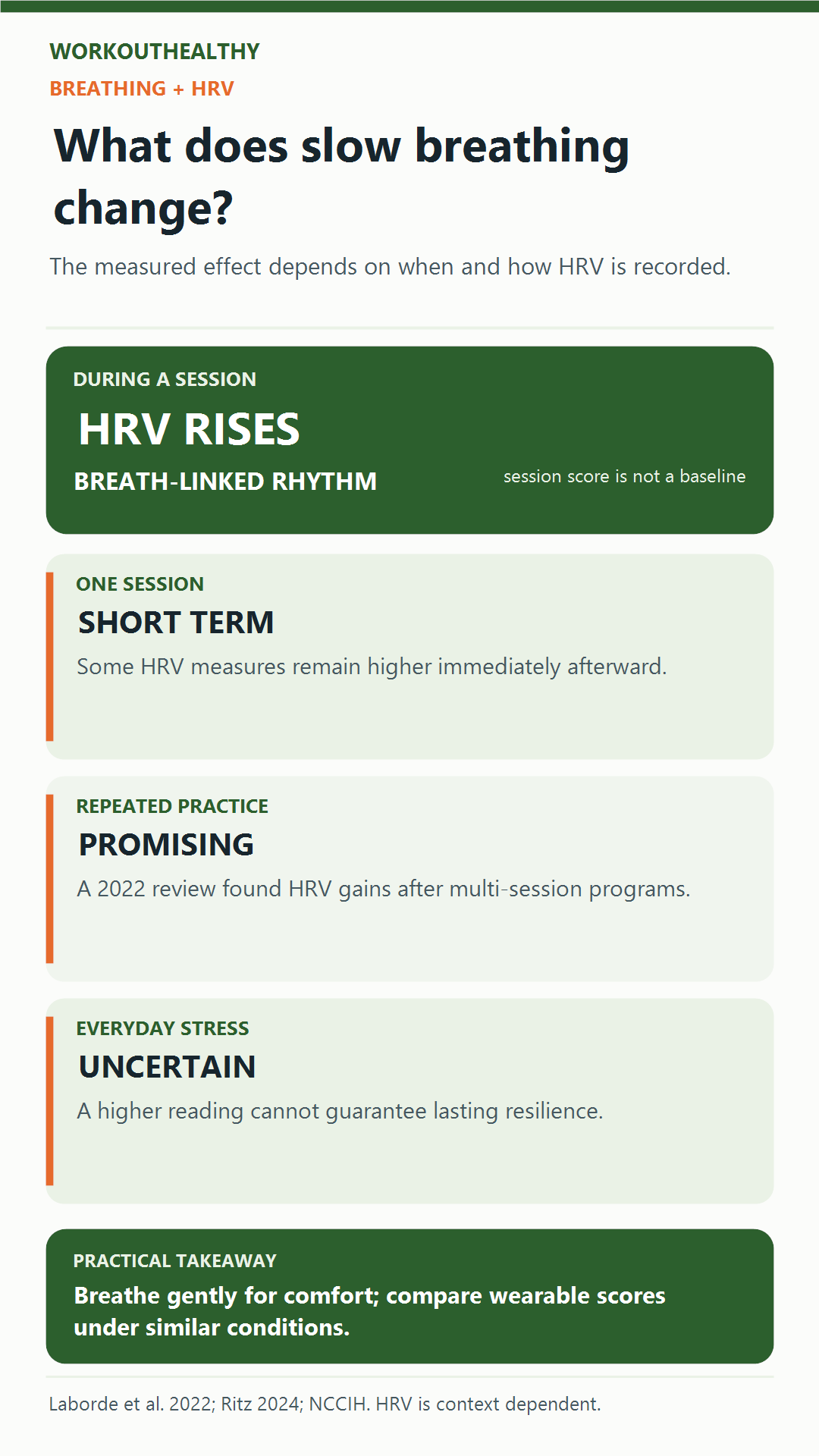
For many adults, a few minutes of unforced, slower breathing is a reasonable way to pause and settle. The 2022 systematic review and meta-analysis by Laborde and colleagues found increases in vagally mediated HRV during breathing, immediately after one session, and after multi-session programs. That is more substantial than a claim based on one viral experiment.
Even so, the studies used different breathing methods, durations, participants, and measurement conditions. A higher HRV reading taken while you deliberately breathe slowly cannot be compared directly with your usual resting reading. It may partly reflect the mechanics of the breathing pattern itself.
Use breathing as a low-cost relaxation tool if it feels comfortable. Keep medical care, sleep, movement, and social support in the picture. No particular HRV target or five-minute routine has been shown to make everyone reliably “stress-proof.”
What Heart-Rate Variability Measures
Your heart does not beat like a metronome. The intervals between successive beats change subtly as you breathe, move, sleep, and respond to your surroundings. HRV describes aspects of that beat-to-beat variation, usually calculated from an electrocardiogram or a device estimating pulse intervals.
One component is respiratory sinus arrhythmia: heart rate tends to rise somewhat during inhalation and fall during exhalation. Reviews of cardiovascular physiology explain that this rhythm involves the nervous system, breathing, blood pressure, and reflexes working together. It is not a direct one-number readout of willpower, mental health, or “vagus-nerve strength.”
Different HRV metrics capture different properties. RMSSD, a time-domain measure, is often used in studies of parasympathetic cardiac regulation. Spectral measures also depend on the frequency of the breathing rhythm. At a slow pace near six breaths per minute, respiratory oscillations can move into a frequency band that a device labels differently from ordinary breathing. A change on the screen does not automatically mean a permanent change in your resting physiology.
Age, illness, medication, sleep, exercise, posture, recording length, and device quality can all change an HRV value. If you track it, compare similar measurements under similar conditions over time, and avoid treating another person’s number as your goal.
Why Breathing Changes the Reading So Quickly
Slow breathing gives the heart more time to speed up and slow down with each breath. Around six breaths per minute, some people show especially large breathing-linked fluctuations. The 2017 review by Russo and colleagues describes how respiratory rhythm, blood-pressure reflexes, and cardiac timing interact during these sessions.
That immediate effect is interesting, but it creates a measurement trap. A large HRV value during a guided breathing exercise may mean that the exercise is successfully producing a breathing-linked rhythm. It does not prove that your everyday baseline has improved. A 2024 review by Ritz stresses that respiratory pattern can substantially influence common HRV measures without necessarily showing a change in tonic cardiac vagal activity.
This is why a breathwork app can show a dramatic chart within minutes while the clinical meaning remains uncertain. The chart is capturing a real signal; the interpretation has to fit the context in which that signal was recorded.
What the Longer-Term Studies Suggest
The 2022 Laborde review included 223 studies suitable for its analyses: 172 looked at HRV during slow breathing, 16 immediately after one session, and 49 after a multi-session intervention. It reported increases in vagally mediated HRV at all three time points. That supports the possibility of more than a purely momentary response.
However, “after an intervention” is not identical to “permanently raised baseline.” Programs differed in frequency and length, and follow-up periods were not a universal test of lifelong change. A routine that helps one person feel calmer or improves a particular metric may produce a smaller effect, a different effect, or no noticeable effect for another.
A 2018 systematic review by Zaccaro and colleagues found links between slow-breathing techniques, physiological changes, and positive psychological outcomes such as relaxation. The authors also highlighted inconsistent descriptions of the breathing protocols and the need for stronger long-term studies. The most defensible message is promising evidence for a practice, with limits on precise prescriptions and health claims.
When the aim is stress management, subjective experience matters too. Feeling less tense after a session is a useful outcome even if your wearable does not show a dramatic number. Conversely, a favorable number does not mean an ongoing anxiety disorder, blood-pressure problem, or sleep deficit has been treated.
A Gentle Five-Minute Practice
Sit or lie somewhere safe and comfortable. Let your shoulders relax. Breathe through your nose if that feels easy, or through your mouth if it does not. Start with a normal, quiet breath rather than a maximal inhale. Then lengthen the exhale a little, keeping the pace comfortable.
You might aim for an inhale of about four seconds and an exhale of about six seconds, which works out to roughly six breaths per minute. This is an example, not a requirement. If counting makes you tense, simply make each breath smooth and slightly slower than usual. Avoid holding your breath unless a clinician has advised a particular method.
Try one or two minutes first. If it remains pleasant, continue to about five minutes. Stop or return to normal breathing if you feel dizzy, short of breath, tingling, or panicky. Forcing large breaths can make you uncomfortable and may turn a calming exercise into a stressful one.
Choose a repeatable cue, such as after waking, after a walk, or before bed. The value of the routine is that it is easy to return to. It is not necessary to hit an exact six-breath pace or to watch a live HRV graph throughout. Our guide to box breathing for stress offers another gentle option, with guidance on when to stop.
How to Read a Wearable HRV Score
If you use a watch or ring, note when and how it measures HRV. A nighttime average, a brief seated resting test, and an in-session guided-breathing score are different observations. The same device can display all three without making them interchangeable.
For a personal trend, use the same device and similar circumstances. Consider sleep, hard training, illness, alcohol, travel, and medication changes before drawing a conclusion from one low or high day. A moving average is usually more informative than trying to “win” each morning’s number.
Do not diagnose heart disease, overtraining, or an anxiety disorder from a consumer HRV value. If a device flags an irregular rhythm or you have chest pain, fainting, significant palpitations, or breathing difficulty, seek appropriate medical assessment instead of adjusting a breathing timer. HRV is one piece of context, not a stand-alone clinical test.
Where Breathwork Fits in a Bigger Routine
The National Center for Complementary and Integrative Health describes breathing exercises as one way to elicit a relaxation response. It also says that evidence for specific health conditions is limited and that relaxation techniques should not replace conventional care. That distinction keeps the practice useful without promising a cure.
Regular movement, sleep, nutrition, and support from other people also shape how you handle stress. A five-minute practice can be a convenient bridge into those habits: a pause before a workout, a transition away from work, or a moment to notice that you need rest. Our article on slow breathing and blood-sugar claims explains why a relaxation effect should not be mistaken for a direct treatment of a separate medical condition.
People living with respiratory or cardiovascular disease may need a tailored approach. For some, breathing exercises are part of a rehabilitation plan; for others, forcing a very slow pace may feel wrong. Our review of gentle movement and easier breathing explains why a personalized rehabilitation program matters when symptoms or lung disease are involved.
What to Take Away
Controlled breathing can alter the heartbeat rhythm you measure during a session, and a large research review found HRV changes after repeated practice as well. That makes it a reasonable tool to explore for relaxation. It does not prove that a precise daily dose permanently trains the heart or reliably prevents stress-related illness.
If a gentle five-minute pause helps you feel calmer, keep it. Let comfort and consistency guide you, and interpret wearable HRV numbers in context. If you are using breathwork for a diagnosed condition, work with your clinician on the broader plan.
Sources and Editorial Notes
- Laborde S, et al. Effects of voluntary slow breathing on heart rate and heart rate variability: A systematic review and meta-analysis. Neuroscience & Biobehavioral Reviews. 2022.
- Ritz T. Putting back respiration into respiratory sinus arrhythmia or high-frequency heart rate variability. Biological Psychology. 2024.
- Russo MA, et al. The physiological effects of slow breathing in the healthy human. Breathe. 2017.
- Zaccaro A, et al. How Breath-Control Can Change Your Life: A Systematic Review. Frontiers in Human Neuroscience. 2018.
- National Center for Complementary and Integrative Health. 5 Things To Know About Relaxation Techniques for Stress.
Medical note: This article is for education, not individualized medical advice. Seek urgent care for chest pain, fainting, or severe breathing difficulty. Ask a qualified clinician about persistent symptoms or a breathing technique for a diagnosed condition.