
Irish legend has a hero who did not become great on talent alone.
His name was Cú Chulainn, and the old stories send him overseas to learn from a master.
A popular post says he trained for years under a specialist to master combat skills and balance.
The broad idea matches the legend. The “years” part is harder to confirm.
And because this is myth, the real lesson is about coaching, not about ancient fitness records.
A Legend, Not a Biography
Cú Chulainn belongs to the Ulster Cycle, a group of early Irish tales.
He is not a documented historical person.
His training story appears mainly in a tale called Tochmarc Emire, or The Wooing of Emer.
That tale survives in two versions: a short one mostly in Old Irish and a longer one from the Middle Irish period.
The earliest version exists only in a manuscript copied in the 15th or 16th century.
Scholar Kuno Meyer dated that text to the tenth century and suggested it rests on an older original.
So the story was written down long after any time it claims to describe.
Who Taught Him
In the tale, his journey abroad is tied to his wish to marry Emer.
One version has him first train with a warrior named Domnall before moving on.
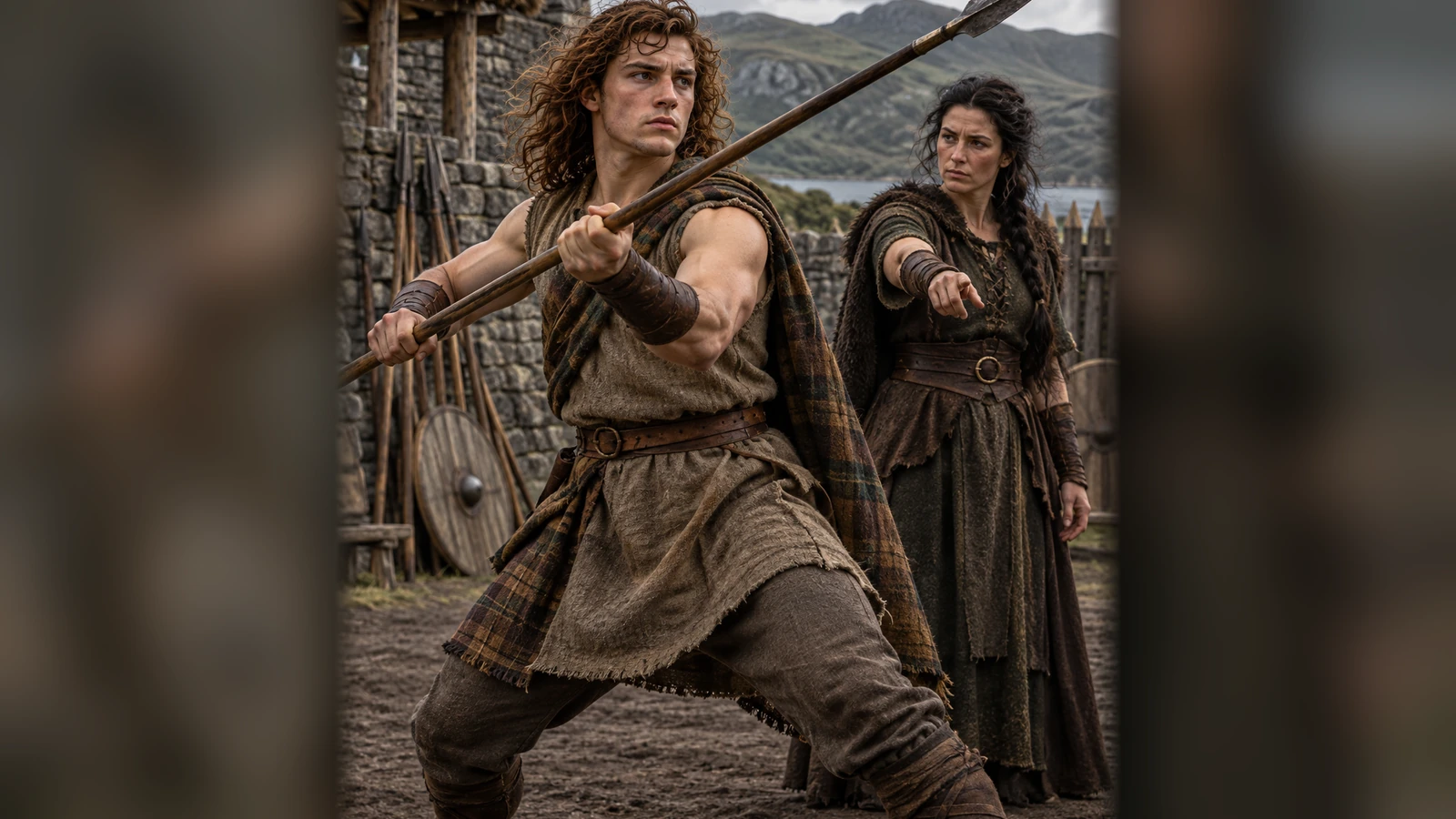
He ends up with Scáthach, a famous warrior woman in Alba, the old name for Scotland.
Later tradition places her fortress, Dún Scáith, on the Isle of Skye.
Scáthach teaches him the arts of war.
She also teaches him to use the Gáe Bulg, a barbed spear thrown with the foot.
What the Training Looked Like
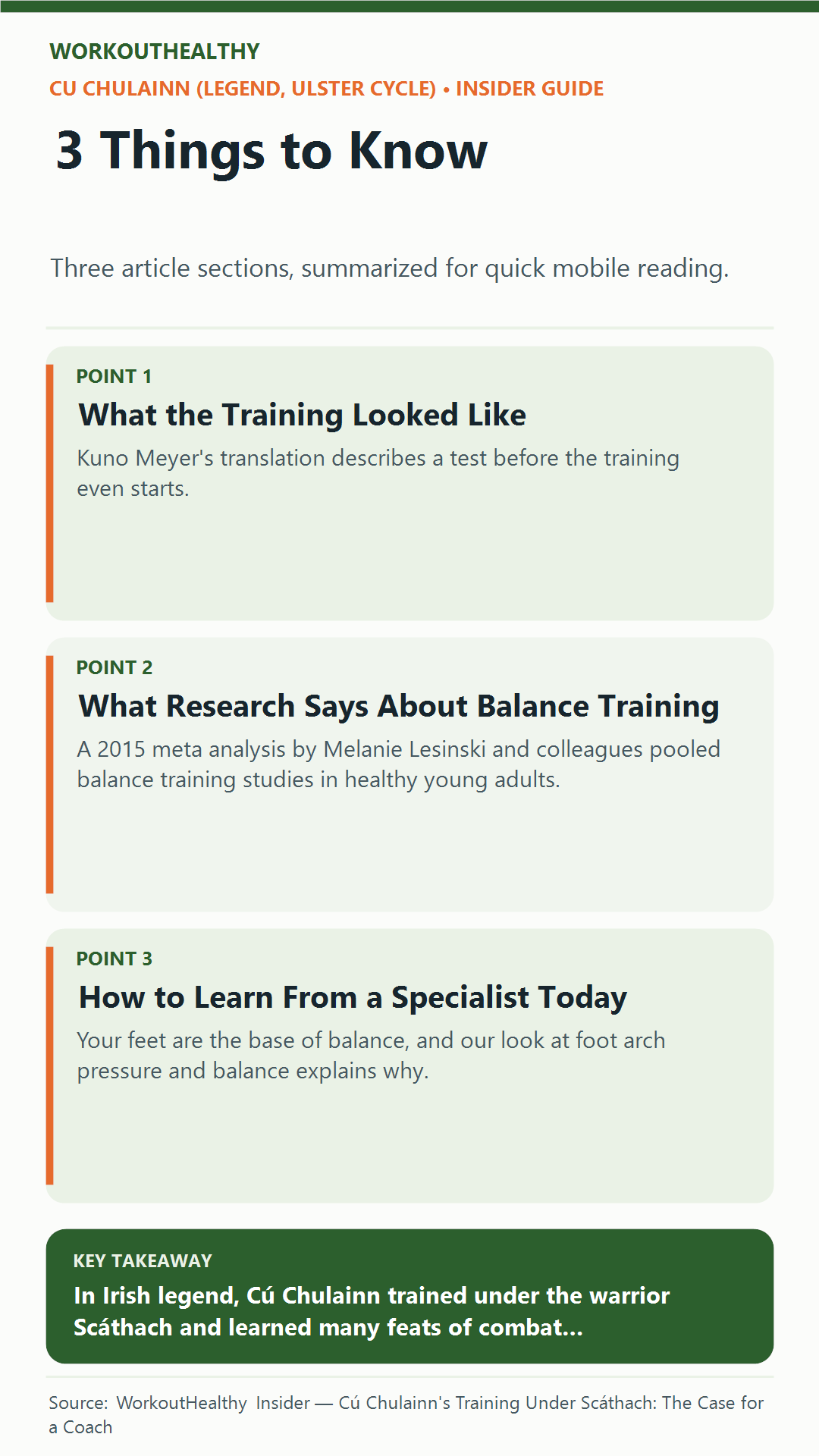
Kuno Meyer’s translation describes a test before the training even starts.
To reach Scáthach, Cú Chulainn must cross the Bridge of the Cliff.
Whenever someone jumps onto one end, the other end rises and throws them back.
He fails three times, then uses “the hero’s salmon leap” to land in the middle.
Once there, he learns a long list of feats, including the apple feat, the thunder feat, the rope feat, and the cat’s feat.
Another feat linked to Scáthach is balancing on the butt of a spear.
A modern sculpture of Cú Chulainn balancing on a tall pole is based on that story.
Checking the “Years” Claim
The sources we reviewed did not state how long he trained.
The translation says only that he stayed until he had the full lore of his soldierly arts.
Some retellings give a specific length of time, but we could not confirm one in the versions we checked.
The fair summary is this: he trained under a specialist until she judged him complete.
Even the legends did not trust raw talent. They sent their heroes to a teacher.
What Research Says About Having a Coach
The idea that a skilled coach speeds progress has modern support.
In a 2000 study, Scott Mazzetti and colleagues compared supervised and unsupervised strength training.
Moderately trained men followed the same 12 week periodized program.
One group trained with a personal trainer, and the other trained alone.
The supervised group used heavier training loads.
They also gained maximal strength faster and to a greater degree than the unsupervised group.
The study was small, with 10 men in the supervised group and 8 in the other.
Still, it suggests that expert oversight changes how hard and how well people train.
What Research Says About Balance Training
Balance is a trainable skill, not just a gift.
A 2015 meta analysis by Melanie Lesinski and colleagues pooled balance training studies in healthy young adults.
Balance training improved steady balance and proactive balance, the kind you use when you move on purpose.
The largest effects on steady balance showed up in elite athletes.
The most effective programs lasted about 11 to 12 weeks.
They used about three sessions per week of 11 to 15 minutes each.
The authors also noted that more research is needed on reactive balance, the kind that saves you from a slip.
What the Legend Does Not Teach
The feats in the story are exaggerated, even magical.
No one should try pole balancing or leaping across unstable structures without proper progressions and safety.
The myth also suggests one teacher can give you everything.
In real life, you may need different coaches for strength, skill, and recovery.
How to Learn From a Specialist Today
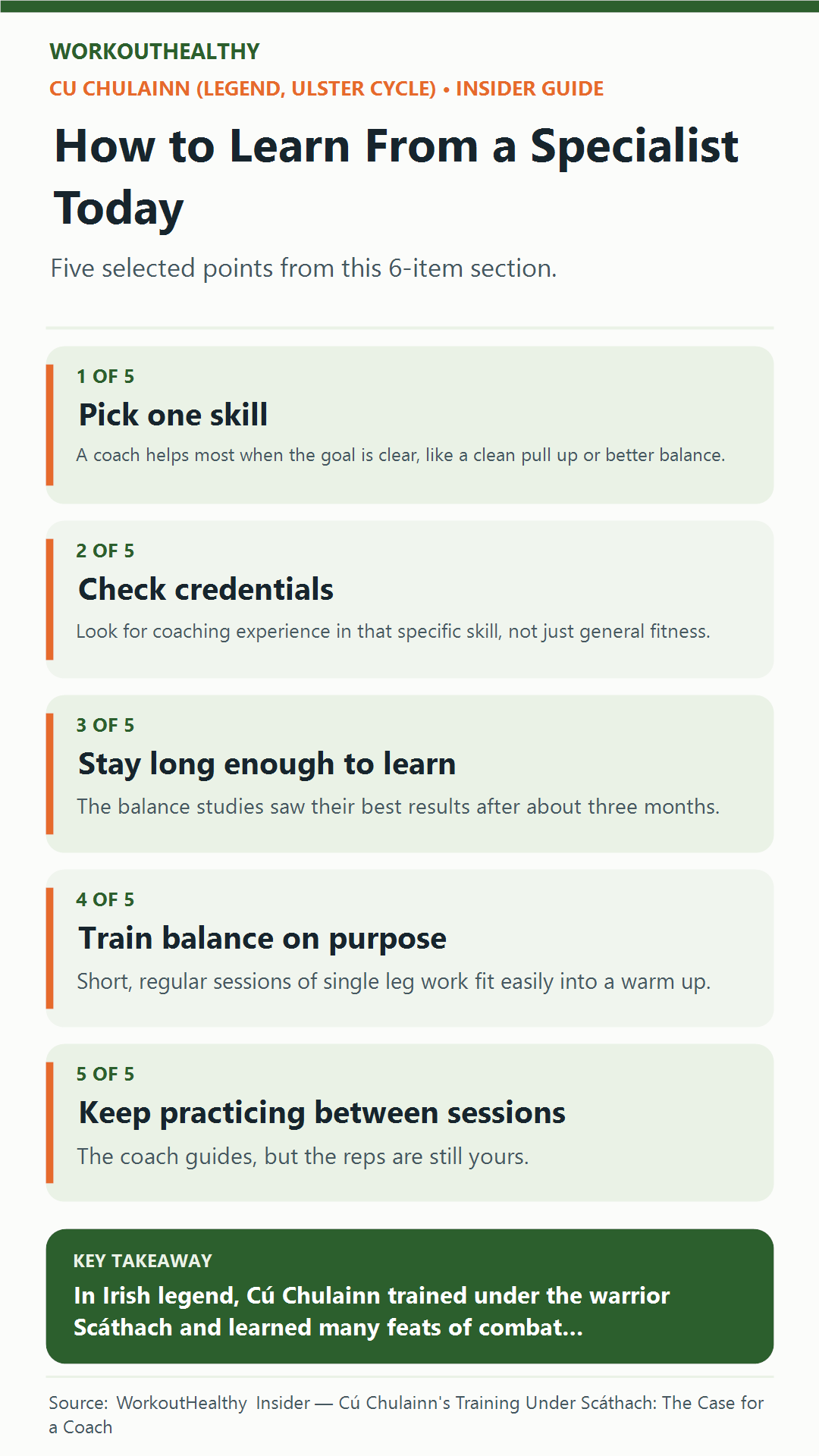
- Pick one skill. A coach helps most when the goal is clear, like a clean pull up or better balance.
- Check credentials. Look for coaching experience in that specific skill, not just general fitness.
- Stay long enough to learn. The balance studies saw their best results after about three months.
- Train balance on purpose. Short, regular sessions of single leg work fit easily into a warm up.
- Keep practicing between sessions. The coach guides, but the reps are still yours.
- Know when you are ready to move on. Like Cú Chulainn, finish the lessons before you test yourself.
Your feet are the base of balance, and our look at foot arch pressure and balance explains why.
If you want a skill with clear steps, our guide to planche lean form and progression is a good example of coached progress.
Who Should Be Careful
People with dizziness, inner ear problems, or a history of falls should get medical advice before balance training.
Always train balance near a wall or support at first.
If you are joining a group class for coaching, our review of whether boot camp classes are worth it can help you choose.
The Bottom Line
In Irish legend, Cú Chulainn trained under the warrior Scáthach and learned many feats of combat and balance.
The story is myth, and the claim that he trained for years could not be confirmed in the versions we checked.
Modern research does support the core idea: supervised training and focused balance work both lead to real gains.
Find a good teacher, stick with the process, and practice the basics.
Want more stories like this? Subscribe to WorkoutHealthy Insider for practical explanations behind popular fitness claims.
References
- Lesinski, M., Hortobágyi, T., Muehlbauer, T., Gollhofer, A., & Granacher, U. (2015). Dose response relationships of balance training in healthy young adults: A systematic review and meta-analysis. Sports Medicine, 45(4), 557 to 576. https://doi.org/10.1007/s40279-014-0284-5
- Mazzetti, S. A., Kraemer, W. J., Volek, J. S., Duncan, N. D., Ratamess, N. A., Gómez, A. L., Newton, R. U., Häkkinen, K., & Fleck, S. J. (2000). The influence of direct supervision of resistance training on strength performance. Medicine and Science in Sports and Exercise, 32(6), 1175 to 1184. https://doi.org/10.1097/00005768-200006000-00023
- Meyer, K. (Trans.). (1890). The oldest version of Tochmarc Emire. Revue Celtique, 11, 434 to 457. Text at https://www.maryjones.us/ctexts/emer.html
- Wikipedia contributors. (n.d.). Tochmarc Emire. In Wikipedia. Retrieved September 16, 2026, from https://en.wikipedia.org/wiki/Tochmarc_Emire
This article is for general information only and is not medical advice. If you have an injury, ongoing pain, or a medical condition, talk to a doctor or physical therapist before you change how you train or eat.