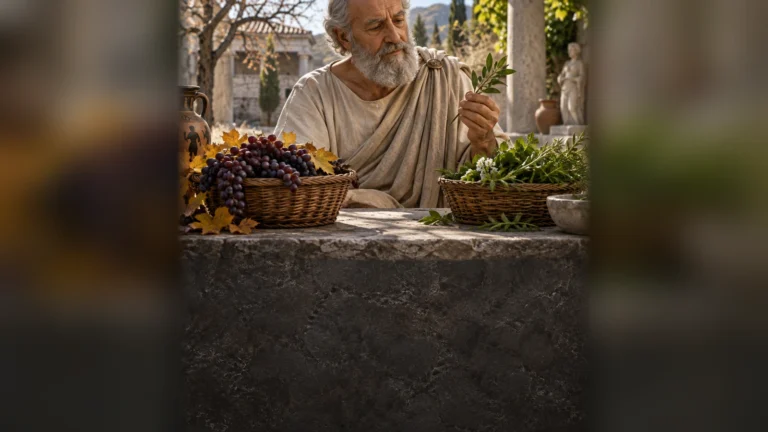

Illustration note: The featured scene imagines a ruler and an adviser in conversation. It is an editorial illustration, not an authenticated likeness of Huangdi or a record of a historical meeting.
The Huangdi Neijing is an ancient Chinese medical classic. Its Suwen, or Basic Questions, opens with passages about daily habits, exertion and the seasons.
Those passages are worth reading in their own setting before turning them into recovery advice. This guide locates the work and seasonal passages, identifies the translation used, and separates what the text says from what modern exercise research can establish.
Which Huangdi Neijing text are you reading?
This guide uses Unschuld and Tessenow’s 2011 annotated Suwen, with Zheng Jinsheng. Its publisher describes a text developed over centuries.
The Lingshu is another Neijing text, published in Unschuld’s translation as The Ancient Classic on Needle Therapy. It has its own chapters; a chapter number without the work’s name can therefore send you to the wrong passage.
The immediate question here is modest: where do the familiar statements about overwork, rest and seasons occur, and what can a reader responsibly take from them? A selected passage guide cannot stand in for the entire medical classic or its commentary tradition.
Use the work, chapter and edition together when checking a quotation. A page number is useful only after you know which translation or printing supplied it.
Chapter 1: the work and rest passage
Chapter 1, pp. 30 to 31, contrasts antiquity with its own present and praises moderation and regular habits. Qibo’s answer includes this wording:
“They did not tax [themselves] with meaningless work.”
This is the named translators’ wording, not an English sentence spoken by an identifiable ancient author. Preserve the brackets if quoting this edition, and do not silently replace its wording with a more modern training slogan.
Footnote 15 discusses variant readings. The opening longevity contrast belongs to the dialogue, rather than a measured cohort.
That makes a difference to the conclusion. The passage can document an ideal expressed in this text; it cannot identify someone’s training tolerance, prove that rest extends life, or diagnose overtraining syndrome.
It also gives no sets, repetitions, recovery interval or limit on working hours. Calling it an ancient deload plan adds a program that the quoted sentence does not supply.
Chapter 2: locate the four seasonal passages
The following summaries are reading aids, rather than quotations or instructions to follow. Page numbers refer to the 2011 translation, and the last column explains the limits of using a historical passage as present-day advice.
| Passage | Brief paraphrase | Modern boundary |
|---|---|---|
| Spring, p. 45 | Later sleeping, earlier waking; courtyard movement. | No walking duration, pace or tested health outcome is supplied. |
| Summer, pp. 46 to 47 | Later sleeping, earlier waking; openness to sunlight. | This is not evidence that more sun or heat is safe for every reader. |
| Autumn, pp. 47 to 49 | Earlier sleeping and waking; mental calm. | It does not establish a treatment for a sleep or mental-health condition. |
| Winter, p. 49 | Earlier sleeping, later waking; awaiting daylight. | It provides no universal bedtime, sleep requirement or winter training dose. |
The passages connect conduct with seasonal qi and describe harms from opposing it. Keep that setting visible.
A modern list of seasonal wellness tips can retain the familiar habits while losing the framework that gives them meaning in the chapter. Conversely, accurately explaining that framework does not validate its claims about illness.
For interpretation, ask what kind of statement you are reading: an instruction, a description of nature, an explanation of disease, or a later commentator’s note. Those categories are related in the edition, but they should not be blended into one proven health claim.
Translation, commentary and modern paraphrase
An annotated edition contains several voices on the same page. The translated base text, the translators’ explanatory additions and commentary quoted in a note do different jobs.
When copying a memorable line, keep its attribution and location attached. If an article rewrites that line in simpler language, it should call the result a paraphrase rather than place quotation marks around newly composed advice.
Also check whether an explanation belongs to the main passage or to a commentator discussed below it. An annotation can help explain a difficult reading without being another sentence from the base text.
The short seasonal table above deliberately avoids pretending to be a new translation of the Chinese. Readers checking exact wording should return to the identified edition and its notes.
What modern recovery research adds
The ECSS and ACSM overtraining consensus discusses excessive training overload combined with inadequate recovery. It distinguishes functional overreaching from longer maladaptation, while emphasizing the difficulty of distinguishing nonfunctional overreaching from overtraining syndrome and the need to exclude other causes.
Its abstract also reports that none of the reviewed markers met every criterion for general acceptance. A single symptom, feeling or ancient quotation cannot supply that missing diagnostic certainty.
This gives the comparison a clear boundary: a contemporary clinical consensus and a historical dialogue are different forms of evidence. Similar concerns about exertion do not demonstrate that the older text anticipated or established the modern syndrome.
If your question is how rest fits lifting, our separate guide to rest days and muscle growth addresses modern training decisions. The chapter-reading guide here does not assign a rest-day schedule.
Weather research asks a different seasonal question
Tucker and Gilliland’s 2007 review examined 37 studies of season, weather and physical activity. It found that poor or extreme weather could hinder participation and suggested considering indoor opportunities during cold or wet months.
That review concerns activity behavior. It did not test the Suwen‘s four-season instructions, its illness explanations, or whether a specified seasonal bedtime improves health.
The distinction is useful even when both discussions mention winter. Evidence that rain makes walking less convenient cannot confirm a traditional explanation of organ harm, and a historical seasonal instruction cannot establish an effective exercise intervention.
Changing where an activity happens is also different from choosing a recovery workout. Our active recovery guide discusses that separate modern question without treating the classic as its trial evidence.
A passage-check card for a wellness claim
Use this short record when a book passage becomes a fitness headline or a social-media recommendation. It helps expose where a source ends and a modern inference begins.
- Locate it: Record the work, chapter, translator, publication and page.
- Identify the voice: Base text, named translator, quoted commentator or modern writer?
- Keep the surrounding claim: Note the explanation and qualifications around the memorable phrase.
- Name the added conclusion: Has someone supplied a modern dose, diagnosis, safety assurance or promised outcome?
- Ask for matching evidence: Which contemporary population, comparison and measured outcome could actually support that added conclusion?
For example, a post might turn the spring courtyard passage into a fixed daily walking target. The location can verify the historical reference, but the proposed target and its claimed benefit still need their own evidence.
Likewise, keep a note about changing habits separate from a claim that those habits explain a person’s symptoms. A reading exercise cannot clear someone for training or replace care for persistent fatigue, pain or illness.
The value of reading the Huangdi Neijing here is a more accurate encounter with an influential medical text. Its rest and seasonal passages remain interesting without being converted into a modern prescription or proof of longer life.
Sources and edition
Unschuld, P. U., & Tessenow, H., with Zheng Jinsheng. (2011). Huang Di Nei Jing Su Wen. University of California Press. Chapters 1 and 2. Edition; p. 31; seasonal passages.
Unschuld, P. U. (2016). Huang Di Nei Jing Ling Shu: The Ancient Classic on Needle Therapy. University of California Press. Publisher’s description and contents.
Meeusen, R., et al. (2013). Prevention, diagnosis, and treatment of the overtraining syndrome. Medicine & Science in Sports & Exercise, 45(1), 186 to 205. Consensus abstract.
Tucker, P., & Gilliland, J. (2007). The effect of season and weather on physical activity: A systematic review. Public Health, 121(12), 909 to 922. Review abstract.
Medical disclaimer: This fitness-history article is for general education, not medical advice or an exercise prescription. Consult a qualified healthcare professional about symptoms, a medical condition or an exercise program suited to you.