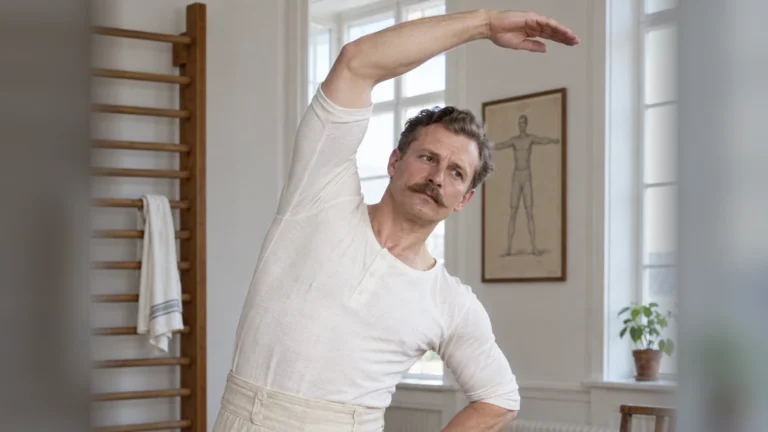

Box breathing technique: inhale, pause, exhale, and pause again for four comfortable counts each. The square pattern gives attention a simple job, while the count remains adjustable if a hold feels unpleasant.
The sections below distinguish teaching aids from clinical trial protocols. They also separate positive results from outcomes that did not change.
Quick answer: try the self-paced cue below only while comfortable; skip holds whenever you prefer.
A silent cue you control
Trace the four sides of an imaginary square with a finger. Move to the next side only when you are ready; no animation or timer sets the pace for you.
- Side one: inhale gently for a comfortable count, up to four.
- Side two: pause only if the hold feels easy.
- Side three: exhale smoothly for a comfortable count.
- Side four: pause only if the hold feels easy, then decide whether to repeat.
Prefer no holds? Breathe in gently and exhale at a comfortable pace instead.
This cue is an editorial teaching aid, not a tested stress-treatment dose.
The purpose of a breathing drill is to make breathing feel steadier, not to win a contest with the clock.
How to do one box-breathing cycle
Sit or stand in a supported position where you do not need to balance. Let your jaw, hands, and shoulders soften before changing the breath.
Four seconds in each phase creates one 16-second teaching cycle. The self-paced cue above also works with shorter counts, without animation or a timer.
Shorter counts or continuous breathing are comfort adjustments, not the exact trial protocols below. You do not need to complete a hold.
Keep the breath quiet and moderate. Overbreathing can lower blood carbon dioxide and cause tingling or lightheadedness.
If you need to gulp air afterward, shorten the count or remove the holds.
Practice at a neutral time before relying on the technique during stress. Learning the sequence when you already feel safe reduces the mental load of remembering it later.
Use a timer only if it helps. Counting silently, tracing a square with one finger, or following a visual cue can all provide the four-part structure without staring at a screen.
What controlled research found
A remote 2023 randomized study assigned adults to five minutes per day of box breathing, cyclic sighing, cyclic hyperventilation with retention, or mindfulness meditation for one month (Balban et al., 2023).
Breathwork, especially exhale-focused cyclic sighing, improved mood and reduced respiratory rate compared with mindfulness meditation. This does not establish unique superiority for box breathing.
A separate 12-week randomized trial compared slow breathing with either a longer or equal exhale-to-inhale ratio. Perceived stress decreased, but the longer-exhale condition did not outperform the equal-ratio condition, and heart-rate variability did not clearly change (Birdee et al., 2023).
A 2026 randomized trial assigned 66 participants, 22 each, to normal breathing, prolonged exhalation or box breathing (McAllister et al., 2026). They practiced for five minutes before and one minute during a modified virtual social-stress test.
This small, acute experiment does not establish anxiety-disorder treatment or effectiveness in real-world crises. Participants were aged 18 to 39, and diagnosed psychological conditions were excluded.
Read each result with its duration, comparison and outcome in view.
Both active groups had smaller post-stressor rises in heart rate, anxiety and salivary alpha-amylase than controls. Heart-rate variability, cortisol and cognitive performance showed no significant between-group differences.
Before treating a research headline as a personal promise, ask which outcome actually changed.
What the carbon-dioxide claim misses
The controlled trials above do not establish a universal carbon-dioxide-tolerance mechanism. Do not treat their stress outcomes as proof of that explanation.
Ask a mechanism claim to name its measurement and the experiment that tested it. You do not need a mechanism story to decide whether you want to continue a comfortable practice.
Do not chase longer holds or force larger breaths. Dizziness, tingling, chest discomfort or escalating panic are reasons to stop, not signs of beneficial adaptation.
The WorkoutHealthy five-round dial
This is an original coaching framework, not a clinical protocol. It turns five cycles into a live comfort check.
Round one is orientation. Notice whether four seconds feels natural or strained without trying to correct anything.
Round two is volume. Make the inhale smaller if the chest or shoulders lift dramatically.
Round three is tension. Release the jaw, belly, hands, and throat during the pauses.
Round four is choice. Continue the box, shorten all phases, or switch to an easy inhale and slightly longer exhale.
Round five is transfer. Let the timing go and take two normal breaths while keeping the slower, less urgent feeling.
Stop for rising air hunger or anxiety; feeling calmer does not establish a medically safe dose.
This dial treats comfort as more important than completing every count. If the practice feels worse, stop or choose another grounding method.
With a four-second count, the five rounds take about 80 seconds. Add a short settling period and two normal breaths afterward, and the entire practice can fit inside two minutes.
Choose a time that fits your routine. The five-round dial does not prescribe a daily frequency.
When box breathing may be useful
Box breathing can fit before a presentation, after a tense commute, between work tasks, or during the transition into a warm-up. It creates a short boundary around attention.
For a separate look at competing inputs, see our review of multitasking, stress, and immunity.
Before exercise, keep the drill brief enough that it does not make you drowsy or lightheaded. The goal is readiness, not maximum relaxation.
After exercise, slow breathing can be one part of a cooldown, but it does not replace hydration, food, sleep, or appropriate training load. It is a state-management tool, not a complete recovery plan.
At bedtime, some people prefer continuous slow breathing without holds because it feels less effortful. A technique that makes you monitor every second can be counterproductive when the goal is sleep.
Other low-intensity strategies can work too. Our article on whether foot massage can help relaxation uses the same standard: a modest benefit does not need to become a cure-all.
Pair the technique with an action that addresses the stressor when possible. Breathing may make a difficult email easier to answer, but it cannot resolve workload, conflict, or unsafe conditions by itself.
Then choose the next practical action, whether that means answering the email, asking for help or taking a break.
When to stop or choose another method
Stop if you feel faint, numb, confused, increasingly panicked, or unable to get a comfortable next breath. Sit safely and resume normal breathing.
People with significant heart or lung disease, a history of fainting, pregnancy-related complications, or symptoms triggered by breath holding should ask a clinician whether the method is appropriate.
Never practice prolonged breath holds in water, while driving, on exercise equipment, or anywhere that dizziness could cause a fall. Box breathing is not an underwater training drill.
If focusing on breathing intensifies panic, use an external grounding method instead. Name objects in the room, feel your feet on the floor, or take a slow walk.
For sudden breathing difficulty or breathing that seriously interferes with speaking, call 911 or your local emergency number. Do not wait for box breathing to help.
Seek medical care for new or worsening breathlessness or chest discomfort; persistent anxiety or panic also deserves professional support.
A useful breath practice gives you more options, including the option to stop.
The bottom line
Use the guide as a set of choices, not an obligation to finish every count. The original comfort dial and silent cue do not replace clinical assessment or the trial protocols.
Start with a gentle count, keep the breaths moderate, and judge the technique by comfort and function. If equal holds feel worse, use continuous slow breathing or another grounding strategy.
Get the next evidence check.
Five practical fitness stories worth your time, every Friday.
One email a week. No product pitches. Unsubscribe in one click.
References
Balban, M. Y., Neri, E., Kogon, M. M., Weed, L., Nouriani, B., Jo, B., Holl, G., Zeitzer, J. M., Spiegel, D., & Huberman, A. D. (2023). Brief structured respiration practices enhance mood and reduce physiological arousal. Cell Reports Medicine, 4(1), 100895. https://doi.org/10.1016/j.xcrm.2022.100895
McAllister, M. J., Martaindale, M. H., Sutton, N., & Andersen, J. P. (2026). Box breathing and prolonged exhalation reduces markers of physiological stress reactivity in response to a virtual Trier social stress test. Comprehensive Psychoneuroendocrinology, 27, 100360. https://doi.org/10.1016/j.cpnec.2026.100360
Birdee, G., Nelson, K., Wallston, K., Nian, H., Diedrich, A., Paranjape, S., Abraham, R., & Gamboa, A. (2023). Slow breathing for reducing stress: The effect of extending exhale. Complementary Therapies in Medicine, 73, 102937. https://doi.org/10.1016/j.ctim.2023.102937
Veterans Health Library. Relieving tension in your back: box breathing.
NHS. Breathing exercises for stress.
MedlinePlus. Hyperventilation.
MedlinePlus. Breathing difficulty.
This article offers general stress-management information, not medical or mental-health treatment. If breath holding causes symptoms or stress and anxiety interfere with daily life, speak with a qualified clinician.