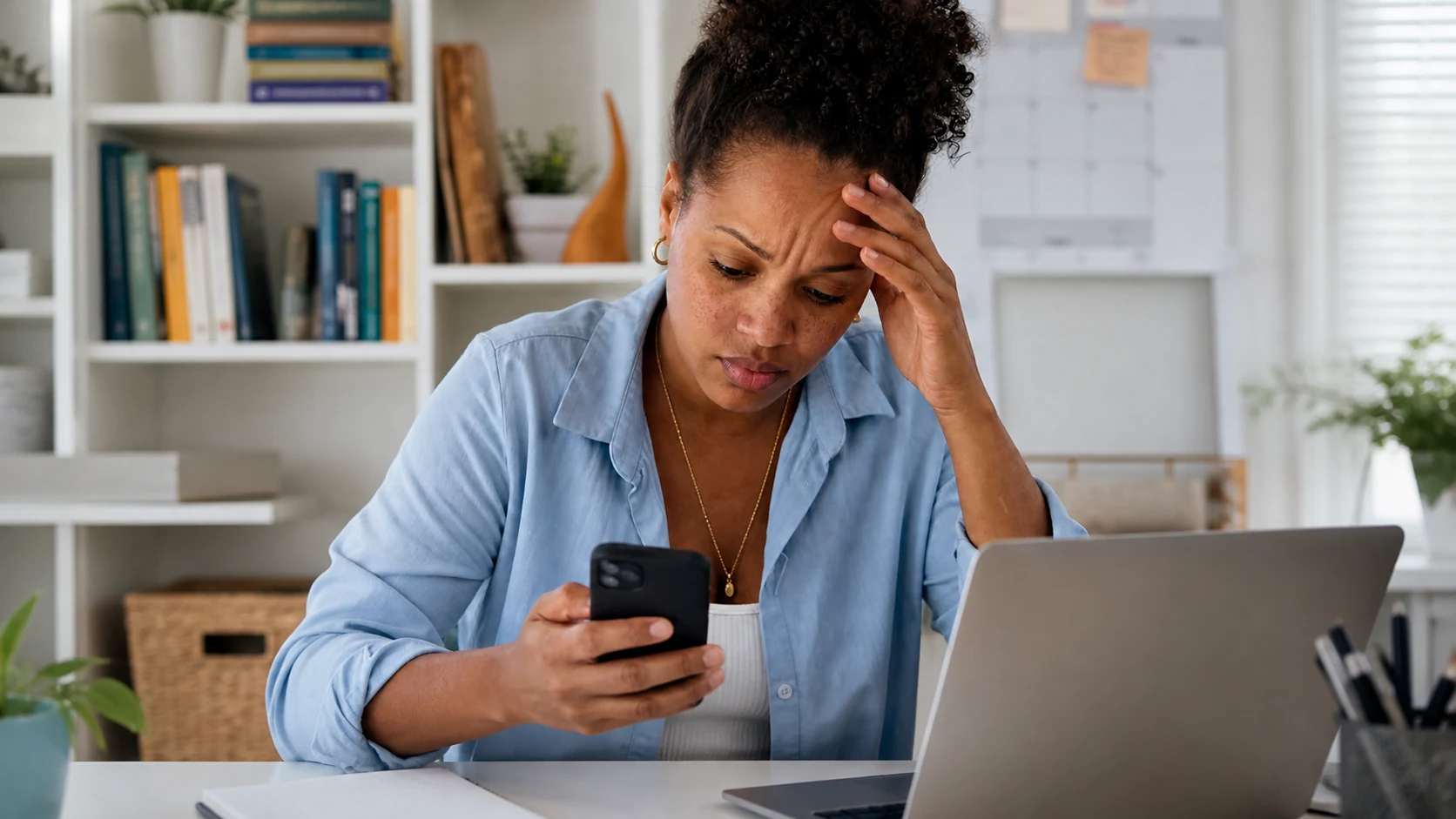

Social media and stress have a mixed relationship: a feed can connect you with support, while repeated interruptions or distressing updates can make a day feel harder. Research does not show that simply using social media raises everyone’s stress, and the viral claim that social media multitasking weakens immunity goes further than the evidence.
The answer depends on what you do online, what it interrupts, and what the study measured. A survey of perceived stress, a laboratory multitasking task, and a clinical immune outcome answer different questions.
What the main studies actually measured
| Evidence | Finding | Limit for everyday social media |
|---|---|---|
| Pew Research Center’s 2015 survey of 1,801 US adults | Frequency of social media use was not directly linked to greater perceived stress in men. Some digital communication among women was associated with modestly lower stress, while awareness of others’ difficult events was associated with higher stress. | A cross-sectional self-report survey cannot say a platform caused either effect, and its 2015 platforms and habits may differ from today’s. |
| Becker and colleagues’ multitasking review, 26 studies and 1,142 participants | Dual and multitasking conditions were associated with more sympathetic and less parasympathetic activity than single tasks. No eligible study in that review measured immune reactivity. | The tasks were broader than social feeds; short-term arousal is not illness or immune damage. |
| Becker and colleagues’ later randomized lab trial, 186 healthy young adults | Some task-switching conditions raised salivary alpha-amylase and perceived stress. The trial found no significant condition differences for cortisol, secretory IgA or C-reactive protein. | These were brief digital and partly nondigital laboratory tasks, not a long-term social-media or infection trial. |
| Ahmed and colleagues’ 2024 review, 182 studies with 1,169,396 participants | Social-media use, especially problematic use, had small average associations with depression, anxiety and sleep problems in young people. | Most included studies were observational; the average does not predict one person’s response or prove a one-way cause. |
| A 2025 meta-stress editorial | Proposes that constant connectivity can add stress about one’s own stress. | It is a perspective, not a new experiment or an estimate of how often this happens. |
The two Becker papers resolve an easy-to-miss timeline issue. The earlier review had no eligible immune measure, while the later experiment measured two immune markers and found no significant task-condition difference.
When can social media feel stressful?
A notification may interrupt focused work, and an upsetting update about a friend can be emotionally demanding. Those experiences differ from using a group chat for support or deliberately catching up with someone you care about.
Pew’s survey is useful precisely because it did not find a simple more-use-means-more-stress pattern. Its researchers described a possible cost of caring: greater awareness of difficult events in other people’s lives was related to greater perceived stress, even while some digital communication was related to lower stress among women.
Social connection can also be a benefit. The McLean Hospital mental-health guide describes both the value of staying in touch and the risks of comparison, unwanted contact and sleep disruption; neither side applies equally to every reader.
Does multitasking raise cortisol or weaken immunity?
A circulating claim joins digital multitasking, stress hormones and immune weakening into one chain. That chain has not been established in social-media users.
The Becker review supported a short-term autonomic stress response across laboratory tasks, but had too few cortisol studies for a strong pooled conclusion and no eligible immune-reactivity study. In Becker’s subsequent randomized trial, the tested tasks changed sympathetic and perceived-stress measures, while cortisol, secretory IgA and C-reactive protein did not show significant differences between conditions.
A nonsignificant result does not prove that every digital habit is harmless. It means these particular measures, in this short laboratory setting, did not establish immune suppression or a higher risk of infection.
What can you test in your own routine?
Try the three-boundary reset below as a seven-day self-observation exercise, not a proven medical treatment. Keep the boundary that helps your actual day and discard one that causes more friction than it solves.
| Boundary | One concrete example | What to notice |
|---|---|---|
| Attention | Choose one 25 to 45 minute work or study block with feeds and nonessential alerts closed. | Could you finish the chosen task with fewer switches? |
| Access | Check feeds at a few planned times while leaving a direct emergency contact route open. | Did the change reduce automatic checking without isolating you? |
| Recovery | Put a screen-light period near bedtime or after a demanding work stretch. | Did the transition help you settle, or did another activity work better? |
You can jot down interruption count, bedtime and a simple stress rating if that helps you compare days. These notes tell you whether a boundary fits your routine; they cannot diagnose stress or show an immune effect.
A walk or a conversation can replace some automatic feed checks, but neither should become another rigid rule. Our walking guide gives flexible ways to start moving without a fixed mileage target.
When is extra support useful?
Online demands are sometimes part of work, caregiving, school or a relationship, so changing notifications alone may not solve the problem. If anxiety, low mood, harassment, compulsive checking or disrupted sleep keeps interfering with daily life, talk with a qualified mental-health professional or a trusted person who can help change the situation.
Keep the core distinction in mind: some online experiences can add strain, and some can offer support. The evidence does not justify an immunity scare, but it does justify choosing digital habits that leave room for attention, sleep and connection.
Sources
- Pew Research Center, Social Media and the Cost of Caring (2015).
- Becker et al., multitasking stress-system review (2023).
- Becker et al., randomized digital and nondigital task trial (2023).
- Ahmed et al., social media, mental health and sleep review (2024).
- Meta-stress in the digital age, editorial (2025).
Get the next evidence check.
Five practical fitness stories worth your time, every Friday.
One email a week. No product pitches. Unsubscribe in one click.
This article is general information and is not mental-health or medical advice. If stress, anxiety or sleep problems persist or interfere with your daily life, seek guidance from a qualified professional.