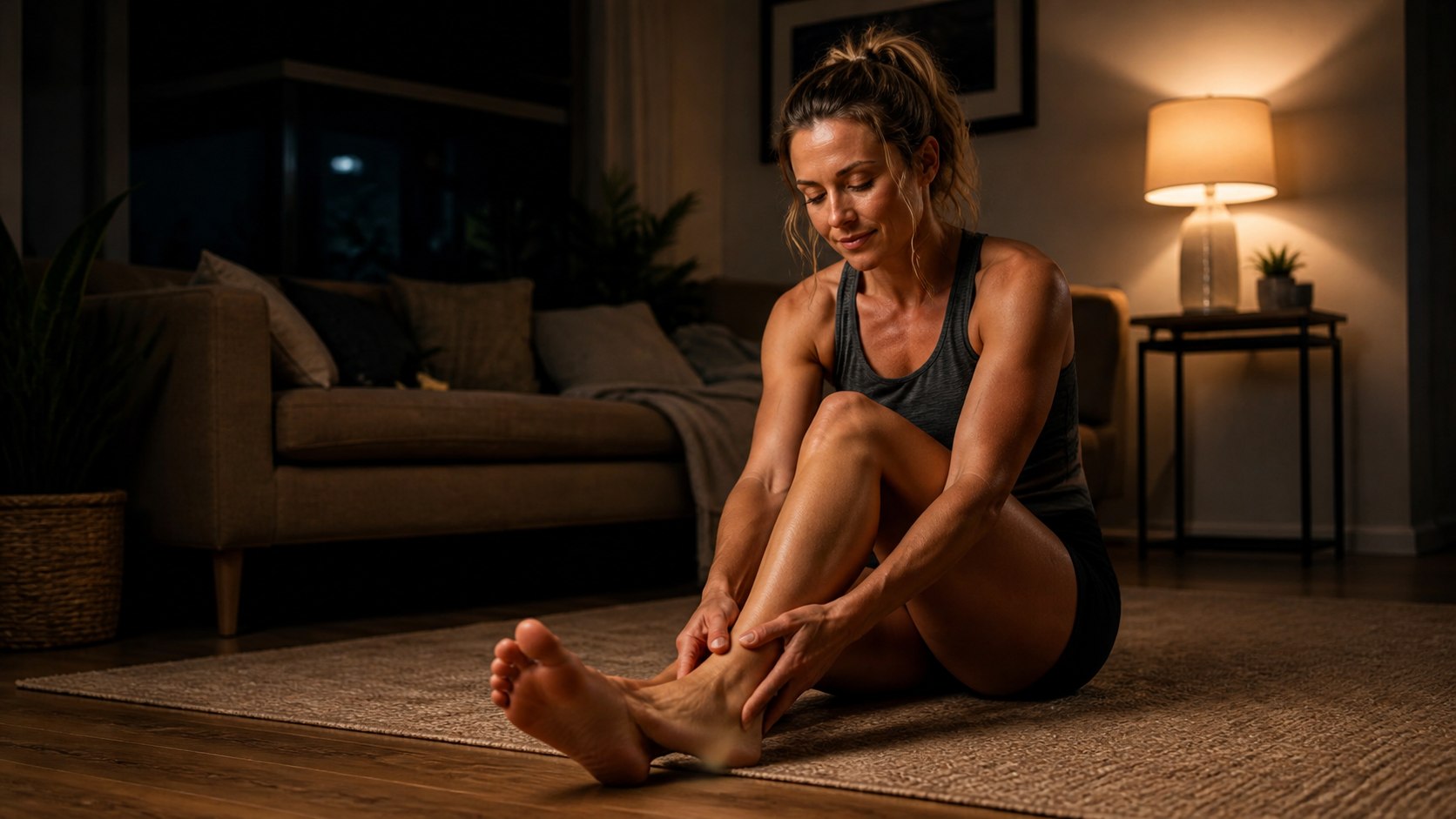

Massaging the arch of your foot can feel calming after a long day or a hard workout. The stronger claim that foot pressure is wired directly into a whole body relaxation response through the vagus nerve is much harder to support.
The feet contain many sensory receptors, and massage provides pressure, touch, warmth, and focused attention. Those inputs can feel soothing without proving a unique nerve pathway from the arch to the brain.
Foot massage does not need a dramatic nervous system story to be a useful comfort practice.
What the research supports
A 2020 meta analysis included 26 randomized trials with 2,366 adults and reported improvements in anxiety, depression symptoms, and sleep quality after foot reflexology interventions. The authors also called for larger, more rigorous trials with longer follow up (Wang et al., 2020).
You can review the study through PubMed, PMID 33014101. Many included trials studied specific clinical groups, so the results should not be treated as proof that a brief self massage works the same way for everyone.
Massage research also has challenges with blinding and placebo controls. Feeling better after caring touch is still meaningful, but it does not validate every reflexology map or vagus nerve explanation.
Foot massage and reflexology are not identical
Ordinary foot massage uses touch and pressure to improve comfort in the area being handled. Reflexology adds a theory that specific points on the feet correspond with other organs or regions of the body.
The 2020 review studied reflexology interventions, so it cannot prove that every form of self massage produces the same results. It also does not establish the proposed point-to-organ maps as the mechanism behind any improvement (Wang et al., 2020).
A separate randomized trial in postmenopausal women found improvements in anxiety, fatigue, and sleep after a structured foot massage intervention. That result is encouraging for the group studied, but it still does not make the effect universal (Gökbulut et al., 2022).
The WorkoutHealthy comfort test
Use a single standard: gentle pressure should feel comfortable during the massage and leave the foot no worse afterward. Sit in a stable position, support the ankle, and use your thumbs or a soft ball with light to moderate pressure.
Stop if you feel sharp pain, burning, numbness, or symptoms that travel. More pressure is not automatically more effective.
This simple test keeps the practice focused on comfort instead of chasing a neurological claim that has not been established.
Why the evidence is hard to interpret
Participants usually know whether someone is touching their feet, which makes a convincing blinded comparison difficult. Attention, expectation, quiet rest, and human contact can all contribute to how a person reports anxiety or sleep.
Studies also vary in pressure, session length, frequency, practitioner training, and the health of participants. Combining those interventions can estimate an overall pattern, but it cannot identify one perfect home routine.
Short follow up is another limitation because an immediate calming effect may not become a durable change in sleep or mental health. Better trials can clarify which benefits persist and which people are most likely to experience them.
Where foot massage fits
A few minutes of massage may be a pleasant recovery ritual, especially after walking or prolonged standing. It does not replace gradual training, appropriate footwear, sleep, or evaluation of persistent pain.
If walking volume is the issue, our guide to daily walking mileage can help you scale activity. Our article on standing versus sitting also explains why changing position matters.
For a recurring problem that affects training, a qualified clinician or coach may be more useful than another recovery gadget. Our guide to hiring a personal trainer can help clarify the coaching side of that decision.
Use massage as a low risk comfort tool when it feels good, not as a reason to ignore pain that keeps returning.
When to skip self massage
Avoid pressing on an acute injury, open wound, skin infection, suspected fracture, or a hot and swollen area. People with reduced sensation, circulation problems, or medical conditions affecting the feet should ask a clinician before trying aggressive pressure.
Get the next evidence check.
Five practical fitness stories worth your time, every Friday.
One email a week. No product pitches. Unsubscribe in one click.
References
Gökbulut, N., Ibici Akça, E., & Karakayali Ay, Ç. (2022). The impact of foot massage given to postmenopausal women on anxiety, fatigue, and sleep: A randomized-controlled trial. Menopause, 29(11), 1254 to 1262. https://doi.org/10.1097/GME.0000000000002062
Wang, W.-L., Hung, H.-Y., Chen, Y.-R., Chen, K.-H., Yang, S.-N., Chu, C.-M., & Chan, Y.-Y. (2020). Effect of foot reflexology intervention on depression, anxiety, and sleep quality in adults: A meta-analysis and metaregression of randomized controlled trials. Evidence-Based Complementary and Alternative Medicine, 2020, Article 2654353. https://doi.org/10.1155/2020/2654353
Medical disclaimer: This article is general product information, not medical advice. The equipment described here is not a treatment for any condition. If you have an injury, ongoing pain, or a medical condition, talk to a doctor or physical therapist before using any of it.