
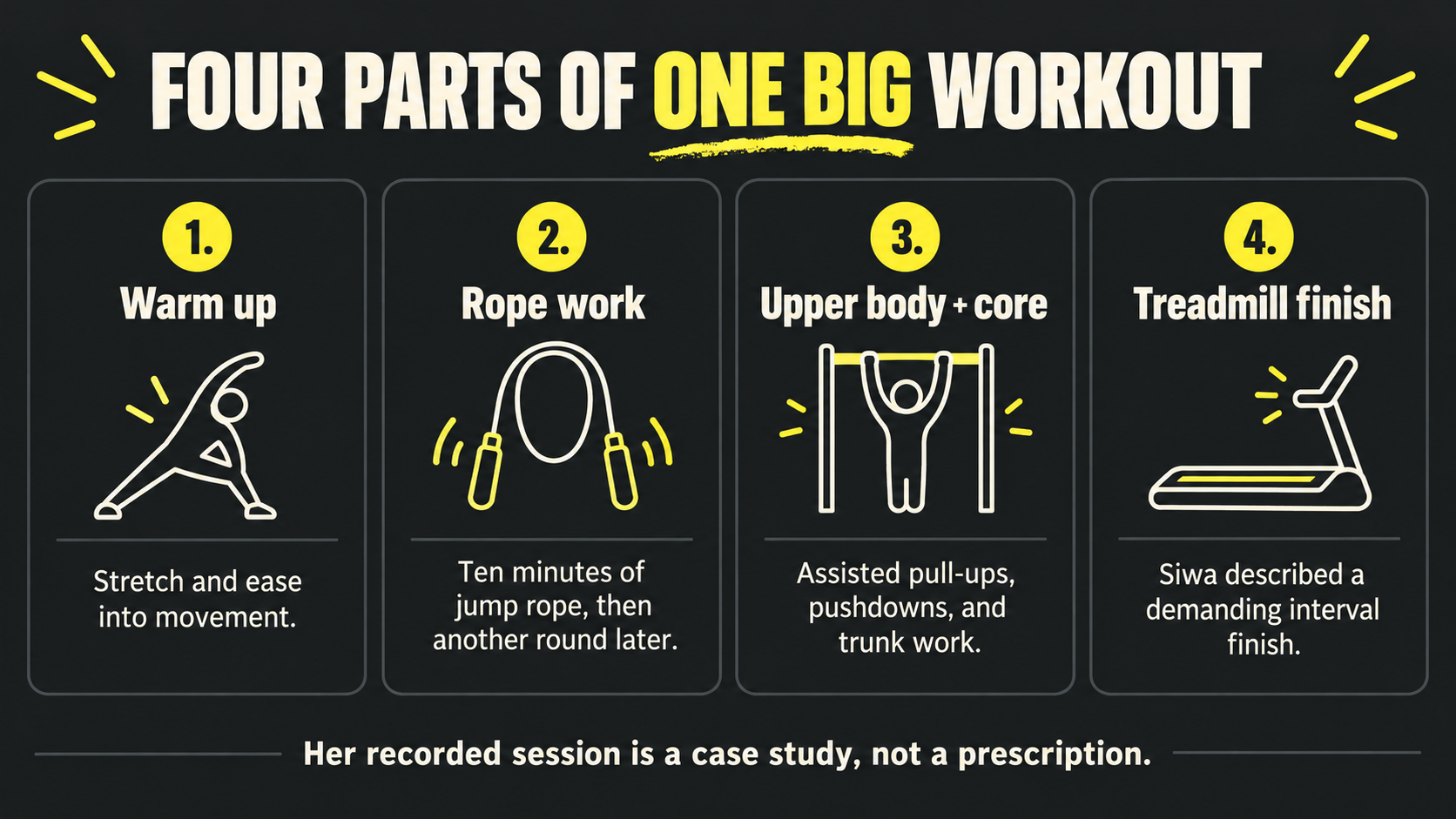
JoJo Siwa’s roughly two-hour workout is a vivid example of how many training styles can fit into one session. A 2022 account of the video she shared described stretching, jump rope, upper-body and core work, and a treadmill interval finish. It is easy to watch that sequence and assume the lesson is to train longer. The more useful lesson is to understand what each piece does—and which parts are worth borrowing for a normal week.
A celebrity’s recorded day is a snapshot, not a prescription. We do not know from one video how frequently Siwa trains that way, how she recovered, or how the session fits with her work and personal schedule. Her experience also says nothing about what a beginner should attempt tomorrow.
What was actually shown?
The published account of Siwa’s video says she began with stretching and about ten minutes of jump rope. Her session then moved through medicine-ball slams, mountain climbers, plank shoulder taps, assisted pull-ups, triceps pushdowns, hanging leg raises, and weighted abdominal work. She returned to the rope and finished with treadmill intervals plus additional push-up and abdominal movements. That is a lot of distinct work for one day.
The report described the session as “about a two-hour workout,” based on Siwa’s own narration. The exact minute-by-minute density, load, rest periods, and intensity cannot be reconstructed from a short social video. That matters because two routines with identical exercise names can demand very different levels of effort. A few relaxed rope rounds are not the same as repeated fast double-unders; assisted pull-ups differ greatly from unassisted sets near failure.
The scheduled Facebook image is an illustration inspired by the story, not a photograph of this specific workout. The article relies on the described video and its reported exercise sequence, not the image, for what Siwa did.
Block one: prepare to move
The opening stretch and jump-rope work gave the session a transition from rest to more demanding exercise. Warming up is not a ritual with one required sequence. A useful warm-up rehearses the upcoming movements at an easier pace, gradually raises exertion, and lets a person notice whether anything feels off. Someone about to sprint or jump may need a longer progressive build-up than someone planning a comfortable walk.
The takeaway is not that everyone must stretch for a fixed number of minutes. Static stretching, dynamic mobility, and low-intensity practice have different jobs. For a rope-and-sprint session, a few minutes of easy movement and progressively quicker practice may be more relevant than copying a celebrity’s exact opening. As the workout grows more intense, so does the value of entering it prepared.
Block two: jump rope for skill and conditioning
Rope work can challenge coordination, calf endurance, rhythm, and cardiovascular fitness at the same time. It also has a learning curve. Siwa’s video reportedly showed advanced variations such as double-unders and crossovers. Those are skill tasks, not necessary gateways to a good workout. A novice can start with a light bounce, short intervals, or even a rope-free rhythm drill before adding speed.
The most common mistake is copying the duration of a skilled performer on day one. Impact accumulates in the feet, calves, and Achilles tendon, especially when the rest of the session already includes running or jumping. A shorter, controlled dose with adequate recovery is more likely to become a repeatable habit than a heroic attempt that leaves someone too sore to train again.
Block three: upper body and trunk work
Assisted pull-ups and pushdowns target different pulling and pushing actions. Plank variations and hanging leg raises challenge trunk control in different ways. The list is broad, but breadth should not be confused with necessity. A well-designed session can cover upper-body pushing, pulling, and trunk stability with far fewer exercises, provided the movements suit the person and progress gradually.
Assistance on a pull-up is not a shortcut; it is a way to practice the movement at an appropriate load. Similarly, a simpler plank or supported row can be more valuable than a difficult variation performed poorly. The goal for most readers is not to reproduce Siwa’s exercise inventory. It is to identify the movement patterns they can perform well and repeat over weeks.
Training principle: A long menu of exercises is interesting to watch, but progress usually comes from repeatable work you can recover from—not from checking every box in one afternoon.
Block four: the hard treadmill finish
The account describes about twenty minutes of treadmill sprints on an incline, followed by faster calisthenics. “Sprint” can mean different speeds and work-rest patterns, so the video description should not be treated as a precise interval prescription. What is clear is that an intense finish after rope, strength, and core work can be demanding. Fatigue may alter gait, coordination, and judgment.
A trained person may enjoy that combination occasionally. A beginner, someone returning from injury, or someone with cardiovascular concerns should not treat it as a default template. If intervals are appropriate, they can be scaled by speed, incline, duration, and rest. It can also be smarter to separate a hard conditioning day from a demanding strength day rather than stacking everything because a video made it look exciting.
Why two hours is not the useful benchmark
Duration alone does not measure quality. A two-hour session may include generous rests, filming, equipment changes, or a carefully structured progression. The same clock time could also reflect too much volume for a person’s current capacity. There is no physiological prize for staying in the gym after the planned work is done. A session is successful when it matches a goal, can be performed safely, and fits into a sustainable week.
Siwa’s broader fitness history and professional schedule are not interchangeable with most readers’ lives. The video is a compelling look at one high-volume day, but it cannot tell us whether anyone else would benefit from doing it regularly. Recovery capacity, sleep, previous training, nutrition, and competing demands shape what is practical. A person with 30 minutes who trains consistently may make more progress than someone who attempts a marathon workout and then disappears for two weeks.
The same principle appears in our coverage of Adam Driver’s training context: the useful part of a public routine is the underlying principle, not the assumption that a celebrity’s exact schedule is universally optimal. Similarly, a short, well-planned mix of strength and conditioning can be productive without mimicking a headline-making session.
A practical shorter version
For an otherwise healthy adult with exercise experience, a shorter session inspired by the structure could include a few minutes of progressive warm-up, a compact strength block, and a brief conditioning finish. The exact exercises and intensity should follow the person’s ability and goals. Someone who enjoys jump rope might put it into the conditioning section; someone with foot discomfort could use a lower-impact alternative. The point is to keep the mix, not the two-hour runtime.
One possible framework is to choose one upper-body pull, one push, one lower-body movement, and a simple trunk exercise, then add intervals or steady cardio if time and recovery allow. Not all elements have to live in one session. Across a week, separate workouts can cover the same capacities more comfortably. Readers new to exercise can begin with much less and add volume only after the habit is established.
If a workout feels like a race through equipment, it may be too crowded. A short log can track what you actually did, how hard it felt, and whether you were ready to train again. Improvement in movement quality, consistency, and recovery is more useful than boasting about a long session. For another look at sustainable training, see our discussion of two weekly workouts and muscle aging.
Recovery is part of the story
High-volume sessions create a larger recovery bill. Rope work and treadmill intervals both load the lower legs; pull-ups and abdominal work can add upper-body and trunk fatigue. That does not mean a trained athlete must avoid combining them. It means the next session, sleep, food, and any warning signs matter. If soreness or fatigue repeatedly interrupts the week, reducing the dose may produce a better long-term pattern.
Pain is not proof that a workout worked. Sharp pain, dizziness, chest discomfort, or unusual shortness of breath calls for stopping and appropriate assessment. People with medical conditions or a long break from vigorous activity should discuss high-intensity exercise with a qualified professional. And anyone recovering from an injury should adapt impact and loading to their own rehabilitation plan.
Reader takeaway: Borrow the categories—warm-up, skill or cardio, strength, and conditioning—then scale the dose to a week you can actually repeat.
What Siwa’s session teaches—and what it cannot
The workout demonstrates variety and effort. It also reminds us that a single, highly visible session has limited explanatory power. It does not prove a particular body-composition result, reveal every part of Siwa’s routine, or establish that two hours is better than 30 or 45 minutes. Those would require information the public video does not provide.
The strongest lesson is editorial rather than prescriptive: fitness stories become more useful when we separate what was documented from what viewers infer. Siwa showed a demanding combination of rope, strength, core, and treadmill work. A reader can admire the effort, understand the training categories, and still choose a much shorter program. That is not doing less; it is choosing the right dose for a different life.
Source note
This account is based on a 2022 report of Siwa’s shared workout video and her later first-person discussion of fitness and starting small. The original social clip was not independently accessible during this review. Exercise descriptions are therefore attributed to the published report; no unseen footage or private training plan is claimed. The featured image is an illustration, not a photograph of the reported session.
Fitness note: This article is educational, not individualized exercise or medical advice. Scale activity to your experience and seek qualified guidance when health conditions or symptoms make vigorous training uncertain.