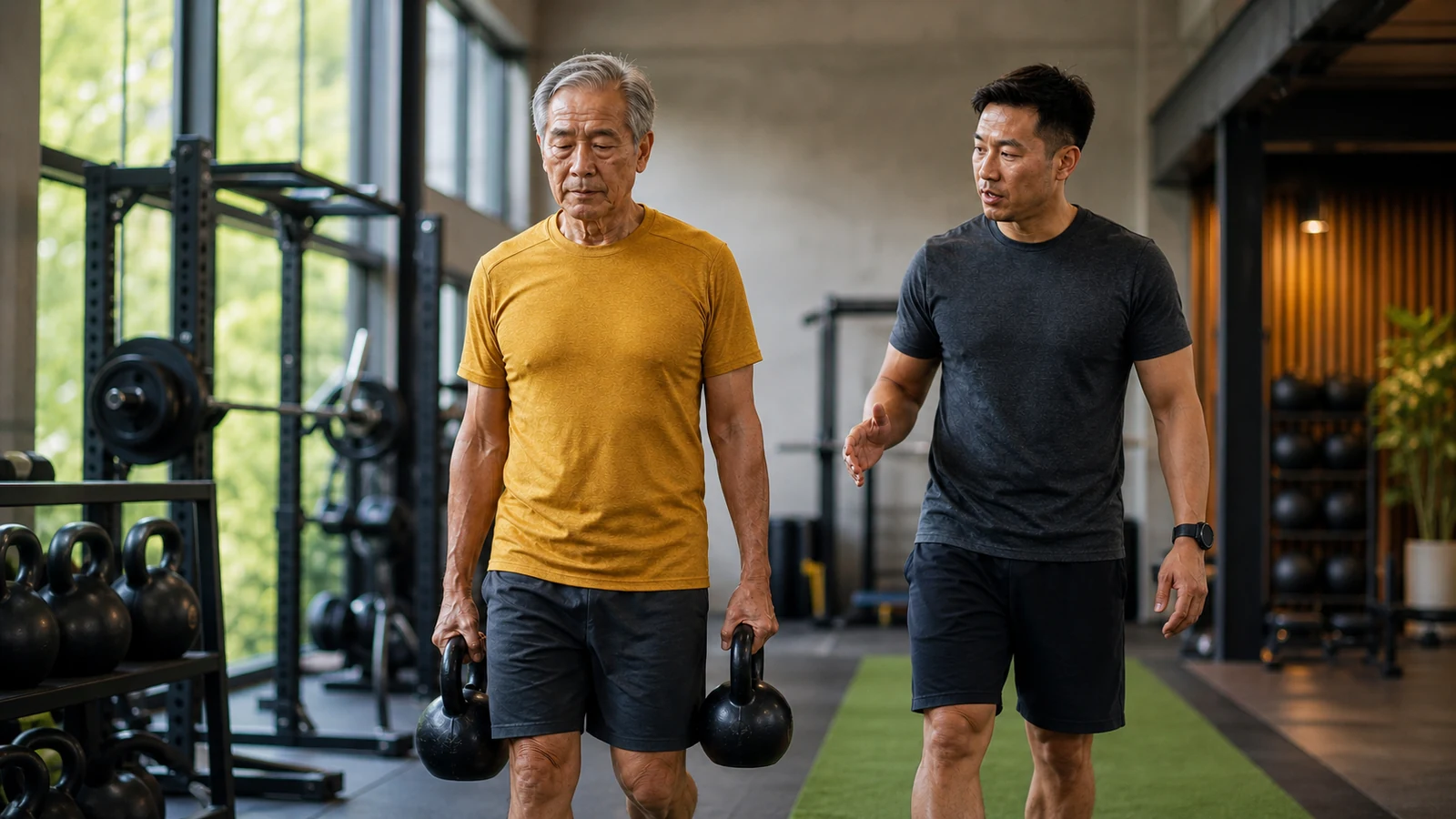

A YouTube video from personal trainer Robert Ranelli claims strength training is the real key to healthy aging.
That is a broad claim, so this article narrows it down to one specific, measurable piece of it.
Doctors now diagnose a real medical condition called sarcopenia, the age-related loss of muscle strength and mass.
This article looks at what the actual sarcopenia research says about strength training and staying independent.
It also looks at whether lifting weights really helps older adults keep doing everyday tasks on their own.
What the Video Claims
Ranelli’s video frames strength training as the single most important habit for aging well.
He is a certified personal trainer and the founder of RanelliFit, a training studio in the Bucks County, Pennsylvania area.
His certifications include the American Council on Exercise personal trainer credential, plus group fitness and CPR certifications.
He was also named Bucks County’s Personal Trainer of the Year in 2024, according to his own studio website.
He is not a doctor or a research scientist, so his video works better as motivation than as a clinical source.
That does not make his central point wrong.
It just means the actual research needs to be checked on its own.
What Real Research Shows About Sarcopenia as a Diagnosis
Sarcopenia is not just a casual term for getting weaker with age.
In 2019, a panel of European aging researchers published updated diagnostic criteria for it in the journal Age and Ageing.
The panel is called the European Working Group on Sarcopenia in Older People, or EWGSOP2 for short (Cruz-Jentoft et al., 2019).
Their definition treats sarcopenia as a real, diagnosable condition, not just a vague sign of getting older.
The group first defined sarcopenia back in 2010, then rewrote the criteria in 2019 based on newer evidence.
The updated guideline recommends starting with a short symptom questionnaire to flag who might need the full workup.
After that, the diagnosis moves through three formal steps.
First, a clinician screens for low muscle strength, often using a hand grip test or a chair stand test.
Second, low muscle quantity or quality confirms the diagnosis, usually measured with a body composition scan.
Third, slow walking speed or poor physical performance marks the sarcopenia as severe.
Sarcopenia moved from a vague description of getting older into a diagnosable medical condition with specific, testable criteria.
Grip strength matters here for a reason that goes beyond the diagnosis itself.
A long-term study following more than a thousand adults found that weaker grip strength in midlife predicted a higher risk of disability decades later (Rantanen et al., 1999).
That is one reason grip strength shows up as an early screening tool inside the EWGSOP2 criteria.
What Real Research Shows About Muscle Loss and Everyday Independence
Sarcopenia is not just about strength on a gym floor.
It affects real daily tasks, like climbing stairs and carrying groceries.
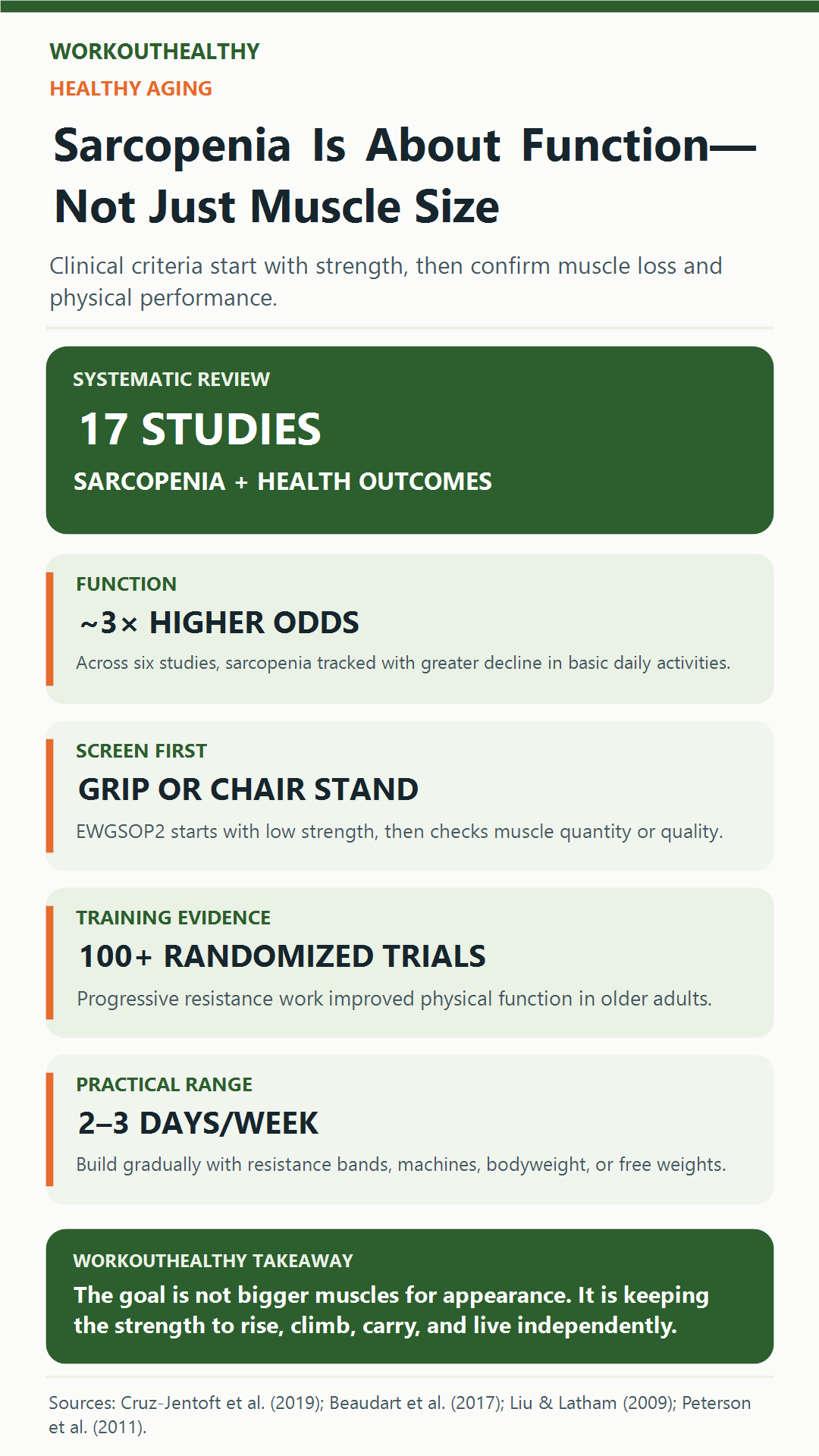
A large systematic review pooled data from 17 separate studies on sarcopenia and health outcomes (Beaudart et al., 2017).
Across six studies in that review, people with sarcopenia had roughly three times the odds of functional decline in basic daily activities.
The same review found sarcopenia linked to nearly three and a half times the odds of dying from any cause during the study follow-up periods.
One of the included studies also found a large jump in fall risk tied to sarcopenia.
These are not small, abstract statistics for someone living through it.
Losing the ability to rise from a chair alone or carry your own bags changes what independence looks like day to day.
This is exactly why the activities of daily living framing matters more than a number on a bathroom scale.
WorkoutHealthy has covered the wider causes of age-related muscle loss in more detail elsewhere.
That piece covers diet-related triggers, which are separate from a formal sarcopenia diagnosis.
What Real Research Shows About Rebuilding Function With Resistance Training
The reassuring part is that muscle loss is not simply a one-way street.
A major Cochrane review pooled data from more than 100 randomized trials on resistance training in older adults (Liu & Latham, 2009).
Cochrane reviews are considered some of the highest quality evidence in medicine, since they combine many controlled trials at once.
The review found that progressive resistance training improved physical function in older adults across the pooled trials.
That included measurable gains in the exact tasks that make up daily independence, like rising from a chair and climbing stairs.
The keyword there is progressive, meaning the training gradually increases in weight or difficulty over time.
A single easy workout is not what produced these results.
Consistent training that got gradually harder over months was.
This is the part of Ranelli’s video that lines up well with the actual research.
WorkoutHealthy has written separately about a stair climbing fitness test doctors sometimes use.
It ties directly into this same idea of measurable, everyday physical function.
The Mechanism
Resistance training does not just make muscles look bigger.
It changes how muscle tissue works at a cellular level.
Lifting against resistance signals muscle fibers to rebuild themselves slightly stronger and slightly larger than before.
This process is called muscle protein synthesis, and it slows down naturally with age.
Some early strength gains in a new program come from the nervous system too.
The brain gets better at recruiting existing muscle fibers efficiently, before any real muscle growth even happens.
Aging also causes a specific loss of fast-twitch muscle fibers.
Those are the fibers responsible for quick, powerful movements, like catching your balance before a fall.
A meta-analysis of controlled trials found that resistance training reliably increased lean body mass in older adults (Peterson et al., 2011).
That held true even in trials that lasted only a few months.
More muscle mass and better fast-twitch function both feed directly into the strength and balance skills that daily tasks depend on.
That is the biological link between a barbell and being able to catch yourself before a fall.
The real return on strength training in later life is not a bigger muscle. It is being able to carry your own groceries at eighty.
What This Evidence Does Not Prove
None of this research proves that strength training alone prevents sarcopenia in every single person.
Genetics, chronic illness, and severe calorie restriction can all drive muscle loss even in people who train.
The Cochrane review’s trials mostly involved supervised training, not the kind of casual gym routine most people do alone.
Supervised training with real coaching likely produced better results than an unsupervised program would.
Sarcopenia diagnosis itself also requires actual testing, not a guess based on how weak someone feels.
A person cannot self-diagnose sarcopenia from a YouTube video, no matter how convincing the video sounds.
Ranelli’s video is a reasonable overview, but it is not a substitute for a real grip strength or gait speed test.
Common Mistakes
The most common mistake is treating cardio alone as enough protection against sarcopenia.
Walking and cycling support heart health, but they do not load muscles heavily enough to reliably build strength.
Another mistake is picking a weight that never gets any harder over time.
Without some form of progression, muscles have little real reason to adapt or grow stronger.
Many older adults also stop training after an injury and never restart.
That actually speeds up muscle loss instead of protecting against it.
Skipping protein is another quiet mistake, since muscle needs enough protein to rebuild after a workout.
Doing only single joint moves, like bicep curls alone, misses the compound movements that carry over best to daily tasks.
Waiting until a fall or a hospital stay to start strength training is also common.
Rebuilding muscle after that kind of setback is much harder than preventing the loss in the first place.
Who Should Be Extra Careful
Anyone starting strength training after age 60 with no recent training history should get medical clearance first.
People with osteoporosis, recent joint replacements, or uncontrolled heart conditions need a doctor or physical therapist involved before starting.
Anyone who already struggles with daily tasks, like standing up from a chair, should start with supervised sessions, not a solo program.
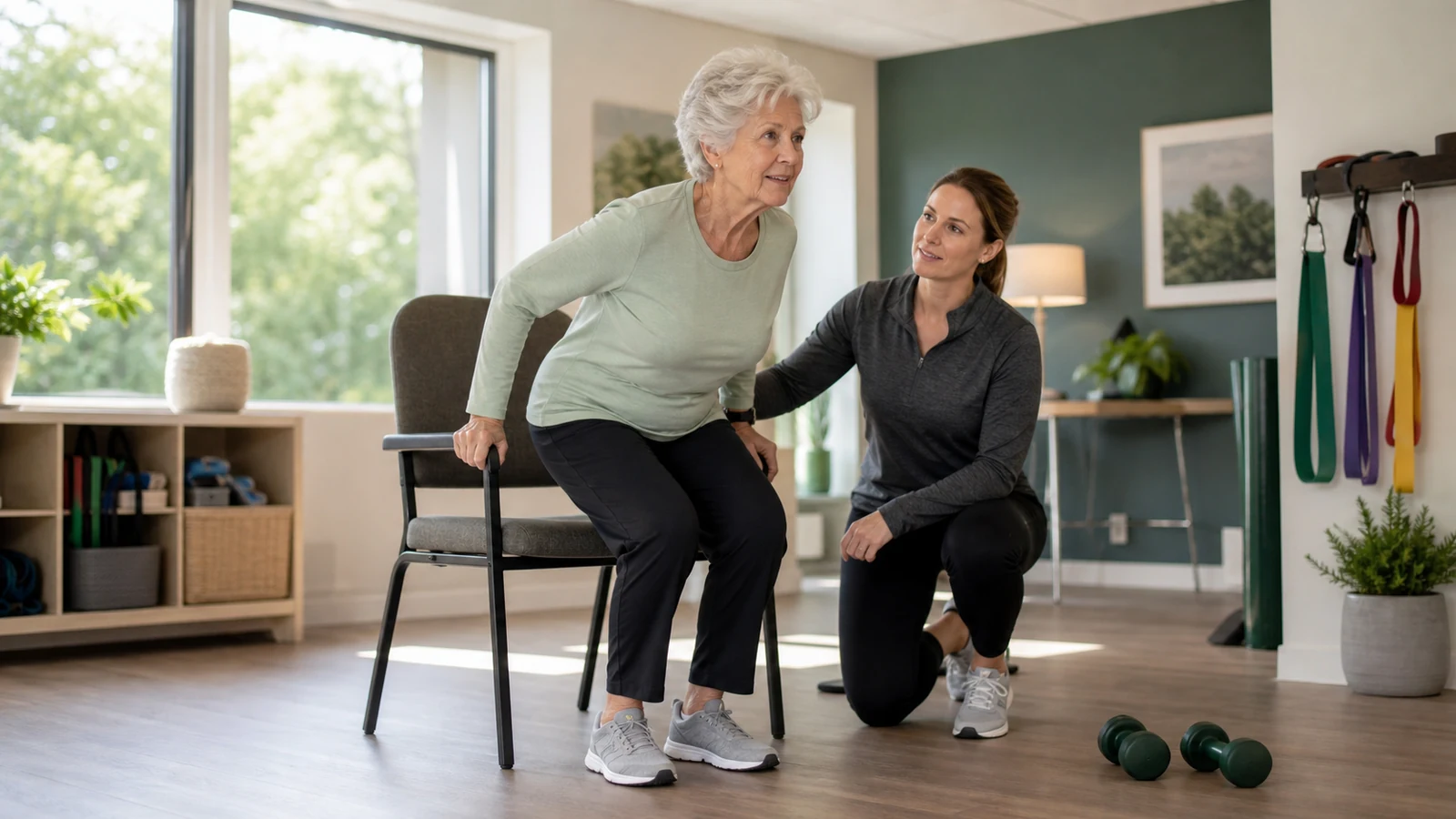
Balance problems and a history of falls both call for extra caution, and possibly a physical therapist’s guidance first.
People on blood thinners or with severe joint pain should also get individual guidance before lifting heavier loads.
Anyone managing diabetes or another condition that affects healing should loop in their care team before starting a new lifting program.
Anyone showing early signs of sarcopenia, like a weakening grip or slower walking pace, should ask a doctor about formal testing rather than guessing.
A Practical Takeaway
Strength training two to three times a week is the general range most research in this area uses.
Each session does not need to be long.
Thirty to forty-five minutes is enough for real, measurable results.
Focus on compound movements first, like squats, presses, rows, and step-ups, since they mimic real daily movements.
A chair stand test is a simple way to track progress at home.
Count how many times you can stand up and sit back down in thirty seconds, then repeat the test every few weeks.
Grip strength can be tracked too.
Some pharmacies and physical therapy clinics offer a simple grip dynamometer test for a low cost.
Progression matters more than intensity.
Add small amounts of weight, or a few more reps, every couple of weeks.
Resistance bands or bodyweight moves work as a lower impact starting point for anyone not ready for free weights.
Keeping a simple log of weight, reps, and how a session felt makes progress easier to see over months.
Pair training with enough protein and consistent sleep, since both directly support the muscle rebuilding process.
For inspiration on what stays possible with age, WorkoutHealthy profiled a record-holding older bodybuilder who still trains competitively.
None of this requires becoming a competitive lifter.
Small, consistent effort produces real functional gains over time.
WorkoutHealthy has also looked at whether lifting weights protects brain health with age, which pairs naturally with this same idea of training for real-world function.
Watch the video
Want more like this? Subscribe to WorkoutHealthy Insider for practical explanations behind popular fitness claims.
References
Beaudart, C., Zaaria, M., Pasleau, F., Reginster, J. Y., & Bruyère, O. (2017). Health outcomes of sarcopenia: A systematic review and meta-analysis. PLOS ONE, 12(1), e0169548. https://doi.org/10.1371/journal.pone.0169548
Cruz-Jentoft, A. J., Bahat, G., Bauer, J., Boirie, Y., Bruyère, O., Cederholm, T., Cooper, C., Landi, F., Rolland, Y., Sayer, A. A., Schneider, S. M., Sieber, C. C., Topinková, E., Vandewoude, M., Visser, M., Zamboni, M., & Writing Group for the European Working Group on Sarcopenia in Older People 2 (EWGSOP2). (2019). Sarcopenia: Revised European consensus on definition and diagnosis. Age and Ageing, 48(1), 16 to 31. https://doi.org/10.1093/ageing/afy169
Liu, C. J., & Latham, N. K. (2009). Progressive resistance strength training for improving physical function in older adults. Cochrane Database of Systematic Reviews, (3), CD002759. https://doi.org/10.1002/14651858.CD002759.pub2
Peterson, M. D., Sen, A., & Gordon, P. M. (2011). Influence of resistance exercise on lean body mass in aging adults: A meta-analysis. Medicine & Science in Sports & Exercise, 43(2), 249 to 258. https://doi.org/10.1249/MSS.0b013e3181eb6265
Rantanen, T., Guralnik, J. M., Foley, D., Masaki, K., Leveille, S., Curb, J. D., & White, L. (1999). Midlife hand grip strength as a predictor of old age disability. JAMA, 281(6), 558. https://doi.org/10.1001/jama.281.6.558
This article is for general information only and is not medical advice. If you have an injury, ongoing pain, or a medical condition, talk to a doctor or physical therapist before you change how you train or eat.