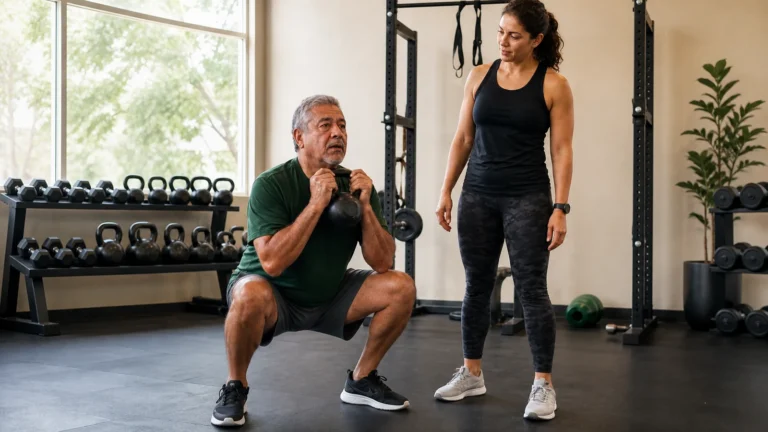

A Marine Before He Was Kylo Ren
Adam Driver joined the United States Marine Corps shortly after the September 11 attacks.
He was assigned to Weapons Company, 1st Battalion, 1st Marines, where he served as an 81mm mortar man.
His service lasted two years and eight months before a mountain biking accident fractured his sternum and ended it early.
After leaving the Marines, he spent a year at the University of Indianapolis before auditioning for Juilliard.
He has described feeling like an outsider among classmates who had trained in theater since childhood.
That path from military service to acting is unusual in Hollywood.
Driver has spoken about how it still shapes the way he approaches physically demanding roles today.
He has also talked about the discipline and structure of military life carrying over into how he prepares for a role, describing acting itself as requiring a similar kind of total commitment.
After leaving the service, he co-founded Arts in the Armed Forces, a nonprofit that brings live theater performances to military communities.
That project reflects how directly his military background and his acting career have stayed connected, rather than existing as two separate chapters of his life.
An Injury That Still Shapes His Training
The mountain biking accident that fractured Driver’s sternum and ended his Marine Corps service is a detail that matters beyond the history lesson.
A sternum fracture is a serious injury that affects the chest, ribcage, and the muscles that support pressing and pulling movements.
Actors and athletes recovering from chest or rib injuries typically need a longer, more careful return to heavy pressing work than the injury’s initial healing time alone would suggest.
There is no public record detailing exactly how Driver’s training accounts for that old injury today.
But it is a useful reminder that even highly physical performers are often managing an old injury history, not training with a blank slate.
Sternum and rib injuries specifically can affect breathing mechanics during heavy lifts, since a stable ribcage helps create the pressure needed to safely brace under a heavy barbell.
Many coaches address this kind of history by building up pressing strength gradually, using lighter loads with strict form before progressing to near maximal weights.
The Role of Discipline Over Raw Athleticism
Military training is built on repetition, structure, and consistency more than it is built on natural athletic talent.
That distinction matters for how Driver’s background likely shapes his approach, since showing up for a planned session regardless of motivation is itself a trained habit, not just a personality trait.
Sports psychology research consistently finds that consistency over time predicts long term training outcomes better than any single hard workout does.
A background that trains discipline as directly as military service does may be part of why Driver’s physical transformations across roles, whether losing weight for Silence or maintaining an action ready build for Star Wars, have appeared consistent rather than one time events.
Building a Body for the Job, Not the Mirror
Driver became a global star playing Kylo Ren across the Star Wars sequel trilogy from 2015 to 2019.
That role required years of sustained physical performance, stunt work, and on camera intensity.
For Silence in 2016, he reportedly lost close to 50 pounds to portray a Portuguese Jesuit priest.
That transformation went in the opposite direction of typical action movie bulk.
More recently he took on the science fiction thriller 65, a film built around physical survival sequences.
Across these very different roles, reports describe his approach as favoring functional strength and endurance work over training built purely for appearance.
That is the kind of conditioning meant for carrying gear, moving quickly, and staying capable over long, demanding days on set.
What Military Style Conditioning Actually Trains For
Military training is not built around how a body looks.
It is built around how a body performs under real physical stress, often while carrying equipment and under fatigue.
A narrative review by Orr, Pope, Johnston, and Coyle, published in the Journal of Military and Veterans’ Health, looked at how physical conditioning affects injury risk during load carriage.
Load carriage means moving with heavy equipment on your back, a task central to military service.
The review found that targeted strength and conditioning work, built around the muscles and movement patterns used in load carriage, meaningfully reduced injury risk compared to general fitness training alone.
That is a useful distinction for anyone training outside the military too.
Conditioning built around a specific real world demand tends to transfer better than generic exercise aimed only at appearance.
A body built for a job tends to outperform a body built only to look strong.
Why Strength Still Matters Even in Functional Training
It is tempting to think functional training means dropping heavy lifting altogether in favor of endurance and bodyweight work.
The research does not support that trade off.
A 2016 review by Suchomel, Nimphius, and Stone in Sports Medicine examined the role of maximal strength across a wide range of athletic and physical performance tasks.
That included sprinting, jumping, and change of direction speed.
The review found that a higher baseline of muscular strength consistently supported better performance in nearly every explosive or endurance based task studied, including jumping ability, which lines up with separate research on how explosive jump training itself can contribute to muscle and power development.
Not just heavy lifting itself.
Raw strength acts as a kind of foundation that other physical qualities, like endurance and agility, are built on top of.
It is not something separate from them.
What This Evidence Does Not Prove
No published study has measured Adam Driver’s actual training program.
Reports on any celebrity’s routine are second hand at best.
The research on load carriage and strength transfer describes general patterns across groups of people, not guarantees for any one individual.
It also does not mean lifting heavy is the only path to functional fitness.
Endurance work, mobility training, and skill practice all matter too.
What the research does support is the general logic behind training for real tasks rather than appearance alone.
That logic lines up with how Driver’s approach has been described publicly.
How This Compares to General Fitness Guidance
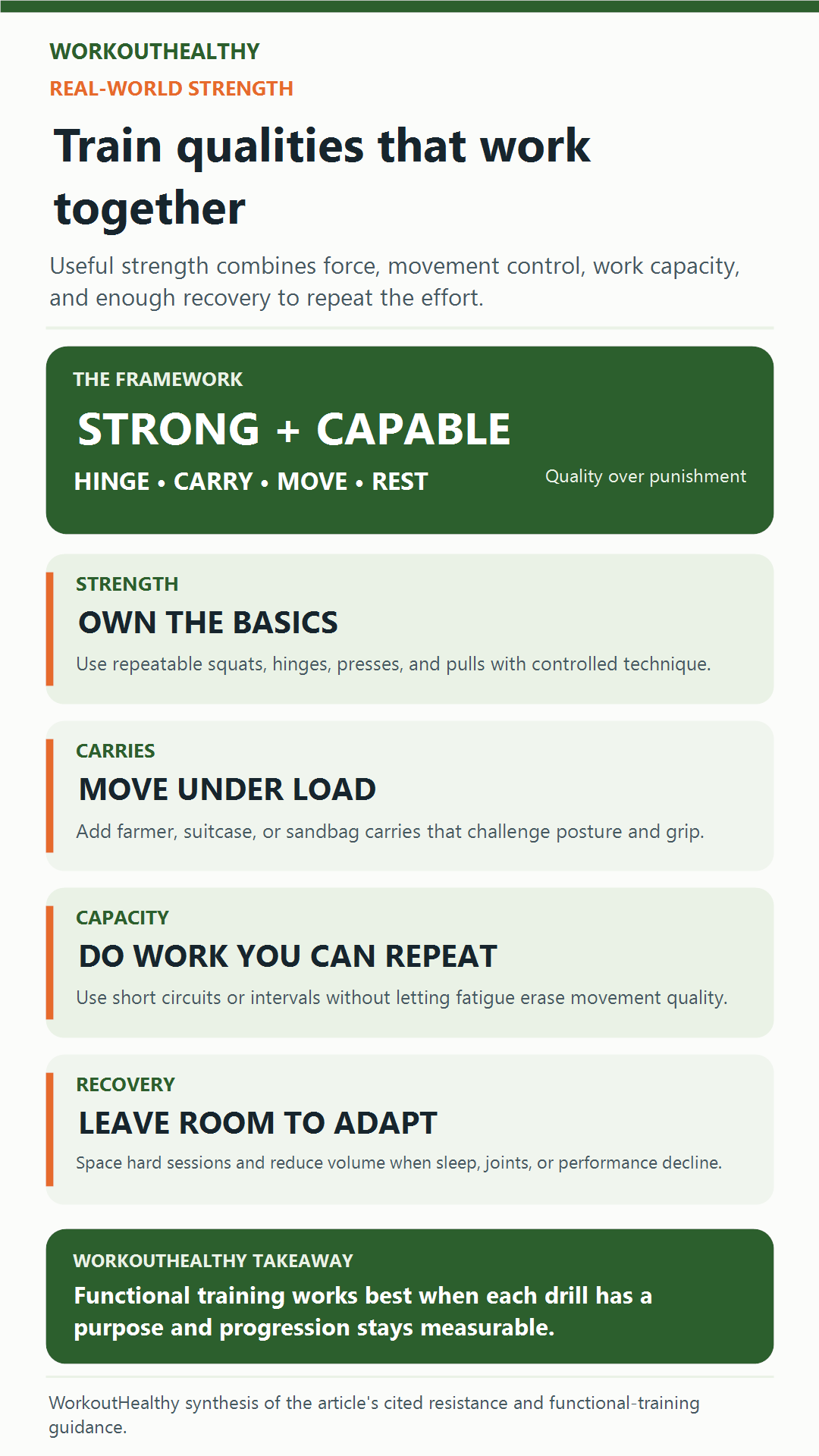
Most strength and conditioning coaches today recommend a training split that includes both heavy compound lifts and functional movement patterns.
That includes carries, presses, and rotational core work.
This mirrors general public health guidance too.
The Physical Activity Guidelines for Americans recommend muscle strengthening activity at least two days a week, built around major muscle groups, alongside regular aerobic activity.
A military informed approach, built around real tasks under load, is really just a more specific version of that same general advice.
It is simply tailored to a very physical job.
Common Mistakes People Make With Functional Training
A common mistake is assuming functional training means avoiding traditional strength work like squats, deadlifts, and presses.
Those lifts actually build the strength base that functional movements rely on.
Another mistake is loading up on movement variety without ever tracking whether strength, endurance, or work capacity is actually improving over time.
People also frequently skip lower body and posterior chain training in favor of upper body work.
Carrying, climbing, and most real world physical tasks depend heavily on the legs, hips, and back.
Overtraining is another risk, especially when someone tries to combine heavy lifting, cardio, and skill work every day without planned rest.
Finally, many people copy a celebrity’s reported routine exactly without accounting for their own training history, injury background, or available recovery time.
Ignoring an old injury while chasing a new training goal is one of the most common ways people end up hurt, whether that injury is an old sports strain, a surgery, or something like a healed fracture.
Working around an old injury usually means adjusting range of motion or exercise selection, not avoiding training in that area altogether.

A Practical Way to Train for Real World Strength
Build a weekly plan around three or four sessions that mix heavy compound lifts, such as a pressing variation like the bench press or floor press, with functional patterns.
Compound lifts include squats, deadlifts, presses, and rows.
Functional patterns include farmer’s carries and sled work.
Pick one or two carry or load exercises each week that mimic a real task you care about.
That might mean hiking with a pack, or simply carrying groceries and kids without strain.
Include at least one endurance focused session weekly, such as a longer walk, ruck, or steady state cardio session.
That builds the aerobic base that supports everything else you train.
Progress load gradually. Add small amounts of weight or a few more reps every one to two weeks rather than jumping up quickly.
Build in a genuine rest day where you do only light walking or stretching.
Recovery is what allows the strength gains to actually show up.
If you are new to heavy lifting or carrying exercises, work with a certified trainer for your first several sessions.
They can help you build safe form before you increase load.
If you have an old injury, tell your trainer or coach about it before your first session, not after something starts to hurt.
A good coach can usually modify a lift’s range of motion or angle to work around old injury history rather than skipping the movement entirely.
Reassess your program every six to eight weeks and note which movements feel strong and which still feel limited, since that pattern often points to where extra mobility or stability work is needed.
References
- Orr, R., Pope, R., Johnston, V., & Coyle, J. (2010). Load carriage: Minimising soldier injuries through physical conditioning: A narrative review. Journal of Military and Veterans’ Health, 18(3), 31 to 38.
- Suchomel, T. J., Nimphius, S., & Stone, M. H. (2016). The importance of muscular strength in athletic performance. Sports Medicine, 46(10), 1419 to 1449. https://doi.org/10.1007/s40279-016-0486-0
This article is for general educational purposes and is not medical advice. Talk with a qualified healthcare provider or certified trainer before starting a new training program, especially if you have an existing injury or health condition.