
Kristine Lilly’s 2026 Boston Marathon finish drew attention because of the distance between two athletic chapters. She was a defining player for the U.S. women’s national soccer team; at 54, she completed 26.2 miles in Boston. Her story is not evidence that everyone can or should run a marathon. It is a concrete example of how an athletic foundation can be adapted to a new goal over decades.
There is an important correction to the social shorthand around this event. In her own pre-race account, Lilly described 2026 as her fourth Boston Marathon, not her second. She also said the effort supported two causes: the Mia Hamm Foundation and Boston Children’s Hospital. Getting those details right matters because the charity mission and long training history are central to the story.
The verified 2026 finish
Lilly ran the 2026 Boston Marathon at 54. Contemporary race coverage reported a finish time of 5:16:32. The time is not the reason her story resonates: she moved from a professional team-sport career into a demanding endurance event years after retirement. A marathon is a substantial challenge for any participant, and one runner’s finish should be read in the context of their preparation rather than turned into an age-defying promise.
Before the race, Lilly wrote that she was taking on her fourth Boston Marathon alongside Katie Henebry, who was preparing for her first. Lilly said their training had begun January 1 and combined long runs with heavy lifting. That first-person description is more informative than an image of a finish line. It shows that the race was built through months of preparation, not through a sudden burst of motivation.
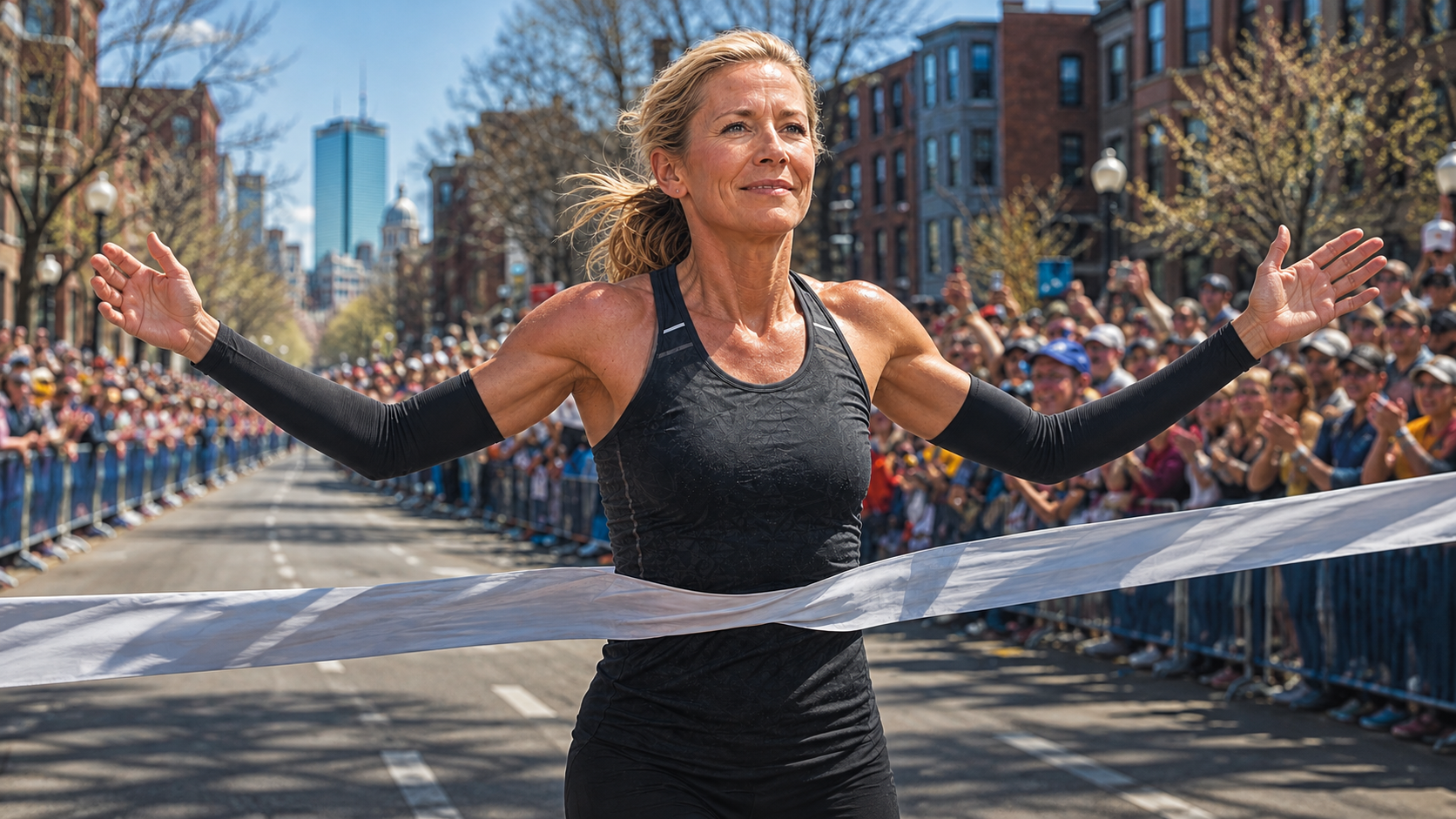
The accompanying image here is an editorial illustration derived from the Facebook post’s source creative. It does not document Lilly crossing the finish line or depict a specific moment from the 2026 race.
Why her soccer career provides context
Lilly’s U.S. soccer résumé is extraordinary. Team USA records 354 international appearances, five Women’s World Cups, and three Olympic medals. A career like that requires years of conditioning, competitive practice, and repeated adaptation to training demands. Those achievements do not mechanically transfer into marathon readiness, but they help explain why she might approach a new sport with familiarity in planning, discipline, and sustained effort.
The movement demands are different. Soccer involves accelerations, decelerations, changes of direction, and intermittent high-intensity play. A marathon asks for prolonged endurance, fueling, pacing, and tolerance for many miles of repeated impact. An elite soccer background is not a substitute for building running volume. Lilly’s account of long runs and strength work suggests she treated the marathon as a fresh preparation task rather than assuming her old fitness would carry her.
The distinction: A strong athletic past can provide experience and confidence, but a new endurance goal still demands specific, progressive preparation.
What Lilly said about the build
Her pre-race post described training together with Henebry from the beginning of the year. Long runs developed event-specific endurance; heavy lifting remained in the mix. Lilly did not publish a complete week-by-week training plan in that post, so it would be misleading to invent her mileage, paces, lifting loads, or recovery schedule. What can be said is narrower and useful: she described a multi-month build that combined running and strength.
For most recreational runners, the lesson is to select a realistic starting point and progress over time. “Train like Lilly” should not mean copying an unknown elite-athlete plan. It should mean recognizing that long-distance running requires repeated sessions, adjustment, and a way to manage fatigue. The same principle applies to other endurance goals, from a first 5K to a long charity walk.
Strength work can complement running, but the exact dose depends on experience and total load. Some runners will keep two carefully placed sessions; others may need to reduce lifting volume as long runs grow. The balance changes across the training cycle. A single inspiring example cannot settle that decision for every reader.
The charitable purpose was part of the race
Lilly’s own post named the Mia Hamm Foundation and Boston Children’s Hospital as the organizations she and Henebry supported. She described Mia Hamm as a longtime teammate and friend, and said the foundation’s work includes help for families needing marrow or cord-blood transplants and broader sports opportunities for young women. She also connected Boston Children’s to her first marathon in 2012 and her visits with young patients.
This purpose is not a decorative footnote. A marathon training block has difficult days, and Lilly explicitly discussed thinking about the people the fundraising would support when the miles became tough. That is her stated motivation, not a clinical claim that having a cause guarantees adherence. It shows why the event mattered beyond a finish time or a headline about age.
Readers who want to understand the causes should use the organizations’ official channels rather than a shortened social link. This article does not reproduce personal medical details about the families Lilly discussed; their stories belong to them.
What athletic longevity really looks like
It is tempting to treat a 54-year-old former soccer star finishing Boston as proof that “peak fitness” has no age limit. That overreaches. Different physical capacities change differently with age, and individual outcomes vary. Lilly’s case shows continued participation at a high level of challenge; it cannot establish a universal peak or predict another person’s future.
Longevity is better understood as an ongoing process of selecting goals, training for them, and adjusting the workload to the body and life you have now. An athlete’s experience can help, but it does not erase injury risk, recovery needs, or the role of opportunity and support. Lilly’s public account gives us a reason to value consistent preparation, not a license to ignore warning signs.
Our analysis of regular exercise and age-related muscle change reaches a similar practical conclusion: the quality and continuity of training matter more than a single dramatic workout. For readers drawn to public athletic examples, the story of Jack LaLanne’s later-life challenge also benefits from separating the event from the long base beneath it.
A four-part framework inspired by the story
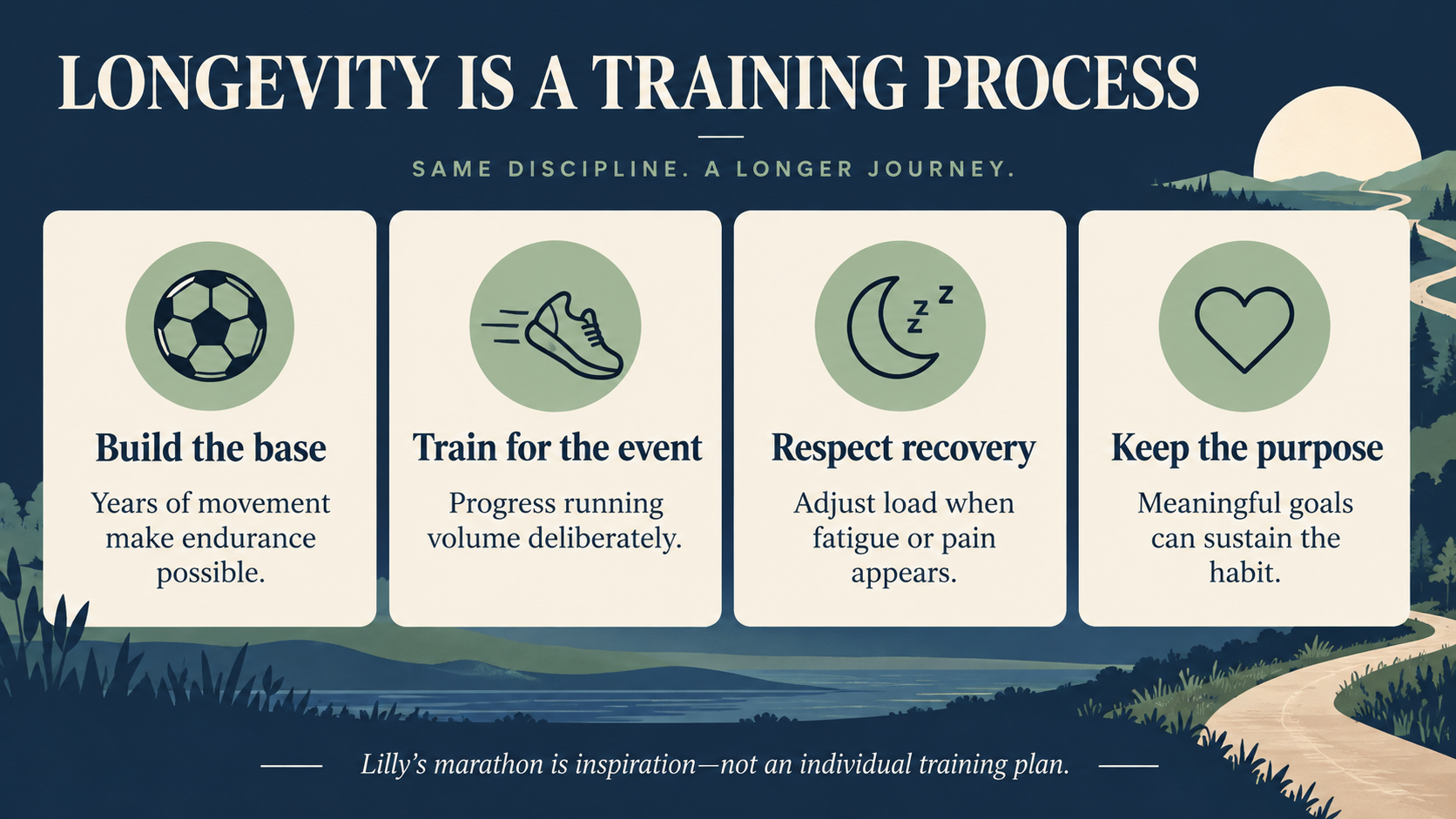
First, build a base. If you are new to running, start with a manageable amount of walking and running. Repeated, comfortable sessions are a more reliable foundation than occasional maximal efforts. Someone with a long athletic background may still need to rebuild running-specific tissue tolerance after time away.
Second, prepare for the event you actually chose. A marathon plan should gradually introduce the distance, pacing, and fueling demands of a marathon. A shorter race or a noncompetitive walking goal calls for a different plan. The name on the bib is not the only measure of success; arriving healthy enough to participate matters.
Third, make recovery visible. Record how legs, energy, and motivation respond to each increase in workload. A reasonable plan leaves room to adjust for illness, soreness, schedule pressure, and injury. Pain that changes your stride or persists needs attention, not a motivational slogan. A qualified coach or clinician can help distinguish normal adaptation from a problem.
Fourth, keep a meaningful purpose. Lilly’s stated charities gave her race an audience beyond herself. Another runner might value community, curiosity, or simply enjoying time outside. Motivation will not replace training, but a goal that matters can help people keep returning to it. Our guide to personalizing activity around health needs is a useful reminder that the right version of a goal is individualized.
Reader takeaway: Admire the marathon finish, but copy the process: a realistic base, event-specific practice, recovery decisions, and a reason to keep showing up.
One reason the distinction matters is that a lifelong athlete may have both advantages and vulnerabilities a newcomer does not. Movement experience can make structured practice familiar, while old injuries or an abrupt change in sport can demand extra care. Neither a soccer record nor a birthday predicts an individual marathon outcome. The most transferable lesson is the deliberate choice to prepare for the current task instead of resting on a former identity.
What the story cannot tell us
We cannot infer Lilly’s entire weekly training plan, her exact recovery routine, or how much of her finish was caused by any one method. We also should not tell an untrained reader to sign up for a marathon tomorrow. The evidence for this particular story is a first-person pre-race account, official career records, and contemporaneous race coverage—not a controlled experiment in aging.
That limitation does not make the accomplishment smaller. It makes the lesson more honest. A remarkable athletic career can continue in new forms, and a meaningful event can connect competition with community service. Lilly’s finish is best appreciated as a specific person’s preparation and purpose, not as a universal fitness formula.
Source note
Lilly’s first-person pre-race post is the source for her fourth-Boston statement, training start, long runs, lifting, and the two charitable causes. Team USA’s Hall of Fame biography documents her soccer record. Contemporary Boston race reporting documents her 2026 finish. The article’s illustration is not a photograph of the event.
Fitness note: This story is informational. Marathon training, especially after injury or with medical concerns, should be tailored with qualified guidance; stop and seek care for concerning symptoms.