
Illustration note: The featured scene represents a quiet pause beside a glucose meter. It is not a study photograph, a measured glucose response or evidence that the pictured person received diabetes care.
Can breathing exercises lower blood sugar? Some small studies report improvements, but others find no significant glucose benefit even when heart-rate measures change.
The useful answer depends on the participants, comparison and outcome. A lower reading at one time, a change in fasting glucose and a change in A1c answer different questions.
Gentle breathing can be an optional stress-management practice. It has not been established as a reliable way to treat a high reading, replace diabetes medication or prevent complications.
Breathing Practice and Breathing Difficulty Are Different
Deliberately slowing a comfortable breath is different from developing fast, deep or difficult breathing while unwell. Do not assume a new breathing problem is stress or try to correct it with a breathing timer.
The CDC identifies fast, deep breathing as a possible sign of diabetic ketoacidosis, a medical emergency that can occur in either diabetes type. Call 911 or go to an emergency department for trouble breathing, fruity-smelling breath, vomiting that prevents keeping food or drink down, or multiple ketoacidosis symptoms.
Which Blood-Sugar Outcome Did the Study Measure?
Before interpreting a breathwork claim, identify what changed and over what period. The following distinctions prevent a favorable finding from becoming a promise the experiment never tested.
| Measurement | What it describes | What it cannot establish alone |
|---|---|---|
| One post-challenge reading | Glucose at a selected time after a standardized glucose drink | The total response across the observation period or an effect after an ordinary meal |
| Glucose area under the curve | A summary of glucose measurements across a specified period | Long-term diabetes control or fewer complications |
| Fasting glucose | A measurement after fasting under the study’s conditions | The entire daily glucose pattern or an A1c improvement |
| A1c, also called HbA1c | A blood test reflecting average glucose over roughly three months | Whether one short breathing session caused an immediate change |
| Heart-rate variability, or HRV | Variation in the intervals between heartbeats | A direct measurement of glucose or proof of a diabetes-treatment benefit |
NIDDK explains that A1c reflects average glucose over the past three months and does not show a sudden, temporary rise or fall. An in-session wearable score and an A1c result should therefore never be treated as interchangeable evidence.
Five Studies: Compare the Participants and the Control
This is a selected study comparison, not a systematic review or a pooled estimate of benefit. Research schedules below describe what investigators tested; they are not breathing doses prescribed to readers.
| Study and participants | Comparison | Finding and boundary |
|---|---|---|
| Wilson et al., 2013: 26 healthy adults | Relaxation versus control breathing, repeated around a glucose drink | The relaxation group had lower glucose at 30 minutes, but glucose and insulin area under the curve did not significantly differ. This was an acute experiment, not diabetes treatment. |
| Vosseler et al., 2021: 15 healthy men | Slow versus normal paced breathing on separate glucose-challenge visits in a randomized crossover trial | A cardiac HRV measure increased, but fasting and post-load glucose, insulin-sensitivity and insulin-secretion indices did not significantly differ. A small, acute study cannot settle every longer-term question. |
| Yesmin et al., 2022: 60 men with type 2 diabetes | Thirty minutes of breathing twice daily for three months versus no breathing program | The abstract reports improved fasting glucose, two-hour post-meal glucose and A1c in the breathing group. It describes a prospective intervention, not a confirmed randomized, attention-matched trial. |
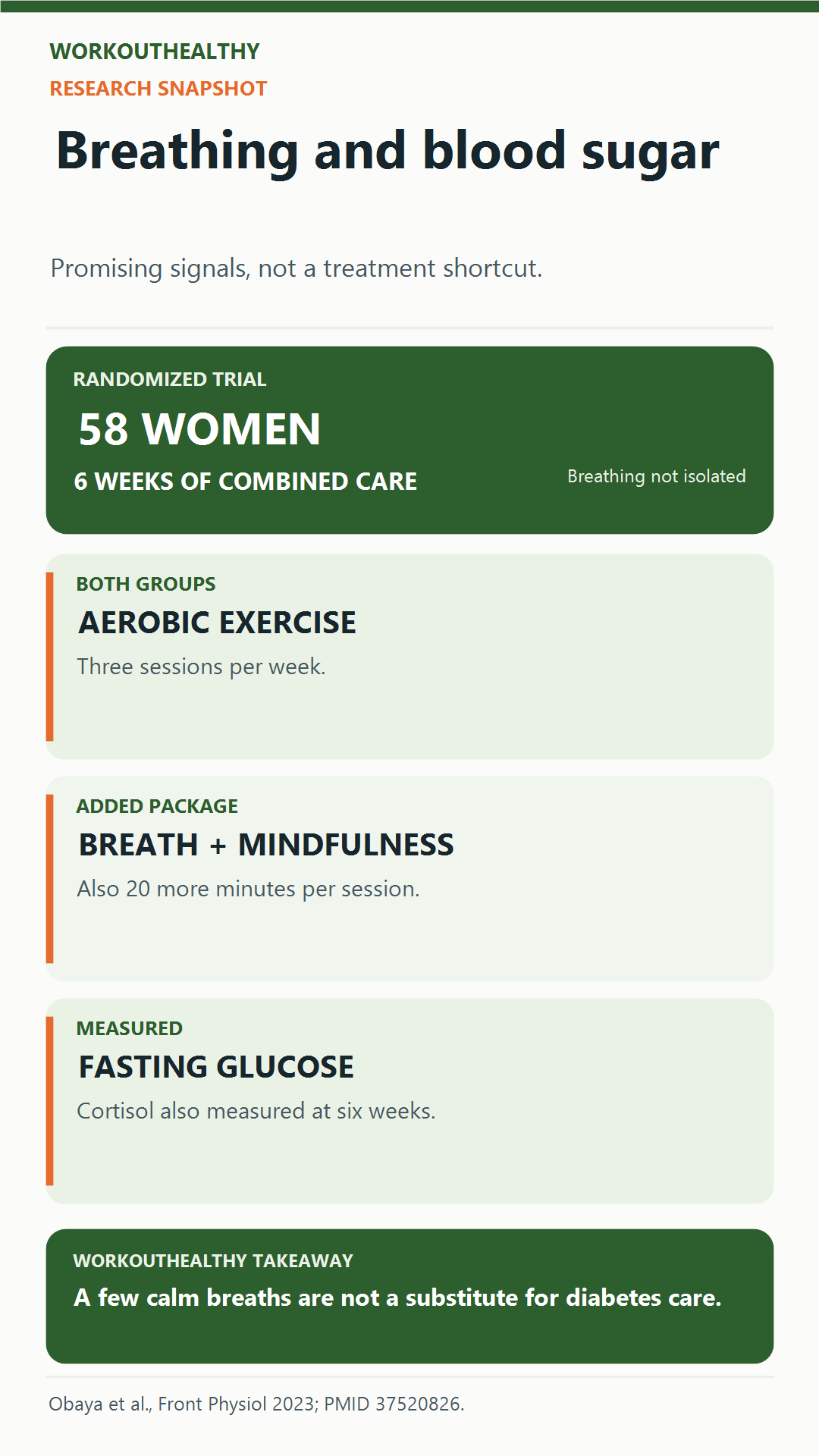
| Obaya et al., 2023: 58 women with type 2 diabetes | Six weeks of aerobic exercise versus a longer session adding breathing and mindfulness | Fasting glucose and cortisol favored the combined program. Breathing, mindfulness and extra session time were not separated, and no intervention-change A1c result was reported. |
| Xuan et al., 2025: 60 randomized adults with type 2 diabetes and cardiovascular autonomic neuropathy | Twenty minutes daily of breathing with music versus chest expansion for three months, alongside background treatment | Fifty-eight completed; several HRV measures improved, but A1c did not significantly change within either group or differ between groups afterward. This specific complication population does not represent everyone with diabetes. |
The primary reports are linked in References. For the 2013 and 2022 studies, this comparison is limited to their published abstracts, so it does not supply unseen allocation details or numerical effects.
Why One Lower Reading Is Not the Whole Response
The 2013 experiment illustrates a common headline problem: its favorable 30-minute comparison and its nonsignificant whole-period glucose comparison can both be true. Selecting only the favorable time hides part of the result.
Area under the curve considers multiple measurements across time rather than one selected point. A nonsignificant difference also does not prove that two treatments are equivalent or that a small effect is impossible.
For a fictional example, Alex sees a headline saying breathing improved glucose after a drink. Checking the outcome reveals an isolated early difference, so Alex drops the assumption that the study demonstrated lower glucose throughout the day.
That is a research-reading exercise, not an invitation to reproduce a glucose challenge at home. Keep glucose monitoring on the schedule agreed with your care team.
Why Better HRV Does Not Automatically Mean Better Glucose
The healthy-men crossover trial directly tested the link: breathing changed a cardiac HRV measure without a significant improvement in the measured glucose outcomes. A physiological response can be real while the proposed metabolic benefit remains unproven.
The 2025 diabetes trial is also informative because it included an active chest-expansion comparison and background medical care. Its HRV results and nonsignificant A1c findings support different conclusions, rather than one universal claim that breathing improved diabetes.
Neither experiment proves that every breathing method is ineffective. They show why a heart signal alone cannot establish glucose control, reduced medication needs or protection from complications.
Our separate slow-breathing and HRV explainer discusses measurement conditions. Here the question stays narrower: whether glucose outcomes improved in the people and comparisons actually studied.
Why the Longer Exercise Program Cannot Isolate Breathing
In the 2023 trial, the exercise-only session lasted 40 minutes and the combined session lasted 60. The added 20 minutes included both breathing and mindfulness, so the result cannot identify which addition mattered.
The 2022 study raises another practical distinction: an hour of daily research practice is different from a few relaxed breaths. Its positive abstract supports further investigation, but does not establish what a casual practice would do for an individual.
These are reasons to match the claim to the intervention. They are not instructions to increase breathing time, add mindfulness or recreate a clinical program without appropriate guidance.
If You Want a Calming Practice, Keep the Goal Clear
The NHS offers gentle breathing for stress with a comfortable position, unforced breathing and optional counting. It is stress guidance, not a glucose-lowering protocol.
- Sit comfortably with your back supported and feet resting on the floor.
- Let the breath move into the belly only as far as comfortable, without forcing a large inhale.
- Try a gentle inhale through the nose and an easy exhale through the mouth.
- If counting helps, count steadily during each phase; the NHS suggests up to five without requiring you to reach it.
- Continue only while comfortable; the NHS practice suggests at least five minutes, rather than a diabetes-treatment dose.
The earlier four-in, six-out suggestion on this page was a pacing example, not the pattern validated by the glucose studies. There is no need to force that ratio or add breath holds to pursue a lower number.
Stop if the practice makes you feel dizzy, short of breath or more distressed. Persistent symptoms deserve medical assessment rather than progressively slower breathing.
A Useful Claim Check Before Changing Your Routine
Write down the exact promise before following a social post or app recommendation. Then check these four points against the study it cites.
- People: Were participants healthy, living with type 2 diabetes, or selected because of a particular complication?
- Comparison: Was breathing compared with another breathing pattern, another activity, no program, or a shorter combined session?
- Outcome: Did glucose change, or did a heart-rate or stress measure change?
- Time: Was the finding one reading, one visit, several weeks or a longer clinical outcome?
For example, “HRV improved after three months” does not become “five minutes lowers sugar after dinner.” The gap contains a different outcome, duration and claim about an individual.
A pleasant pause can still be useful without producing a treatment effect. Notice comfort and whether the practice helps you handle stress, rather than judging success by a number you expect to fall immediately.
The National Center for Complementary and Integrative Health advises discussing complementary approaches with healthcare providers and seeking help for severe or lasting symptoms. Relaxation should not replace conventional care or delay seeing a professional.
Keep prescribed medicines, glucose checks and your high- or low-glucose instructions in place. If stress interferes with self-care, bring that specific difficulty to your diabetes team rather than changing treatment from a breathwork headline.
References
- Wilson, T., et al. (2013). Relaxation breathing improves human glycemic response. Journal of Alternative and Complementary Medicine, 19(7), 633 to 636. Abstract reviewed.
- Vosseler, A., et al. (2021). Slow deep breathing modulates cardiac vagal activity but does not affect peripheral glucose metabolism in healthy men. Scientific Reports, 11, 20306.
- Yesmin, J., Begum, N., & Ferdousi, S. (2022). Effect of slow breathing exercise on glycaemic status in type 2 diabetic male patients. Mymensingh Medical Journal, 31(1), 230 to 233. Abstract reviewed.
- Obaya, H. E., et al. (2023). Effect of aerobic exercise, slow deep breathing and mindfulness meditation on cortisol and glucose levels in women with type 2 diabetes mellitus. Frontiers in Physiology, 14, 1186546.
- Xuan, M., et al. (2025). Effect of slow deep breathing on cardiovascular autonomic neuropathy in type 2 diabetes mellitus patients. Diabetology & Metabolic Syndrome, 17, 330.
- National Institute of Diabetes and Digestive and Kidney Diseases. The A1C test & diabetes.
- National Health Service. (2026). Breathing exercises for stress.
- Centers for Disease Control and Prevention. (2024). Diabetic ketoacidosis.
- National Center for Complementary and Integrative Health. Relaxation techniques: What you need to know.
Medical disclaimer: This article provides general diabetes-research and stress-management information, not personal medical advice. Ask your treating healthcare team about practices for your condition, and do not change medicines, monitoring or emergency treatment because of a breathing exercise.