

A local news story about a Philadelphia running club recently caught our attention.
The report came from 6abc Philadelphia, and it described something simple.
Five friends started running together in June 2024.
According to reporting from the Philadelphia Inquirer, that small group of five has since grown into a club of more than 250 people who show up for shared runs along Kelly Drive and the Schuylkill River.
We could not independently verify every detail of how the group runs day to day, so this article does not try to explain the specific inner workings of Philly Run Tribe.
Instead, we used their story as a starting point for a question researchers have actually studied for decades.
Does exercising with other people really help you stick with it longer than exercising alone?
It’s so amazing to see so many Black people come together for something so positive.
What the Research Found When Scientists Compared Group and Solo Exercise
The most complete answer so far comes from a 2026 systematic review and meta-analysis published in the journal Nature Human Behaviour.
A team led by researcher Marlene Kritz combined data from 71 separate studies covering tens of thousands of participants in total.
They compared people assigned to group-based exercise programs against people assigned to individual, mostly home-based programs.
One finding surprised us.
For raw physical activity levels, meaning total minutes of movement per week, group and individual programs improved by roughly the same small amount.
That difference was not statistically significant.
Group-based programs did show a real, statistically significant edge on functional outcomes like strength, balance, and flexibility.
Group programs also showed a small edge on psychological and social outcomes, though that particular difference did not reach statistical significance.
One more detail stood out to us.
Online group programs performed about as well as in-person group programs, which suggests that being in a group matters more than exactly how the group meets.
Why the Group Itself May Matter Less Than the Bond Inside It
If group workouts do not clearly beat solo workouts on raw activity minutes, why do so many people say a group changed how consistent they became?
An older but still widely cited study by researchers Turner Loughead, Melanie Colman, and Albert Carron looked at older adults enrolled in community exercise classes.
They measured something called task cohesion, which is how much a person feels the whole group is working toward a shared goal together.
The researchers found that task cohesion acted as a mediator between the instructor’s behavior and how often people actually showed up.
An instructor’s enthusiasm did not directly boost attendance on its own.
Instead, that enthusiasm helped build a shared sense of purpose in the group.
It was that shared sense of purpose, not the enthusiasm itself, that predicted whether people kept coming to class.
Translated to a running club, the mechanism is probably not simply “more people equals more motivation.”
The mechanism looks more like this: when a group feels like a real team working toward something together, skipping a session starts to feel like letting the team down, not just letting yourself down.
That is a different psychological trigger than willpower, and it lines up with what we described in our guide to workout partner benefits, just scaled up from two people to a much bigger group.

A Second Study: How Big Is the Accountability Effect, Really
A 2024 study in the Journal of Back and Musculoskeletal Rehabilitation put an actual number on this effect, though in a very different population than a running club.
Researchers led by Katharine Roberts followed 20 adults with chronic low back pain for six months after they finished a supervised treatment program.
At the start, each person reported how much perceived social support they had using a standard questionnaire.
Researchers then tracked real exercise sessions through weekly online diaries across the full six months.
The pattern was striking.
People with the lowest social support scores were predicted to complete about 28 exercise sessions over six months.
People with the highest social support scores were predicted to complete about 107 sessions over that same six months.
That is close to four times as many workouts, tied to one single factor: whether a person felt supported.
The researchers also checked whether this worked by boosting people’s confidence, technically called self-efficacy.
It did not.
Social support appeared to shape behavior fairly directly, not simply by making people feel more capable first.
In one small study, people with the strongest social support did almost four times as many workouts over six months as people with the least support.
What This Evidence Does Not Prove
None of these studies followed Philly Run Tribe specifically, so we cannot say their exact model is what explains the group’s growth to over 250 people.
The Nature Human Behaviour meta-analysis found that groups and individuals improved raw activity levels by a similar amount overall.
That means group exercise is not a guaranteed shortcut to more total minutes of movement for everyone who tries it.
The cohesion study involved older adults in structured indoor exercise classes, not necessarily younger or middle-aged adults meeting for an evening run outdoors.
The social support study involved only 20 people, all recovering from chronic back pain, which is a small sample from one specific medical population.
None of this research proves that any particular running club is automatically safe for any particular person, regardless of that person’s health history.
And none of it proves that joining a group will fix a motivation problem entirely on its own, with no other change in structure or commitment.
Common Mistakes People Make When Trying to Build This Kind of Habit
The most common mistake is joining a group and expecting the group alone to create motivation, with no personal commitment attached.
Motivation still has to come from somewhere inside you.
The group works best as structure around a decision you have already made, not as a replacement for making that decision.
Another mistake is jumping straight into a group’s normal distance or pace before checking it against your own current fitness.
If a club’s standard run is three miles and you have not run at all recently, matching that distance on day one raises your injury risk.
Our guide to how many miles you should walk in a day is a reasonable way to check your own baseline before you scale up toward running with a group.
A third mistake is treating one group as the only accountability source you will ever need.
Groups change their schedules, locations, and seasons, and a group that fits your life perfectly this month may not fit as well next month.
A fourth mistake is ignoring early pain because everyone else in the group looks fine.
Shared enthusiasm can make it feel socially awkward to admit you need to slow down, even when your body is telling you exactly that.
Who Should Check With a Doctor Before Joining a Group Running Program
Anyone who has been mostly inactive for months or years should talk with a doctor before starting a running program with a group.
This matters even more for people with a history of heart disease, uncontrolled high blood pressure, joint problems, or diabetes.
People recovering from a recent injury or surgery should get clearance from the clinician who treated them, not just reassurance from a friend in the group.
Chest pain, unusual shortness of breath, or dizziness during exercise are always reasons to stop and seek medical advice, no matter how the rest of the group is doing.
The Centers for Disease Control and Prevention recommends that adults with a chronic health condition talk with a doctor about which activities, and how much activity, fit their specific situation.
A supportive running club is a source of accountability, not a substitute for that conversation.
If you are weighing outside professional support instead of, or alongside, a peer group, our guide on deciding whether you need a personal trainer covers a related kind of accountability that comes with real coaching, not just company.
How to Build or Join a Fitness Accountability Group That Actually Lasts
Here is a practical way to apply what the research above actually supports, whether you are joining an existing group or starting your own with a few friends.
- Get honest about your current baseline first. Track a normal week before you commit to a group’s regular distance or pace, so you know what you are actually starting from.
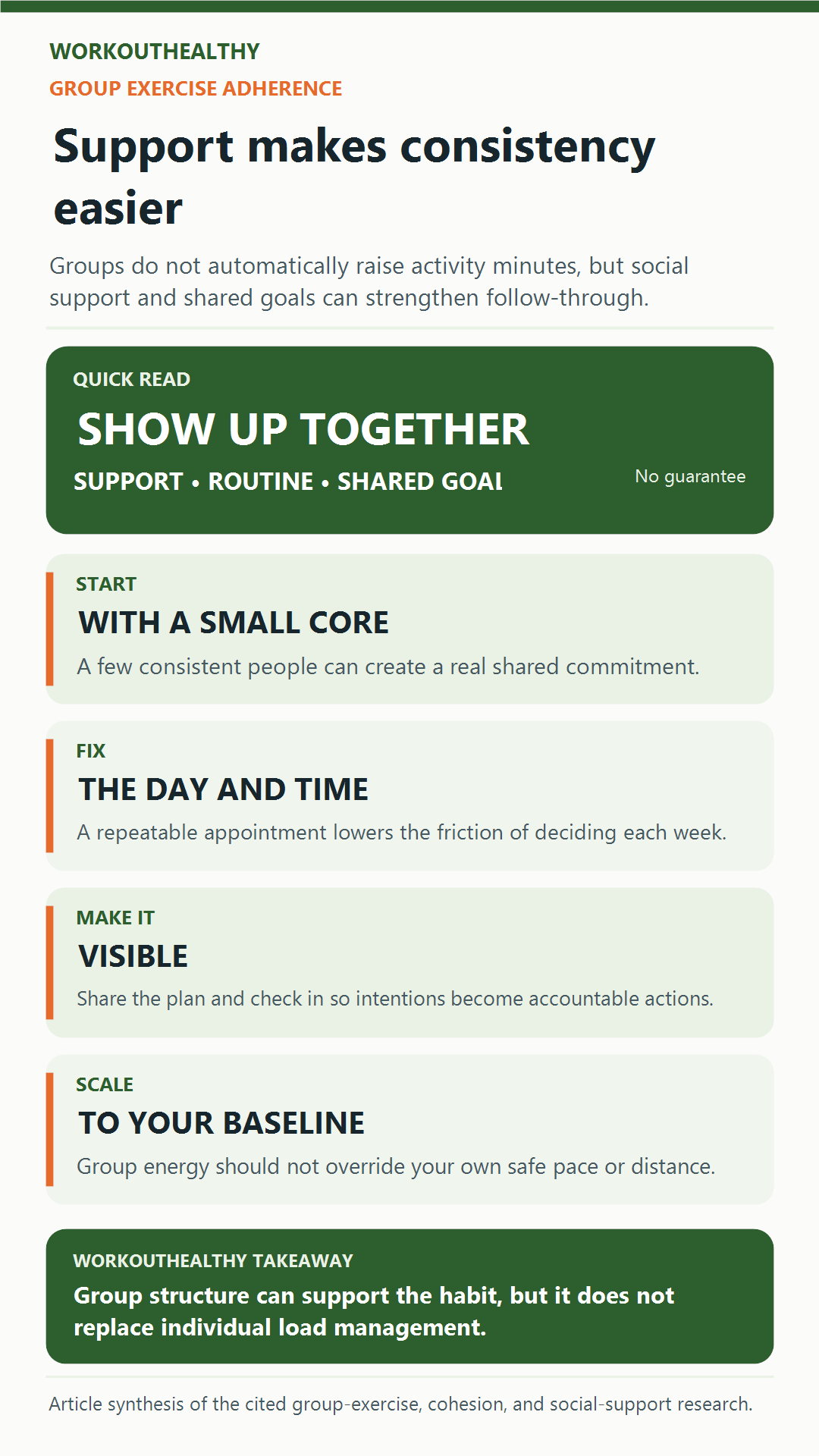
- Start with a small, specific group rather than waiting for a big one. Two or three consistent people produce the same task cohesion effect described above, and a large group can always grow from there.
- Pick one fixed day and time, and treat it like an appointment. The research on cohesion and adherence keeps pointing to consistency of the shared commitment, not the size of the group.
- Make your commitment public inside the group. Telling others your plan, out loud or in a group chat, is what turns a personal intention into the kind of external accountability the workout partner research describes.
- Build in a short check-in ritual. A two-minute group chat message after each session, even just “done,” reinforces the shared-goal feeling that the cohesion research found actually predicts attendance.
- Track attendance as a group, not only as individuals. Seeing that the group as a whole showed up taps into the same mechanism that made task cohesion protective in the research above.
- Increase distance or intensity slowly, and say so if something hurts. Do not let a group’s pace or mileage override your own body’s feedback, especially in the first few weeks.
- Give it eight to twelve weeks before judging whether it is working. The studies behind this article followed people for months, not single sessions, because that is roughly how long it takes a shared habit to feel automatic.
Watch the Original Video
Want more stories like this one, checked against the actual research? Subscribe to WorkoutHealthy Insider for practical explanations behind popular fitness claims.
References
- Kritz, M., Riddell, H., Olsen, D., Harden, S. M., Burke, S. M., Ntoumanis, N., & Thøgersen-Ntoumani, C. (2026). Individual versus group-based interventions: A systematic review and meta-analysis of physical activity, functional, psychosocial and health outcomes. Nature Human Behaviour, 10(6), 1109-1121. https://doi.org/10.1038/s41562-026-02429-0
- Loughead, T. M., Colman, M. M., & Carron, A. V. (2001). Investigating the mediational relationship of leadership, class cohesion, and adherence in an exercise setting. Small Group Research, 32(5), 558-575. https://doi.org/10.1177/104649640103200503
- Roberts, K. E., Ho, E., Gassen-Fritsch, C., Halliday, M., Mattinty, M. M., & Ferreira, P. (2024). Perceived social support impacts on exercise adherence in patients with chronic low back pain. Journal of Back and Musculoskeletal Rehabilitation, 37(6), 1467-1477. https://doi.org/10.3233/BMR-230239
- Centers for Disease Control and Prevention. (2023). Adults: How much physical activity do you need? https://www.cdc.gov/physical-activity-basics/guidelines/adults.html
This article is for general information only and is not medical advice. If you have an injury, ongoing pain, or a medical condition, talk to a doctor or physical therapist before you change how you train or eat.