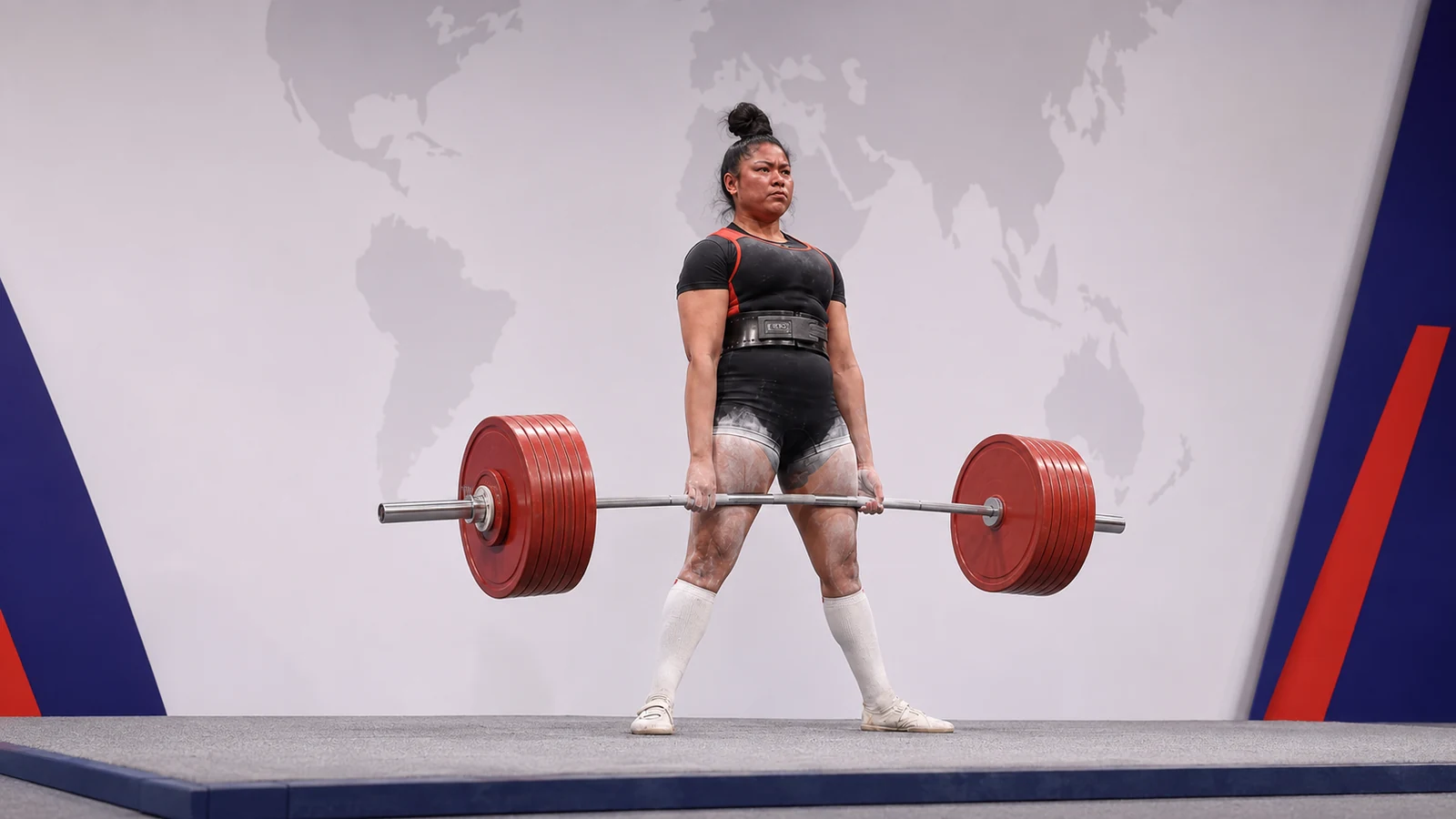

In June 2025, a 27-year-old lifter from Sheffield, England pulled 269.5 kilograms off a competition platform in Chemnitz, Germany.
That works out to roughly 594 pounds, lifted raw with only a belt for support.
The pull set a new International Powerlifting Federation world record in the women’s 84 kilogram raw deadlift.
Her name is Ziana Azariah, and the record did not come out of nowhere.
It came at the end of a five year climb through one of the deepest weight classes in women’s powerlifting, a climb this article traces using her full verified competition history.
A World Record Set in Chemnitz
Azariah competed at the 2025 IPF World Classic Powerlifting Championships, held in Chemnitz, Germany from June 8 to 15.
In the women’s 84 kilogram class, she built to a final deadlift attempt of 269.5 kilograms.
BarBend, one of the most widely followed outlets in competitive powerlifting, listed the lift as a world record deadlift in its meet coverage.
The International Powerlifting Federation’s own YouTube channel posted the lift the same way, titling the clip a world record deadlift in the 84 kilogram class.
OpenPowerlifting, the sport’s open results database, independently lists the same numbers: 269.5 kilograms, a 607 kilogram total, and a second place finish behind Amanda Lawrence of the United States, who won the class outright.
A world record inside a losing effort sounds like a contradiction, but it is common in raw powerlifting, where the overall placing is decided by total, not by any single lift.
A world record inside a losing effort is not a contradiction in raw powerlifting. It is what happens when a class gets deep enough that one historic lift still is not enough to win.
Who Is Ziana Azariah?
Azariah lifts out of Sheffield, England, competing for Great Britain internationally and for British Powerlifting domestically.
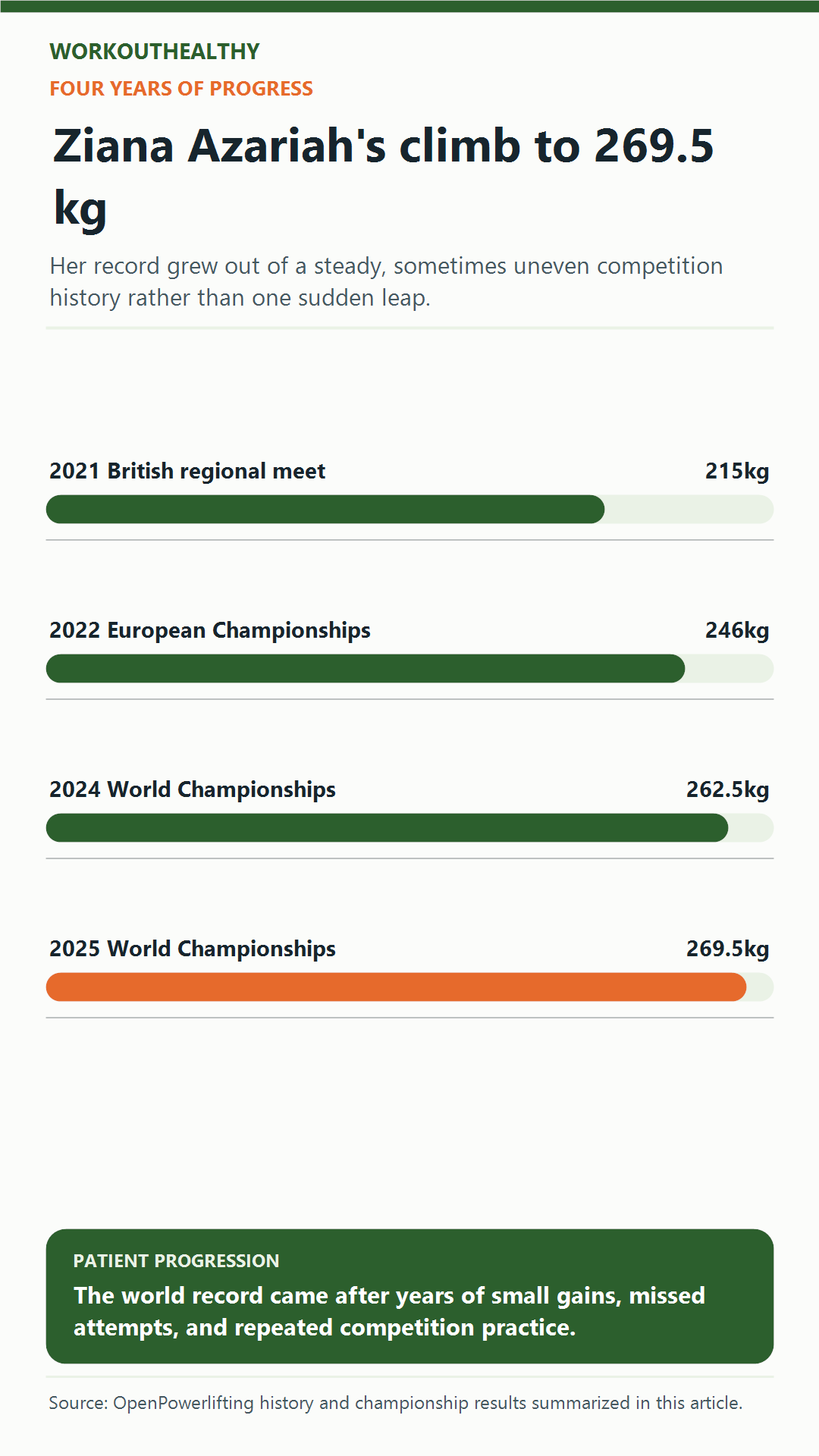
Her competitive record, verified through OpenPowerlifting, stretches back to July 2021, when she pulled 215 kilograms at a regional British meet for a total of 477.5 kilograms.
That is a useful starting point, because it shows how far the record breaking lift actually traveled.
Four years earlier, her deadlift was 54.5 kilograms lighter than the number that would eventually make her a world record holder.
A Five Year Climb, Verified Meet by Meet
Azariah’s full OpenPowerlifting history shows a steady, sometimes uneven climb rather than one lucky day on the platform.
She missed lifts along the way.
Her deadlift attempts failed at three separate meets between 2021 and 2023 before she found her footing.
By November 2022, at the European Classic Powerlifting Championships, she pulled 246 kilograms for a new European record in the class.
She broke that European mark again in December 2023 with 253.5 kilograms, then kept climbing through 2024 as her total moved from the low 500s into the low 600s.
By June 2024, at the IPF World Classic Championships, she finished second in the class with a 262.5 kilogram deadlift and a 592.5 kilogram total.
One year later, at the same championship, the deadlift alone had grown by another seven kilograms, and it was enough to make her a world record holder.
Patient, incremental progress toward a record shows up in other WorkoutHealthy coverage too, including DonnaJean Wilde’s push-up world record, which came from months of structured preparation rather than a single lucky day.
What Her Progression Says About How Elite Lifters Actually Improve
Azariah’s climb, roughly four years from a 215 kilogram deadlift to a world record 269.5 kilogram pull, looks fast from the outside.
Research on long term powerlifting development suggests the pace is not as unusual as it looks.
A 15 year analysis of competitive powerlifters found that most of an athlete’s total strength gain happens in the first several years of serious competition, with year over year improvement slowing sharply after that early window (Latella et al., 2020).
That pattern fits Azariah’s numbers.
Her deadlift grew by roughly 50 kilograms in her first three competitive years, then by a smaller, steadier margin in the years after.
The Fast Lockout Behind the Numbers
Azariah has been described online as a lifter known for a fast, aggressive lockout, the final phase of the deadlift where the hips and knees finish extending and the bar locks into a standing position.
That description is a stylistic read on her technique, not a measured claim, and it has not been independently verified here with force plate or video analysis data.
It is a plausible read, though.
Biomechanics research on the deadlift breaks the lift into a floor phase and a lockout phase, and the two demand different things from the body.
Electromyography research comparing conventional and sumo deadlift styles found that the glutes and lower back extensors carry a large share of the work as the bar passes the knees and the lifter drives the hips through to lockout (Escamilla et al., 2002).
A separate biomechanics review of the deadlift describes the lockout as the phase most often lost on near maximal attempts, because hip extension strength and bar path efficiency both have to hold up after the slower, more grinding pull off the floor (Hales, 2010).
A lifter who finishes attempts quickly through that phase is usually finishing them with less wasted motion, not necessarily with more raw hip strength than a slower lifter moving the same weight.
A fast lockout does not mean a lifter skipped the hard part. It usually means the hard part, the pull off the floor, was won long before the bar reached the knees.
The 84 Kilogram Class Is One of the Deepest in Women’s Powerlifting
The caption that accompanied this record online called the women’s 84 kilogram class one of the deepest and most competitive in the world, and the results from Chemnitz back that up.
Azariah set a world record deadlift and still finished second, more than 20 kilograms behind Amanda Lawrence’s winning total.
Large scale normative data on competitive powerlifting, drawn from more than 800,000 logged competition entries, shows that elite totals in mid range women’s classes like 84 kilograms cluster tightly together rather than spreading out behind one dominant lifter (van den Hoek et al., 2024).
A tightly clustered class is exactly the kind where a single missed attempt, or a single extra kilogram on a training max, can be the difference between a medal and fourth place.
That is the field Azariah is competing in every time she steps on the platform.
Readers building their own strength base may also want to see why WorkoutHealthy readers overwhelmingly favor weightlifting over running when the goal is getting stronger rather than just logging cardio miles.
The Record Has Already Moved Again
Records set inside a fast rising career rarely stay still for long, and this one did not either.
Two months after Chemnitz, at the 2025 World Games in August, Azariah pulled 270 kilograms, a new personal best deadlift.
She returned to the World Classic Championships in June 2026 and matched that 270 kilogram pull while raising her total to a new best of 620 kilograms.
Independent tracking of all time deadlift records in the class lists Azariah as the current holder at 270 kilograms as of that meet, not at the 269.5 kilograms that first made her famous.
In other words, the number that went viral was never the ceiling.
It was a checkpoint inside a career that kept climbing after the cameras moved on.
What a World Record Deadlift Does Not Prove
A single maximal deadlift, world record or not, measures one thing: how much weight one body can move through one specific range of motion on one specific day.
It does not measure general fitness, overall strength across multiple lifts, or long term joint health.
Azariah’s total, not just her deadlift, is what actually decided her placing at every meet in her career, and her squat and bench numbers matter just as much to that outcome as her pull.
A record like this also says nothing about whether attempting a near maximal single lift is a safe or sensible goal for someone outside competitive powerlifting.
Azariah trains for years, under coaching, working up to attempts like this inside a structured competition, not as a spontaneous test of strength.
Common Mistakes People Make Chasing a Big Pull
Most lifters who get hurt going for a heavy deadlift are not hurt by the weight itself.
They are hurt by chasing a number their technique cannot support yet.
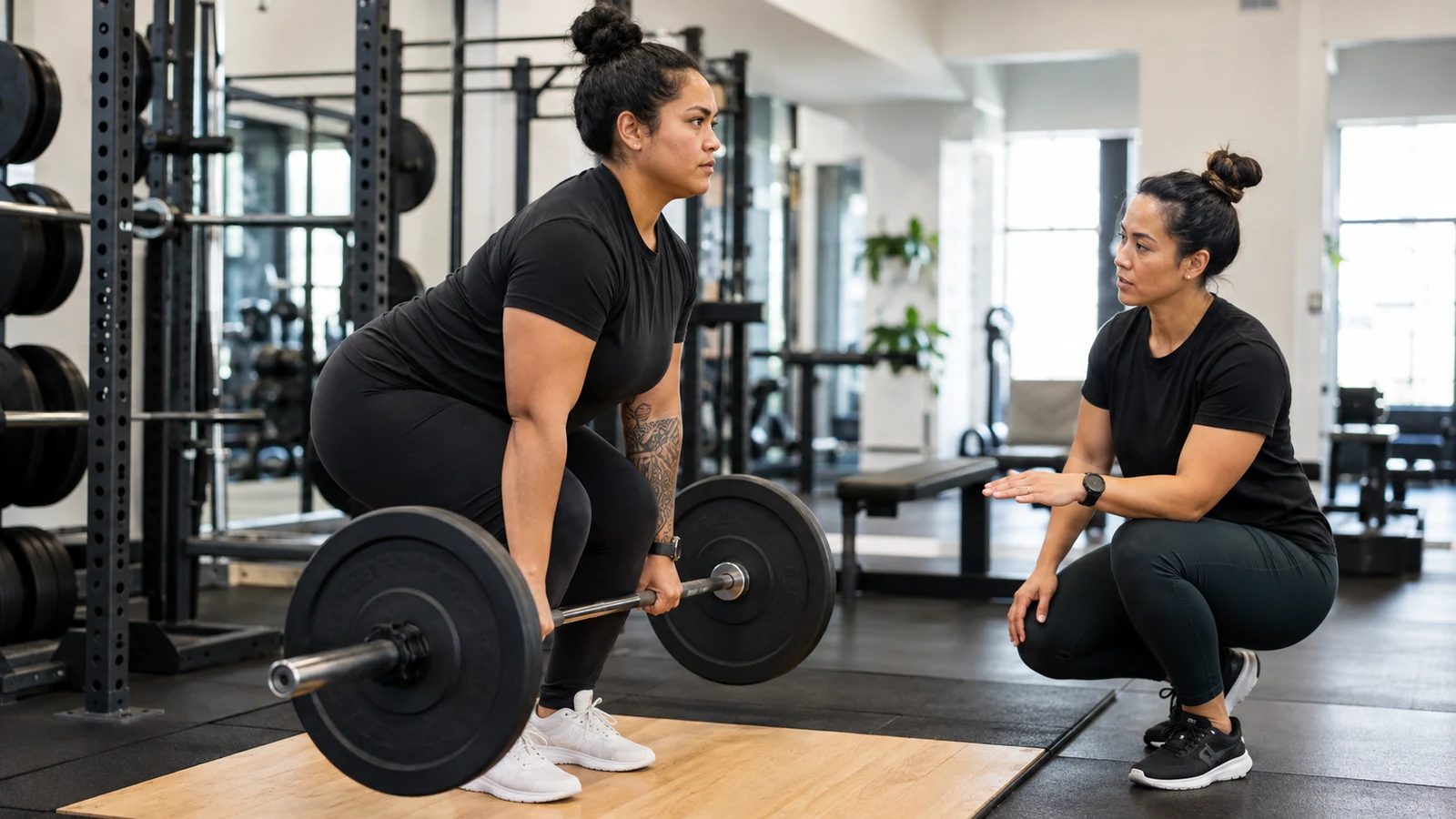
Rounding the lower back to close the gap between the bar and the body is one of the most common mistakes, and it shows up most often on a lifter’s very heaviest attempts, when fatigue and ego both push form to break down first.
Starting a pull with the hips too high, which turns the lift into a stiff legged movement dominated by the lower back instead of the legs and hips together, is another frequent error.
Jumping up in weight too quickly between training cycles, without enough time for tendons and connective tissue to adapt at the same pace as muscle strength, is a slower and less visible mistake, but it is a common cause of nagging injuries in lifters chasing personal records.
None of these mistakes are unique to elite lifters.
They show up just as often in a home gym as they do on an international platform.
Who Should Be Extra Careful With Maximal Deadlift Attempts
Anyone with a current or recent lower back injury should not test a near maximal deadlift without a doctor or physical therapist’s clearance first.
People with uncontrolled high blood pressure should also be cautious, since a heavy single rep lift involves a brief but real spike in blood pressure from the effort of bracing and holding a breath under load.
Older lifters returning to heavy training after a long break, and anyone recovering from a hernia or recent abdominal surgery, fall into the same cautious category.
None of this means heavy deadlifts are dangerous by default for a healthy, trained lifter.
It means the jump from a moderate working weight to a true one rep maximum is not something to attempt without preparation and, in most cases, without supervision.
The Practical Takeaway for Everyday Lifters
Nobody needs to deadlift 269.5 kilograms to benefit from watching how Azariah got there.
The more useful lesson is the shape of her progress: small, repeated jumps across dozens of meets over several years, not one miracle training block.
A lifter working toward their own deadlift goal is better served by tracking progress meet to meet, or session to session, the same way Azariah’s climb only shows up clearly when her whole multi year record is laid out together.
Big achievements in strength sports are almost always the product of years, not weeks, something also visible in Edith Connor’s Guinness record for oldest female bodybuilder, a very different athlete who built her own title the same patient way.
Watch the Original Video
Want more verified strength stories like this one? Subscribe to WorkoutHealthy Insider for practical explanations behind popular fitness claims.
References
Escamilla, R. F., Francisco, A. C., Kayes, A. V., Speer, K. P., & Moorman, C. T., III. (2002). An electromyographic analysis of sumo and conventional style deadlifts. Medicine & Science in Sports & Exercise, 34(4), 682-688. https://doi.org/10.1097/00005768-200204000-00019
Hales, M. (2010). Improving the deadlift: Understanding biomechanical constraints and physiological adaptations to resistance exercise. Strength & Conditioning Journal, 32(4), 44-51. https://doi.org/10.1519/SSC.0b013e3181e5e300
Latella, C., Teo, W.-P., Spathis, J., & van den Hoek, D. (2020). Long-term strength adaptation: A 15-year analysis of powerlifting athletes. Journal of Strength and Conditioning Research, 34(9), 2412-2418. https://doi.org/10.1519/JSC.0000000000003657
van den Hoek, D. J., Beaumont, P. L., van den Hoek, A. K., Owen, P. J., Garrett, J. M., Buhmann, R., & Latella, C. (2024). Normative data for the squat, bench press and deadlift exercises in powerlifting: Data from 809,986 competition entries. Journal of Science and Medicine in Sport, 27(10), 734-742. https://doi.org/10.1016/j.jsams.2024.07.005
This article is for general information only and is not medical advice. If you have an injury, ongoing pain, or a medical condition, talk to a doctor or physical therapist before you change how you train or eat.