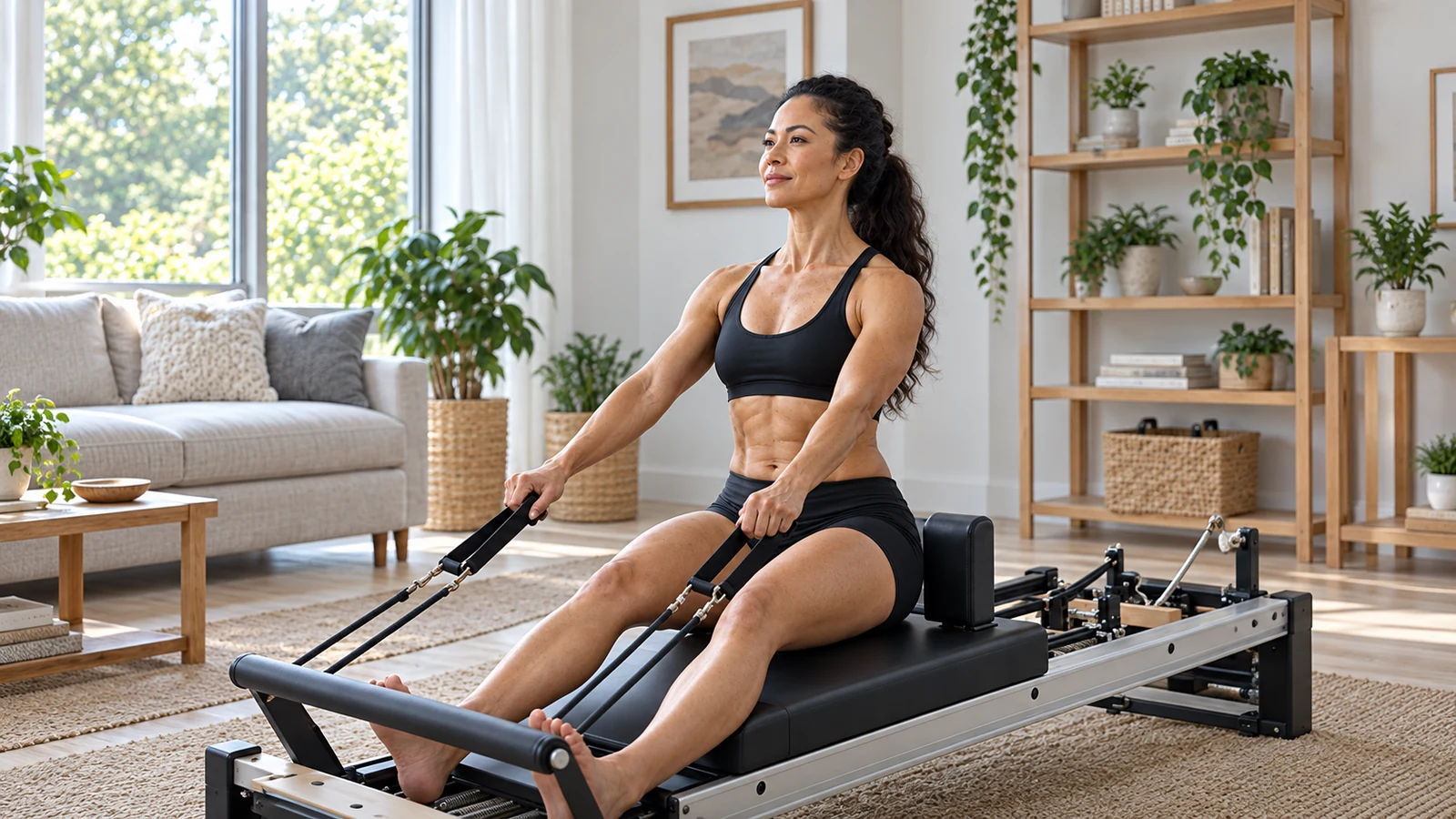

An eight-week trial found that a home-based Pilates program improved reported fatigue, anxiety, and depressive symptoms in people with multiple sclerosis.
That result is encouraging, but the details determine who can reasonably use it.
Quick answer: 80 adults with MS and minimal-to-mild mobility disability were randomized to twice-weekly DVD-guided home Pilates or a wait-list control. The Pilates group improved on several validated symptom scales. The study supports Pilates as an exercise option alongside medical care, not as a treatment replacement, and it does not prove the same results for people with more advanced disability.
Home exercise becomes clinically interesting when it is accessible enough to repeat and structured enough to measure.
What the trial tested
Fleming, Coote, and Herring published the randomized controlled trial in the Multiple Sclerosis Journal in 2021.
The researchers enrolled 80 adults with MS. Sixty-nine were women, and participants had minimal-to-mild mobility disability.
Thirty-nine people were assigned to home Pilates and 41 to a wait-list control. The intervention used a DVD and called for two sessions per week over eight weeks.
Researchers measured symptoms at baseline and every two weeks. The tools included two depression measures, two anxiety measures, and the Modified Fatigue Impact Scale.
That design is stronger than comparing symptoms before and after exercise in one group. Random assignment and a control group help separate the intervention from ordinary change over time.
The trial was registered as NCT04120207. Attrition was low, and the published report states that no adverse effects or relapses were reported.
The participants still represent a specific group. Most were women, and mobility limitations were relatively mild.
What improved
The group-by-time analyses were statistically significant for all measured outcomes. In plain language, symptom scores changed differently in the Pilates group than in the wait-list group.
Depressive-symptom effects were moderate to large across the two measures. Anxiety effects ranged from small to moderate.
Physical, cognitive, psychosocial, and total fatigue scores also improved. The reported effect sizes for physical and total fatigue were moderate to large.
The female-only analysis produced materially similar findings. That adds reassurance because women made up most of the sample, but it does not establish a separate sex-specific effect.
The study authors described some changes in depression and fatigue as clinically meaningful. Symptom scales are valuable, but they are not the same as a cure or a change in the underlying disease process.
The results support the statement that twice-weekly home Pilates helped this sample over eight weeks. They do not support the idea that Pilates replaces medication, neurologic care, counseling, or rehabilitation.
Our article on movement and life with MS describes why symptom management often requires several strategies at once.
What the study cannot prove
A wait-list control does not match the attention, expectation, or routine created by a new exercise program. Some improvement may reflect those nonspecific effects.
Participants knew whether they were doing Pilates. Exercise trials cannot easily blind people to the activity they perform.
The study lasted eight weeks. It does not tell us whether the improvements remained months later or whether the same DVD program would continue to help indefinitely.
Most participants were women with minimal-to-mild mobility disability. Results should not be generalized automatically to severe balance limits, substantial spasticity, recent relapse, or other complex medical situations.
A 2022 systematic review found potential Pilates benefits across balance, gait, fatigue, cognition, and quality of life, but the included studies varied in design and quality (Sánchez-Lastra et al., 2022).
A newer network meta-analysis of randomized trials also reported possible benefits while rating certainty as limited by bias, heterogeneity, imprecision, and short follow-up.
The honest conclusion is promising and conditional. Pilates can be a useful form of exercise for some people with MS when it is adapted to their function and symptoms.
The home-Pilates readiness map
Use four checkpoints before copying a home program.
- Medical stability: no current relapse, sudden neurologic change, or unexplained new symptom that requires assessment.
- Movement access: a safe way to get to and from the floor, or chair-based alternatives if floor work is not suitable.
- Symptom plan: a strategy for fatigue, heat sensitivity, pain, dizziness, spasticity, and balance changes.
- Feedback route: a clinician, physical therapist, or qualified instructor who can adjust exercises when needed.
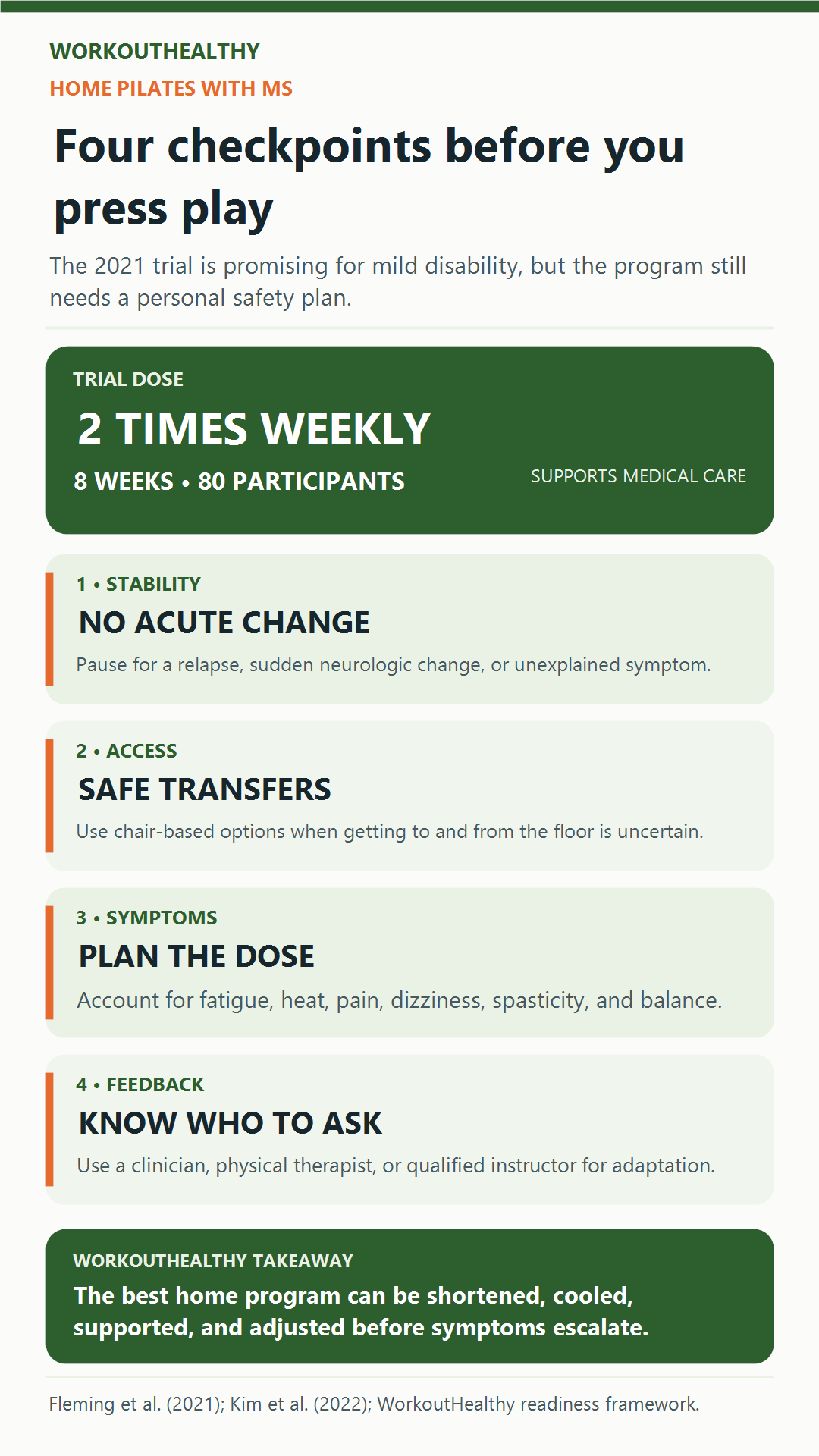
The map is not a test you must pass perfectly. It identifies the support that turns a generic video into a usable plan.
The right home program is not the hardest one you can finish. It is the one you can adapt before symptoms force you to stop.
What the program required
The trial used two home sessions per week. That frequency fits broader exercise recommendations for people with mild-to-moderate MS.
An Exercise and Sports Science Australia position statement concluded that moderate aerobic and resistance training two to three times per week is generally safe and beneficial for people with mild-to-moderate disability (Kim et al., 2022).
Pilates is not identical to traditional resistance or aerobic exercise, but it can contribute to trunk control, mobility, balance, and structured activity.
More is not always better. Fatigue can be a symptom of MS and also a normal response to exercise.
A useful session should allow recovery without a prolonged symptom flare. Begin shorter than the full video if needed.
Use rest pauses, fewer repetitions, and supported positions. Track how you feel later that day and the next morning.
The trial’s eight-week structure also matters. Benefits came from repeated sessions, not one dramatic workout.
Our guide to quiet home cardio offers another low-impact format that can be scaled when floor exercise is not practical.
How exercise can be adapted for MS
A home program does not require a reformer. Mat or chair-based work can train breathing, trunk control, hip strength, and coordinated movement.
Choose a stable surface and keep support within reach. A chair, wall, or countertop can make transitions and standing work safer.
Reduce range when spasticity, weakness, or joint pain makes the full movement difficult. Quality matters more than touching an ideal position.
Work one side at a time when strength differs, but use enough support to prevent a fall. The goal is a controlled challenge, not perfect symmetry.
Some people with MS are sensitive to heat. A cool room, fan, water, lighter clothing, and shorter exercise blocks may help.
Visual demonstrations should include alternatives. If a program offers only one version of each movement, it may not be appropriate for variable symptoms.
A physical therapist familiar with MS can assess gait, balance, fatigue, and transfer ability. That evaluation is especially useful after a relapse or change in disability.
The article on what Pilates research really found explains why population and program details matter when interpreting a broad exercise claim.
Safety and symptom monitoring
Stop exercise for chest pain, fainting, severe shortness of breath, or a sudden neurologic change. Seek urgent care when symptoms suggest an emergency.
Contact the treating clinician for a suspected relapse, substantial new weakness, vision change, or symptoms that are clearly different from usual fluctuations.
Temporary worsening with heat can occur in MS. Cooling and rest may help, but new or persistent symptoms still deserve medical guidance.
Use a simple session record. Note the exercises, duration, effort, room temperature, immediate symptoms, and next-day response.
That record helps distinguish a consistently tolerable dose from a pattern that repeatedly creates excessive fatigue. It also gives a therapist useful information.
Mental-health improvements in the trial are encouraging, but depression and anxiety may need direct treatment. Exercise can support care without replacing therapy or medication.
Home access is a strength only when the environment is safe. Clear trip hazards, secure pets, keep a phone nearby, and avoid floor work alone if transfers are uncertain.
Use the same small group of movements for several sessions before adding variety. Repetition makes it easier to notice whether control, range, or recovery is changing.
A practical starter session might include supported breathing, seated trunk rotation, heel slides, a gentle bridge if floor access is safe, and a supported sit-to-stand. The exact selection should match current function.
Rate effort on a zero-to-ten scale and begin around light to moderate. The position statement for mild-to-moderate MS supports moderate exercise, but individual symptoms still determine the usable dose.
Plan rest before exhaustion arrives. Short pauses between movements can preserve form and reduce the pressure to finish a video at its original pace.
Review the week, not only the session. An exercise dose that feels manageable immediately but repeatedly disrupts the next day may need to be shortened.
Care partners can help with setup and observation, but they should not force a limb farther or turn a painful movement into a test of motivation.
The bottom line
The 2021 trial is real and stronger than the average viral exercise claim. Twice-weekly home Pilates for eight weeks improved reported fatigue, anxiety, and depressive symptoms in adults with MS and relatively mild mobility disability.
The study does not show that Pilates treats the disease itself or replaces standard care. Its best use is as evidence that an accessible home program can be a meaningful part of individualized symptom management.
Start with medical stability, safe access, a symptom plan, and a route for professional feedback. Those conditions matter as much as the exercise list.
References
Fleming, K. M., Coote, S. B., & Herring, M. P. (2021). Home-based Pilates for symptoms of anxiety, depression and fatigue among persons with multiple sclerosis: An 8-week randomized controlled trial. Multiple Sclerosis Journal, 27(14), 2267-2279.
Kim, Y., et al. (2022). Exercise and Sports Science Australia position statement on exercise for people with mild to moderate multiple sclerosis. Journal of Science and Medicine in Sport, 25(1), 6-16.
Sánchez-Lastra, M. A., et al. (2022). Therapeutic effects of the Pilates method in patients with multiple sclerosis: A systematic review. Journal of Clinical Medicine, 11(3), 683.
Wu, J., et al. (2026). Comparative effects of Pilates-based interventions on functional mobility, balance, fatigue, and quality of life in people with multiple sclerosis. Frontiers in Neurology.
Medical disclaimer: This article is general product information, not medical advice. The equipment described here is not a treatment for any condition. If you have an injury, ongoing pain, or a medical condition, talk to a doctor or physical therapist before using any of it.