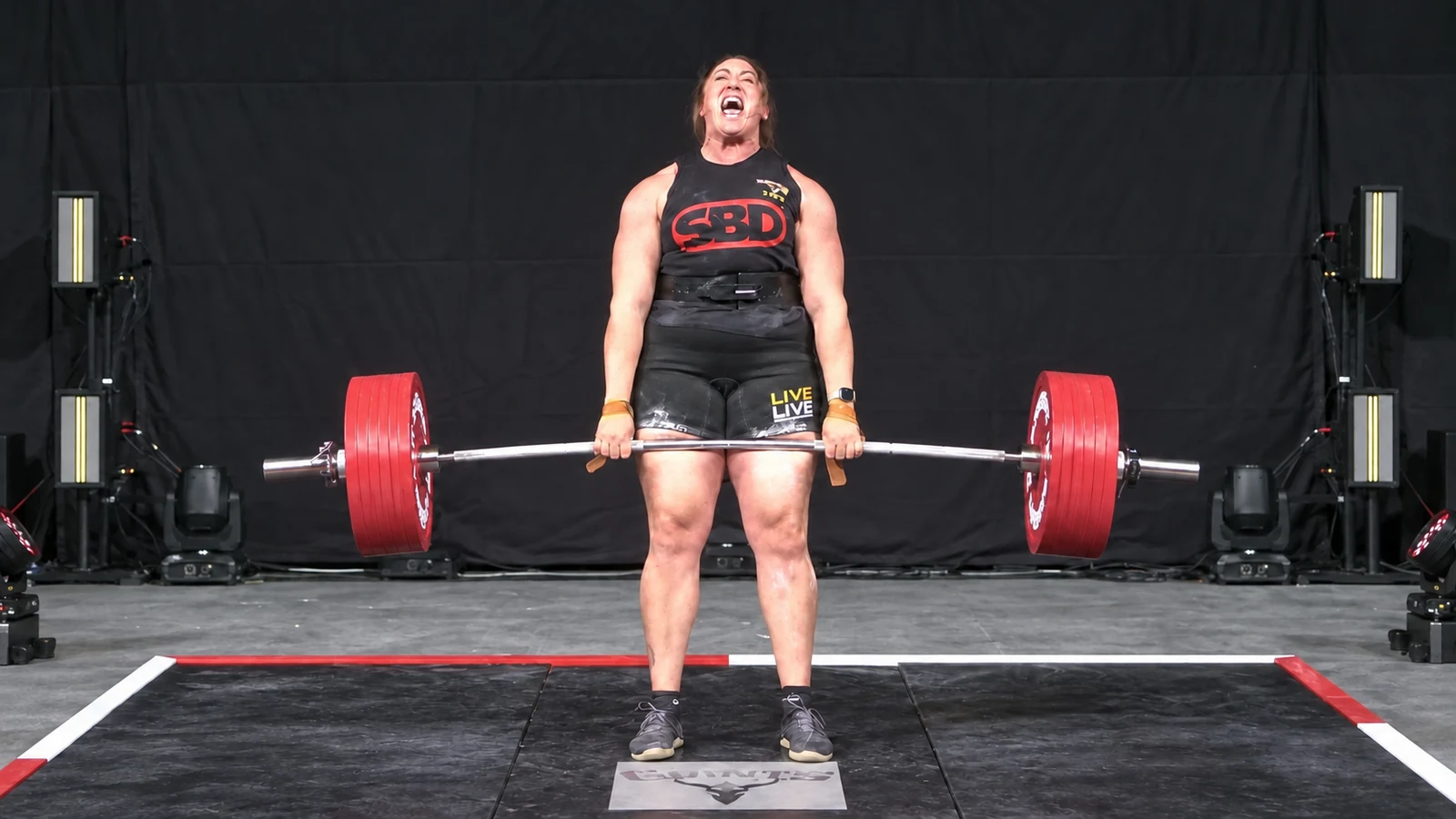

Lucy Underdown pulled 325 kilograms, or about 716.5 pounds, at the 2024 Women’s World Deadlift Championships. The official Giants Live footage shows a lift that lasted only seconds, but the number carries years of context.
It was not simply a viral gym clip. It extended Underdown’s own standard-bar strongwoman world record and pushed the mark well beyond the 700-pound barrier she had first crossed in 2023.
Quick answer: the 325 kg lift remains the women’s standard-bar strongwoman world record in current Giants Live coverage. It matters because Underdown raised an already historic mark from 318 kg to 325 kg under competition rules. It does not mean every woman should chase maximal deadlifts or that records across strongwoman, powerlifting, and elephant-bar events can be compared without qualification.
The remarkable part is not that a limit vanished overnight. It is that a lifter kept moving the limit after already making history.
What Lucy Underdown lifted
The competition bar held 325 kg. Converted more precisely, that is roughly 716.5 pounds. Giants Live published the official lift on September 28, 2024 and described it as a new women’s world record.
Underdown completed the pull from the floor to a standing lockout. She used the equipment and rules of the strongwoman event, including straps and supportive gear that are permitted in that setting.
That detail does not reduce the feat. It identifies the feat correctly. A record belongs to a defined event, implement, and rule set.
Giants Live later called Underdown the current women’s world-record holder with 325 kg to her name. That organization also documented her earlier 318 kg pull, which made her the first woman to exceed 700 pounds in this event.
The viral post says experts once considered 700 pounds physically impossible for women. That sweeping historical claim is much harder to document than the lifts themselves.
The defensible story is already extraordinary. Underdown crossed 700 pounds, returned the following year, and added another 7 kg to her own mark.
How the record progressed
Record progress can look sudden when it is reduced to one clip. Underdown’s path shows the opposite.
Her 2023 performance reached 318 kg, or about 701 pounds. That lift broke the symbolic 700-pound boundary and established a new target for the field.
In 2024, she moved the record to 325 kg. A 7 kg increase is about 15.4 pounds, which is a substantial jump at an elite maximum.
The percentage increase was only about 2.2 percent. That small percentage is still enormous near the edge of human performance, where improvements are normally difficult and expensive.
Elite records are built from many adaptations that are less visible than the attempt. Technique must remain repeatable under heavier loading. Grip support, bracing, recovery, competition timing, and confidence must converge on the same day.
Underdown also competed successfully outside this single event. Her broader strongwoman results show that she was not training only for one highly specific gym lift.
That wider base matters. Maximal strength is displayed in one moment, but it is supported by a program that manages fatigue across many movements and contests.
Why record rules matter
Strongwoman, powerlifting, and elephant-bar deadlifts are related, but they are not interchangeable.
A standard competition bar bends differently from a long elephant bar. The plates, bar diameter, starting height, straps, suit rules, stance, and judging commands can also change.
Powerlifting federations have their own divisions for raw and equipped lifting. Some allow sumo stance. Some records are separated by body-weight class.
Strongwoman events may use straps and suits in an open-weight competition. The goal is still to lift the declared load from the floor to an accepted lockout, but the category is distinct.
This is why calling 325 kg the largest women’s deadlift in every possible format would be imprecise. Calling it the women’s standard-bar strongwoman world record is accurate and specific.
The distinction also protects athletes from unfair comparisons. Two lifters can perform outstanding deadlifts while competing under different constraints.
The record-context ladder
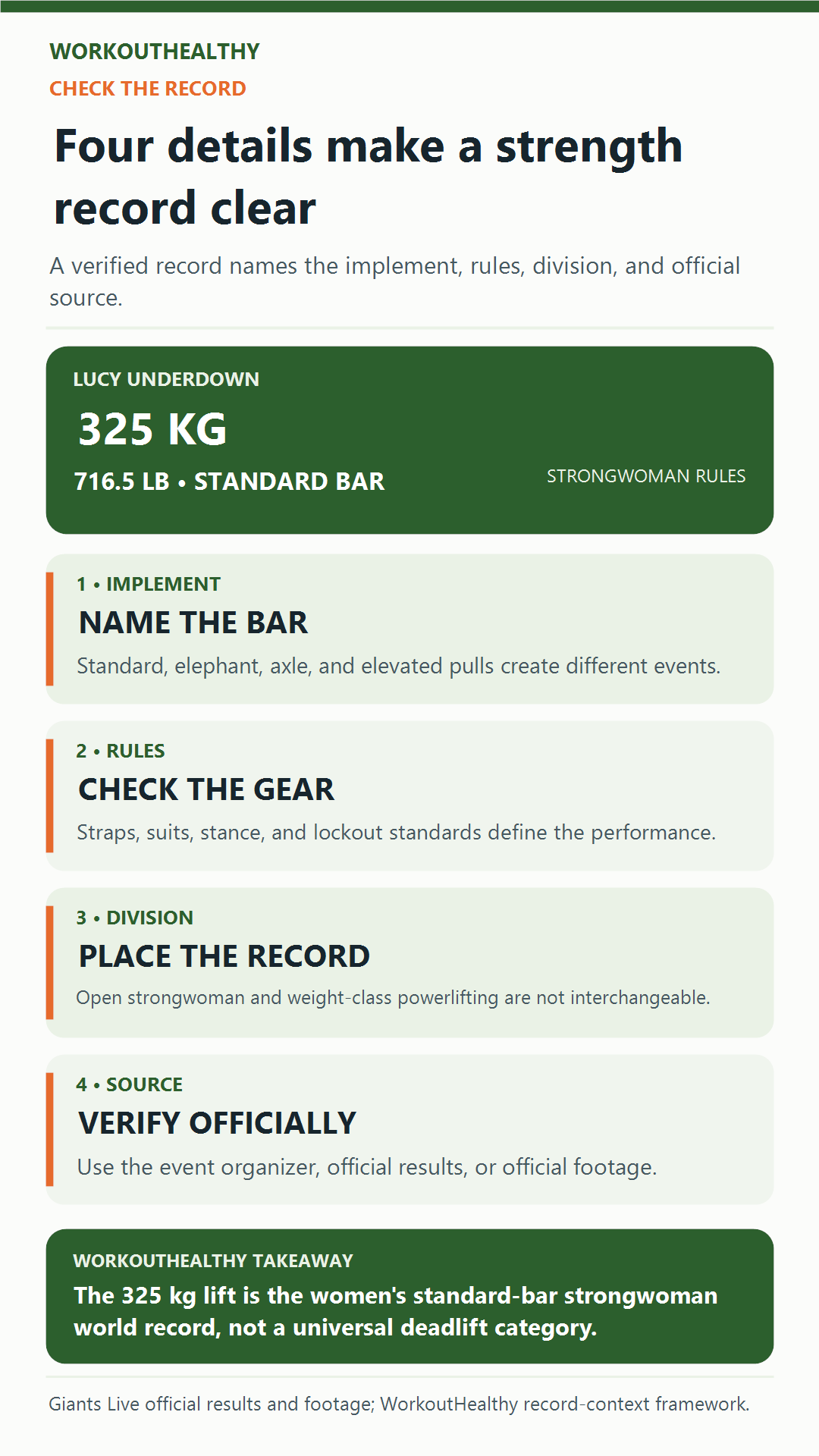
A useful way to evaluate any record headline is to climb four steps before deciding what it means.
- Name the implement. Identify a standard bar, elephant bar, axle, elevated pull, or another apparatus.
- Name the rules. Note straps, suit, stance, lockout standard, and judging organization.
- Name the division. Separate open-weight strongwoman from weight-class powerlifting and other categories.
- Confirm the record source. Prefer the event organizer, official results, or official footage over recycled captions.
This ladder turns a vague superlative into a verifiable claim. It also makes different performances easier to appreciate on their own terms.
The method applies beyond deadlifting. It works for records in squatting, pressing, carrying, running, and other sports where conditions shape the result.
A record becomes more impressive, not less, when its exact rules are clear enough for the next athlete to chase.
What the lift shows about performance
Underdown’s record is evidence of an individual athlete’s extraordinary capacity. It is not a biological experiment and cannot define the potential of every woman.
It does show why old assumptions should be treated cautiously. Competitive standards can move when participation grows, coaching improves, and athletes receive more opportunities to specialize.
A record also changes expectations inside a sport. Once 700 pounds has been completed on the platform, it becomes a concrete performance rather than an abstract target.
That can influence programming and confidence for other elite lifters. It does not guarantee that anyone else will reproduce the lift.
The visual drama of the lockout can hide another point. Maximum attempts are not smooth demonstrations of textbook submaximal form.
They are judged competition efforts performed by specialists. Recreational lifters should not imitate the strain, speed, or loading shown in a record attempt.
If you enjoy strength milestones, our guide to keeping a training log explains how ordinary sessions provide the information that makes safe progress possible.
What recreational lifters can learn
The most transferable lesson is patience. Elite numbers come from repeated exposure to manageable training, not from repeatedly testing an absolute maximum.
Most lifters benefit from building technique with loads that allow consistent bracing and a controlled start. The bar should be close, the trunk should be prepared before the pull, and the load should match current capacity.
Progress can be measured through repetitions, total volume, cleaner technique, and recovery. Weight on the bar is only one signal.
Our guide to loading a hip hinge safely explains how range of motion and equipment can be adjusted when the floor pull is not the right starting point.
A complete program also needs more than one showcase lift. Squatting, pushing, pulling, carrying, trunk work, and conditioning cover qualities a single deadlift cannot.
The seven-point training-program audit offers a practical way to find those gaps.
People new to lifting should learn under qualified supervision when possible. Pain, neurologic symptoms, dizziness, or a recent injury are reasons to stop and seek individualized guidance.
Maximal-strength preparation also depends on recovery. Sleep, food, stress, and the spacing of hard sessions influence whether training becomes an adaptation or only accumulated fatigue.
Warm-up sets should become more specific as the weight rises. Early sets can rehearse position and speed. Later sets bridge the gap to the day’s working load without exhausting the lifter.
Competition attempts require a different plan from ordinary training. Athletes select attempts around known performance, event strategy, and judging rules. Recreational lifters rarely need that level of risk.
Celebrate personal records that preserve technique and recovery. A first controlled set of five can represent more useful progress than a strained single that cannot be repeated.
Underdown’s achievement can motivate ambitious goals while still supporting conservative daily decisions. Inspiration and imitation are not the same thing.
The record rewards disciplined preparation.
What the headline gets wrong
The social headline frames the record as proof that a physical impossibility disappeared. That language is emotionally effective, but it compresses history and science too aggressively.
There is no single published boundary that declared 700 pounds impossible for every woman. Human performance predictions depend on assumptions, samples, equipment, and the population being discussed.
The headline also says the weight is something most elite male strength athletes will never touch. That may be intuitively plausible across all athletes, but the comparison has no defined denominator.
More useful comparisons stay close to the event. Underdown improved from 318 to 325 kg and remained identified by Giants Live as the women’s standard-bar record holder.
That verified sequence needs no exaggeration. It documents one athlete moving the top mark twice in consecutive championship appearances.
The bottom line
Lucy Underdown’s 325 kg deadlift is a genuine competition record, not an internet myth. Official footage and later Giants Live coverage support the number and its status.
The best reading is specific. She set the women’s standard-bar strongwoman world record at the 2024 Women’s World Deadlift Championships after becoming the first woman past 700 pounds in 2023.
Her lift should inspire respect for long-term preparation, not reckless imitation. Records expand a sport’s imagination while leaving the basics of safe, gradual training unchanged.
References
Giants Live. (2024, September 28). New women’s world record deadlift 2024 [Video]. YouTube.
Giants Live. (2025). Underdown hits overdrive to take second British title.
Giants Live. (n.d.). Lucy Underdown.
Medical disclaimer: This article is general product information, not medical advice. The equipment described here is not a treatment for any condition. If you have an injury, ongoing pain, or a medical condition, talk to a doctor or physical therapist before using any of it.