
Your feet do send important information to your nervous system. Skin receptors in the sole detect pressure, stretch, contact, and motion while you stand and walk.
That does not mean pressing a thumb into the arch “wakes up” balance nerves in a proven, lasting way.
Quick answer: plantar sensation contributes to balance, especially during standing. Brief touch or texture can change sensory input, but studies do not show that firm self-massage of the arch reliably fixes balance. Use foot-awareness drills as optional practice, not treatment, and perform balance work near stable support.
Your feet are part of the balance system, but a stronger signal is not automatically a better signal.
How the balance system works
Balance is not controlled by one muscle, nerve, or body part. The brain combines visual information, signals from the inner ear, sensation from skin and joints, and the ability to produce a quick muscular response.
The contribution of each source changes with the task. Closing the eyes increases reliance on other signals. Standing on foam makes information from the feet and ankles less reliable.
Walking adds momentum, repeated foot contact, and the need to place each step. A strategy that changes quiet standing may not improve walking.
Strength, reaction time, confidence, medications, pain, and neurologic health also matter. That is why a single foot trick cannot diagnose or solve a balance problem.
People often use the word proprioception for every body-position signal. The sole mainly provides cutaneous, or skin-based, information. Deeper receptors in muscles and joints contribute proprioception.
Both streams are useful, but they are not identical.
What the sole can sense
The glabrous skin on the bottom of the foot contains several types of mechanoreceptors. They respond to sustained pressure, changing pressure, vibration, and skin stretch.
Single-unit research shows that plantar afferents provide detailed information about contact between the foot and the ground. The nervous system can use that information to help manage equilibrium and orientation (Strzalkowski et al., 2018).
Sensation is distributed across the heel, forefoot, toes, and midfoot. The arch is not the only important region.
Pressure also changes naturally during movement. A healthy step transfers load from initial contact through the foot before push-off.
Reduced sensation from aging, neuropathy, or other conditions can alter standing control. In one study, standing pressure patterns were associated with sensitivity at specific foot sites, while walking patterns did not show the same relationship (Zhang & Li, 2013).
That difference warns against treating a standing result as proof of improved gait.
What pressure studies actually show
Researchers have changed plantar input with texture, vibration, electrical stimulation, cooling, anesthesia, and mechanical contact. These methods can alter sway or movement under specific test conditions.
A study in healthy older adults found that plantar stimulation reduced postural sway during quiet standing. The effect supports a role for foot-sole input, but it does not establish a home massage treatment (Machado et al., 2018).
Other results are mixed. Textured stimulation placed in specific zones has sometimes increased instability during walking rather than reducing it (Hatton et al., 2016).
The timing, location, intensity, and task all matter. More sensation is not always helpful if the signal conflicts with the movement the nervous system expects.
The viral instruction says firm arch pressure makes balance signals easier for the brain to notice. That is a reasonable hypothesis, but the cited research does not directly test a thumb pressed into the arch before balance training.
Short-term awareness after touching the foot may feel real. It should not be confused with a measured reduction in falls or a lasting rehabilitation effect.
The foot-feedback safety filter
Run a foot-awareness claim through four questions before trying it.
- Is sensation intact? Numbness, reduced protective sensation, open skin, or unexplained burning changes the risk.
- Is the pressure comfortable? Gentle contact may increase awareness. Painful pressure is not required.
- Is the balance task supported? Use a counter, rail, or stable chair and keep the floor clear.
- Does the effect transfer? Feeling the foot is not the same as walking more safely. Judge the actual task over time.
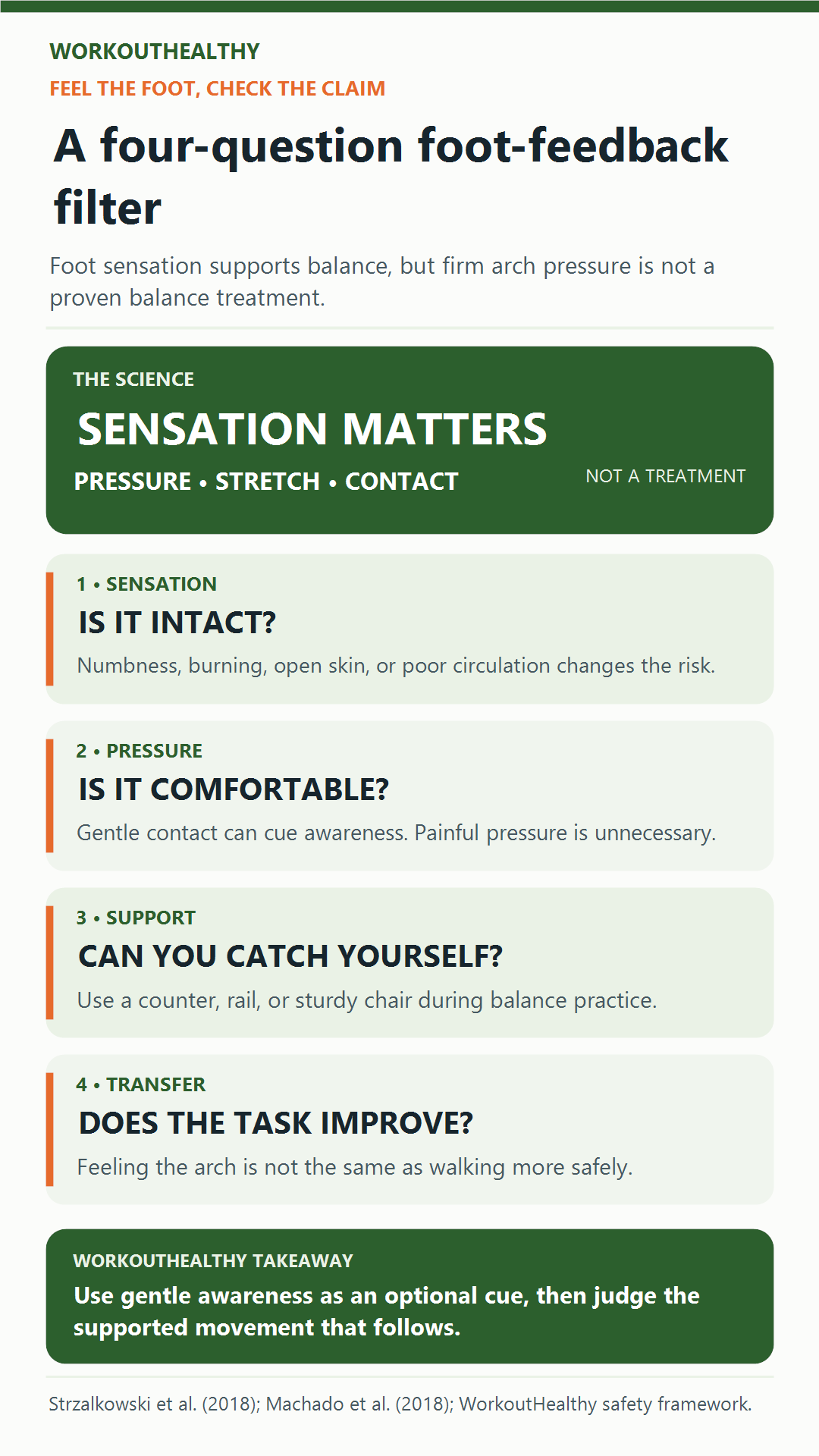
This filter keeps a low-stakes sensory drill in proportion. It can be a warm-up or awareness cue without becoming a medical promise.
A useful cue should make the next movement clearer, not distract you from the support needed to practice it safely.
A supported awareness drill
Stand barefoot or in secure flat shoes beside a sturdy counter. Keep both hands close enough to catch yourself.
Notice three contact regions: heel, base of the big toe, and base of the little toe. Do not force the arch down.
Shift a small amount of weight toward the heels, then return to center. Shift gently toward the forefoot without lifting the heels.
Next, move slightly toward one foot while keeping both feet on the floor. Return to center and repeat on the other side.
Use slow breathing and a range that feels stable. Five controlled shifts in each direction are enough for a first session.
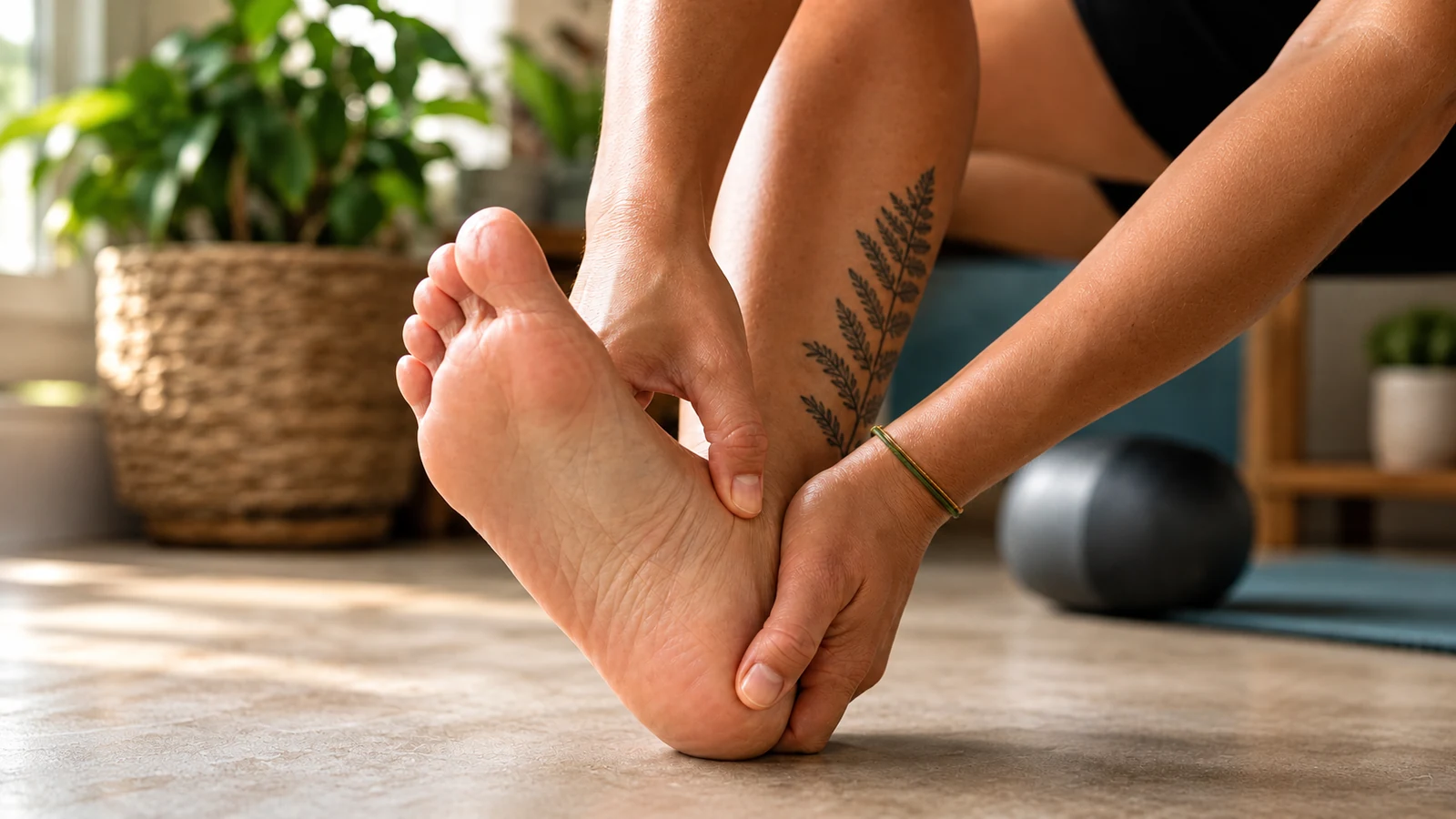
If you want a sensory cue first, rub the sole lightly with your hand or roll it briefly over a smooth ball while seated. Avoid digging into painful tissue.
Repeat the supported shifts and notice whether control changes. Treat the result as personal feedback, not proof that nerves have been “activated.”
Our guide to ankle mobility and control explains why the foot works with the ankle and lower leg rather than in isolation.
Barefoot practice, shoes, and texture
Barefoot standing increases direct contact with the surface, but it is not automatically superior. Shoes can provide traction, structure, warmth, and protection.
People with diabetes, neuropathy, poor circulation, fragile skin, or a history of ulcers may need protective footwear and clinical foot-care guidance.
Textured insoles and mats change the information reaching the sole. Research results depend on the texture and the task.
Do not assume that an aggressive texture improves balance. Discomfort can change gait, and poorly placed stimulation can increase instability.
The most practical choice is the surface and footwear that allow safe, repeatable practice. If a shoe feels unstable or worn unevenly, replace it before adding harder balance drills.
General leg strength also supports balance. The smarter strength plan for your 40s includes movements that can be scaled while keeping support nearby.
When to get professional help
New or worsening balance problems deserve more than a social-media drill. A clinician can review vision, inner-ear symptoms, sensation, strength, medications, blood pressure, and neurologic signs.
Seek urgent care for sudden severe imbalance, facial droop, speech trouble, new one-sided weakness, fainting, chest pain, or a severe new headache.
A physical therapist can test standing and walking under controlled conditions. They can also choose support, footwear, strength work, and progressive balance tasks.
People with ongoing foot pain should not repeatedly press into the sore area in hopes of restoring balance. Pain can change movement, and the cause may need evaluation.
Our article on standing versus sitting offers a broader look at how posture and movement breaks should fit daily life.
Falls, near-falls, and loss of confidence are worth recording. Patterns such as turning, darkness, fatigue, or uneven ground help a professional identify the next step.
A complete balance plan normally includes more than sensory practice. Lower-body strength helps create corrective force. Ankle and hip mobility influence the positions available for that correction.
Vision can be trained as a constraint only after basic safety is established. Closing the eyes makes a drill harder, but harder does not automatically mean more useful.
Walking practice should reflect real environments. Turning, stepping over an object, changing speed, and carrying something light may matter more than standing still on one foot.
Progress one demand at a time. You might reduce hand support, narrow the stance, or add a gentle head turn. Changing all three together makes a loss of balance more likely.
Use a simple rating from zero to ten for steadiness and confidence. Record whether you touched the support and whether symptoms appeared later.
A home drill earns a place when it improves a real task without increasing falls or fear. A pleasant tingling sensation in the arch is not enough evidence by itself.
Sleep, hydration, illness, and medication timing can change balance from day to day. Compare practice under similar conditions before deciding that one technique caused the difference.
If the feet feel numb, do not increase pressure simply to chase sensation. Reduced protective sensation can make excessive rubbing, heat, or sharp texture dangerous.
Inspect the skin after any new foot tool or textured surface. Redness that persists, blistering, swelling, or broken skin is a reason to stop and seek guidance.
The bottom line
The soles of the feet provide real sensory information for standing and walking. That science supports attention to foot contact.
It does not prove that firm arch pressure wakes up nerves or corrects balance. The research uses varied stimulation methods and produces task-specific results.
Use gentle awareness work if it feels helpful. Keep actual balance practice supported, progressive, and connected to the movements you need to perform.
References
Hatton, A. L., Dixon, J., Rome, K., Newton, J. L., & Martin, D. J. (2016). Effects of the site and extent of plantar cutaneous stimulation on dynamic balance and muscle activity while walking. Clinical Biomechanics, 31, 9-15.
Machado, Á. S., da Silva, C. B. P., da Rocha, E. S., & Carpes, F. P. (2018). Effect of plantar cutaneous inputs on center of pressure during quiet stance in older adults. Human Movement Science, 58, 64-72.
Strzalkowski, N. D. J., Mildren, R. L., & Bent, L. R. (2018). Cutaneous afferent innervation of the human foot sole: What can we learn from single-unit recordings? Journal of Neurophysiology, 120(3), 1233-1246.
Zhang, S., & Li, L. (2013). The differential effects of foot sole sensory on plantar pressure distribution between balance and gait. Gait & Posture, 37(4), 532-535.
Medical disclaimer: This article is general product information, not medical advice. The equipment described here is not a treatment for any condition. If you have an injury, ongoing pain, or a medical condition, talk to a doctor or physical therapist before using any of it.