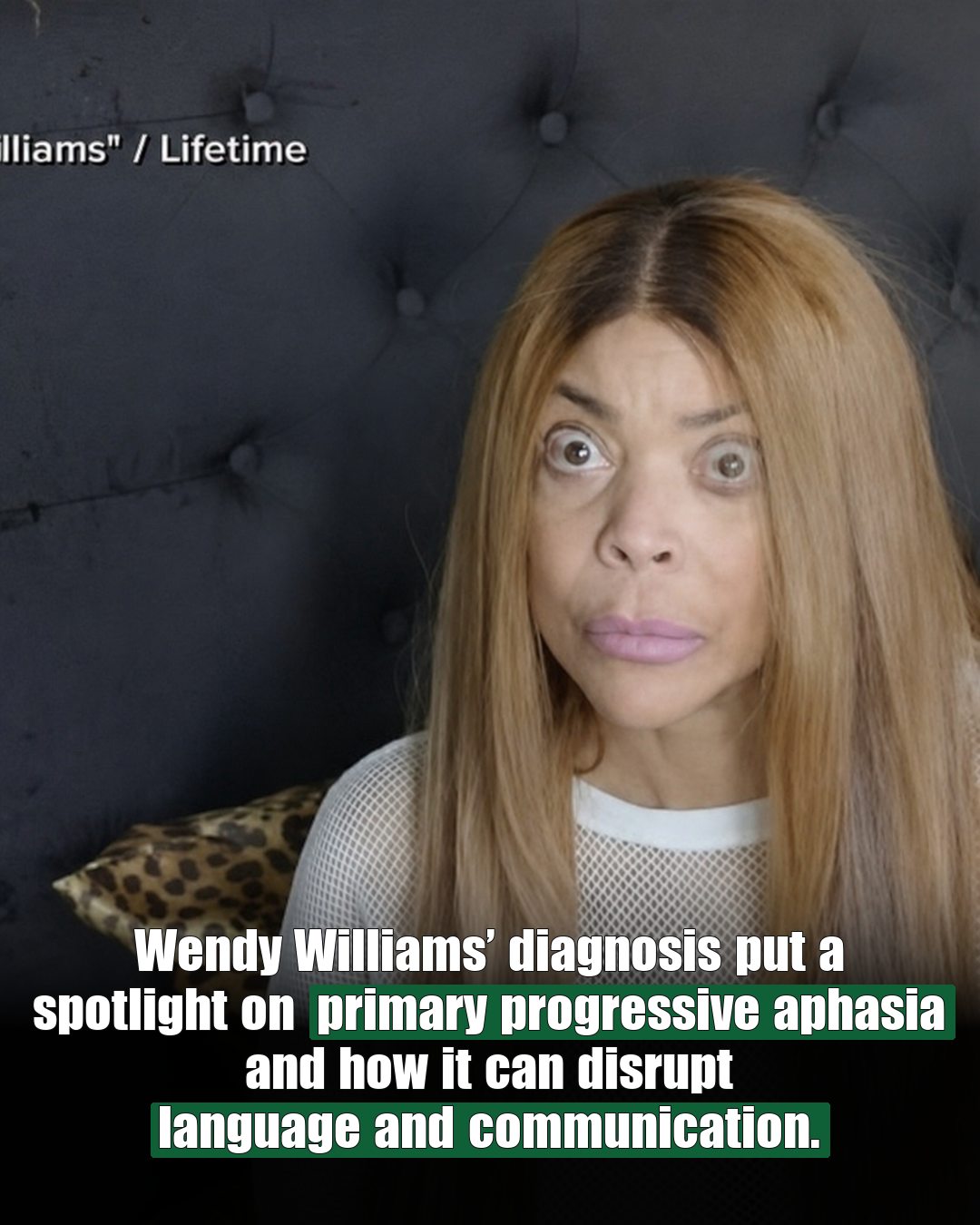

Wendy Williams spent more than a decade as one of daytime television’s most recognizable hosts, known for a direct, unfiltered style on The Wendy Williams Show.
In 2024, a health announcement introduced many viewers to a condition most people had never heard of before.
Williams’s team shared that she had been diagnosed with primary progressive aphasia, along with frontotemporal dementia.
That announcement, and everything that has happened since, has put a public spotlight on a group of conditions that quietly affect language long before they affect memory in the way many people expect dementia to.
Williams built her career on radio before moving to television, developing a reputation for candid celebrity interviews and an outspoken on air personality.
The Wendy Williams Show ran for more than a decade before ending production in 2022, the same year her health situation first became a matter of public concern.
What Was Announced, and What Has Happened Since
The diagnosis was shared publicly in February 2024.
That announcement came around the same time a Lifetime documentary titled “Where Is Wendy Williams” aired.
The documentary covered events in her life going back to 2022.
Williams had already been under a court appointed financial guardianship since 2022, after a bank raised concerns about her health and finances.
In the time since her diagnosis was announced, Williams has spoken publicly on more than one occasion to dispute how her guardianship has been handled.
In a January 2025 radio interview, she pushed back strongly against claims that she is legally incapacitated and described parts of her situation in sharply critical terms.
Her niece has also spoken publicly in support of Williams and has pushed for changes to her guardianship arrangement.
In March 2025, Williams underwent a new round of cognitive testing as part of the ongoing legal case over her guardianship, and she later said in a television interview that she had stopped drinking alcohol.
Public reporting in late 2025 noted that a neurologist involved in that court ordered evaluation raised questions about the original 2023 dementia diagnosis, based on the newer exam findings.
That is a genuinely unresolved part of her story. Williams’s exact current diagnosis, and how settled it is, remains disputed in public reporting rather than fully confirmed one way or the other.
What has not been disputed is that the situation has been difficult for Williams and her family, and that it has unfolded largely in public.
That combination of a serious health question and a public legal fight is unusual, and it is part of why her story has drawn so much attention.
Her Own Words
Williams has repeatedly said in interviews that she does not feel her guardianship reflects who she actually is or what she is capable of.
She has described feeling controlled by decisions made on her behalf, and has said she wants more say over her own daily life and finances.
She has also spoken about giving up alcohol, framing it as a personal choice tied to taking better care of herself going forward.
Whatever the final word on her diagnosis turns out to be, Williams has been consistent in wanting to speak for herself in public rather than only being described by others.
What Primary Progressive Aphasia Actually Is
Primary progressive aphasia, often shortened to PPA, is a condition where a person’s language abilities decline gradually over time.
It was first formally described by neurologist M-Marsel Mesulam in a landmark 1982 paper in the Annals of Neurology, which identified a pattern of slowly worsening language problems that occurred without the broader memory loss typically associated with dementia early on.
PPA affects the ability to find words, follow conversation, read, or write, while a person’s insight and personality often stay intact for some time.
That distinction matters. A person with PPA can struggle to get a sentence out while still fully understanding what is happening around them, which is very different from how memory loss conditions typically progress.
Researchers describe several subtypes of PPA, each affecting language in a slightly different way.
One subtype mainly affects grammar and fluent, easy speech production.
A second subtype mainly affects a person’s ability to understand and name common words and objects.
A third, called the logopenic variant, mainly affects word finding and the ability to repeat longer sentences, and it is closely linked to specific patterns of brain change.
A 2013 study in the journal Brain and Language used repeated brain scans to track how this logopenic variant progresses over time, mapping the specific regions where language processing breaks down.
PPA overlaps closely with a broader group of conditions called frontotemporal degeneration, which is why Williams’s announcement mentioned both terms together rather than just one.
Why Aphasia Awareness Matters Beyond One Diagnosis
Aphasia is often misunderstood by the public as confusion, low intelligence, or disinterest, when it is really a communication barrier layered on top of an otherwise intact mind.
That misunderstanding can be isolating for people living with it, and painful for families trying to explain what is happening to someone they love.
A 2020 report from the Lancet Commission on dementia prevention, intervention, and care reviewed the modifiable factors linked to dementia risk across a person’s life, including physical activity, social engagement, and cardiovascular health.
The commission’s broader point was that public understanding of these conditions, and reducing the stigma around them, is part of what helps families get an accurate diagnosis and appropriate support sooner rather than later.
A public figure’s diagnosis, confirmed or contested, can genuinely push that understanding forward, even when the specific facts of the case remain unsettled.
Regular movement and cognitive engagement are part of general brain health guidance, and readers curious about that connection can look at the research on whether exercise itself supports brain health as we age.
What This Comparison Does Not Prove
None of the general PPA and dementia research can confirm or rule out what is actually happening with Williams specifically.
Her case involves a legal guardianship dispute, competing medical opinions, and a public disagreement between family members, none of which is typical of most PPA cases.
The scientific literature on PPA describes the condition in general terms across many patients. It cannot settle an individual, contested diagnosis playing out in a courtroom.
Readers should treat her specific medical status as an open, disputed question rather than a settled fact in either direction.
Who Should Talk to a Doctor First
Anyone who notices gradual word finding problems, trouble following conversations, or difficulty reading and writing in themselves or a loved one should bring it up with a doctor.
These symptoms are easy to dismiss as stress, tiredness, or normal aging, especially when they start subtly.
A neurologist can order the right kind of evaluation, which often includes brain imaging and detailed language testing, to help identify what is actually going on.
Getting an accurate diagnosis early matters because different causes of language decline are managed differently, and some causes are more treatable than others.
Family members who suspect a loved one may need a guardianship arrangement should also involve an elder law attorney and a geriatric care specialist early, since these situations carry real legal and emotional weight.
Anyone supporting a family member through a PPA or dementia diagnosis should also take care of their own mental health, since caregiving for a progressive condition is demanding over the long term.
Caregiver support groups, whether in person or online, are worth seeking out early rather than waiting until burnout sets in.
A second medical opinion is a reasonable request, not an insult to the first doctor, especially for a diagnosis as serious and life changing as PPA or frontotemporal dementia.
How Families Can Respond to Early Language Changes
Write down specific examples of the changes you are noticing, including when they started and how often they happen, before your first doctor’s visit.
Bring a family member or friend to appointments when possible, since they can help remember details and ask follow up questions.
Ask directly whether a referral to a neurologist or a speech language pathologist is appropriate, rather than waiting for a primary care doctor to suggest it.
Learn basic communication strategies that speech therapists commonly recommend for aphasia, such as speaking in shorter sentences, allowing extra time for a response, and using gestures or writing to support conversation.
Avoid finishing sentences for someone with word finding trouble unless they ask for help, since it can feel frustrating even when it is meant kindly.
Reduce background noise during conversations when possible, since a quieter setting makes it easier for someone with aphasia to focus on following and joining in.
Connect with a support organization focused on aphasia or frontotemporal degeneration, since talking with other families in a similar situation can reduce the isolation that often comes with an unfamiliar diagnosis.
Revisit the diagnosis and care plan periodically with the medical team, since conditions like PPA can be reassessed as new symptoms appear or as testing improves.
Be patient with yourself and with the person experiencing the changes. Progress in managing these conditions is usually measured in small, steady adjustments rather than dramatic turnarounds.
References
- Mesulam, M-Marsel. (1982). Slowly progressive aphasia without generalized dementia. Annals of Neurology, 11(6), 592 to 598.
- Rohrer, J. D., Caso, F., Mahoney, C., Henry, M., Rosen, H. J., Rabinovici, G., Rossor, M. N., Miller, B., Warren, J. D., Fox, N. C., Ridgway, G. R., & Gorno-Tempini, M. L. (2013). Patterns of longitudinal brain atrophy in the logopenic variant of primary progressive aphasia. Brain and Language, 127(2), 121 to 126.
- Livingston, G., Huntley, J., Sommerlad, A., Ames, D., Ballard, C., Banerjee, S., Brayne, C., Burns, A., Cohen-Mansfield, J., Cooper, C., Costafreda, S. G., Dias, A., Fox, N., Gitlin, L. N., Howard, R., Kales, H. C., Kivimaki, M., Larson, E. B., Ogunniyi, A., Orgeta, V., Ritchie, K., Rockwood, K., Sampson, E. L., Samus, Q., Schneider, L. S., Selbaek, G., Teri, L., & Mukadam, N. (2020). Dementia prevention, intervention, and care: 2020 report of the Lancet Commission. The Lancet, 396(10248), 413 to 446.
This article is for general information and is not medical advice. It is not an assessment of any individual’s diagnosis or legal situation. Anyone noticing language changes in themselves or a loved one should talk with a doctor, and anyone facing a guardianship question should consult a qualified attorney.