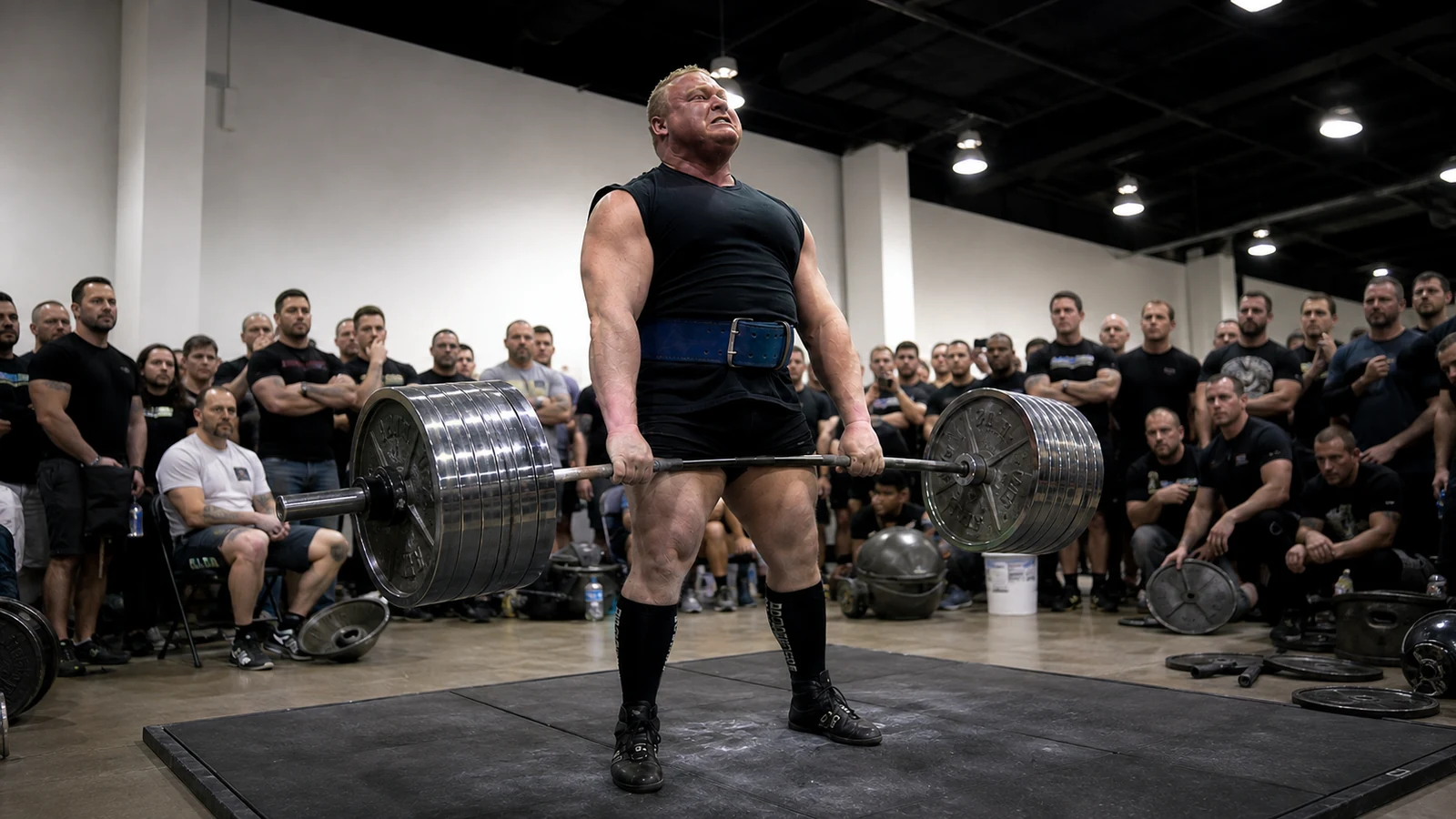

In April 2011, a 27-year-old strongman from Iceland walked up to a loaded barbell in Texas.
No suit. No straps. Just chalk, a belt, and raw strength.
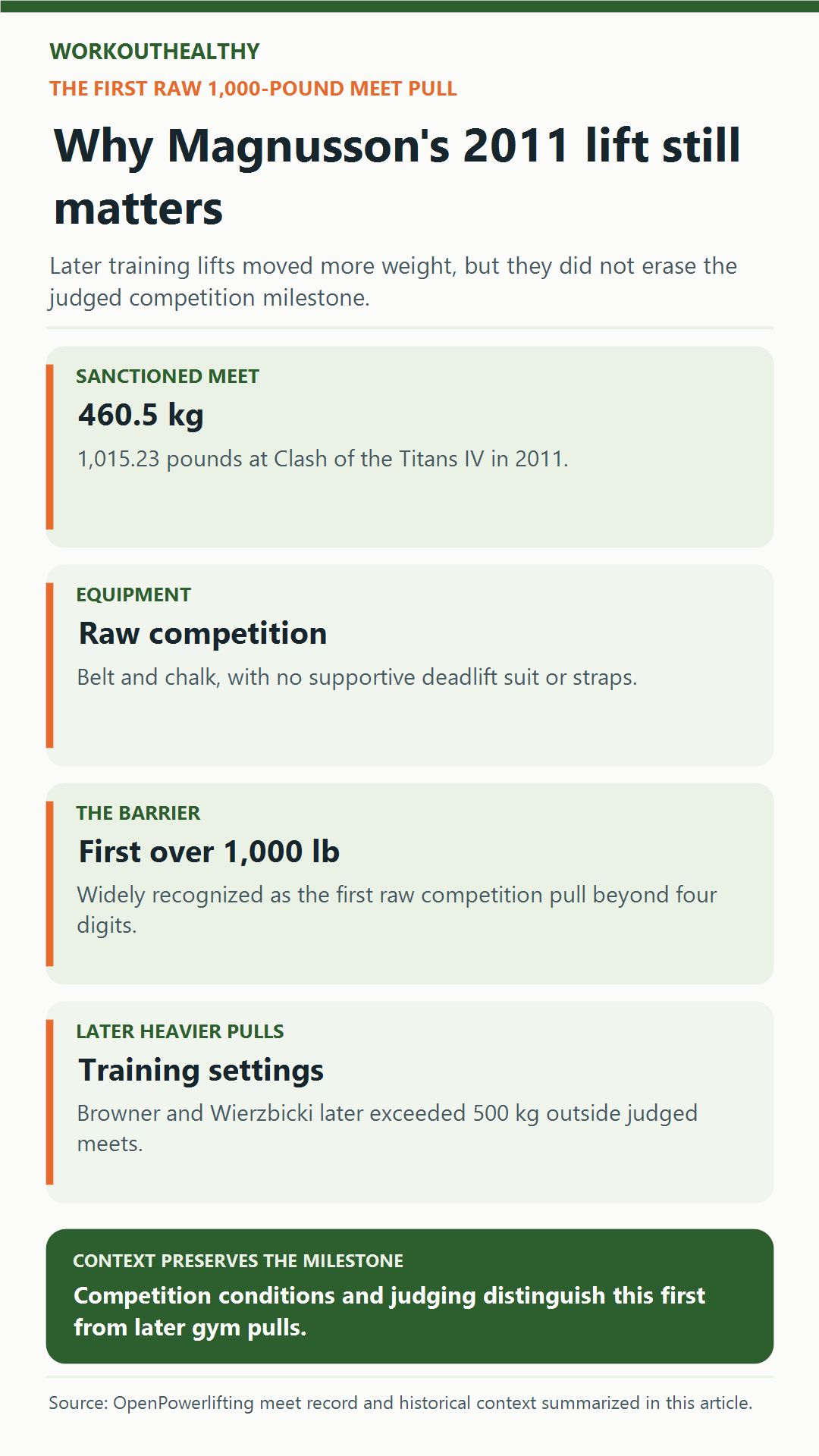
Benedikt Magnusson locked out 460.5 kilograms, which converts to 1,015.23 pounds.
The crowd erupted, and for good reason.
It became widely known as the first raw deadlift over 1,000 pounds ever pulled in a real, judged competition.
That claim gets repeated often, and mostly it holds up.
But “first ever” and “officially certified world record” are not always the same thing, and this record sits right on that line.
What Actually Happened at Clash of the Titans IV
The meet was called Clash of the Titans IV, part of the 2011 Ronnie Coleman Classic weekend in Texas.
Public meet records from OpenPowerlifting, an open database built from official federation results, list the lift under a federation called Hardcore.
Magnusson competed in the Open division, raw category, at age 27.
He placed first with a 460.5 kilogram deadlift, entered into the results as Raw equipment.
That detail matters more than it sounds like it should.
A federation result means judges were watching for a full lockout, no straps, and no supportive gear beyond a belt and chalk.
It also means the lift is on public record, tied to a specific meet, date, and federation, rather than only living inside a highlight video.
Raw vs. Equipped: What “No Suit, No Straps” Actually Means
Powerlifting splits into two broad categories, raw and equipped.
Equipped lifting allows supportive suits and shirts that store elastic energy and can add real weight to a max lift.
Raw lifting strips that away.
A raw deadlift can still use a belt and chalk, but nothing that assists the pull itself.
Straps are a separate issue entirely.
Straps wrap the wrist to the bar and remove grip strength as the limiting factor.
Many gym lifters use them without thinking twice.
In competition, straps are banned outright, so grip becomes part of the test.
Magnusson’s pull had neither a suit nor straps, which is why record trackers describe it as a true raw deadlift rather than an equipped or strap-assisted number.
That distinction is also why not every huge number you see online belongs in the same conversation as this one.
The Biomechanics Behind a Max Conventional Pull
Magnusson pulled in a conventional stance, feet roughly hip width, hands outside the knees.
That is the harder of the two common deadlift stances to load heavy.
A biomechanical comparison of conventional and sumo deadlifts found that the conventional stance places greater demand on the lower back and hip extensors, while sumo shifts more work toward the hips and quadriceps (Escamilla et al., 2000).
In practice, that means a max conventional pull asks the spine and hip hinge to do more of the work than a sumo pull of the same weight would.
A 460.5 kilogram conventional lift also has to travel further before the hips can help drive the bar, since the setup position sits lower to the floor.
None of that is a technicality for spectators.
It is the reason lifters and coaches treat a conventional raw pull at this weight differently than an equally heavy sumo or strapped pull.
Why Round Numbers Like 1,000 Pounds Play Tricks on the Brain
There is a real psychological effect behind chasing a round number, and it is not unique to powerlifting.
Researchers studying more than nine million marathon finish times found that runners clustered heavily just under round-number barriers like three or four hours, and pushed noticeably harder in the final stretch to get under them (Allen et al., 2017).
People do not just want to run fast.
They want to beat a number that feels meaningful, even when the difference between 4:01 and 3:59 changes almost nothing physically.
Big barriers usually fall only after one person is willing to look impossible in the eye.
Deadlifting works the same way.
A 985 pound pull and a 1,015 pound pull are close in raw physical terms.
But one sits under four digits and one sits over them, and that gap is what turned Magnusson’s lift into a story people still tell 15 years later.
Competition Lift vs. Training Pull: The Distinction That Gets Blurred
This is the part of the story that most retellings flatten out.
Magnusson’s 1,015.23 pound pull happened at a sanctioned meet, under a federation, with judges and a placing.
The lifters who have since pulled more raw weight, Jamal Browner and Krzysztof Wierzbicki, both surpassed 1,102.31 pounds in training settings, not inside a judged competition.
A gym pull can still be filmed, real, and genuinely heavy.
What it usually lacks is a judge checking depth and lockout in real time, a federation entering the result into a public database, and drug testing tied to the specific meet.
Those differences do not erase what Browner and Wierzbicki did.
They do mean the two kinds of lifts answer different questions.
One asks “what is the heaviest raw weight a person has ever pulled off the floor.”
The other asks “what is the heaviest raw weight verified inside a competition, under judges, at a specific meet.”
Magnusson still holds a strong claim to the second question.
The first question has moved on since 2011, and this article is not trying to argue otherwise.
Was This Ever an Officially Certified World Record?
Here is the honest answer, checked directly rather than assumed.
The lift is on record with a real powerlifting federation, Hardcore, inside a public meet database.
That is a genuine, verifiable, judged result, not an internet rumor.
What this research did not find was a dedicated Guinness World Records listing specifically for this 460.5 kilogram pull.
That does not prove no such Guinness entry exists anywhere.
It means the number should be described carefully.
Powerlifting does not have one single global record book the way, say, track and field does through World Athletics.
Records get tracked separately by dozens of federations, plus independent databases and strength media outlets that build their own “all time” lists from federation results.
Record verification looks very different across the fitness world.
A Guinness-certified age category record, like Edith Connor’s oldest female bodybuilder title, goes through one central body with a clear application process.
Raw deadlift records do not work that way, and that gap is exactly why a widely repeated claim like “first raw 1,000 pound deadlift” can be true in substance while still not carrying one single official seal.
The most accurate summary is this: a real, judged, competition-verified lift, widely treated across the strength community and multiple reference sources as the first of its kind, but not something that traces back to one centralized certifying authority the way some other fitness records do.
Common Mistakes People Make Repeating This Claim
The most common error is treating “raw” and “no straps” as the same thing.
They overlap, but a lifter can be raw and still use straps in a gym setting, just not in most competitions.
Another common mistake is assuming every huge deadlift number floating around online happened in competition.
Plenty of the biggest raw numbers people cite today, including the ones that eventually passed Magnusson’s total, came from training sessions rather than meets.
That does not make them fake.
It does mean they should not be compared to a competition result as if the two were tested the same way.
A third mistake is calling any large, well known number a “Guinness world record” by default.
Guinness certifies a specific, defined set of feats through its own application process.
Plenty of legitimate strength milestones, this one included, sit outside that specific system entirely.
Training Toward a Meaningful Deadlift Milestone Safely
Most readers are not chasing 1,015 pounds, but the principles behind a safe max attempt scale down.
Grip is the first limiting factor to train deliberately if you plan to pull without straps.
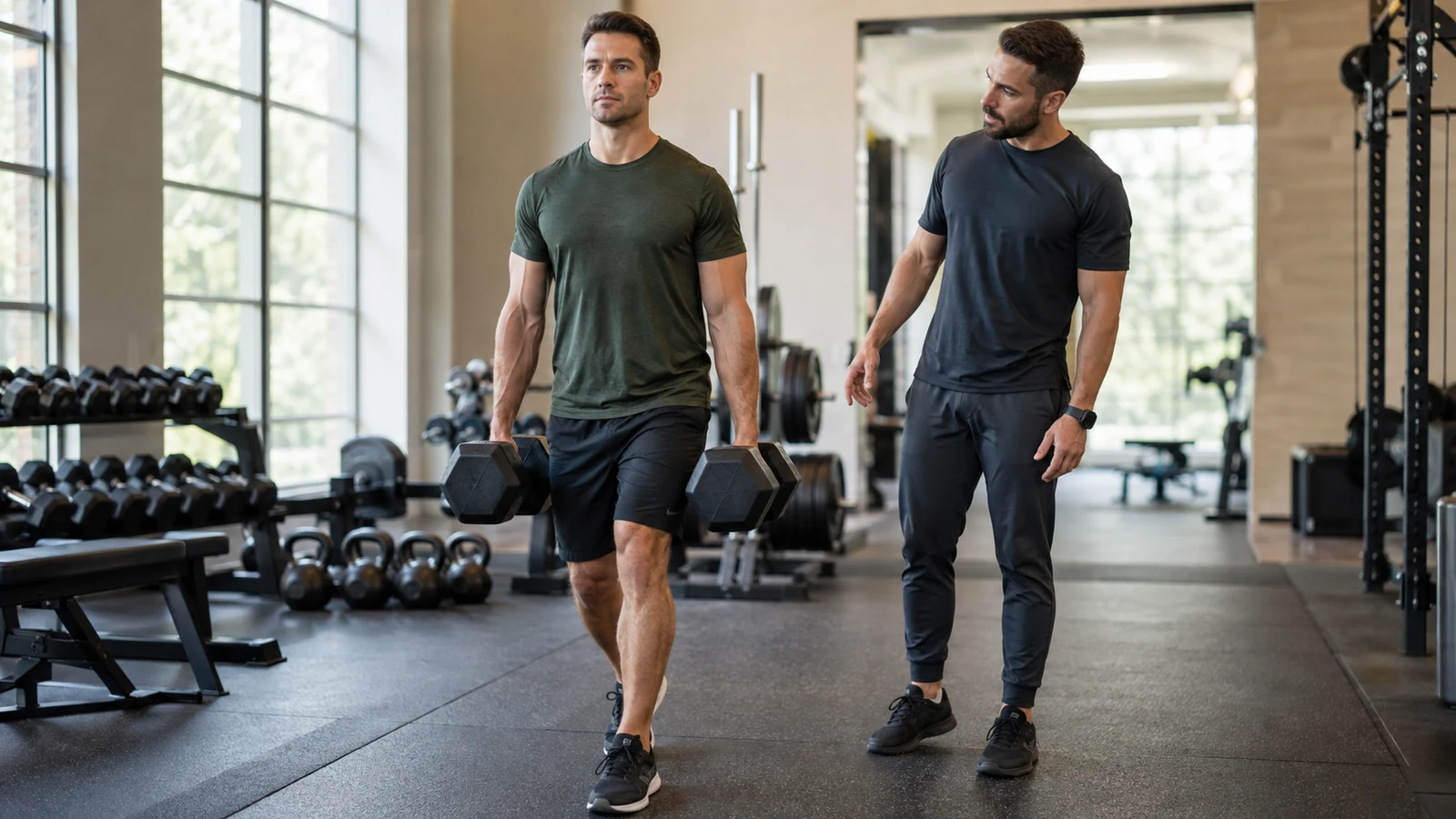
Rotating between a double overhand grip and a mixed or hook grip during heavy training sets builds the forearm and hand strength that straps otherwise mask.
Bar path matters as much as raw strength.
The bar should travel in a nearly straight vertical line, staying close to the shins and thighs throughout the pull.
A bar that drifts forward turns a strong lifter’s pull into a weak position almost instantly.
Bracing comes before the pull even starts.
A full breath into the belly, followed by tightening the core against that breath, protects the spine far more than simply “keeping your back straight” as a cue.
Straight bar biomechanics research supports treating the setup and bar path as separate skills worth training on their own, not just an afterthought before adding weight (Swinton et al., 2011).
Progress toward a personal milestone gradually, adding small increases over months rather than jumping straight to a single all-out attempt.
Work with a qualified coach for any true one-rep max attempt, especially past your current best.
A spotter alone is not enough for a deadlift the way it is for a bench press, since there is no safe way to bail out from underneath a bar that will not come up.
None of that requires chasing a round number for its own sake.
Consistent, well paced training tends to beat single dramatic attempts, in strength sports just as much as in endurance ones.
Who Should Be Extra Cautious With Max-Effort Deadlifts
A true one-rep max deadlift attempt raises blood pressure sharply for a few seconds, through a breath-holding technique called the Valsalva maneuver.
Anyone with uncontrolled high blood pressure, a diagnosed heart condition, or a hernia should talk to a doctor before attempting a near-max pull, raw or otherwise.
People recovering from a back injury, a disc issue, or recent spinal surgery need medical clearance first, not just a lighter warm-up weight.
Pregnant lifters should also check with their doctor, since heavy Valsalva breathing and abdominal pressure changes carry different considerations during pregnancy.
Beginners in particular should build technique at lighter loads for months before testing any kind of max, since the injury risk in a max pull comes mostly from unfamiliar loading on unpracticed positions.
None of this is a reason to avoid deadlifting.
It is a reason to treat a true max attempt as a planned, coached event rather than something to try on a random Tuesday.
Watch the Original Video
Watching the clip makes the 2011 framing easier to understand.
There is no bar bend theatrics and no slow-motion replay, just a heavy bar coming off the floor and a room that knows exactly what it is watching.
Readers still gravitate toward raw strength feats like this one more than almost any other kind of fitness content, and a clean lockout on a four-digit number is a big part of why.
Want more record stories checked against the actual source, not just the caption. Subscribe to WorkoutHealthy Insider for practical explanations behind popular fitness claims.
References
Allen, E. J., Dechow, P. M., Pope, D. G., & Wu, G. (2017). Reference-dependent preferences: Evidence from marathon runners. Management Science, 63(6), 1657-1672. https://doi.org/10.1287/mnsc.2015.2417
Escamilla, R. F., Francisco, A. C., Fleisig, G. S., Barrentine, S. W., Welch, C. M., Kayes, A. V., Speer, K. P., & Andrews, J. R. (2000). A three-dimensional biomechanical analysis of sumo and conventional style deadlifts. Medicine & Science in Sports & Exercise, 32(7), 1265-1275. https://doi.org/10.1097/00005768-200007000-00013
Swinton, P. A., Stewart, A., Agouris, I., Keogh, J. W. L., & Lloyd, R. (2011). A biomechanical analysis of straight and hexagonal barbell deadlifts using submaximal loads. Journal of Strength and Conditioning Research, 25(7), 2000-2009. https://doi.org/10.1519/JSC.0b013e3181e73f87
This article is for general information only and is not medical advice. If you have an injury, ongoing pain, or a medical condition, talk to a doctor or physical therapist before you change how you train or eat.