
David Harbour’s change between seasons three and four of Stranger Things was real, but the shorthand version—“80 pounds with fasting and Pilates”—leaves out almost everything a reader would need to judge it. Harbour told British GQ that he went from about 270 pounds to about 190 over eight months for the story in which Jim Hopper is imprisoned. He described intermittent fasting and Pilates, but later also named running, weight training, and substantial food restriction. That makes this a report about one actor’s temporary, role-specific preparation, not a reproducible weight-loss prescription (King, 2022a; Kain, 2022).
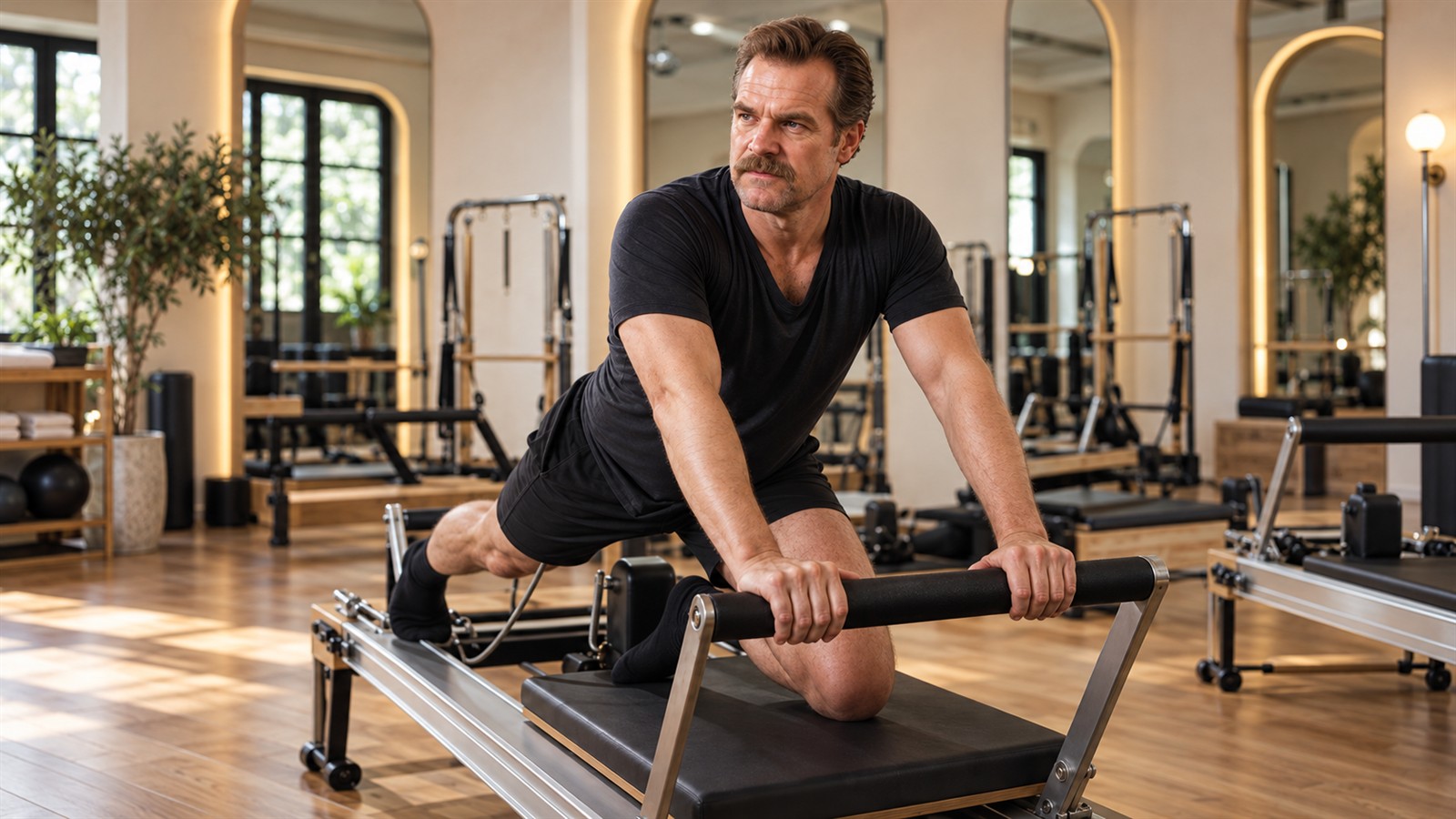
The most important distinction is between what Harbour reported, what independent research can support, and what remains unknown. We know his approximate self-reported starting and ending weights. We do not have a published body-composition assessment, a complete training log, or a clinical evaluation proving that Pilates preserved a particular amount of muscle. The Facebook illustration accompanying this story is editorial art, not a photograph of Harbour’s actual training session.
What Harbour actually said
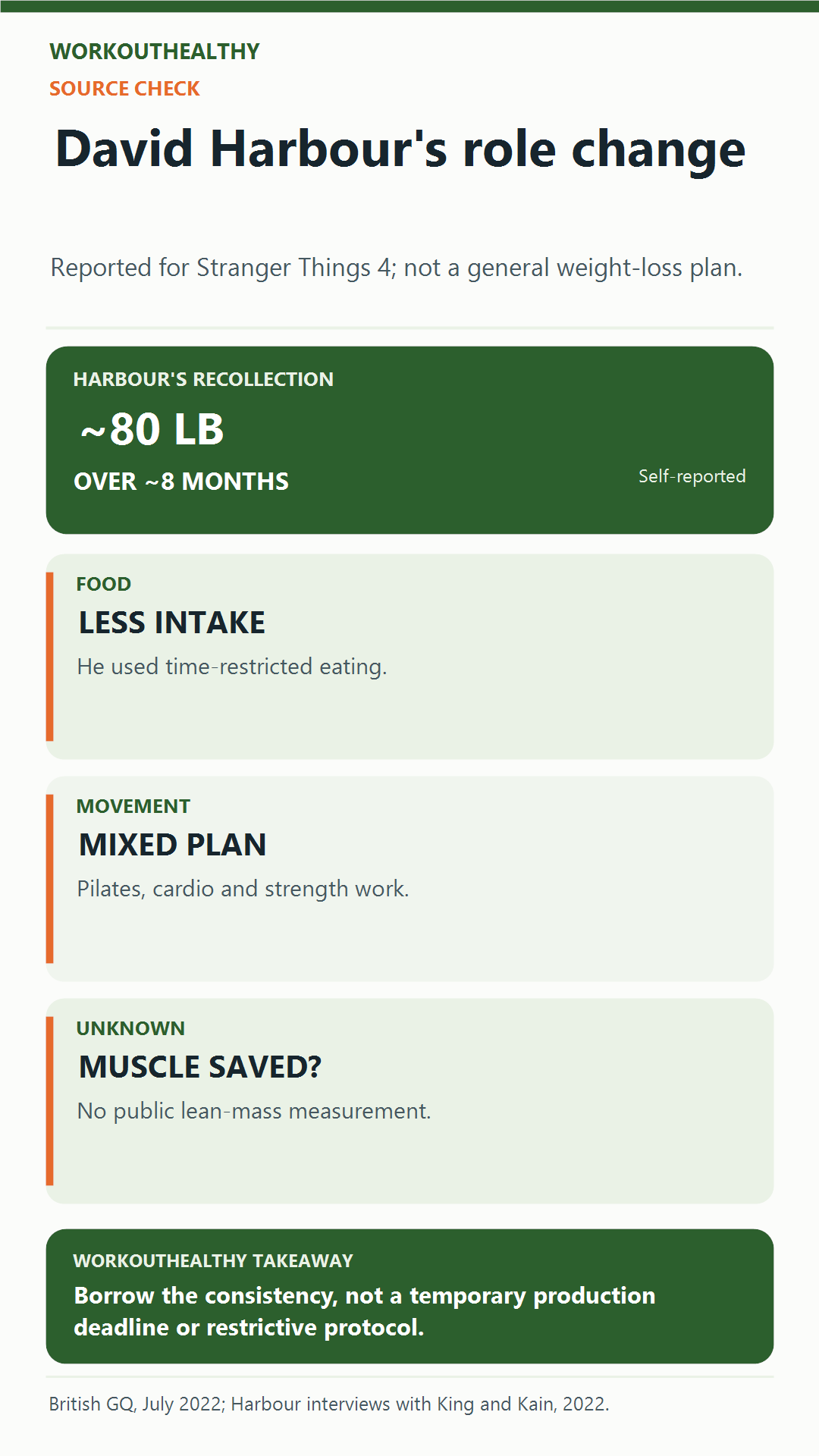
In a July 2022 British GQ interview, Harbour recalled being roughly 270 pounds around season three and roughly 190 when season four was filmed. He placed the change at about eight months, said he had taken up intermittent fasting and Pilates, and told the interviewer he did not expect to repeat the process (King, 2022a). The numbers are his recollection, not independently measured study outcomes.
A later GQ account of his discussion with trainer and physical therapist David Higgins adds important detail. The exercise plan included mobility and activation, kettlebell work, Pilates, and steady-state cardio (King, 2022b). An interview with Forbes adds running and weight training to Harbour’s own description, while he emphasized that most of his weight change came from eating less (Kain, 2022). Saying “Pilates caused the 80-pound loss” would therefore misrepresent even Harbour’s explanation.
The transformation served a fictional role. Hopper’s physical appearance was meant to reflect imprisonment and deprivation, not a model of health. Harbour later gained weight for another role and described the up-and-down cycle as something he would not want to keep doing. A production goal can be visually compelling while still being a poor health goal for a viewer.
Why the eight-month timeline matters
Eighty pounds sounds sudden when a headline omits time. Spread over about eight months, the reported change averages a little over two pounds per week. That arithmetic does not imply a smooth weekly curve: changes in fluid, food intake, training, and measurement can shift the scale differently from week to week. It also does not tell us his body-fat or lean-mass change.
The Centers for Disease Control and Prevention describes gradual loss of about one to two pounds a week as more likely to be maintained than faster loss for many people. Harbour’s approximate average sits at or slightly above that range, and his circumstances were unusual. He had a specific production deadline and professional support; those facts do not establish that his method was appropriate for someone else (CDC, 2025).
A weight number is not an outcome by itself. A clinician would also consider medical history, medications, blood pressure, symptoms, eating behavior, functional strength, and whether a person can sustain the new pattern without excessive distress. None of those can be inferred from a before-and-after image or an interview. The useful timeline question is not “How fast can I copy this?” but “What health and performance costs accompany this rate for me?”
What fasting did—and did not—show
Harbour said restricting when he ate helped him limit intake in a work life shaped by set catering and irregular meals. In the Forbes interview, he spoke candidly about eating much less, including very narrow eating windows on some days, and about the discomfort of hunger (Kain, 2022). That personal account explains a mechanism by which his total calorie intake fell; it is not evidence that everyone needs the same schedule.
Randomized research helps separate a workable structure from a special metabolic effect. In a 12-month trial of adults with obesity, a group using time-restricted eating plus calorie restriction lost weight, but the difference from daily calorie restriction alone was not statistically significant (Liu et al., 2022). Trials differ in timing, participants, and adherence, so one study does not settle every fasting question. It does show why “fasting itself was the secret” is too strong.
For some people, a meal window is a convenient way to organize eating. For others, it conflicts with shifts, family meals, training, medication, or a history of disordered eating. People who are pregnant, have diabetes treated with glucose-lowering medicine, or have other medical conditions should not copy a celebrity’s restrictive regimen without individualized clinical guidance. Hunger and exhaustion are not proof that a strategy is superior.
Our related explainer on fasting and hunger cues looks at why noticing appetite is different from treating all hunger as something to defeat. The practical question is whether an eating pattern supports adequate nutrition and daily functioning over time, not whether it produces a dramatic short-term photograph.
The role of Pilates and other exercise
Harbour and Higgins described a mixed program rather than a single training method. Pilates can challenge trunk control, coordination, and movement quality. Mobility, kettlebell work, running, and conventional resistance exercises train other capacities. That variety is plausible for an actor preparing to move and perform on camera; it is not evidence that one named modality caused the entire body change (King, 2022b; Kain, 2022).
Harbour later discussed low-heart-rate running as something he valued for how he felt, not merely for his weight. He described beginning with short run–walk bouts and building consistency. That slower, adaptable part of the story is easier to translate into ordinary life than the role-specific food restriction. His experience is still an anecdote, however; an enjoyable routine should be selected around one’s own health, preferences, and current capacity.
A systematic review of Pilates and body composition in healthy people found small and mixed studies, with too little high-quality evidence to make a confident claim about body-composition effects (Silva et al., 2022). A separate meta-analysis did not find mat Pilates superior to comparison conditions for lean mass or the other pooled body-composition measures it evaluated (de Souza Cavina et al., 2020). None of that makes Pilates useless. It means that an attractive explanation—Pilates “saved” the actor’s muscle—must not be upgraded from a possibility to a verified fact.
The unproven muscle-preservation claim
The social caption says Pilates helped Harbour hold onto core strength and lean muscle. The first part is a reasonable description of what Pilates often trains; the second is a specific body-composition outcome that the public record cannot establish. No before-and-after lean-mass scan or controlled comparison was presented in the interviews. Harbour also reported weight training, so there is no way to isolate a Pilates effect from his other activity and diet.
Even the phrase “lean muscle” can mislead. Skeletal muscle is lean tissue; what people usually mean is the amount of muscle retained during weight loss. Preserving it depends on several factors, including the size of the energy deficit, adequate dietary protein, resistance training, recovery, and individual biology. A person can lose scale weight while also losing some muscle. A photo cannot measure the division.
The stronger editorial claim is narrower: Harbour continued moving, including Pilates and strength work, while losing weight for the role. We cannot quantify which activity protected what tissue. That distinction matters because someone considering an aggressive diet might otherwise assume one Pilates class makes a large restriction safe. An exercise method cannot erase the risks of inadequate intake or medical contraindications.
The cost of a role-specific transformation
Harbour spoke about the physical and mental difficulty of the process, and later described regaining weight for Violent Night. In the Forbes interview he said a doctor had warned him against continuing the cycle of major role-driven changes (Kain, 2022). We do not know his personal medical details, and there is no reason to speculate about diagnoses. His own public account is enough to reject the idea that the transformation was effortless or a universally healthy template.
Rapid changes can also distort the lesson viewers take from celebrity stories. The actor’s appearance is one component of a production, with costume, lighting, camera angles, scheduling, and a temporary narrative goal. Audiences see the result, not the private trade-offs. A before-and-after frame does not tell a viewer how the person slept, felt, trained, or ate day after day.
If weight change is a personal health goal, it is more useful to establish a realistic plan with a qualified professional than to reverse-engineer a role. The CDC emphasizes an eating pattern, physical activity, sleep, and stress management rather than a single trick (CDC, 2025). If exercise itself is the goal, a modest repeatable practice has value even when the scale barely moves.
A more useful takeaway
There are three transferable lessons, none of which requires copying an extreme protocol. First, Harbour’s case illustrates that a deadline and support can produce a dramatic result, but dramatic is not the same as sustainable. Second, a structured eating pattern may help some people eat less; it is not uniquely required for fat loss and should fit medical needs. Third, the movement plan was varied and adjusted—not just Pilates, and not proof of muscle preservation by Pilates.
A reader who wants to start can choose one manageable change: make meals more consistent, add a comfortable walk, or begin supervised resistance training. Track how the plan affects energy, strength, hunger, sleep, and mood as well as weight. Change course if it produces dizziness, persistent fatigue, or obsessive restriction. A professional can help tailor goals when medical conditions or a history of disordered eating make self-directed dieting risky.
Harbour’s most useful line is his later emphasis on simply showing up for activity. That is a more humane and durable takeaway than treating a fictional character’s prison look as a health standard. Borrow the consistency and the willingness to train; leave the extreme production timeline behind.
Bottom line: Harbour reported losing about 80 pounds over eight months for Stranger Things, using substantial dietary restriction along with Pilates and other exercise. The public evidence does not show that Pilates preserved a specific amount of muscle or that his fasting schedule is superior for everyone. This story is informational, not individualized nutrition or medical advice.
References
- King, J. (2022a, July 4). David Harbour on failure, Lily Allen and that mindblowing Stranger Things finale. British GQ.
- King, J. (2022b, July 26). How David Harbour lost more than 75 pounds for Stranger Things 4. British GQ.
- Kain, E. (2022, December 23). David Harbour on the run: The Stranger Things star on fitness. Forbes.
- Liu, D., et al. (2022). Calorie restriction with or without time-restricted eating in weight loss. New England Journal of Medicine, 386, 1495–1504.
- Silva, L. L., et al. (2022). Is the Pilates method efficient to cause changes in the body composition of healthy individuals? A systematic review. Journal of Bodywork and Movement Therapies, 32, 51–59.
- de Souza Cavina, A. P., et al. (2020). Effects of the mat Pilates method on body composition: Systematic review with meta-analysis. Journal of Physical Activity and Health, 17(6), 673–681.
- Centers for Disease Control and Prevention. (2025). Steps for losing weight.