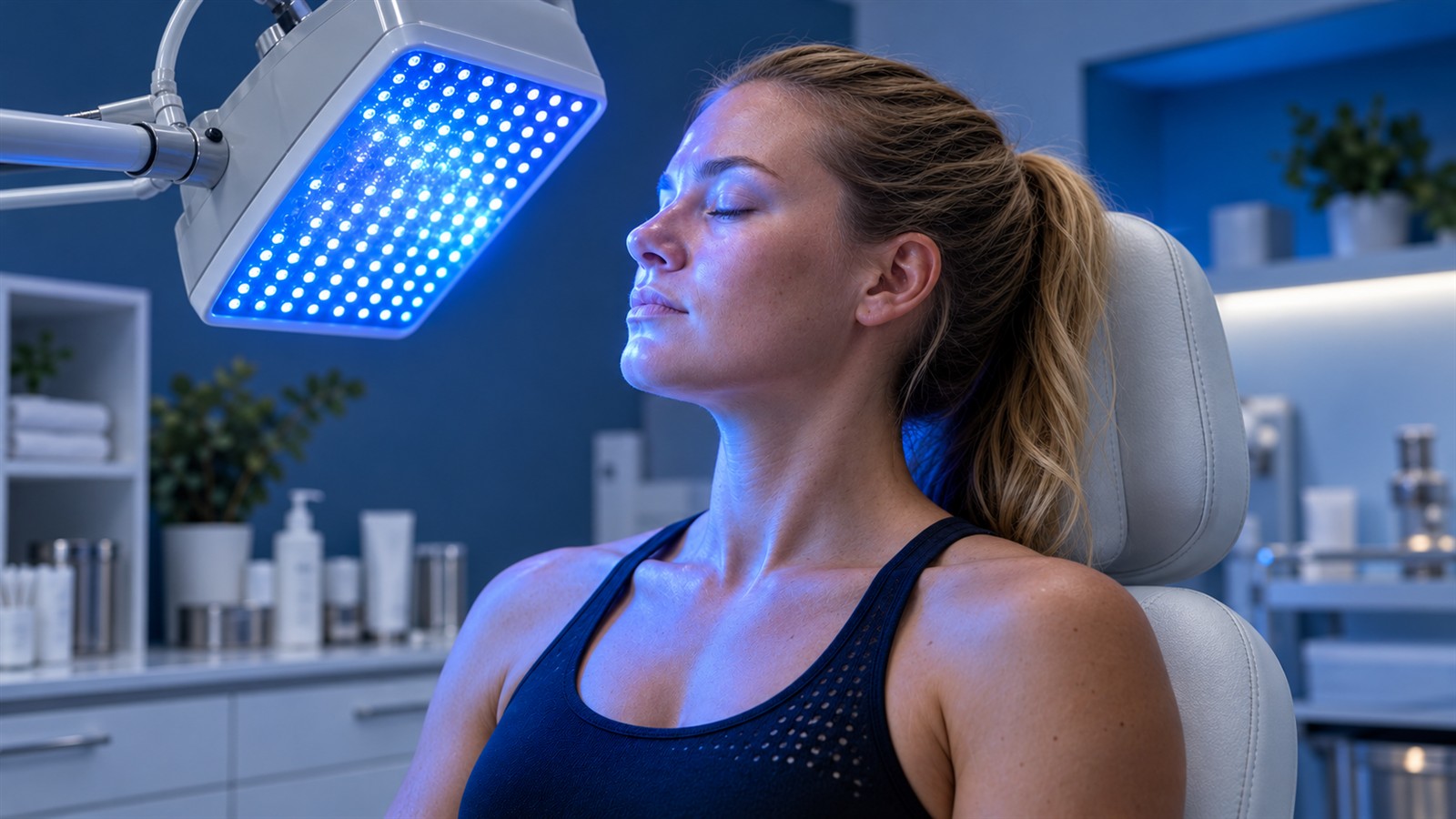

Image context: The opening image is an editorial reconstruction, not a study patient or a demonstration of a safe treatment setup. Closed eyes are not a substitute for required eye protection; follow the specific protection requirements provided by the treating clinician and the actual device instructions.
Blue light for acne can improve some acne outcomes, but the benefit depends on the people, light system and comparison studied. Human trials support a more cautious answer than claims that a laboratory bacterial reduction means complete skin clearance.
The useful questions are whether a study counted pimples or bacteria, whether improvement exceeded a comparison treatment, and whether its findings apply to the care being considered. A percentage without those details can sound much more certain than the evidence allows.
What blue light can and cannot tell us about acne
Some acne research targets light-sensitive compounds produced by Cutibacterium acnes, the bacterium formerly called Propionibacterium acnes. A plausible bacterial mechanism does not establish how much acne will improve in a person.
Clinical studies therefore matter more for the question a person is asking: did visible acne improve, compared with what, and for how long? A laboratory survival count, a percentage change in lesions and an investigator’s severity score answer different questions.
The American Academy of Dermatology’s patient guidance describes visible light as an option for pimples, with variable results and frequent use alongside other care. It does not present light as a universal treatment for every acne lesion.
Five studies and the comparisons behind their headlines
Read the comparison column before the result column. Improvement from a person’s own starting point is useful information, but it is weaker evidence of a treatment effect than a well-designed comparison against a suitable control.
| Evidence | People or material | Comparison and outcome | Important limit |
|---|---|---|---|
| 450-nanometer pulsed-light experiment, online 2019 | Bacterial cultures, not acne patients | Pulsed versus continuous conditions; optimized repeated exposure produced a reported seven-log bacterial reduction | No patient lesion, scar or clearance outcome |
| 420-nanometer clinical study, 2004 | 28 volunteers with facial acne | Overall lesion improvement of 64.7% after eight sessions over four weeks | No randomized control arm described in the indexed abstract |
| Self-applied blue-light study, 2009 | 21 participants completed; mean age 31 | Lesion counts compared with baseline during an eight-week study | No separately randomized sham or no-light arm described in the main report |
| Home LED meta-analysis, 2025 | 216 participants across six selected randomized trials | Red, blue or combined light compared with varying controls | Different systems and outcome subsets; not one blue-only device result |
| Red-plus-blue versus blue-only trial, 2026 | 23 completed: 14 combined-light and nine blue-light participants | Eight-week randomized comparison of lesion counts and a global severity score | Open-label, small study with different conclusions for different endpoints |
These studies should not be stitched together into one ideal treatment. A bacterial result from one wavelength cannot validate a different clinical system, and an earlier uncontrolled study cannot supply the missing control group for a later claim.
The seven-log result was a bacterial experiment
The Masson-Meyers laboratory paper was published online in November 2019 and appeared in the January 2020 issue of Journal of Photochemistry and Photobiology B. Its indexed abstract describes cultures exposed to 450-nanometer light under different pulsed and continuous conditions.
The authors reported their best bacterial suppression with an optimized repeated protocol using a 33% pulse rate. Their seven-log result describes a bacterial-count outcome in that experimental system, not the percentage of people whose skin cleared.
The abstract does not establish a human treatment schedule or a clinical advantage for every pulsed device. The appropriate next question is what patient studies found, rather than how to reproduce a culture protocol on skin.
The 64.7% clinical result followed eight sessions
In Omi and colleagues’ 2004 study, 28 volunteers received eight treatments over four weeks. The reported 64.7% overall lesion improvement belongs to that complete course, not to four treatments.
Some participants underwent ultrastructural assessments after four sessions, which helps explain how the session counts can become confused. The same abstract reports no change in bacterial counts by culture or polymerase chain reaction, despite the clinical and ultrastructural findings.
That distinction is valuable: visible lesion improvement and measured bacterial change need not move together. It also shows why an antimicrobial laboratory result cannot be substituted for a clinical acne outcome.
What the early home-use study actually compared
The 2009 self-applied blue-light study reported 21 completers, mostly women, with a mean age of 31. The often-overlooked age of 15 refers to their average age at first acne outbreak, not their age during the trial.
The authors describe the study as prospective and controlled, but the main report presents changes from participants’ own baseline without describing a separately randomized sham or no-light arm. That leaves natural fluctuation and other study effects harder to separate from the light’s contribution.
Papule counts fell by about 41% at day 28 and about 36% at day 56, so the measured response was not a steady climb. Comedones also improved, while pustule and nodule reductions were not statistically significant.
The participant table included skin types I to IV and excluded pregnant or nursing people. One author’s disclosed relationship with the device company is another reason to read the methods and limits alongside the favorable conclusion.
What the 2025 pooled estimate means
A 2025 meta-analysis in JAMA Dermatology combined six randomized trials of home red, blue or combined LED treatment for predominantly mild to moderate acne. Participants were ages 12 to 50, and studies lasted from two days to 12 weeks.
The pooled inflammatory-lesion result was a 45.3 percentage-point greater improvement than control, with a 95% confidence interval of 25.1 to 65.5. That is a difference in percentage change between groups, not a claim that 45.3% of users became acne-free.
Only five studies contributed to that inflammatory-lesion estimate. Four contributed to the noninflammatory-lesion estimate, which had much greater variation between studies.
The review’s 216 participants count the selected LED and control groups, rather than every treatment arm in each original publication. Controls included sham devices, no light, white light and an active benzoyl peroxide comparison.
Reported adverse effects were generally mild, but small, short trials cannot settle every long-term or uncommon safety question. The pooled results are encouraging for the systems studied without establishing that every home device performs alike.
Does adding red light work better than blue alone?
The 2026 randomized trial directly compared combined red-and-blue light with blue light alone. Its indexed abstract illustrates why “significant in one group” and “significantly better than the other group” are different statements.
| Question | Reported finding | Reasonable reading |
|---|---|---|
| Did total lesions improve within each group? | Statistically significant reduction in the combined-light group, but not in the blue-only group | This alone does not demonstrate a difference between the treatments |
| Did lesion-count changes differ between groups? | No statistically significant between-group difference for total, inflammatory or noninflammatory lesions at the measured time points | No demonstrated lesion-count superiority; this small trial also does not prove equivalence |
| Was every between-group result negative? | The combined-light group had a lower median investigator global severity score at week eight | A favorable finding for that particular score, separate from the lesion-count comparison |
The trial was open-label and had 23 completers, so it is a limited direct comparison. A balanced account includes the favorable severity-score finding and the absent lesion-count difference, rather than selecting whichever makes the stronger headline.
Why guidance and individual trials can sound different
The AAD’s January 2024 guideline announcement said evidence was insufficient to develop recommendations for laser and light-based devices. The 2025 review and 2026 trial came later, so those documents are different assessments made at different times.
Insufficient evidence for a guideline recommendation does not mean no one improved in a trial. Equally, a later positive study does not by itself establish a standard regimen for every patient or replace a guideline.
The AAD’s public light-treatment page emphasizes pimples rather than blackheads, whiteheads, cysts or nodules. Some research, including the 2009 study and the 2025 review, reported noninflammatory-lesion improvement, but their limited or variable findings do not establish dependable comedone clearance.
Keep visible LED treatment separate from photodynamic therapy involving a photosensitizing medicine, intense pulsed light and other laser procedures. Their preparation, risks and instructions cannot be exchanged simply because all use light.
A practical card for reading a blue-light claim
Bring the actual study or claim to a dermatologist and use the questions below to make the discussion more specific. They are an evidence-reading aid, not a device ranking, self-diagnosis checklist or home treatment plan.
| Ask | Why it changes the answer |
|---|---|
| Was the result measured in cultures or people? | Bacterial suppression cannot supply a patient clearance rate |
| Which patients and acne outcomes were studied? | Mild to moderate lesion counts do not establish treatment for severe disease, scars or every skin population |
| What was the comparator? | Baseline improvement, sham comparison and comparison with an active treatment answer different questions |
| Was this an actual between-group benefit? | A result can be significant in one arm without establishing superiority over the other |
| What would appropriate care and follow-up look like for me? | A clinician can review diagnosis, other treatments, light sensitivity, medications, eye protection and the point for reassessment |
Seek dermatologic care for deep or painful acne, scarring, persistent symptoms or substantial distress rather than waiting for a light device to solve the problem. Do not stop prescribed care or copy a study’s exposure settings without individual clinical advice.
The strongest conclusion is specific: some human trials show improvement, while study designs, comparators and outcomes vary. Expect a discussion about the evidence and a suitable care plan, rather than a promise built from a seven-log culture result.
Sources and reading scope
The 2009 trial and 2025 meta-analysis were reviewed in their full main reports. The laboratory study, 2004 clinical study and 2026 direct comparison are described from their indexed primary abstracts, which do not expose every method or supplementary result.
- Masson-Meyers and colleagues. Pulsed 450 nm blue light significantly inactivates Propionibacterium acnes more than continuous wave blue light. Journal of Photochemistry and Photobiology B, 2020; online 2019.
- Omi and colleagues. 420 nm intense continuous light therapy for acne. Journal of Cosmetic and Laser Therapy, 2004.
- Gold and colleagues. Clinical efficacy of self-applied blue light therapy for mild-to-moderate facial acne. Journal of Clinical and Aesthetic Dermatology, 2009.
- Ershadi and Barbieri. At-home LED devices for the treatment of acne vulgaris: a systematic review and meta-analysis. JAMA Dermatology, 2025.
- Friedmann and colleagues. Comparing a Red and Blue Light-Emitting Diode Light Device With an Existing Blue Light Device for At-Home Treatment of Inflammatory Acne: An Open-Label Randomized-Controlled Trial. Dermatologic Surgery, 2026.
- American Academy of Dermatology. 2024 acne guideline announcement and patient guidance on lasers and lights.
Medical disclaimer: This article is general health information, not medical advice or an individual acne treatment plan. Consult a qualified clinician about acne, medications, light sensitivity and appropriate treatment before changing your care.