
Pilates for multiple sclerosis has been studied for fatigue, mood, strength and movement outcomes, with different results across programs. The evidence is most useful when the exercise setting, comparison group and measured outcome stay attached to each finding.
For someone interested in home exercise, the important questions are whether the research tested a home program, who participated and what support was provided. A result from a supervised combined program cannot automatically describe an independent home video.
What the eight-week home trial found
In Fleming and colleagues’ 2021 randomized trial, 80 adults with MS, including 69 women, received either DVD-guided home Pilates or a wait-list comparison. Participants had minimal-to-mild mobility disability; the program lasted eight weeks with two sessions weekly and telephone support.
The Pilates group showed better changes in reported anxiety, depressive symptoms and fatigue. These were questionnaire outcomes, not proof of fewer relapses or slower disease progression.
The authors acknowledged that differences in contact time could partly explain the advantage over waiting. The result therefore supports a defined program and comparison, rather than establishing Pilates as superior to other active exercise or mental-health treatments.
Three studies that answer different questions
The table separates the home trial from research on supervision and online delivery. Each row has its own purpose; the results should not be pooled into a single promised benefit.
| Research question | Study and delivery | Main finding | Interpretation limit |
|---|---|---|---|
| Could a supported home program improve reported symptoms? | Fleming 2021: randomized home DVD versus wait-list. | Changes favored Pilates for fatigue and mood-related questionnaires. | Waiting is not an active exercise comparison; contact and expectations may contribute. |
| Does supervision affect Pilates-based core-training outcomes? | Güngör et al.: 50 people randomized to supervised or home training over eight weeks. | Both groups improved on several measures; supervised training was mostly superior. | The comparison addresses delivery and support, not Pilates versus no exercise. |
| Was an online combined program feasible? | Vetrovska et al. 2024: 22 women completed 12 weeks of physiotherapist-supervised online Pilates plus aerobic activity. | Significant changes were reported for waist circumference and sit-to-stand performance. | The pilot combined exercise types and described no separate randomized control group in its abstract. |
The supervised-versus-home trial examined strength, postural control, physical capacity and fatigue. Its findings make delivery a meaningful part of the evidence, rather than treating all programs bearing the Pilates name as interchangeable.
The online pilot reported no statistically significant difference for its other tests despite some improvements. Feasibility means the studied program could be delivered in that sample; it does not establish that Pilates alone caused every observed change.
Fatigue, balance and falls are separate outcomes
A fatigue questionnaire asks about the effect of symptoms, while a sit-to-stand test measures a particular physical task. A balance test supplies another kind of information.
A stronger balance score does not itself count how many falls occurred. Likewise, a statistically significant change in one task does not establish an improvement in all aspects of daily life.
Consider a fictional study report saying that participants rose from a chair more quickly after a program. Without a fall-count measure, that report could not establish that the program prevented a particular number of falls.
The example is about interpreting endpoints, not a prediction about Pilates or MS. Looking for the actual outcome protects against turning a plausible benefit into an unmeasured claim.
Where Pilates fits in MS guidance
NICE’s MS management guideline includes Pilates among exercise options that may help MS-related fatigue. It also discusses supervised exercise and MS-experienced rehabilitation support for people with mobility problems or fatigue.
NICE advises clinicians to assess other possible contributors to fatigue, including sleep problems, medicines, other illnesses and mood symptoms. That is a reason to discuss persistent fatigue within care, rather than assume exercise must address every cause.
The guideline supplies clinical context; a research table supplies study context. Neither selects an individual reader’s movement, support needs or exercise workload.
A five-field check before comparing programs
This editorial worksheet helps organize a discussion with an MS-experienced physiotherapist or the treating team. It compares what a program offers with what the research actually tested.
- Goal: Which outcome matters most to you: fatigue, confidence in a daily task, strength or another agreed goal?
- Delivery: Is the program independent, live online or directly supervised, and who can provide feedback?
- Access: What equipment and exercise surface does it use, and what assistance would you need to participate?
- Adaptation: Who will select appropriate movements and make changes if your needs differ from the demonstration?
- Review: What will the care team assess to judge whether the program is useful for you?
These are discussion questions, not a self-clearance test. A class advertised as “gentle” still needs to be understood in terms of its actual movements and available support.
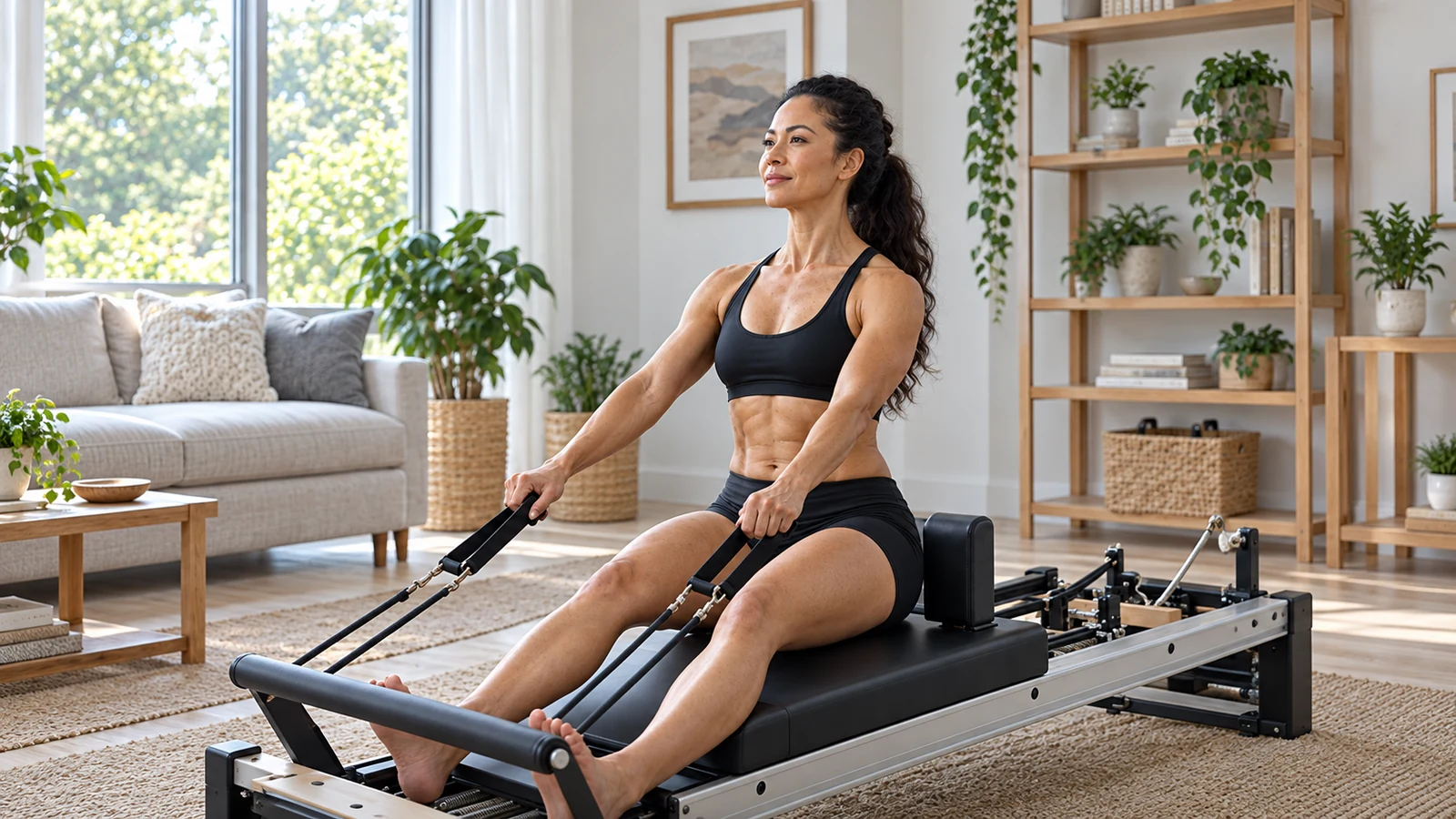
The featured image illustrates reformer Pilates; it does not document the home-DVD study protocol or establish that the person pictured has MS. The presence of a reformer in the illustration does not mean that the home-trial findings require that equipment.
How to read the next Pilates headline
A useful evidence summary has four parts: participants, program, comparison and outcome. A headline that omits one of those parts leaves a question to check.
- “At home”: Was there a prescribed program, regular contact or remote supervision?
- “Improved”: Was the change measured against a comparison group or only against the participants’ starting values?
- “Pilates helped”: Did the intervention also include aerobic exercise or other support?
- “Reduced risk”: Did researchers measure actual events or a test thought to relate to them?
Those distinctions preserve the useful findings without extending them to an untested program. They also help you ask a more specific question than whether Pilates is simply “good for MS.”
The practical conclusion
Pilates research offers promising symptom and function findings in selected groups, with important differences between home, supervised and combined programs. A sensible next discussion connects the program being considered with your goals and the support your treating team considers appropriate.
This article provides an evidence comparison, not a follow-along session or a replacement for MS treatment and rehabilitation. Individual exercise choices belong in the context of your own care.
Get the next evidence check.
Five practical fitness stories worth your time, every Friday.
One email a week. No product pitches. Unsubscribe in one click.
Sources
- Fleming, Coote and Herring (2021), randomized home-Pilates symptom trial.
- Güngör et al., supervised versus home Pilates-based core training.
- Vetrovska et al. (2024), online Pilates and aerobic-activity pilot.
- NICE NG220, MS fatigue and mobility recommendations.
Medical disclaimer: This article is general fitness and research information, not medical advice or an individual MS treatment or rehabilitation plan. Discuss exercise choices with your treating clinician or an MS-experienced physiotherapist who knows your health and support needs.