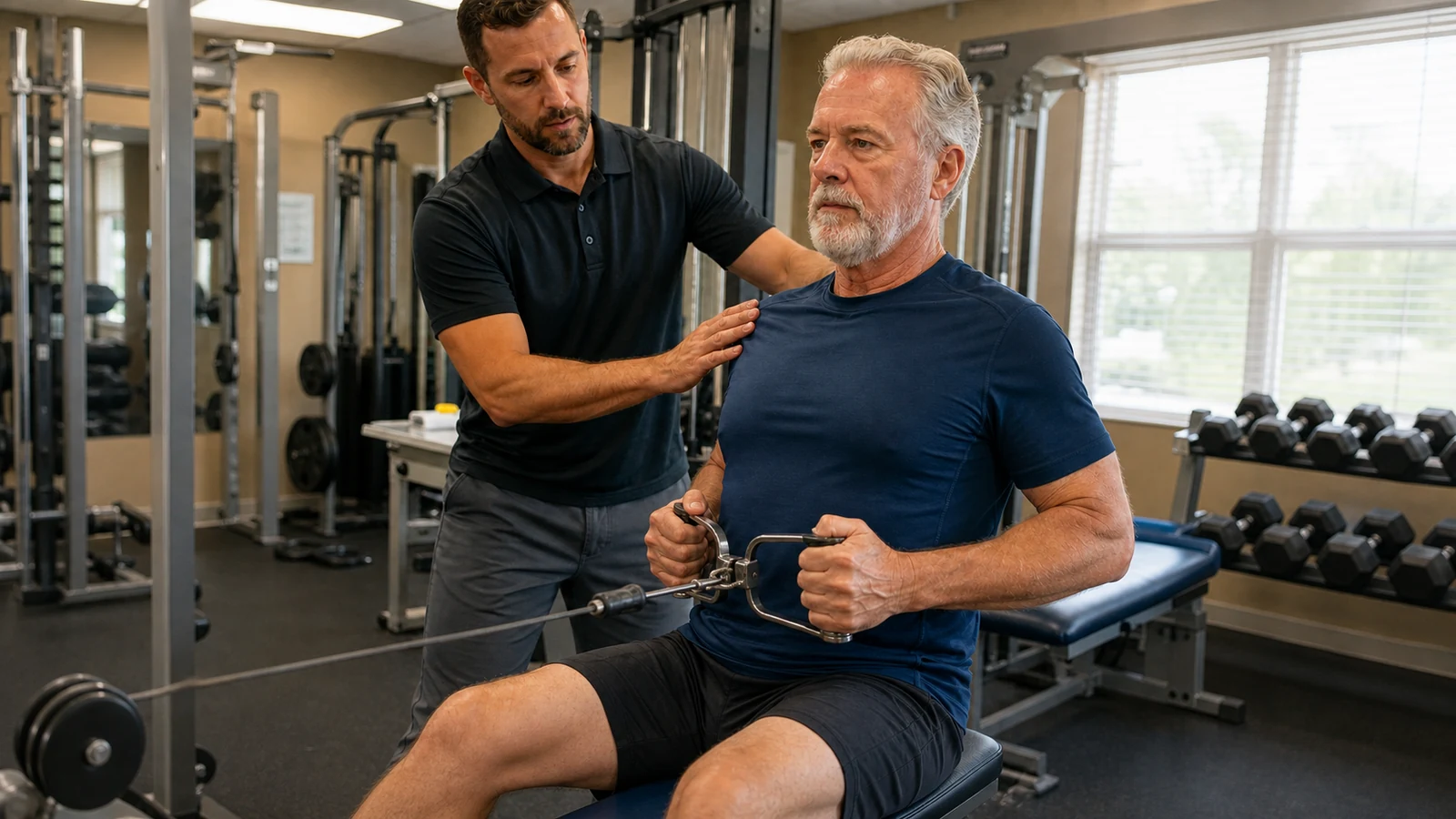

An Elevate Wellness with Santosha episode features Dr. Andrew McKenzie, a physiotherapist and exercise physiologist whose clinic profile lists a doctorate in physiotherapy. The conversation covers aging, cardiovascular health, and resistance training.
Resistance training can affect more than strength: studies examine glucose regulation, blood lipids, and other risk markers. Those effects vary across people and programs, so the podcast is a starting point for an evidence check, not proof of any guaranteed outcome.
Who Is Speaking in the Video?
The episode identifies its guest as Andrew McKenzie of the McKenzie Clinic. The clinic’s own profile lists him as a physiotherapist, exercise physiologist, and nutritionist with a doctorate in physiotherapy. The episode description spells his surname differently in one place, but its clinic affiliation and contact details match that profile.
His professional background is relevant context, not a substitute for studies measuring outcomes. Below, the clinical claims are checked against published resistance-training research.
What Real Research Shows About Resistance Training and Insulin Sensitivity
Blood sugar control is one of the clearest places where muscle work matters.
Skeletal muscle is the largest tissue in the body for clearing glucose after a meal.
A detailed review pulled together the biology behind that link (Strasser & Pesta, 2013).
The review found that resistance training improves how muscle cells respond to insulin.
That effect showed up in people with prediabetes and type 2 diabetes, not only in healthy adults.
More working muscle gives the body more places to store incoming sugar safely.
Muscle that responds better to insulin clears that sugar from the blood more efficiently.
A separate paper looked at resistance training as an actual treatment tool, not just a prevention idea (Pesta et al., 2017).
The authors reviewed trial data from adults already living with type 2 diabetes.
Across trials, resistance training can improve insulin sensitivity and blood-sugar control, but results vary by program and population. The review notes at least one trial in which resistance training alone did not significantly reduce HbA1c compared with a control group.
Benefits do not always require large changes on the scale. Muscle adaptations may contribute, but that does not mean weight loss, medication, and other lifestyle factors are irrelevant.
Resistance training can improve glucose regulation in people with type 2 diabetes, but the size of the effect depends on the program, person, and other treatment.
Several trials tracked HbA1c, a marker of average blood glucose over roughly three months, rather than relying only on a single fasting measurement. Some resistance-training programs improved it; others did not show a significant benefit on their own.
HbA1c and fasting glucose answer different clinical questions, and neither should be used alone to judge whether one workout program is working for every person.
Our piece on why weight loss and muscle loss often happen together covers a closely related part of this same picture.
Preserving muscle during weight loss may help metabolic function, but the cited reviews do not establish that it explains every person’s blood-sugar response.
What Research Shows About Resistance Training and Blood Lipids
A 2009 meta-analysis pooled 29 randomized trials with 1,329 adults comparing progressive resistance training with controls (Kelley & Kelley, 2009). Average changes favored training for total cholesterol, LDL cholesterol, non-HDL cholesterol, and triglycerides, while the average HDL change was not statistically significant.
Those averages were modest, and the trials differed considerably in participants and programs. In a follow-up analysis, the same authors calculated prediction intervals wide enough to include no improvement for each lipid outcome in a future study. They cautioned against promising that resistance training will improve any particular person’s cholesterol.
Resistance training may contribute to cardiovascular risk management, but it is not a substitute for aerobic activity, nutrition, or prescribed lipid-lowering treatment. Our guide to walking volume describes one complementary aerobic option. A clinician can interpret lab changes in the context of a person’s overall risk.
What Real Research Shows About Resistance Training and Metabolic Syndrome
Metabolic syndrome is a cluster of risk factors, not a single measurement.
It includes high blood pressure, high blood sugar, extra abdominal fat, and unhealthy cholesterol levels.
Having three or more of these markers together raises the risk of heart disease and diabetes substantially.
A randomized controlled trial tested resistance training directly against this cluster of markers (Shamlou Kazemi et al., 2023).
The study enrolled postmenopausal women who already had a metabolic syndrome diagnosis.
Participants completed a structured resistance training program over several weeks.
Researchers measured metabolic markers before and after the program.
In this eight-week trial of 45 postmenopausal women with metabolic syndrome, several measured risk markers improved in both the resistance-training and interval-training groups. Sirtuin1 blood levels also increased, but that association does not prove the protein caused the benefits.
The sample was small and the follow-up short. The trial supports further study; it cannot establish long-term cardiovascular outcomes for every person with metabolic syndrome.
Women past menopause face a steeper rise in cardiovascular risk than they did before it.
These results are risk-marker findings, not proof that one eight-week program prevents heart attacks or replaces medical care. Resistance training can be one part of an overall plan that includes aerobic activity and appropriate clinical treatment.
The Mechanism
Why would lifting weights change blood sugar and cholesterol at all?
Skeletal muscle is not just tissue for moving the body around.
It behaves more like an active organ that responds to the demands placed on it.
Muscle contraction and longer-term training can affect glucose transport and insulin responsiveness. Added muscle mass may also increase the tissue available for glucose storage, but individual changes depend on training, medications, diet, and other factors (Strasser & Pesta, 2013; Pesta et al., 2017).
Some studies report changes in inflammatory markers. The proposed pathways are still being investigated, and they do not justify assuming that a person will burn substantially more fat at rest or lower cholesterol simply by lifting. Improvements in glucose regulation can occur without dramatic weight loss, but not every trial finds the same result.
What This Evidence Does Not Prove
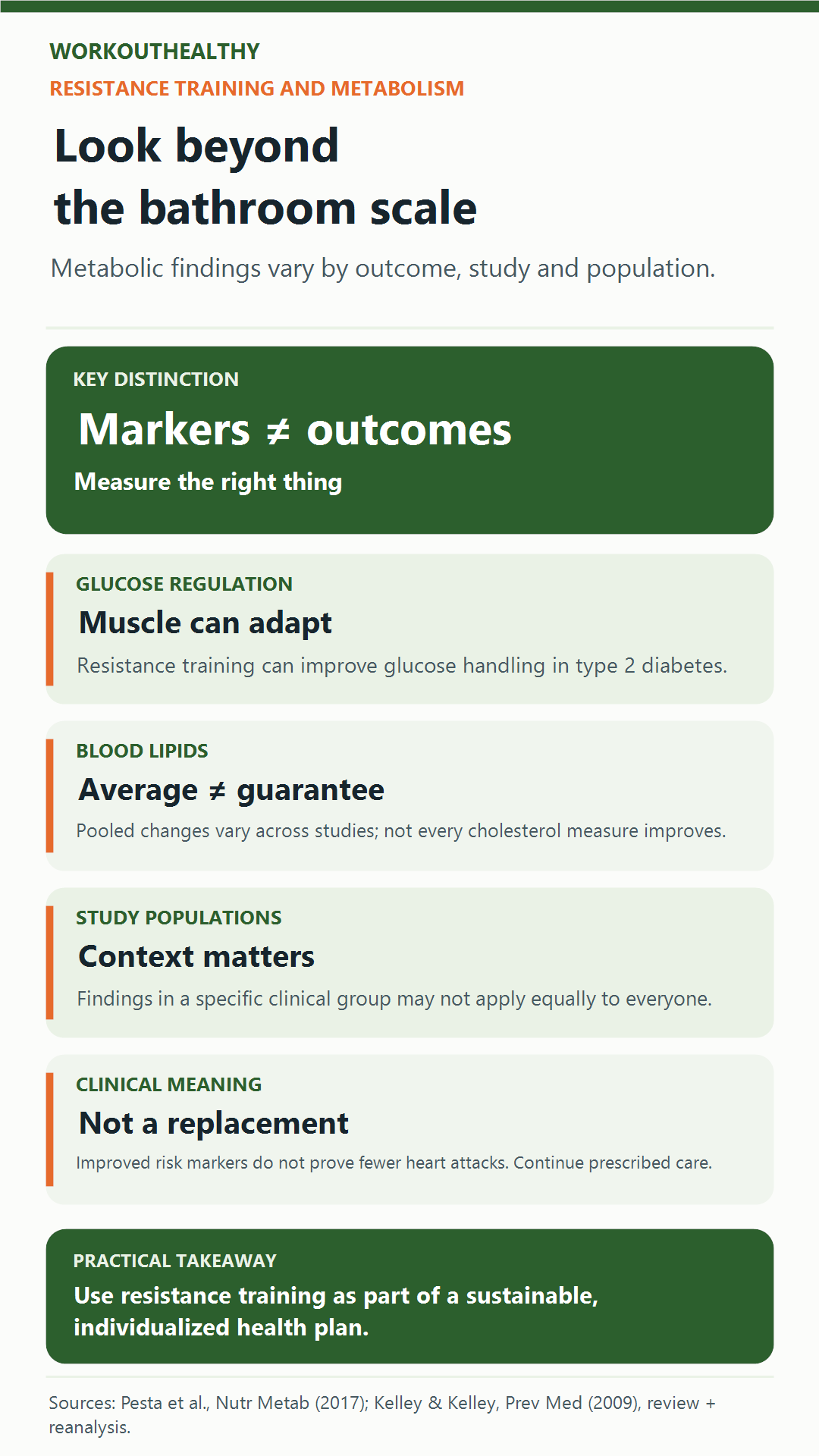
None of this proves that listening to one podcast episode will change a person’s health.
The insulin sensitivity research spans lab studies and real clinical trials, not just a single claim.
Some of the metabolic syndrome evidence comes from one trial in one specific population.
Postmenopausal women are not a stand in for every adult.
Results in that group may not fully apply to younger men, for example.
The lipid meta-analysis pooled many trials, but those trials varied in length and intensity.
Longer term outcomes, like heart attacks actually prevented, are harder to measure directly.
Most of these studies tracked blood markers, not hospital admissions or deaths.
Better numbers on a lab report are a strong signal, not a guarantee of a longer life.
Resistance training is also not a replacement for medication a doctor has already prescribed.
The honest summary is that resistance training can improve some measured risk markers in some groups, but it does not replace medical care.
Common Mistakes
Many people assume cardiovascular health only comes from cardio exercise.
That assumption keeps some people away from a weight rack entirely.
The evidence above shows resistance training earns a real place in a heart healthy routine too.
Another common mistake is treating one hard workout as enough.
Metabolic markers respond to consistency over months, not to a single intense session.
Training the legs is useful for whole-body strength and function. The cited studies do not quantify how much metabolic benefit a person loses by skipping a specific exercise group, so it is better to build a balanced plan than to promise a special effect from leg day.
A final mistake is ignoring diet and sleep while expecting lifting alone to fix everything.
Resistance training helps these markers, but it works alongside other habits, not instead of them.
Who Should Be Extra Careful
Anyone with uncontrolled high blood pressure should get medical clearance before lifting heavy.
The same goes for anyone with a recent heart event, like a heart attack or a stent.
People with diabetes should check their blood sugar around new exercise until they know how their body responds.
Exercise-related low blood sugar is particularly relevant for people using insulin or medications that can cause hypoglycemia; a clinician can advise on monitoring and adjustments.
Anyone recovering from a major surgery needs a modified starting point, not a generic routine.
Our coverage of Misty Copeland’s hip replacement recovery shows how gradual that kind of return usually has to be.
People new to exercise after a long inactive stretch should start lighter than they think they need to.
A physician or physical therapist can help build a program around existing conditions safely.
None of these situations rule out resistance training completely.
They just change how and when it should start.
A Practical Takeaway
Two or three nonconsecutive resistance-training sessions per week can be a practical starting point for many adults, adjusted for health status and experience. There is no universal 30-to-40-minute threshold that guarantees a metabolic benefit; the program’s progression, effort, recovery, and consistency matter.
Focus on compound movements that use the legs, back, chest, and core together.
Add small amounts of extra weight or resistance every week or two, not every session.
A simple starting plan might use squats, rows, push ups, and a hip hinge movement like a deadlift pattern.
Those four movements alone cover most of the major muscle groups in one short session.
Resistance bands or dumbbells at home can be practical ways to begin; whether they produce comparable results depends on the load, exercises, progression, and adherence.

Track blood pressure, waist size, or lab numbers over months, not single workouts.
Edith Connor did not start lifting until her sixties and went on to set a world record.
Her story is a reminder that starting later in life still counts.
Assess progress over weeks to months, not after a single workout. Ask a clinician when to repeat blood tests, particularly if you have diabetes or take medication.
Watch the video
Want more like this? Subscribe to WorkoutHealthy Insider for practical explanations behind popular fitness claims.
References
Kelley, G. A., & Kelley, K. S. (2009). Impact of progressive resistance training on lipids and lipoproteins in adults: A meta-analysis of randomized controlled trials. Preventive Medicine, 48(1), 9 to 19. https://doi.org/10.1016/j.ypmed.2008.10.010
Kelley, G. A., & Kelley, K. S. (2009). Impact of progressive resistance training on lipids and lipoproteins in adults: Another look at a meta-analysis using prediction intervals. Preventive Medicine, 49(6), 473–475. https://pubmed.ncbi.nlm.nih.gov/19804794/
Pesta, D. H., Goncalves, R. L. S., Madiraju, A. K., Strasser, B., & Sparks, L. M. (2017). Resistance training to improve type 2 diabetes: Working toward a prescription for the future. Nutrition & Metabolism, 14, Article 24. https://doi.org/10.1186/s12986-017-0173-7
The McKenzie Clinic. Andrew McKenzie: Clinic profile and credentials.
Shamlou Kazemi, S., Heidarianpour, A., & Shokri, E. (2023). Effect of resistance training and high-intensity interval training on metabolic parameters and serum level of Sirtuin1 in postmenopausal women with metabolic syndrome: A randomized controlled trial. Lipids in Health and Disease, 22(1), Article 177. https://doi.org/10.1186/s12944-023-01940-x
Strasser, B., & Pesta, D. (2013). Resistance training for diabetes prevention and therapy: Experimental findings and molecular mechanisms. BioMed Research International, 2013, Article 805217. https://doi.org/10.1155/2013/805217
This article is for general information only and is not medical advice. If you have an injury, ongoing pain, or a medical condition, talk to a doctor or physical therapist before you change how you train or eat.