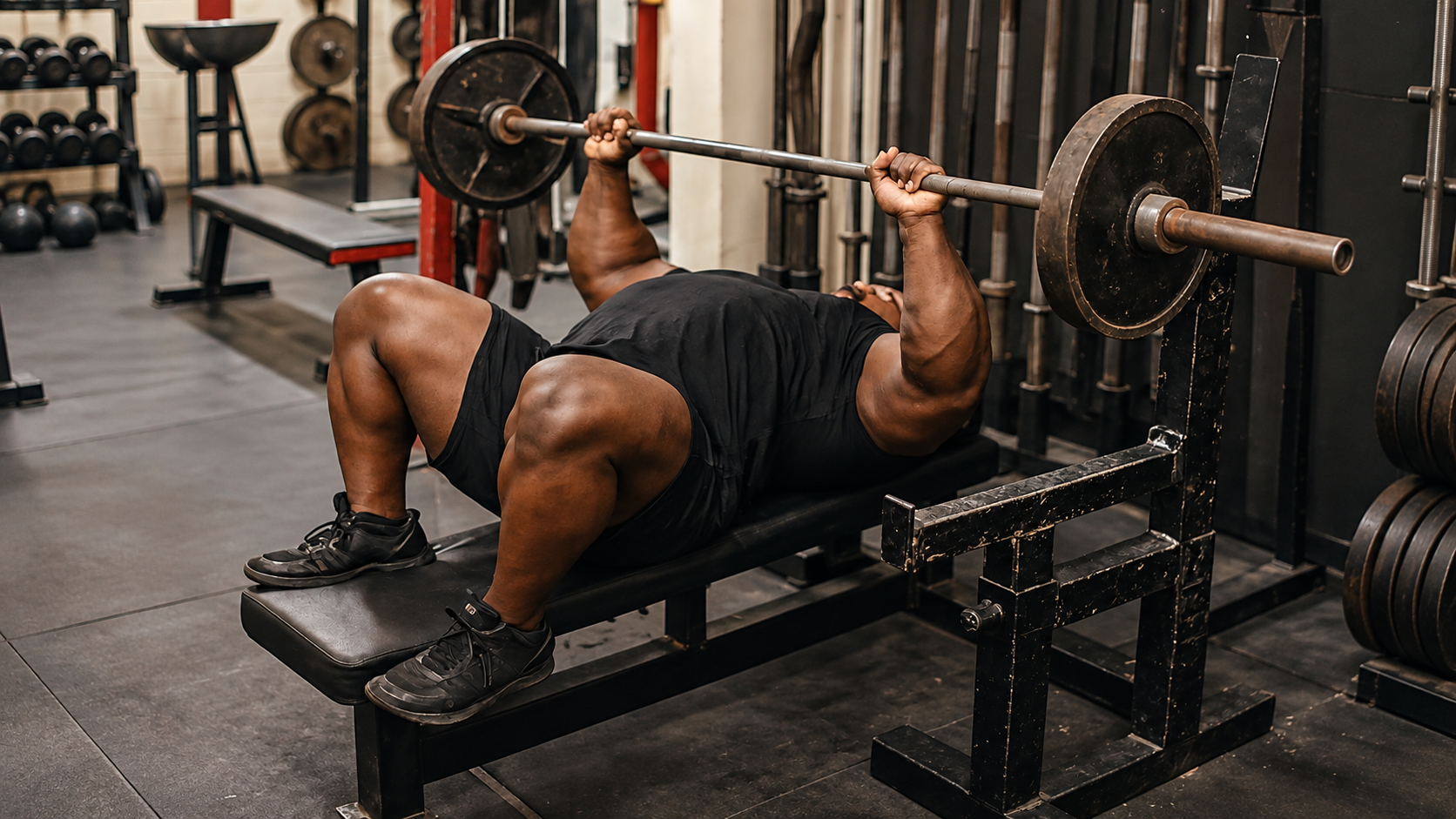

The feet-up bench press removes contact between the feet and the floor, which reduces the leg drive available in a standard powerlifting setup.
It often makes the lift less stable, increases the bar’s travel by reducing the arch, and requires a lighter working load.
Those changes can make it a useful accessory, but they do not prove that the variation grows the chest or shoulders faster.
Acute muscle-activity studies do not show long-term hypertrophy, and no trial has established feet-up benching as a superior fix for every lifter who stalls near the chest.
The best reason to use it is specific and modest: you want bench practice that emphasizes upper-body control while limiting help from the floor.
That benefit still depends on a stable setup, appropriate load, and a program that includes enough competition-style benching for your goal.
What Is a Feet-Up Bench Press?
In the common feet-up version, the lifter lies on a flat bench, bends the knees, and places both feet on the pad.
The upper-back position, grip, touch point, and bar path should remain close to the lifter’s normal bench technique.
Moving the feet from the floor removes the usual base for pushing backward through the legs.
It also makes a large powerlifting arch harder to maintain, which may increase the distance the bar travels to the chest.
The change does not isolate the chest.
Pectorals, anterior deltoids, and triceps remain the main pressing muscles, while the trunk and hips contribute to keeping the body steady.
Feet resting on the pad can still press into that surface, so the lower body is not literally switched off.
The variation reduces one form of leg drive without turning the exercise into a laboratory test of pure upper-body strength.
Is It the Same as a Larsen Press?
Coaches often use the names interchangeably, but a useful distinction exists.
A classic Larsen press extends the legs beyond the end or sides of the bench with the feet unsupported, while a feet-up bench press rests bent legs and feet on the pad.
The unsupported Larsen position is usually less stable and requires continuous trunk tension to hold the legs. The feet-on-pad version offers another contact point and is often the easier place to start.
Neither name guarantees one universal technique.
Write the exact leg position in a training log so sets remain comparable instead of relying on a label that different lifters interpret differently.
What Muscle-Activity Studies Found
A 2019 study tested 20 young men at 60 percent of their standard bench one-repetition maximum.
Pressing with the hips and knees actively flexed to 90 degrees increased electrical activity in every measured muscle compared with feet on the floor.
The pectoral regions, anterior deltoid, triceps, forearm, abdominals, obliques, and rectus femoris all showed higher readings. Because the same absolute load was used in both conditions, the feet-up load represented a harder relative challenge.
A separate 2019 experiment with 27 recreationally trained college participants compared standard benching with a coached leg-drive technique. It found no change in upper-extremity muscle activity when leg drive was added.
The studies used different positions, loads, participants, and questions, so their results are not a direct contradiction. They show that setup can change acute demands, not that one version produces more muscle after months of training.
Does It Build the Chest Faster?
No long-term trial has shown that feet-up benching grows the chest or shoulders faster than a well-programmed standard bench press.
Higher electrical activity during a set is not a measurement of future hypertrophy.
Growth depends on enough hard weekly sets, progressive loading, suitable range of motion, nutrition, and recovery.
A 2023 network meta-analysis found that many loading prescriptions produced comparable hypertrophy when people trained consistently, while multiset programs ranked well.
The feet-up version can contribute to that volume if it feels stable and lets the lifter train the pressing muscles hard.
It does not create a special growth signal simply because the bar is lighter or the legs are repositioned.
WorkoutHealthy’s guide to low and high repetitions for strength and size explains why heavy and moderate sets can serve different goals without making either mandatory.
Can It Fix an Off-the-Chest Stall?
Reducing the arch can lengthen the bar path and make the bottom portion feel harder. That gives the lifter more practice controlling a deeper touch without relying on as much floor pressure.
A stall near the chest can also come from an inconsistent touch point, poor upper-back tension, a grip that does not match the lifter, weak pecs, slow bar speed, or a load that is simply too heavy.
One variation cannot diagnose all of those possibilities.
A paused competition bench is usually more specific when the goal is to improve strength from the required meet pause.
A Spoto press can emphasize control just above the chest, while dumbbell pressing can add range with independent hand paths.
Track whether the standard bench improves after a training block rather than judging carryover by soreness. Specific performance is the test that matters.
Is It a Fatigue-Management Tool?
Most lifters use less weight with their feet up, which can reduce total external loading and the effort spent creating a competition arch.
That may make the variation useful on a secondary bench day.
A lighter bar does not guarantee an easy session.
Longer range, less stability, and sets taken near failure can still create substantial fatigue in the chest, shoulders, triceps, and trunk.
Use repetitions in reserve and total hard sets to manage fatigue, not the exercise name alone. Leaving one to three clean repetitions available on most accessory sets is a practical default.
The caption’s recommendation for one or two feet-up sessions every week is not a research-based requirement. Many lifters need only one accessory exposure, and some progress without the variation at all.
Our review of training frequency and weekly volume explains why the distribution of quality sets matters more than assigning magic status to one day.
Does It Give the Back and Joints a Break?
Feet-up benching often reduces lumbar extension because the lifter cannot use the floor to build the same arch. Someone who dislikes a large arch may find that position more comfortable.
Comfort is not proof of lower injury risk.
Holding the hips flexed can increase abdominal and hip-flexor demand, and feet placed on a narrow pad create a different stability challenge.
Shoulder loading still depends on grip width, elbow position, scapular control, bar path, range, and load.
A 2024 biomechanical study found that scapular retraction and grips narrower than 1.5 biacromial widths reduced several modeled shoulder loads, but it did not test feet-up benching or injuries.
Persistent back, shoulder, chest, elbow, or wrist pain needs a specific assessment. Switching leg position is not a diagnosis or rehabilitation plan.
How to Perform It Safely
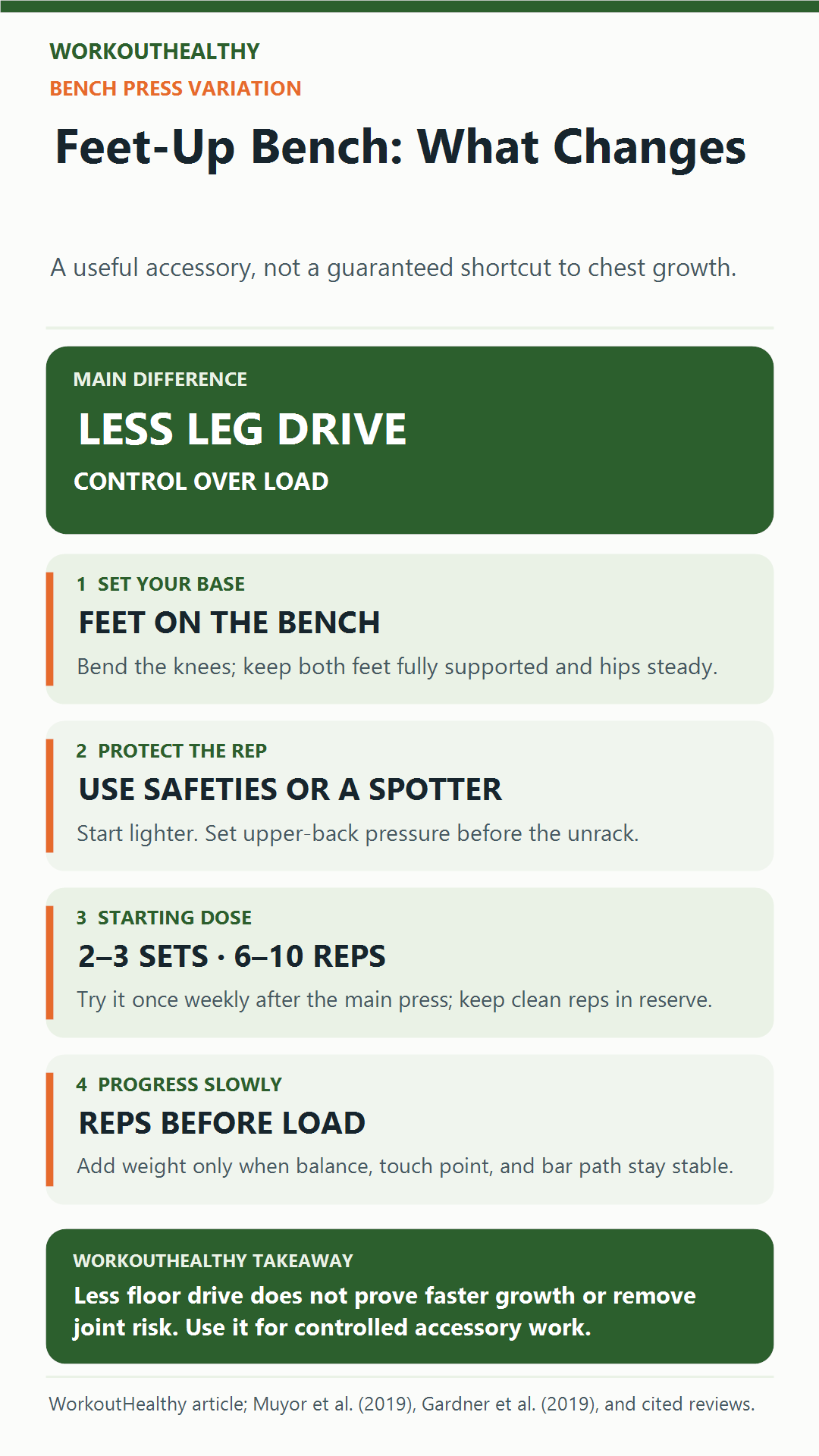
Set safety arms slightly below the chest position or use an attentive spotter. Use a load you can pause comfortably, because losing balance with both feet on the pad makes self-rescue harder.
Lie with the eyes under the bar, grip evenly, and pull the shoulder blades back and down. Establish upper-back pressure before the handoff or unrack instead of trying to reorganize under a heavy bar.
Place the whole foot on the bench with the knees bent and the hips steady. Keep the feet far enough from the edge that they cannot slip, and do not drive the hips upward.
Brace the trunk, lower the bar under control to a repeatable point on the lower or middle chest, and keep the wrists stacked over the forearms.
Press up and slightly back without bouncing or letting one side race ahead.
Re-rack before moving the feet. Trying to find the floor while holding a fatigued bar adds instability at the worst time.
How to Program the Variation
Start with two or three sets of 6 to 10 repetitions once weekly after the primary bench press.
Use about two repetitions in reserve for the first sessions and add load only after every repetition follows the same path.
For a technique emphasis, use three sets of 5 to 8 with a one-second pause on the chest. For hypertrophy, use two to four sets of 8 to 12 while keeping the last repetition controlled.
Add repetitions inside the range before adding 5 pounds to the bar. If range, touch point, or balance changes when load rises, return to the previous weight.
Powerlifters should keep enough competition bench practice to preserve foot pressure, arch, commands, and meet-specific bar path. An accessory earns its place only when it supports the main lift without consuming recovery needed elsewhere.
Should Grip Width Change?
Use the normal competition or medium grip first so the leg position is the only new variable. Changing grip and leg position together makes it harder to identify why the bar path or discomfort changed.
A narrow grip generally increases elbow range and triceps demand, while a wide grip shortens the bar path and alters forces at the shoulder.
Neither automatically creates balanced chest and shoulder development.
A study of 28 men found broadly similar activity across several grip widths for many muscles, with clearer differences in biceps, triceps, and anterior-deltoid readings.
Grip should be selected for control, goal, and comfort rather than rotation for its own sake.
When Another Variation Is Better
Choose a paused standard bench when competition specificity and force from the chest are the priority. Choose a close-grip bench when triceps emphasis and a longer elbow-extension range are useful.
A floor press limits the deepest shoulder position and emphasizes the midrange and lockout. WorkoutHealthy’s floor press versus bench press guide compares that tradeoff in detail.
Use dumbbells or a chest-press machine when independent arms or external stability makes training more repeatable.
The best variation is the one that matches the problem you are trying to solve and can be progressed safely.
The Bottom Line
The feet-up bench press is a legitimate accessory that reduces floor leg drive, often increases range, and challenges control with less load.
It can be useful for secondary pressing volume or for learning to stay tight without relying on the legs.
It is not proven to grow the chest faster, cure an off-the-chest stall, protect every joint, or manage fatigue automatically.
Start once weekly, keep one to three repetitions in reserve, and judge it by improved training quality and carryover rather than novelty.
Get the next evidence check.
Five practical fitness stories worth your time, every Friday.
One email a week. No product pitches. Unsubscribe in one click.
References
- Muyor JM, Rodriguez-Ridao D, Martin-Fuentes I, Antequera-Vique JA. Evaluation and comparison of electromyographic activity in bench press with feet on the ground and active hip flexion. PLoS One. 2019;14(6):e0218209. https://pubmed.ncbi.nlm.nih.gov/31199829/
- Gardner JK, Chia JT, Miller KL. Leg-drive Does Not Affect Upper Extremity Muscle Activation during a Bench Press Exercise. International Journal of Human Movement and Sports Sciences. 2019;7(1):12-17. https://doi.org/10.13189/saj.2019.070103
- Currier BS, McLeod JC, Banfield L, et al. Resistance training prescription for muscle strength and hypertrophy in healthy adults. British Journal of Sports Medicine. 2023;57(18):1211-1220. https://pubmed.ncbi.nlm.nih.gov/37414459/
- Refalo MC, Helms ER, Trexler ET, Hamilton DL, Fyfe JJ. Influence of Resistance Training Proximity-to-Failure on Skeletal Muscle Hypertrophy. Sports Medicine. 2023;53(3):649-665. https://pubmed.ncbi.nlm.nih.gov/36334240/
- Noteboom L, et al. Effects of bench press technique variations on musculoskeletal shoulder loads and potential injury risk. Frontiers in Physiology. 2024. https://pubmed.ncbi.nlm.nih.gov/38974522/
- Saeterbakken AH, et al. The Effect of Grip Width on Muscle Strength and Electromyographic Activity in Bench Press among Novice- and Resistance-Trained Men. International Journal of Environmental Research and Public Health. 2021;18(12):6444. https://pubmed.ncbi.nlm.nih.gov/34198674/
- Gomo O, van den Tillaar R. The effects of grip width on sticking region in bench press. Journal of Sports Sciences. 2016;34(3):232-238. https://pubmed.ncbi.nlm.nih.gov/26055260/
- Currier BS, D’Souza AC, Fiatarone Singh MA, et al. American College of Sports Medicine Position Stand. Resistance Training Prescription for Muscle Function, Hypertrophy, and Physical Performance in Healthy Adults: An Overview of Reviews. Medicine & Science in Sports & Exercise. 2026;58(4):851-872. https://pubmed.ncbi.nlm.nih.gov/41843416/
Medical disclaimer: This article is for general information only and is not medical advice. If you have shoulder pain, an injury, or another medical condition, consult a qualified clinician before changing your training.