

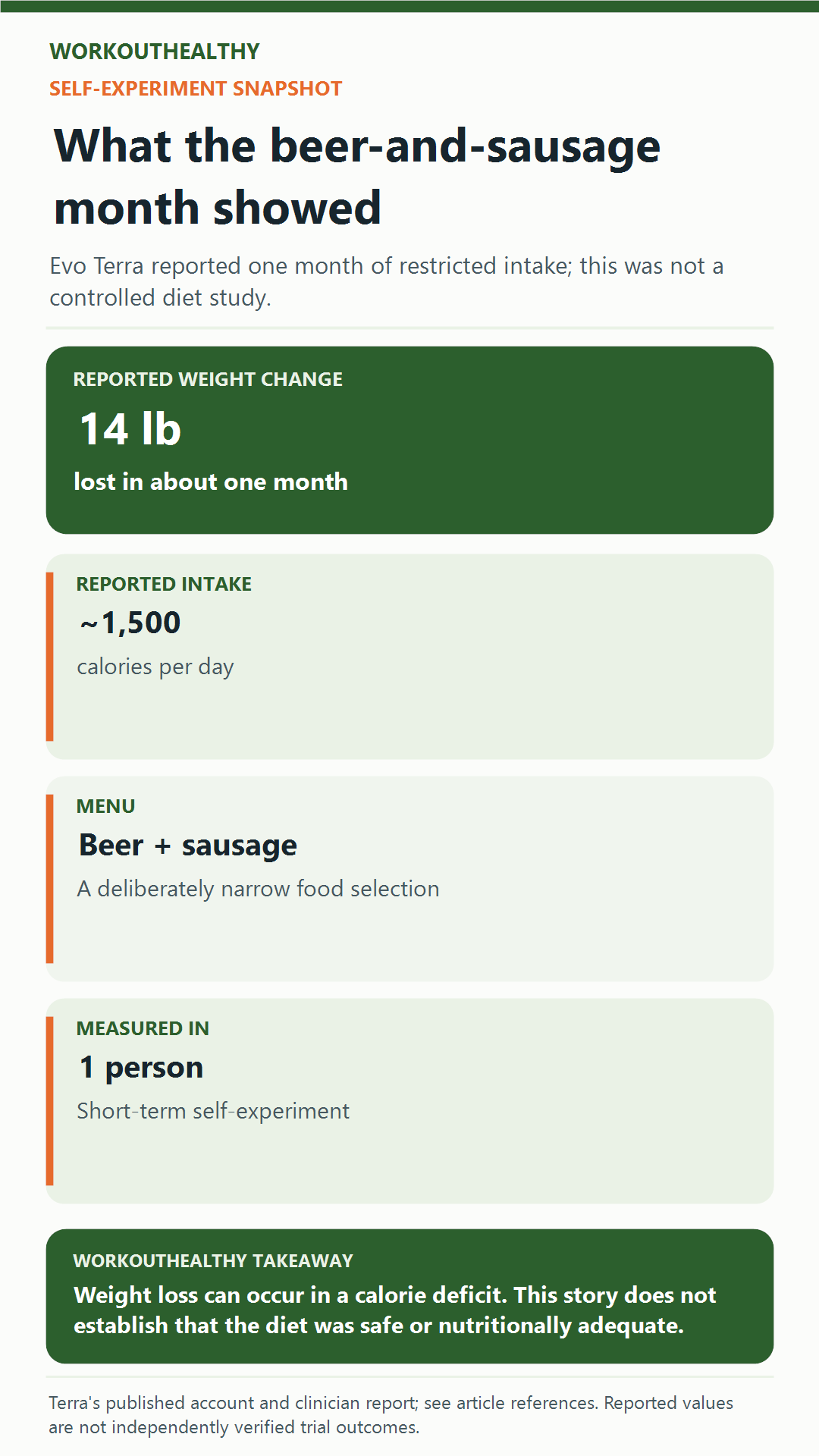
Evo Terra reported losing 14 pounds during a month in which his calories came from craft beer and sausage. His 2013 book says his cholesterol also fell substantially, and physician Terry Simpson says he monitored the experiment with weekly measurements.
The result is plausible as a weight-loss story because Terra limited intake to roughly 1,500 calories per day. It is not evidence that beer and sausage form a healthy diet.
One person’s short self-experiment can illustrate energy balance. It cannot settle long-term questions about alcohol, processed meat, nutrient adequacy, or heart disease risk.
Visual note: The featured scene is an editorial illustration inspired by the Facebook creative, not a verified photograph of Evo Terra or his experiment.
Claim Snapshot
| Participant | Evo Terra |
|---|---|
| Duration | About one month in October |
| Foods | Craft beer and sausage |
| Reported intake | About 1,500 calories per day |
| Reported weight change | About 14 pounds lost |
| Reported lab change | Lower total cholesterol and triglycerides |
| Study design | Personal self-experiment with medical monitoring |
| What it proves | Very little beyond this individual’s short-term response |
The Story Comes From Terra and His Doctor
Terra and Simpson published The Beer Diet: A Brew Story in 2013. Its description says Terra spent a month eating beer and sausage, lost 14 pounds, and cut his cholesterol in half.
Simpson later wrote that he supervised Terra over several October experiments, checking blood chemistry and body measurements. Those accounts are useful primary sources for what the pair say happened.
They are not an independent clinical trial report.
Fourteen or Fifteen Pounds?
The book description gives 14 pounds. In a later podcast interview, Terra recalled losing about 15 pounds in the first year. Memory and rounding can explain the difference.
The careful headline uses the documented 14-pound figure. Reporting the range would also be defensible, but presenting 15 as a precise measured number would overstate the later recollection.
This small discrepancy is another reason to distinguish contemporary records from interviews years later.
The Calorie Deficit Explains the Weight Loss
Terra said he consumed about 1,500 calories per day while his estimated daily needs were higher. When energy intake remains below energy expenditure, body mass generally decreases over time.
The NIDDK Body Weight Planner models how calorie intake and activity influence weight change. It also shows why the relationship is dynamic rather than a perfect fixed equation.
The beer and sausage were not metabolically exempt. The total intake was simply constrained.
Weight Loss Does Not Prove Diet Quality
A person can lose weight while eating an unbalanced menu if calories are low enough. Diet quality asks different questions: Does the pattern supply fiber, vitamins, minerals, essential fats, adequate protein, and a useful variety of plant foods?
A beer and sausage menu can be calorie controlled while remaining low in fiber and limited in several micronutrients. It may also supply large amounts of sodium, saturated fat, and alcohol.
The scale cannot grade all of those factors.
This Was Not a Controlled Study
A controlled trial would define the intervention in advance, recruit enough participants, measure outcomes with standardized methods, compare groups, and report the results for scientific review.
Terra’s experiment had one participant who knew the goal and selected the foods. There was no control group, blinding, randomization, or long follow-up.
Medical supervision may reduce immediate risk and improve measurement. It does not transform a personal experiment into general evidence.
Short-Term Cholesterol Changes Need Context
Rapid weight loss can change lipid measurements, but total cholesterol alone is not a complete cardiovascular assessment. LDL, HDL, triglycerides, blood pressure, glucose, smoking, family history, and other factors contribute to risk.
The American Heart Association advises interpreting triglycerides and cholesterol together with the rest of a person’s health profile.
A favorable month does not establish what years of the same diet would do.
Alcohol Is Not a Health Food
The National Institute on Alcohol Abuse and Alcoholism states that current research finds health risks even at low levels of drinking, regardless of beverage type.
Alcohol affects the brain, liver, gastrointestinal system, heart, immune function, and cancer risk. The dose and pattern matter, but craft beer does not receive a biological exemption because it is part of a calorie experiment.
People who do not drink should not start for a perceived health benefit.
Sausage Is Processed Meat
The National Cancer Institute includes sausage among processed meats and notes that processed meat consumption is associated with increased colorectal cancer risk.
That classification does not mean one sausage causes cancer. It means risk rises across patterns of exposure in the population, with amount and frequency contributing to the overall picture.
A month-long scale result cannot cancel long-term evidence about processed meat.
The Menu Was Likely Low in Fiber
Most sausages and beers provide little dietary fiber. Fiber supports bowel function, contributes to fullness, and feeds gut microbes that produce useful metabolites.
A health-oriented calorie deficit normally includes vegetables, fruit, legumes, and whole grains or other fiber-rich foods that fit the person’s tolerance and preferences.
Removing nearly all plant foods makes the diet easier to describe, not easier to defend nutritionally.
Protein Quantity Is Only One Question
Sausage can provide protein, but the total amount, distribution, sodium, saturated fat, and processing still matter. A food is not automatically ideal because one nutrient is present.
During weight loss, adequate protein and resistance training can help preserve lean mass. A broad menu makes it easier to combine protein with fiber, potassium, magnesium, folate, and other nutrients.
Terra’s account does not provide enough body-composition detail to know how much of the lost weight was fat, water, or lean tissue.
Early Weight Loss Includes Water
Changes in carbohydrate intake, sodium, alcohol, and total food mass can shift glycogen and body water. That means a one-month scale change is not identical to 14 pounds of body fat.
Some fat loss is likely when a sustained energy deficit is large, but the exact composition requires proper measurement. Bathroom scales alone cannot separate the compartments.
This is why short diet challenges often produce eye-catching numbers that slow later.
The Experiment Does Challenge Food Moralizing
One useful lesson is that weight change does not sort foods into morally good and bad categories. A person can include foods they enjoy and still lose weight if the overall plan supports an energy deficit.
Our article on separating cravings from hunger explores the same practical distinction without demanding a stunt diet.
Flexibility can support adherence, but flexibility is not the same as eating only two items.
Fasted and Restricted Are Not the Same
The experiment restricted food variety and total calories. It was not necessarily an intermittent fasting trial, and it cannot answer whether meal timing independently changes fat loss.
Our evidence check on fasted training and fat loss explains why burning more fat during one session does not guarantee greater fat loss across the day.
Total intake, adherence, training, sleep, and time all matter.
Medical Monitoring Did Not Make It Replicable
Terra had a physician involved and reportedly underwent repeated lab checks. Most readers copying a social post would not have the same supervision, baseline testing, or clear stopping rules.
Alcohol can interact with medications and may be unsafe with liver disease, pregnancy, a history of alcohol use disorder, certain heart conditions, and many other circumstances.
A supervised anecdote is not a do-it-yourself protocol.
A Better Calorie-Deficit Experiment
If the goal is to learn how an energy deficit affects weight, use a balanced eating pattern at a modest, sustainable calorie reduction. Keep protein adequate, include fiber-rich foods, and track several weeks rather than chasing a dramatic first-month number.
Monitor strength, energy, sleep, hunger, and waist change alongside scale weight. Those measures help reveal whether the plan supports daily life.
A registered dietitian can personalize the target for medical needs and training goals.
What the Cholesterol Claim Cannot Tell Us
We do not have a peer-reviewed dataset showing the full baseline and follow-up panel, laboratory methods, medication status, recent illness, hydration, or long-term outcome.
Even if the reported reduction is accurate, it applies to Terra during that period. It does not show that beer lowers cholesterol or that sausage protects the heart.
It also cannot separate the effects of weight loss, calorie reduction, alcohol, meat, and normal test variation.
The Best Version of the Story
Evo Terra carried out an unusual, medically monitored self-experiment and reported losing about 14 pounds while consuming roughly 1,500 calories per day from beer and sausage. His doctor reported favorable short-term changes in several blood markers.
The calorie deficit plausibly explains the weight change. The design cannot establish long-term safety, cardiovascular benefit, or superiority over a balanced diet.
The story is a lesson about evidence limits as much as energy balance.
Bottom Line
Yes, someone can lose weight while eating foods that do not form a high-quality diet. That does not make the diet healthy, complete, or safe to copy.
Use the experiment to understand calorie balance, not as permission to build a month around alcohol and processed meat. Sustainable weight management should protect nutrition, function, and long-term health while the scale changes.
Get the next evidence check.
Five practical fitness stories worth your time, every Friday.
One email a week. No product pitches. Unsubscribe in one click.
Medical disclaimer: This article is for general information only and is not medical advice. If you have an injury, ongoing pain, or a medical condition, talk to a doctor or physical therapist before you change how you train or eat.