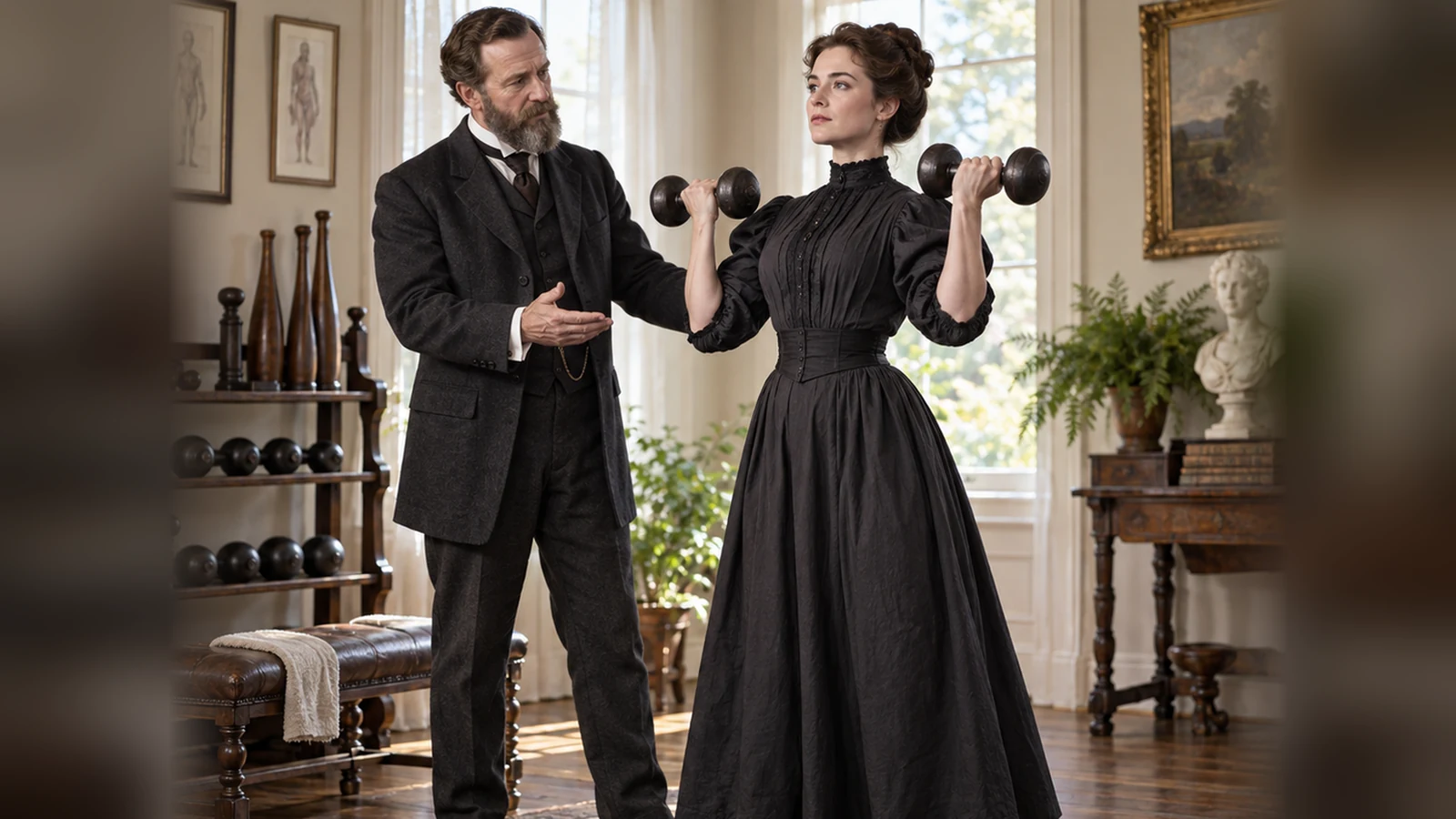

The featured scene is an editorial illustration, not an archival photograph of William Blaikie.
Should women lift weights? Women can gain strength and muscle from resistance training, and the available comparisons do not support a rule that women should avoid it or use a fundamentally different kind of program.
That answer sounds ordinary now, but William Blaikie was making a related case in his 1879 book How to Get Strong and How to Stay So. His argument challenged a fear that vigorous exercise would make women less feminine, while still judging women’s bodies by nineteenth-century standards of beauty.
What does modern training evidence say?
A 2020 review of studies that gave men and women the same resistance programs found similar average muscle-growth and lower-body strength responses, with a larger relative upper-body strength response among women. A 2025 review of 29 studies found that men gained slightly more muscle in absolute amount, especially in the upper body, while gains relative to starting size were broadly similar.
These are group averages, mostly from healthy adults in research programs. They neither predict an individual’s appearance nor tell everyone exactly how much to lift.
| Question | Evidence-led answer | What it does not mean |
|---|---|---|
| Will lifting make women “bulky” by accident? | Muscle growth is gradual and varies with training, time and the person; the reviews report relative growth with training. | No study can promise a specific appearance or make appearance the purpose of every program. |
| Should women skip upper-body training? | No. Both reviews include meaningful strength or size responses in the upper body. | One pooled average does not require a single routine for all women. |
| Must women use a separate exercise method? | The compared studies used the same programs for men and women and found broadly similar relative adaptations. | It does not remove the need to adjust for experience, goals, recovery, symptoms and preferences. |
| Can beginners start? | Yes, with a manageable technique, resistance and progression matched to their situation. | Blaikie’s daily exercise advice is not a required modern schedule. |
What did Blaikie actually write?
The digitized 1883 edition of Blaikie’s book contains separate chapters on girls and women. In the women’s chapter, he describes working women whose long days used some muscles repeatedly while leaving others untrained, then argues that they could begin systematic exercise even in adulthood.
In the girls’ chapter, he argues that play should involve more than walking and gentle movement. He believed girls could run with practiced skill and use their arms more, a point that pushed against restrictive expectations of the time.
| Blaikie’s position in the 1883 text | How to read it now |
|---|---|
| Regular exercise can make girls and women stronger. | This is compatible with modern training findings, but his book is evidence of his view, not a controlled exercise trial. |
| Work should grow as strength develops. | Progression remains a useful training principle; daily hard training is not necessary for everyone. |
| Vigorous exercise can be consistent with beauty and grace. | Those are appearance judgments, not measured health outcomes or standards readers need to accept. |
| Hard muscularity is “essentially masculine.” | This is an era-specific gender assumption, not a biological rule for deciding whether a woman should train. |
Blaikie’s memorable line says trained muscle could be “directly accessory” to beauty. The original passage confirms the wording, but beauty remains his opinion, not an outcome established by the modern reviews.
How can a new lifter use the evidence?
Choose movements you can perform with control for the legs, a push and a pull, and track what you did. On a later session, adjust one variable at a time, such as repetitions or resistance, when the current work feels manageable and form remains consistent.
That is an editorial starting framework, not a program tested by either review. If pain, pregnancy or postpartum recovery, osteoporosis, or another health issue changes your options, ask an appropriate clinician or qualified coach to help adapt the movements.
The question of whether women and men need different programs deserves its own discussion. So does fear of unwanted muscle size; neither requires treating women as unable to train hard.
What is worth keeping from Blaikie?
Blaikie was right to challenge the assumption that women and girls should avoid strength work. His book also shows how an advocate can argue for women’s physical capacity while retaining appearance rules and gender stereotypes.
Use the modern evidence to choose training for the strength and activities you value. Treat the nineteenth-century book as a historical argument, not a workout prescription.
Sources
- Blaikie. How to Get Strong and How to Stay So, 1883 edition.
- Roberts, Nuckols and Krieger. Sex Differences in Resistance Training, 2020.
- Refalo and colleagues. Sex differences in resistance-training muscle growth, 2025.
This article is general fitness information, not personal medical advice. Ask a qualified professional about symptoms, injury or health conditions that affect your training.