

Regular exercise is associated with a lower risk of dying from influenza or pneumonia, according to a large U.S. cohort study. The headline is encouraging, but the details matter more than the slogan.
The study was observational. It found the lowest adjusted risk among people who met both aerobic and muscle-strengthening guidelines, but it could not prove that exercise alone caused the difference.
Quick answer: moderate, consistent physical activity supports general health and is associated with lower influenza-and-pneumonia mortality. It does not replace vaccination, medical treatment, hand hygiene, ventilation, or rest during a significant infection.
Exercise may improve the background conditions for resilience. It is not an invisible shield against infection.
What the 577,909-person study found
Researchers analyzed survey data from 577,909 U.S. adults who entered the National Health Interview Survey between 1998 and 2018.
They linked participant records to the National Death Index through 2019 and followed people for a median of 9.23 years.
During follow-up, 1,516 deaths were attributed to influenza or pneumonia. That is a serious outcome, not the number of ordinary colds or mild infections people experienced.
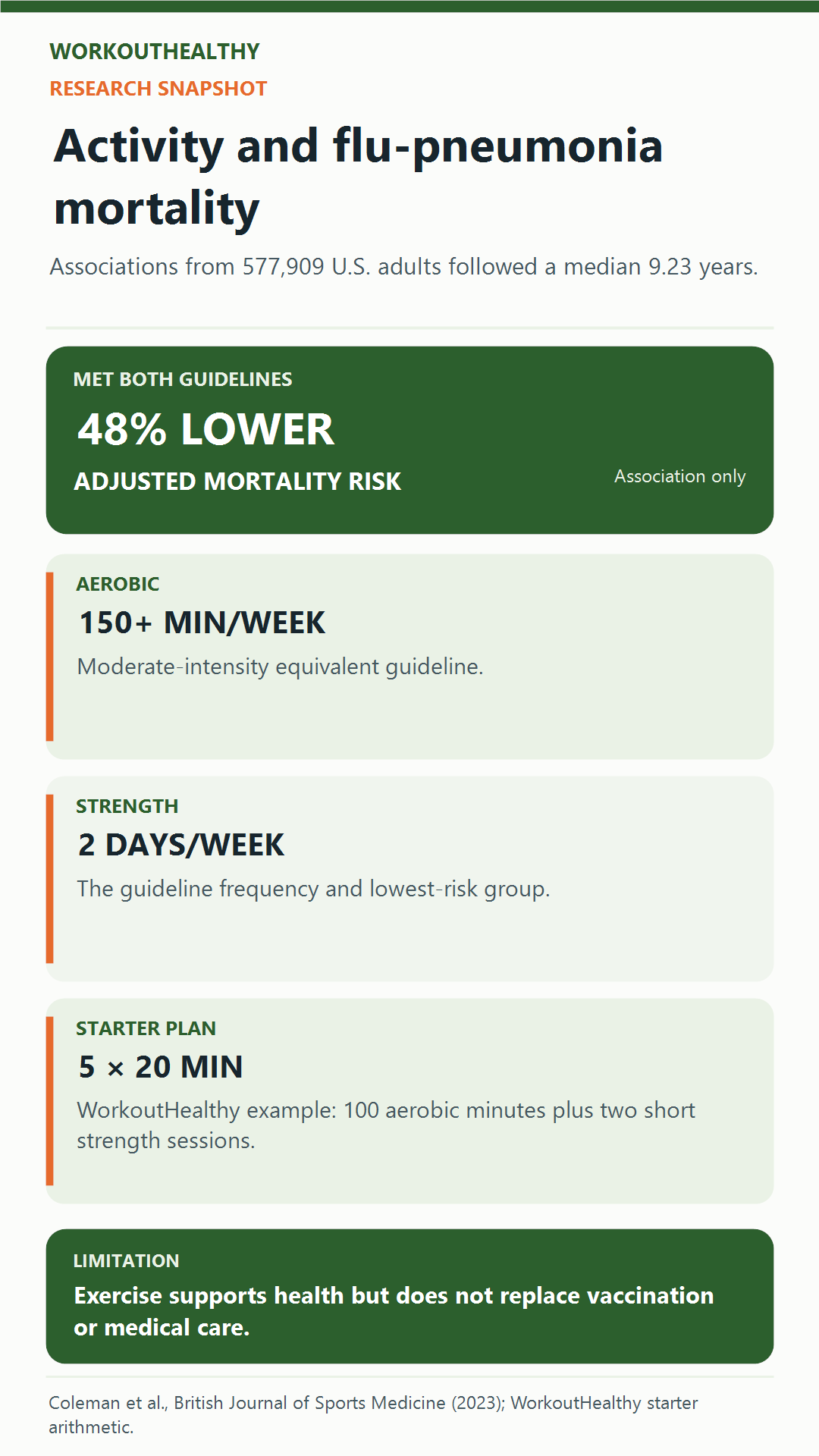
Adults who reported meeting both guidelines had a 48 percent lower adjusted risk of influenza-and-pneumonia mortality than adults meeting neither guideline (Coleman et al., 2023).
The guideline combination was at least 150 minutes of moderate-intensity equivalent aerobic activity per week plus at least two muscle-strengthening sessions.
The analysis adjusted for age, sex, race and ethnicity, education, marital status, alcohol use, smoking, body mass index, and selected health conditions.
Adjustment makes the comparison fairer, but it cannot capture every difference between active and inactive groups. Self-reported exercise also introduces measurement error.
The outcome should therefore be phrased as an association. “Exercise cut flu deaths by half” would overstate what the design can establish.
Why association is not proof
People who exercise regularly may differ in many ways that affect infection outcomes. They may have better access to care, different vaccination patterns, less frailty, higher income, or healthier diets.
Researchers adjust for measured factors, but unmeasured or imperfectly measured differences can remain. Reverse causation also matters because chronic illness may reduce activity before the study begins.
Deaths attributed to influenza and pneumonia are uncommon relative to the huge sample. That makes a large cohort useful, but it also means subgroup estimates can become less stable.
Exercise was recorded at one point. The study could not confirm that every participant maintained the same routine throughout nearly a decade of follow-up.
None of those limitations make the result meaningless. They determine the strength of the conclusion.
The study adds evidence that active lifestyles and lower severe respiratory-disease risk travel together. It does not show that a workout prevents a specific infection tomorrow.
A systematic review of ten prospective studies involving more than one million participants also found lower pneumonia risk among more active adults, which makes the overall direction less dependent on one dataset (Kunutsor et al., 2022).
The aerobic dose-response pattern
The study divided weekly aerobic activity into several ranges. Compared with no aerobic activity, 10 to 149 minutes per week was associated with 21 percent lower adjusted mortality.
The 150-to-300-minute group had 41 percent lower risk, while 301 to 600 minutes was associated with 50 percent lower risk.
More than 600 minutes remained associated with lower risk, but the reduction was 41 percent rather than continuing upward.
This pattern is useful because it rejects two common mistakes. First, doing less than the full guideline was still associated with benefit.
Second, the numbers do not support an unlimited “more is always better” rule. Very high volume did not produce a proportionally larger association.
The categories combine moderate and vigorous activity into moderate-intensity equivalent minutes. One minute of vigorous activity typically counts like two minutes of moderate activity in guideline calculations.
A brisk walk may qualify as moderate activity when breathing and heart rate rise but conversation remains possible. Fitness level and health status affect the exact pace.
For people starting from zero, the 10-to-149-minute result is especially practical. A small repeatable routine is not wasted simply because it falls short of an ideal target.
Why the strength result needs care
Muscle-strengthening activity showed a J-shaped pattern. Two sessions per week were associated with 47 percent lower risk compared with fewer than two sessions.
Seven or more sessions were associated with 41 percent higher risk. That does not prove daily lifting is dangerous.
The survey counted episodes, not standardized workouts. A ten-minute band session and a demanding ninety-minute lifting session could both be recorded as one episode.
People reporting very frequent strength work may also differ in occupation, health behavior, supplement use, training intensity, or other unmeasured characteristics.
The high-frequency subgroup was relatively small, which increases uncertainty. The authors explicitly called for further research on this pattern.
The responsible conclusion is that two weekly strength sessions fit both general guidelines and the lowest-risk group in this study. It is not that a seventh workout directly causes pneumonia.
Recovery still belongs in the plan. Our article on rest days and muscle growth explains why adaptation depends on what you can recover from.
How exercise might influence respiratory risk
Moderate exercise can temporarily increase circulation of immune cells. Over time, regular activity also improves cardiovascular fitness, metabolic health, and physical reserve.
Those changes could help someone tolerate the physiological stress of a serious infection, even if exercise does not stop the infection from occurring.
Physical activity can reduce risk factors that worsen respiratory outcomes, including poor glucose control and low functional capacity. It may also support vaccine responses in some populations.
These are plausible pathways, not a complete explanation of the cohort result. Immune function is complex, and a higher count of circulating cells for a short period is not the same as guaranteed protection.
Sleep, nutrition, vaccination, smoking exposure, age, medications, and chronic conditions all affect respiratory risk.
Very strenuous exercise without adequate recovery can temporarily increase fatigue and may coincide with higher illness risk in some athletes. That context differs from guideline-level activity for the general population.
Exercise should sit inside a prevention strategy, not compete with proven public-health tools.
A minimum viable protection plan
WorkoutHealthy’s minimum viable plan turns the lower end of the evidence into a schedule that is easy to repeat.
Start with five 20-minute brisk walks. That totals 100 moderate minutes and stays inside the study’s below-guideline category associated with lower risk.
Add two 20-minute strength sessions on nonconsecutive days. Each can include a sit-to-stand, hip hinge, push, pull, and calf or carry pattern.
The weekly total is 140 minutes across seven short sessions. The number is a WorkoutHealthy planning example, not a dose proven to prevent infection.
After two or three stable weeks, add ten minutes to each of five walks. That moves aerobic activity from 100 to 150 minutes while strength stays twice weekly.
Progress one variable at a time. Increasing duration, pace, hills, and lifting volume simultaneously makes fatigue harder to interpret.
Use the same walking route or time-based circuit for the first two weeks. A stable baseline makes changes in breathing, effort, and recovery easier to notice.
If five separate walks do not fit, combine minutes into three sessions. The weekly total matters more than copying the sample calendar exactly.
Everyday movement still counts toward a more active life, but planned sessions are easier to track. Record completed minutes rather than relying on intention.
Someone with heart, lung, metabolic, or mobility limitations may need a lower starting dose or clinical guidance. The plan should match current capacity.
The same evidence ladder applies to other wellness claims. Our review of sauna and heart-health research separates physiological response from proven outcomes.
The strongest starter plan is the one that still exists next month.
When you are already sick
A prevention association is not advice to exercise through influenza or pneumonia. Fever, chest symptoms, dehydration, and systemic fatigue change the decision.
Rest and medical guidance take priority during a significant infection. Hard training can add physiological stress when the body is already working to recover.
Chest pain, trouble breathing, confusion, bluish lips or face, fainting, or rapidly worsening symptoms need urgent medical attention.
Older adults, pregnant people, young children, and people with chronic disease or immune suppression may need earlier evaluation.
Return gradually after fever and major symptoms resolve. An easy walk or brief mobility session is a better test than immediately repeating the hardest workout.
Persistent exercise intolerance, palpitations, unusual breathlessness, or chest discomfort after infection warrants clinical assessment.
Vaccination remains a separate layer of protection. Exercise should not be used as a reason to skip recommended influenza, pneumococcal, or other vaccination.
The bottom line
A large cohort found that meeting both aerobic and strength guidelines was associated with 48 percent lower influenza-and-pneumonia mortality. Even some aerobic activity below the guideline was associated with lower risk.
The result supports regular movement as part of a healthy baseline, not as a cure or force field. Build gradually, include two strength sessions, recover, and keep vaccination and medical care in the same plan.
Start here: schedule five 20-minute walks and two short strength sessions. Reassess after two weeks before adding more.
References
Medical disclaimer: This article is general product information, not medical advice. The equipment described here is not a treatment for any condition. If you have an injury, ongoing pain, or a medical condition, talk to a doctor or physical therapist before using any of it.