

A sauna feels relaxing, but heat still puts real work on your heart. Your blood vessels near the skin widen to release that heat, and your heart typically beats faster to keep blood pressure steady while more blood moves toward the surface.
What Heat Does to Your Heart During a Sauna Session
In a traditional sauna near 80 degrees Celsius, heart rate often climbs into a range similar to a brisk walk or a light jog. That is a real cardiovascular response, not just a feeling of warmth.
Some of these short-term changes look a lot like what happens during light or moderate activity. That resemblance is where the sauna-as-exercise idea comes from, and it is worth a closer look.
I think of sauna heat as a stress on the cardiovascular system, not a workout for it. Your heart rate can climb the way it does during light exercise, but sitting still in a hot room does not train a single muscle.
Why Heat Alone Does Not Replace a Workout
A rising heart rate is only one piece of what exercise does for the body. Training also builds muscle strength, improves balance, and reinforces movement skills, none of which come from sitting in the heat.
Real cardio training, the kind built through activities like brisk walking or structured endurance work, also improves how efficiently your heart works over months of repeated effort. Sauna use on its own does not appear to build that same underlying fitness.
It fits better next to a passive recovery habit, similar to how a massage chair supports recovery without replacing the training itself.
What a 21-Year Finnish Study Does and Does Not Show About Sauna Use
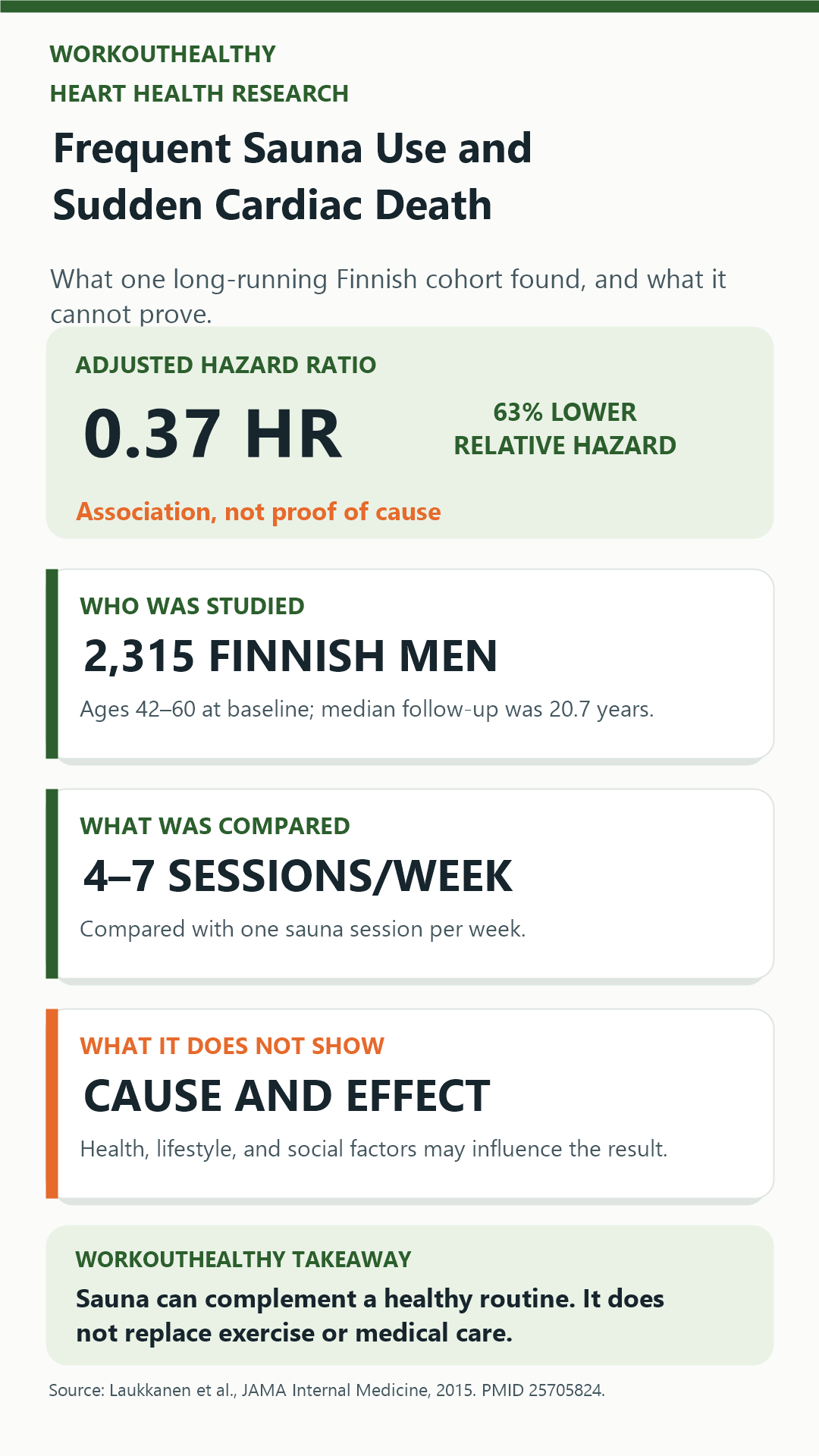
The most cited research on sauna use and heart health is a 2015 study in JAMA Internal Medicine led by researcher Jari Laukkanen. Researchers followed 2,315 middle-aged Finnish men, ages 42 to 60, for a median of just over 20 years.
The study compared men who used a traditional sauna once a week against those who went 2 to 3 times a week and 4 to 7 times a week. The most frequent group had meaningfully lower rates of sudden cardiac death, fatal coronary heart disease, fatal cardiovascular disease overall, and death from any cause.
Longer sessions were linked to lower risk too, with sessions over about 19 minutes showing a stronger association with reduced sudden cardiac death than shorter ones. Those are real numbers from a large, long-running dataset, not a marketing claim.
This was an observational study, not a controlled experiment, so it shows an association rather than proof that sauna use itself causes the lower risk. Men who saunaed more often may also have been healthier, wealthier, or more socially connected to begin with, and any of those factors could explain part of the pattern on their own.
Laukkanen and colleagues were direct about the limits of their own data. An association this size, found in an observational cohort, is not evidence that sauna bathing itself causes the lower risk, and they called for further research into the mechanism before drawing that conclusion.
The men in this study were already regular sauna users in a country where sauna culture is part of daily life. It is not yet clear how well the finding applies to women, to occasional users, or to other styles like infrared cabins, which heat the body differently than a traditional steam sauna.
Later analyses of similar cohorts have found comparable associations, which strengthens the overall pattern. None of that later work turns an association into a demonstrated cause, and no legitimate researcher in this space claims otherwise.
Where sauna use is on firmer ground is as one habit inside a broader wellness routine, not as a stand-in for a workout. Add it after resistance training or a daily walk rather than instead of them, since the heart-health association in the research applies to sauna use as a regular long-term habit, not an occasional visit.
Using Sauna Heat Safely
Treat sauna heat the way you would treat real physical exertion. Drink water before and after, keep sessions at a length that feels comfortable, and leave right away if you feel dizzy, weak, or sick.
Skip alcohol around sauna use, since it affects blood pressure and judgment in ways that compound with heat stress. If you have a heart condition, low blood pressure, are pregnant, or manage another health concern, talk to a doctor before adding regular sauna sessions to your routine.
For a similar look at what the evidence actually supports versus what gets assumed about it, see our breakdown of what resistance training research shows about brain health.
References
Laukkanen, J. A., et al. (2015). Association between sauna bathing and fatal cardiovascular and all-cause mortality events. JAMA Internal Medicine, 175(4), 542 to 548.
This article is for general information only and is not medical advice. If you have an injury, ongoing pain, or a medical condition, talk to a doctor or physical therapist before you change how you train or eat.