
Dale McLaren’s 882.5 kg total is a three-lift achievement, rather than the weight of one extraordinary barbell.
The 2026 IPF World Masters equipped results list the American lifter in the men’s Masters II, 105 kg class, with a 104.55 kg weigh-in (International Powerlifting Federation [IPF], 2026a).
The division-specific record is the important story. Keeping that context makes a remarkable number clearer instead of making it smaller.
The total rewards a complete competition, not just the most shareable lift.
The lifts behind the total
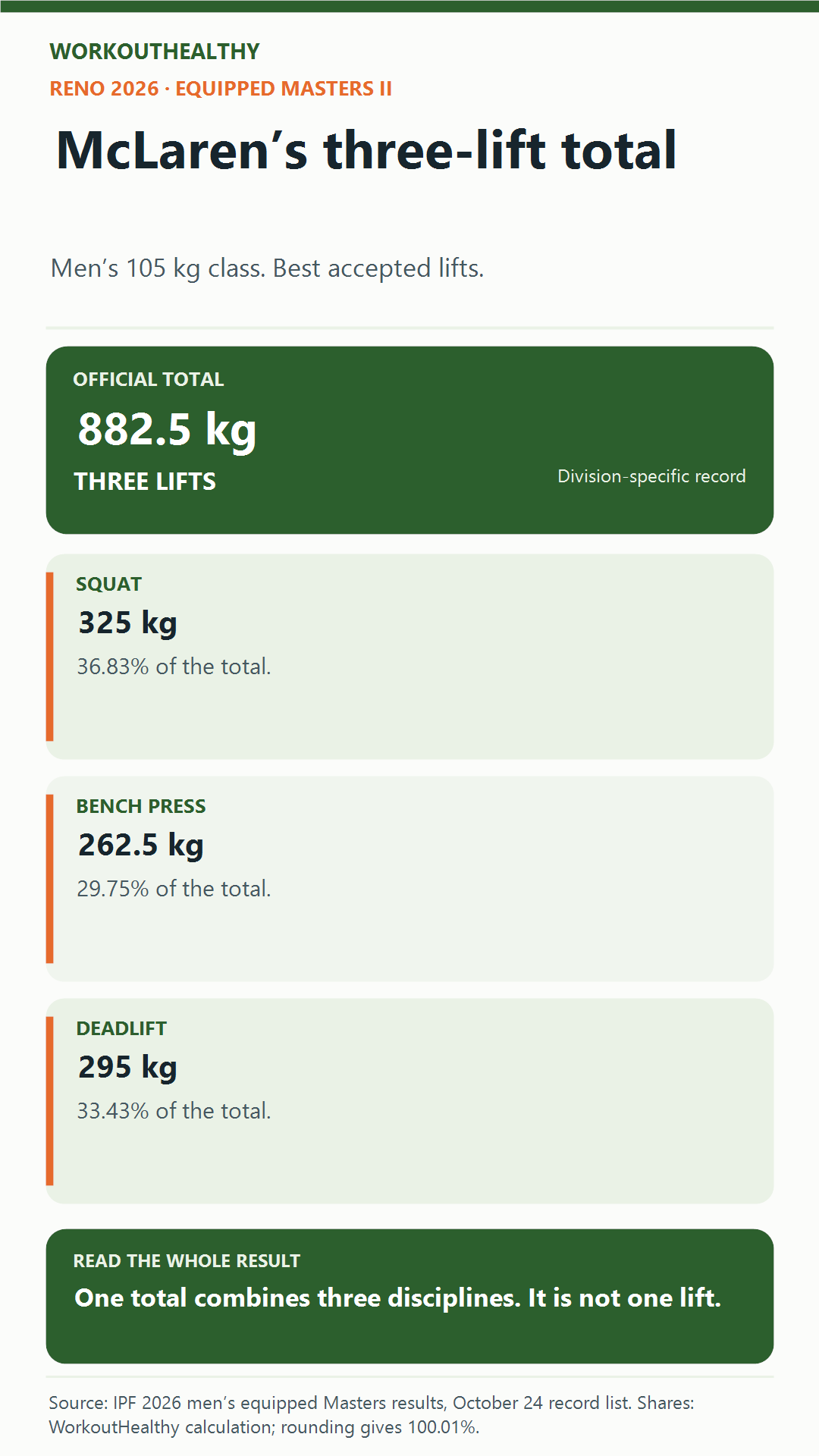
McLaren’s best squat was 325 kg, his best bench press was 262.5 kg, and his best deadlift was 295 kg.
The official men’s results add those lifts to 882.5 kg and list him first in his Masters II weight class (IPF, 2026a).
Each number represents the best accepted attempt in a different discipline.
Reading only the total hides the range of performance required to assemble it.
It also makes it easy to mistake the headline for a squat or deadlift record.
Keep the record label complete
The championship’s record list identifies the 882.5 kg total in the Masters II, 105 kg, equipped division.
It records a date of October 24, 2026 (IPF, 2026a).
This article reports that published championship record entry; it does not claim a separate open or classic record.
Those extra words prevent unlike performances from being placed in the same ranking.
When sharing a result, include the federation, age division, body-weight class, and equipped designation along with the number.
What Masters II and equipped tell us
Masters II covers the calendar years in which a lifter turns 50 through 59 under IPF rules.
The rulebook also defines competition by sex and body weight, with distinct classic and equipped disciplines (IPF, 2026b).
Equipped results use the permitted supportive equipment within that discipline’s rules.
They remain real competition results, but they do not convert automatically into classic results.
A reader can admire the achievement without guessing how many kilograms to subtract for the equipment or comparing it with an unrelated division.
Where the total came from
WorkoutHealthy’s calculation is straightforward: 325 + 262.5 + 295 = 882.5 kg.
Dividing each lift by the total gives a useful descriptive breakdown: squat 36.83%, bench press 29.75%, and deadlift 33.43%.
The rounded percentages sum to 100.01% because each value is rounded separately.
This describes McLaren’s result using the official inputs; it is not a recommended balance for another lifter.
A bigger percentage for one discipline does not prove that a different discipline needs fixing.
It tells us how this particular total was assembled.
The official session gives context
The broadcast below is the men’s Masters II equipped session for the 105 kg through 120+ kg classes.
It provides the relevant competition setting rather than a short video of an unidentified heavy lift.
Watch the athlete name and attempt weight on screen before attributing a lift.
The official results sheet remains the source for the numbers reported here.
The broadcast’s local session date and the results document’s record date need not be treated as interchangeable labels; this article uses the published record entry’s date.
Men’s Masters II equipped competition in Reno
Powerlifting America’s full session covers men’s Masters II equipped lifters in the 105 kg through 120+ kg classes. It is an event broadcast, not a timestamped highlight of McLaren’s final lift.
Why a total changes the story
IPF competitors receive three attempts in each discipline, with the best valid lift in each contributing to the total (IPF, 2026b).
That structure makes the result a sequence of decisions across squat, bench press, and deadlift.
For a spectator, following the accepted lifts is more informative than counting every weight called for the bar.
An unsuccessful attempt does not enter the total merely because the athlete tried it.
This is also why a dramatic single photograph cannot summarize an entire meet or establish the final arithmetic by itself.
Precision gives a record its meaning.
What the source image can show
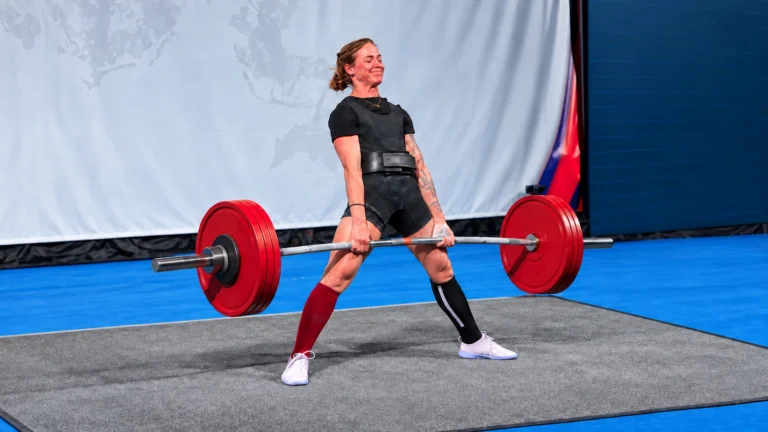
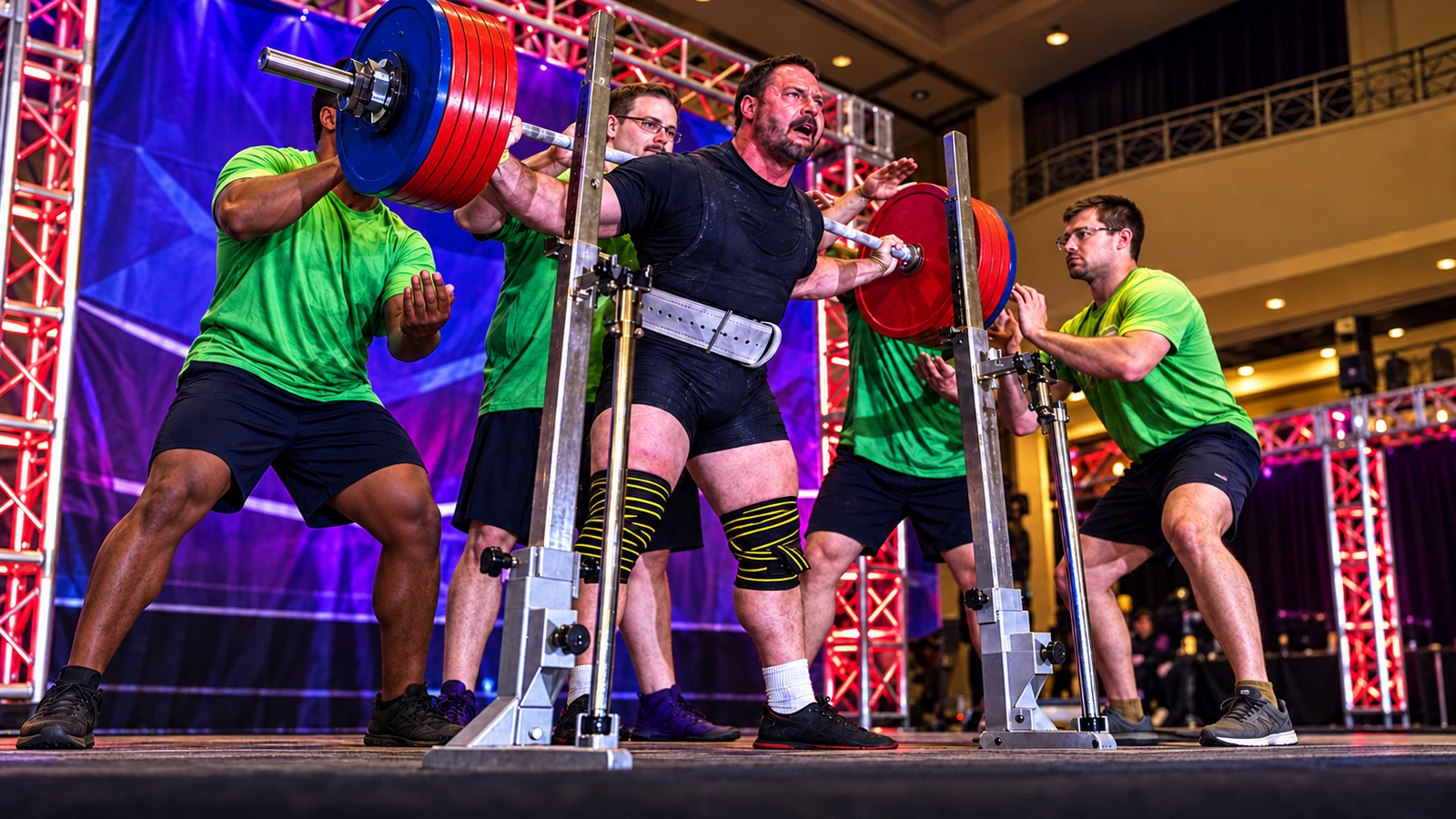
The Facebook post identifies its McLaren photograph as coming from another competition, with restoration and extension applied to the creative.
The cleaned hero preserves that source scene; it is archival and does not document the Reno record attempt.
Treating an older photograph as a new record image would add certainty the source does not provide.
The distinction is simple: the image illustrates the athlete, while the official results support the reported total.
Use the linked competition broadcast for the event context instead of inferring the meet from the hero’s backdrop.
Use the achievement as a better question
For your own training, ask which performance you are trying to improve and how you will compare it fairly next time.
A log that distinguishes exercise variations and conditions is more useful than borrowing an elite total as a deadline.
Our strength training and longevity guide discusses outcomes beyond competition numbers.
If you are returning to resistance work, these exercise and progression considerations can help frame a conversation with a qualified professional.
Celebrate McLaren’s complete result, keep the division in the description, and choose a next step that fits your own current plan.
References
International Powerlifting Federation. (2026a). Men’s results: World Masters Equipped Powerlifting Championships.
International Powerlifting Federation. (2026b). IPF technical rulebook (effective March 1, 2026, version 3).
Medical disclaimer: This article is general product information, not medical advice. The equipment described here is not a treatment for any condition. If you have an injury, ongoing pain, or a medical condition, talk to a doctor or physical therapist before using any of it.