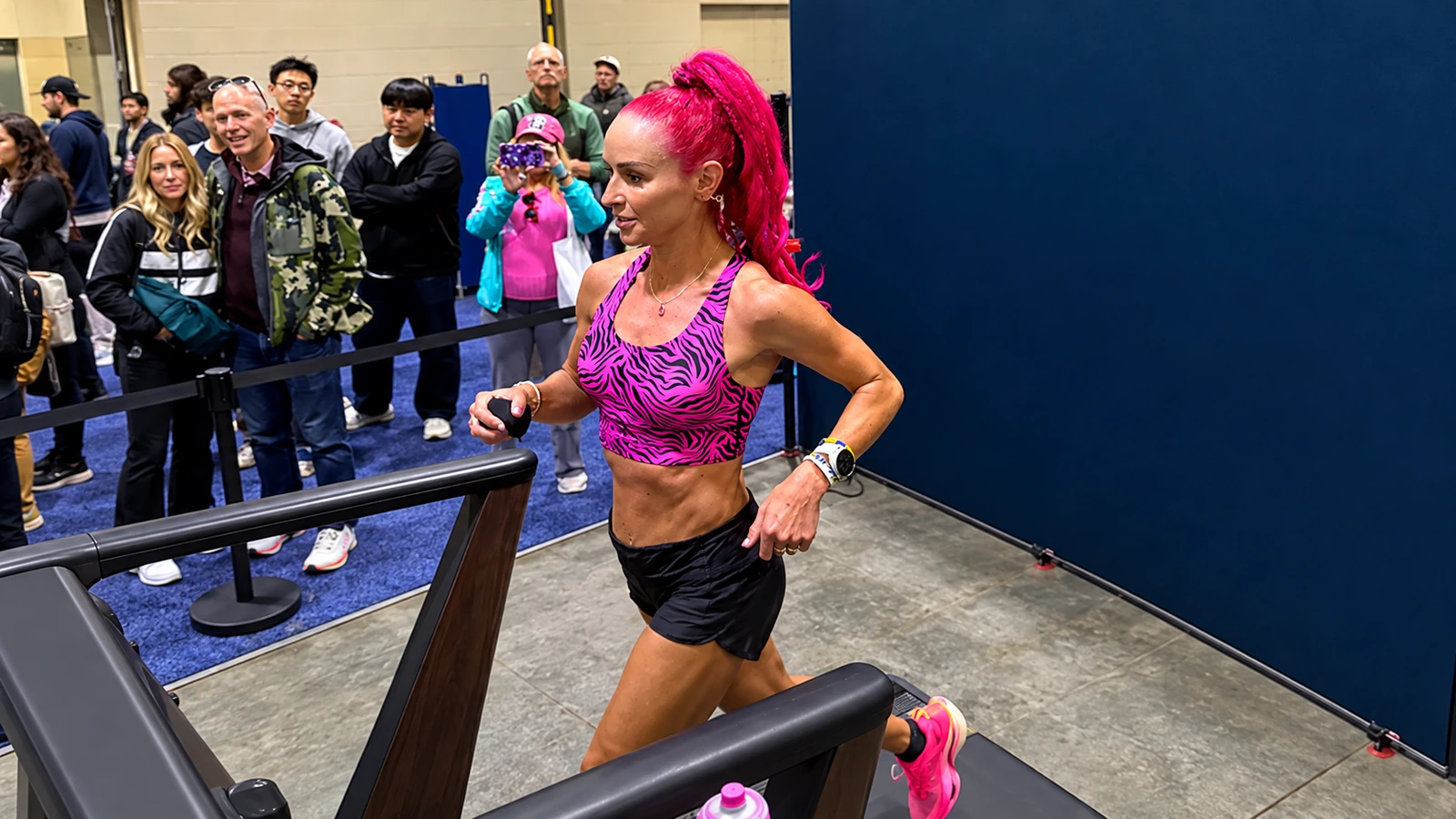

Ashley Paulson completed 100 miles on a treadmill in 12 hours, 47 minutes, and 10 seconds in Boston on April 18, 2026.
Guinness World Records lists it as the fastest 100 miles on a treadmill by a woman (Guinness World Records [GWR], n.d.).
The distance is striking, but the clock explains even more. Her average elapsed pace includes the interruptions that a moving-only average could hide.
The clock gives the distance its context.
The record has a specific setting
Paulson’s attempt took place at the Boston Marathon Expo, in front of spectators collecting their own race materials.
Guinness describes extensive treadmill preparation and practice with nutrition, hydration, and stopping the machine safely for breaks (GWR, n.d.).
That makes this a deliberately prepared record attempt, rather than an unexpectedly long ordinary gym session.
The event and the record category belong together whenever the result is shared.
A treadmill record should not be relabeled as a road, track, or trail performance merely because the distance is familiar.
Why the clock kept running
The record allowed breaks, but elapsed time continued until Paulson reached the full distance.
In her interview with Guinness, she described brief bathroom stops and a longest continuous running stretch of three hours (Newman, 2026).
So the result does not mean she stayed on a moving belt without interruption for the entire attempt.
It means the full distance was completed within the reported start-to-finish time.
That distinction is useful whenever a running app offers both moving time and elapsed time for the same activity.
The pace hidden inside 12:47:10
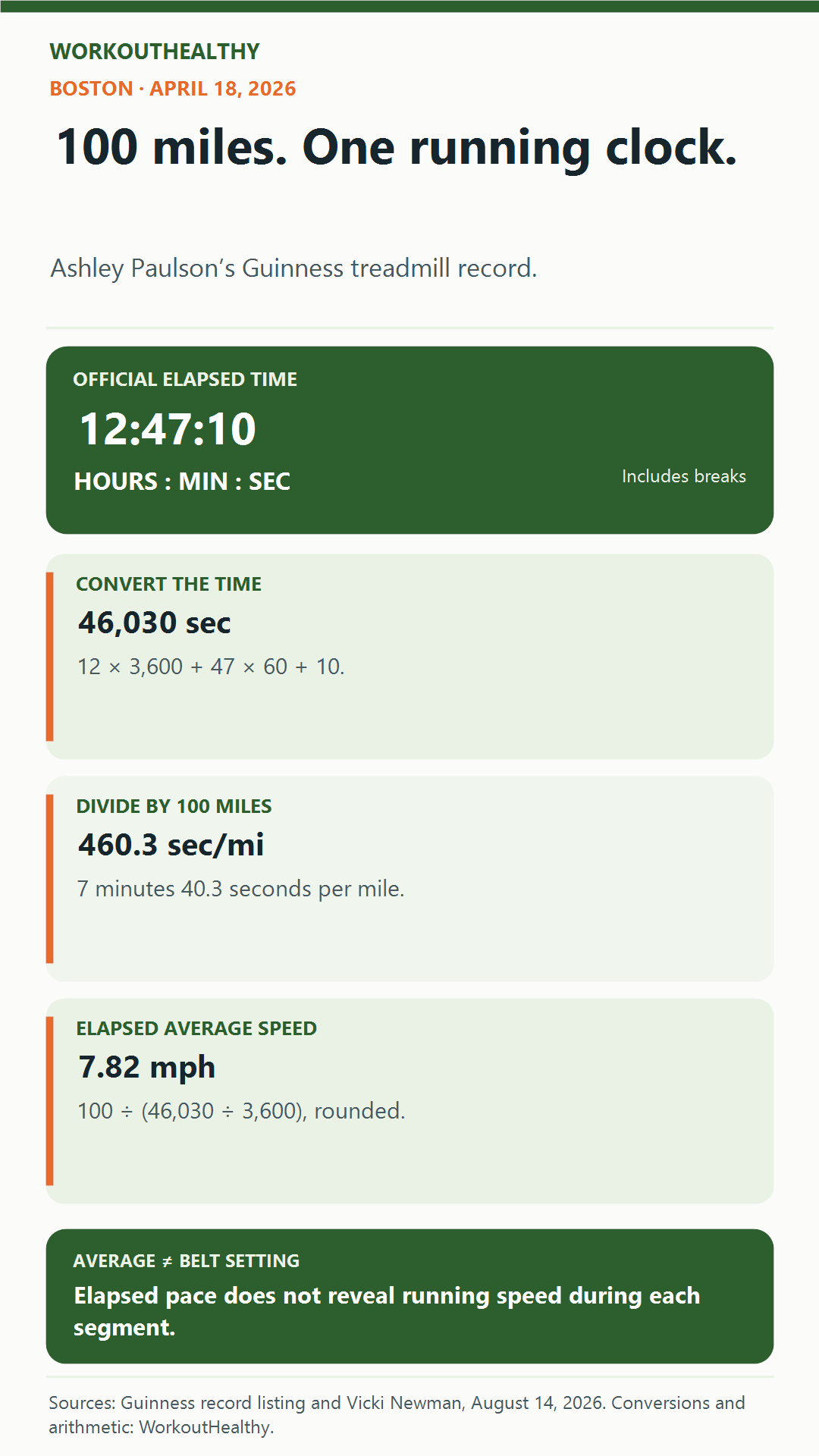
WorkoutHealthy converts the official time into seconds: (12 × 3,600) + (47 × 60) + 10 = 46,030.
Divide by 100 miles and the result is 460.3 seconds per mile, or 7 minutes 40.3 seconds.
The corresponding elapsed average speed is 100 ÷ (46,030 ÷ 3,600) = 7.82 mph, rounded.
These calculations describe the whole attempt, not one treadmill setting.
Because the clock included breaks, the belt speed during running cannot be reconstructed from this average alone.
Do not read 7.82 mph as evidence that she held that exact setting throughout.
Why a treadmill creates its own challenge
Paulson told Guinness that repeating the same movement without turns or changes of terrain brought a different pattern of fatigue.
She also described managing difficult moments while spectators watched nearby (Newman, 2026).
Those are her observations about this attempt, rather than proof that treadmill running is always harder than running outdoors.
The setting changes the task, and the athlete still has to prepare for that task.
A road result and a treadmill result answer related questions, but neither automatically predicts the other to the second.
Ashley Paulson’s Boston treadmill record attempt
iFIT’s documentary identifies the same Boston attempt on April 18, 2026. It shows preparation and the record effort, rather than a continuous recording of the entire run.
A different 100-mile result is easy to confuse
USA Track & Field Utah separately reported Paulson’s 12:19:34 performance at the February 2026 Jackpot 100 Mile in Henderson, Nevada.
That report describes a loop course, not the Boston treadmill attempt (USA Track & Field Utah, 2026).
The two stories share a runner and a distance, which makes a mixed-up caption easy to write.
They do not share the same time, venue, or record category.
When you see a 100-mile headline, check the date and surface before assuming it refers to the performance discussed here.
What an ordinary runner can track
Keep elapsed time, moving time, distance, and the activity setting separate in your own log.
That allows you to explain a session rather than relying on whichever average looks most impressive.
If you pause, note the reason instead of treating a stopped timer as if it erased the interruption.
This is an editorial logging suggestion, not a record-verification protocol.
For another example of how a fixed test changes interpretation, see our guide to the Kenneth Cooper 12-minute run, including its limits and cautions.
A record is a reason to appreciate an athlete, not a requirement for an ordinary workout.
Inspiration needs a manageable scale
CDC guidance for adults describes a weekly activity pattern, including at least 150 minutes of moderate aerobic activity and two days of muscle strengthening.
It also emphasizes that some activity is better than none and that activity can be spread through the week (Centers for Disease Control and Prevention [CDC], 2023).
That is a much more relevant health starting point than attempting an ultrarunner’s record distance.
A goal can be personally meaningful without being extreme.
Keep strength work in the broader picture when deciding what your own routine needs.
Take one clear lesson from the attempt
Paulson’s result rewards preparation for a specific task and honest accounting of its full duration.
For your next session, choose a duration and effort already appropriate to your current plan, then record what happened consistently.
Do not turn the average speed from a record into a test you need to pass.
If you have symptoms, medical concerns, or uncertainty about increasing activity, get individual guidance rather than using a headline as clearance.
Explore the linked guides or join the Insider Five below for more fitness stories with the context kept attached.
References
Centers for Disease Control and Prevention. (2023, December 20). Adult activity: An overview.
Guinness World Records. (n.d.). Fastest 100 miles on a treadmill (female).
Newman, V. (2026, August 14). Super fit gran hopes to inspire after running 100 miles on a treadmill in just half a day.
USA Track & Field Utah. (2026, February 22). Paulson sets 100-mile world record at USATF championships in Nevada.
Medical disclaimer: This article is general product information, not medical advice. The equipment described here is not a treatment for any condition. If you have an injury, ongoing pain, or a medical condition, talk to a doctor or physical therapist before using any of it.