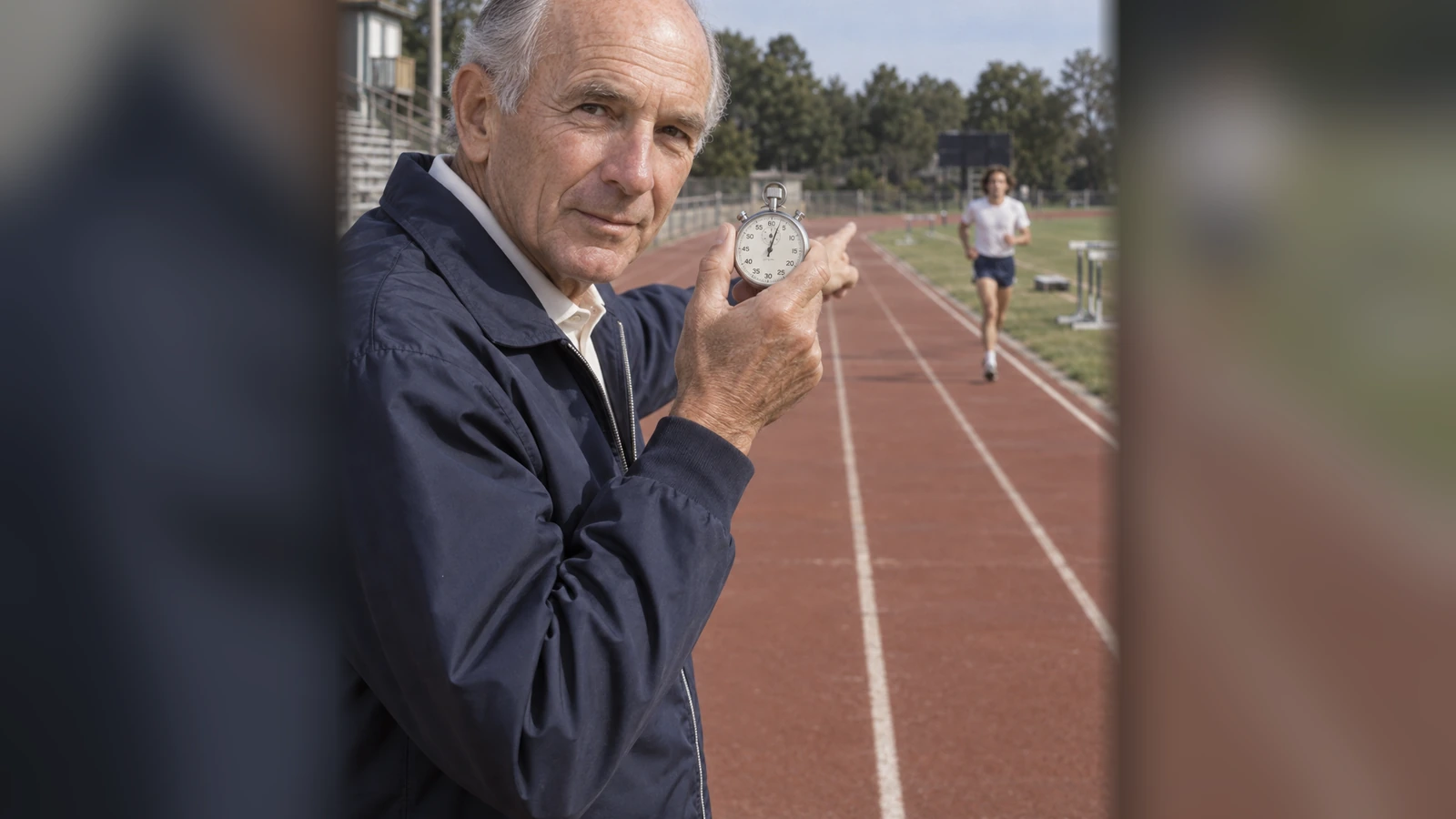

The Cooper test records distance over 12 minutes and supports an estimate of aerobic fitness.
This guide separates the original comparison, later validation findings and the details needed to read a result.
Image context: The featured image does not verify the depicted person’s identity or participation in the research.
Who Kenneth Cooper Is
Kenneth H. Cooper described the test in a 1968 JAMA report. The received publisher abstract concerns 115 male Air Force officers and airmen, rather than a sample representing every adult.
Field and Lab Comparisons
The original comparison related running distance to treadmill VO2 max, or maximal oxygen uptake.
The 1968 Study Behind the Test
Cooper reported a correlation of 0.897. Within that group, farther runners generally had higher measured VO2 max; the correlation does not supply an individual prediction-error range.
The original full paper has not been reviewed for this guide, so this summary stays within the publisher abstract.
Four Results to Keep Separate
| Result | Keep with it |
|---|---|
| Distance | Metres covered during the timed attempt. |
| Predicted VO2 max | The equation, units and population used to assess it. |
| Norm category | The particular chart and its reference group. |
| Measured VO2 max | The laboratory measurement and protocol. |
A category is not a diagnosis or permission to undertake maximal exercise.
How Well It Holds Up Today
A 2016 review pooled 200 correlations from 123 studies of different field tests, not 123 Cooper-only studies. For the 12 minute test, the corrected correlation was 0.78 (95% confidence interval 0.72 to 0.83).
The review’s moderator findings do not establish identical individual accuracy across ages, sexes or fitness levels.
A 2021 review of generally healthy adults aged 19 to 64 included the 12 minute run/walk among supported field options. Its population scope is not personal medical clearance.
A 2026 convenience sample of 73 collegiate team-sport athletes produced a correlation of 0.69, alongside mean underestimation of 6.0 mL/kg/min and wide individual agreement limits. Those findings concern that sample and the prediction studied.
What the Test Cannot Tell You
Correlation describes how results vary together; agreement addresses how close predictions are to measurements. A strong relationship can coexist with substantial errors for individuals.
The athlete study’s average underestimation is not an instruction to add 6 to your result.
Recording the Test
Use a measured course and measure the partial lap. Keep the lane and conditions in the record.
Static distance example: Six completed 400 metre laps plus a measured 150 metres equals 2,550 metres.
Record: course, lane, laps, partial distance, conditions and interruptions.
This arithmetic records distance only; it does not calculate VO2 max, assign a norm category or establish a training plan.
The record is not a complete test-administration or warm-up protocol.
Who the Guidance Covers
The Institute discusses a maximal-effort test for apparently healthy, regularly active people, not an individual clearance assessment.
A review of generally healthy adults cannot establish suitability for someone with symptoms or a medical condition. Discuss an appropriate assessment with a clinician rather than treating this page as a clearance test.
Common Interpretation Mistakes
- Reporting a predicted number without its equation or units.
- Treating a group correlation or average bias as your personal error bound.
- Assuming a universal retest interval.
Use the Result for the Right Question
Keep distance, prediction and chart label in separate fields.
For running-training choices, see our guide to increasing VO2 max with running.
References
Cooper, K. H. (1968). A means of assessing maximal oxygen intake: Correlation between field and treadmill testing. JAMA, 203(3), 201 to 204. Original abstract and citation.
Mayorga-Vega, D., et al. (2016). Criterion-related validity of the distance- and time-based walk/run field tests for estimating cardiorespiratory fitness: A systematic review and meta-analysis. PLOS ONE, 11(3), e0151671. Full article.
[Adult field-test review]. (2021). DOI 10.3390/jcm10163743.
[Collegiate athlete Cooper-test agreement study]. (2026). DOI 10.70252/IJES2026212.
The Cooper Institute. (n.d.). 50 years of the Cooper 12-minute run.
Bracketed labels are descriptive reference locators rather than formal publication titles.
This article explains fitness research and is not medical advice. A clinician should guide testing decisions involving symptoms, injury or a medical condition.