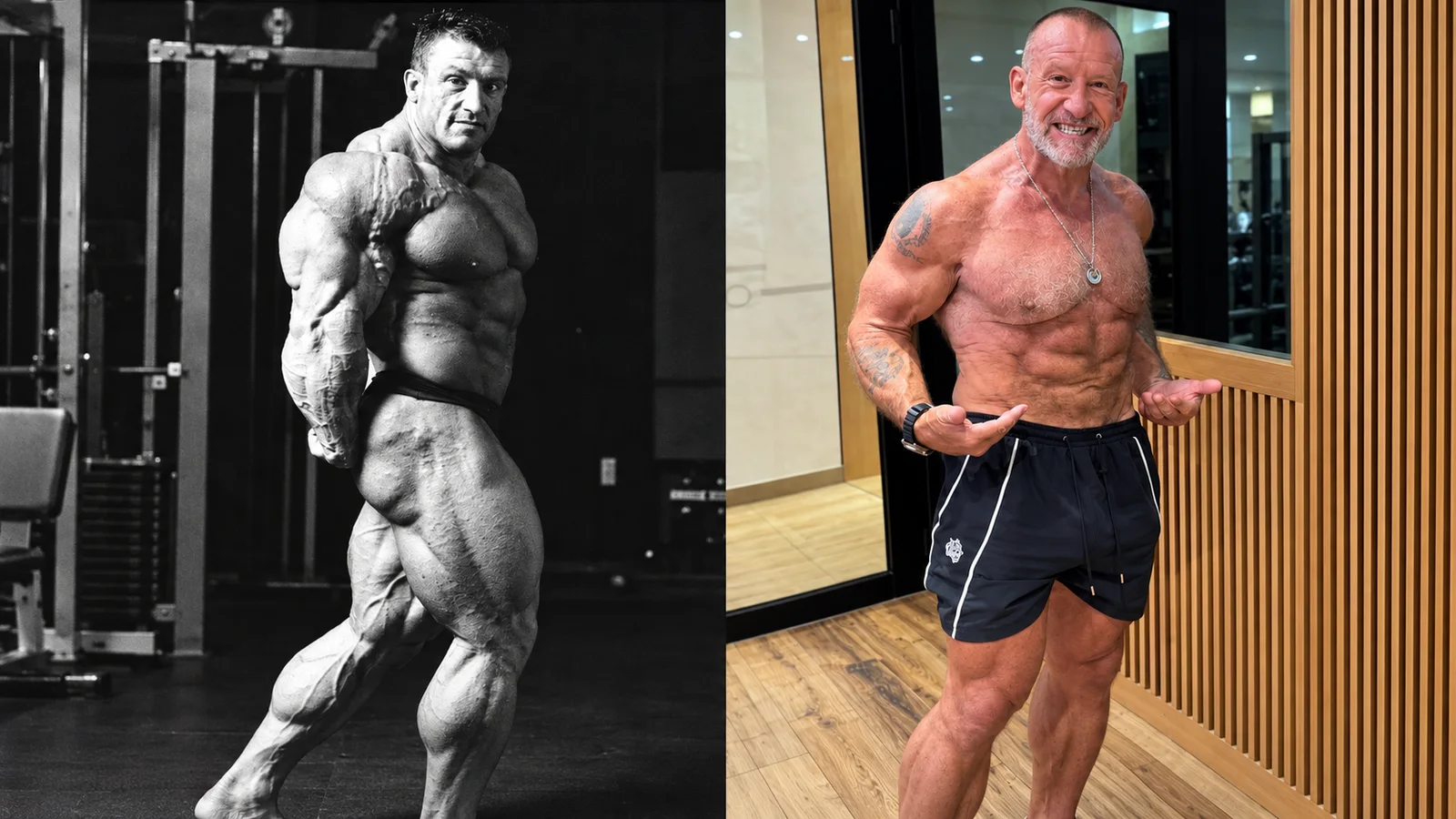

Dorian Yates after 60 is pursuing a very different target from the one that built his reputation. The six-time Mr. Olympia now describes a goal of staying strong, capable, and healthy enough to enjoy daily life—not maximizing muscle size.
That shift did not mean abandoning training. Yates told Andrew Huberman that he still exercises every day, while lifting with moderate weights only a couple of times per week and making room for cycling, yoga, Pilates, hiking, and other activities.
He also explained that an elevated blood-pressure reading helped prompt him to reduce his body weight from roughly 250 to 230 pounds. His experience is personal, not a universal prescription, but it offers a useful way to think about fitness after 60: the goal can change without the commitment disappearing.
What Dorian Yates Said Changed
In the January 2026 Huberman Lab interview, Yates said he had remained around 250 pounds several years after his competitive career. A checkup that showed his blood pressure was “a bit high” became a turning point.
He described lowering his food intake, moving toward a more plant-forward pattern, and accepting that losing body weight would also mean losing some muscle. He framed the decision as one made for health rather than appearance, eventually settling around 230 pounds.
That is an important distinction. The interview documents Yates’s reasoning, but it does not establish that every muscular older adult should pursue the same body weight, diet, or training schedule. Blood pressure, medication, injury history, and nutritional needs are individual clinical questions.
Why Getting Smaller Is Not the Same as Stopping
Yates still looks muscular, but he no longer treats maximum size as the scorecard. He said he wants to remain functional, do the activities he enjoys, and stay healthy for his children.
That is consistent with the longer view in Robby Robinson’s training at 77: the useful lesson is not to copy a famous physique, but to keep adapting the work so it can continue.
For many lifters, reducing volume, changing exercises, or accepting a smaller body can feel like retreat. It can also be deliberate programming. When the objective changes from competition to quality of life, the best routine may be the one that preserves strength without making every session a test of maximum tolerance.
Changing the goal is not abandoning training. It can be the most disciplined form of adaptation.
What Comparison Photos Cannot Tell You
The young-and-current images of Yates make the size difference obvious. They do not show his blood pressure, aerobic capacity, pain, sleep, blood work, or how well he moves through daily life.
Photos also change with lighting, posing, camera distance, and body weight. They can document appearance, but they cannot diagnose health or reveal why a person changed.
The same caution applies to other celebrity transformations. Our analysis of Michael Beach’s fitness photos at 62 uses appearance as one data point beside training, performance, function, and recovery.
How Injuries Change the Training Question
Yates discussed a torn biceps, a torn triceps tendon, shoulder issues, and strength differences between his right and left sides. He said he does not push weights too hard now and adjusts around those limitations.
That does not translate into one safe exercise list for everyone. An old injury may tolerate one range of motion, machine, or loading pattern and reject another. Pain, sudden weakness, loss of function, or a recent injury deserves an appropriate medical assessment.
For a healthy beginner, weight lifting after 60 can begin with four gradual weeks. Someone with a complex surgical or tendon history may need more individualized boundaries.
Why Cardio, Balance, and Mobility Belong in the Plan
Yates described cycling, hiking, yoga, Pilates, and other forms of exercise in addition to resistance training. That mix matches the broad direction of public-health guidance for older adults, which combines aerobic activity, muscle-strengthening work, and balance practice.
The point is not that yoga or cycling replaces strength. Each type of work answers a different question. Resistance training supports force production and muscle. Aerobic work challenges the heart and lungs. Balance and mobility practice can support movement options and confidence.
A complete week does not have to maximize every category. It needs enough variety to serve the person’s actual goals, abilities, and health status.
A Three-Lane Fitness Check After 60
WorkoutHealthy’s three-lane check separates the parts of a routine that social media often blends together.
- Strength: Can you perform the chosen movements with control, and is the load appropriate for your joints and current skill?
- Capacity: Are you also training aerobic fitness, balance, and useful ranges of motion rather than treating muscle size as the only goal?
- Recovery: Are pain, sleep, energy, and day-to-day readiness stable enough for the routine to remain repeatable?
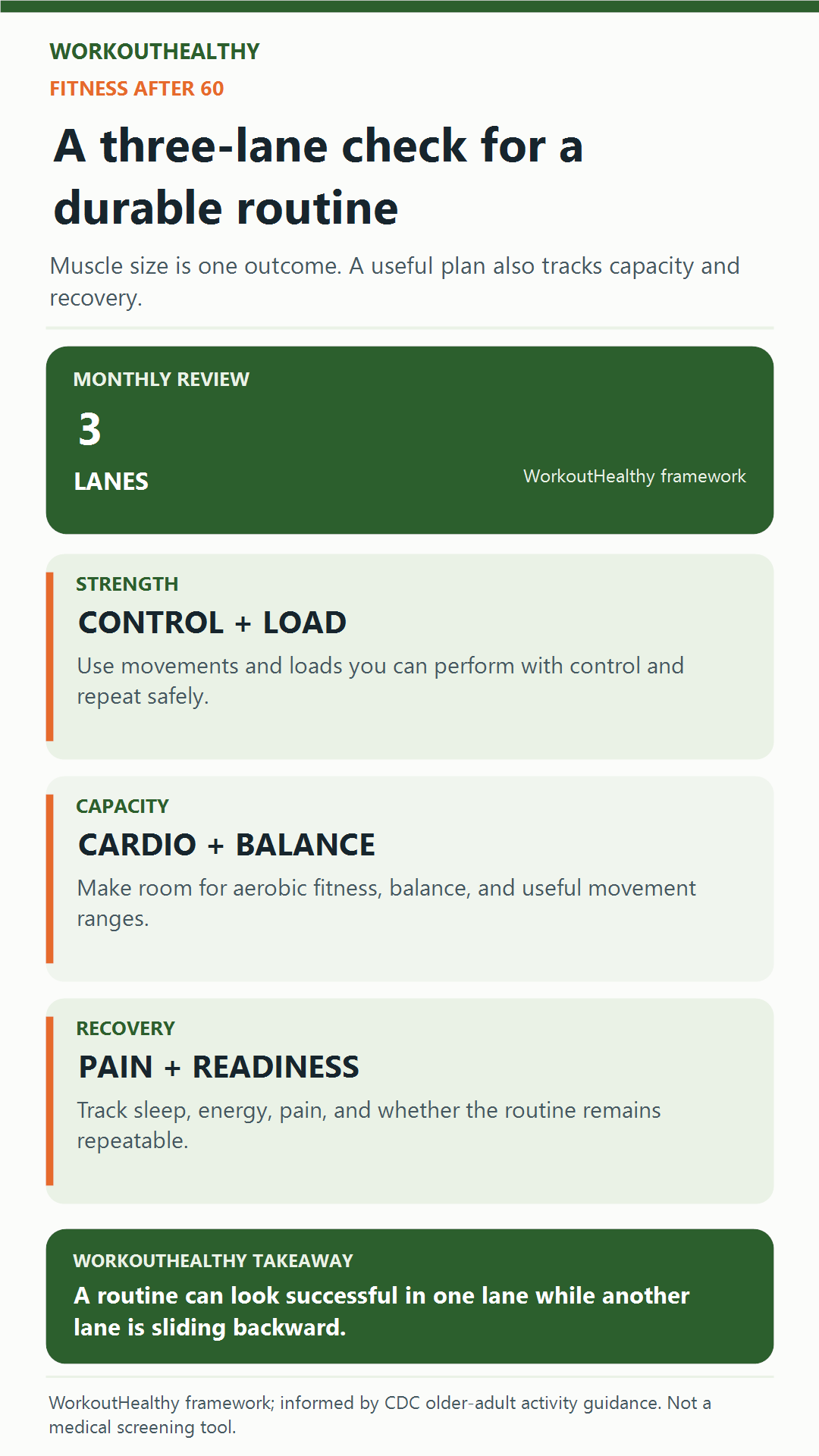
Review all three lanes monthly. If strength is rising while pain and fatigue keep worsening, that is not a clean win. If aerobic work improves while all resistance training disappears, strength may need its own place again. The fundamentals that drive training progress still matter, but the definition of progress should match the phase of life.
A comparison photo shows size. It does not show blood pressure, aerobic capacity, pain, or recovery.
Watch the Full Conversation
The Huberman Lab episode covers Yates’s training history, high-intensity methods, injuries, current exercise habits, and broader views on health and longevity. Watching the full exchange preserves the context that a short social post cannot.
Who Should Be Cautious
Anyone with elevated blood pressure, known cardiovascular disease, unexplained shortness of breath, dizziness, chest discomfort, or a long period of inactivity should get appropriate guidance before making a major change in training intensity.
Do not copy Yates’s weight-loss target, eating window, or supplement choices from an interview. Unintentional weight loss, new weakness, repeated falls, or difficulty eating enough deserve evaluation, especially later in life.
During exercise, stop and seek urgent care for chest pain, fainting, severe breathing difficulty, or sudden neurologic symptoms. Persistent tendon or joint pain is a reason to modify the plan and have the problem assessed—not a character test.
The Bottom Line
Dorian Yates’s current approach is notable because it reverses his old competitive objective. He intentionally accepted less muscle, trains around established injuries, and gives cardio, mobility, and daily function a larger role.
The transferable lesson is not to become smaller. It is to define what training is for now. After 60, a durable plan can keep strength while also making room for aerobic capacity, balance, mobility, recovery, and the health markers a mirror cannot show.
This article is for general information only and is not medical advice. Consult a qualified healthcare professional before changing exercise, diet, medication, or supplement use, especially if you have high blood pressure, an injury, or another medical condition.