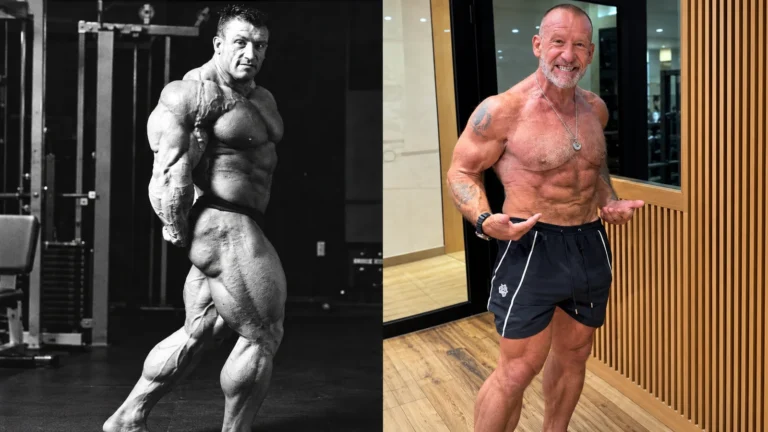

Before and after photos are everywhere on social media.
The idea behind them is much older than the smartphone.
In the early 1860s, Archibald MacLaren used photos and body measurements to track soldiers going through his gymnastics course.
A widely shared post says he tracked army recruits this way to prove the training worked.
The core of that is right, with one correction about who was tracked.
The Army Asks for Help
MacLaren ran a respected gymnasium at the University of Oxford, which opened in 1858.
Around 1860 and 1861, the British Army sent Major Frederick Hammersley and 12 selected non-commissioned officers to train under him.
They completed a 12 month course.
That group went on to form what became the Army Gymnastic Staff.
That body was a forerunner of today’s Royal Army Physical Training Corps.
Photos, Tape, and Proof
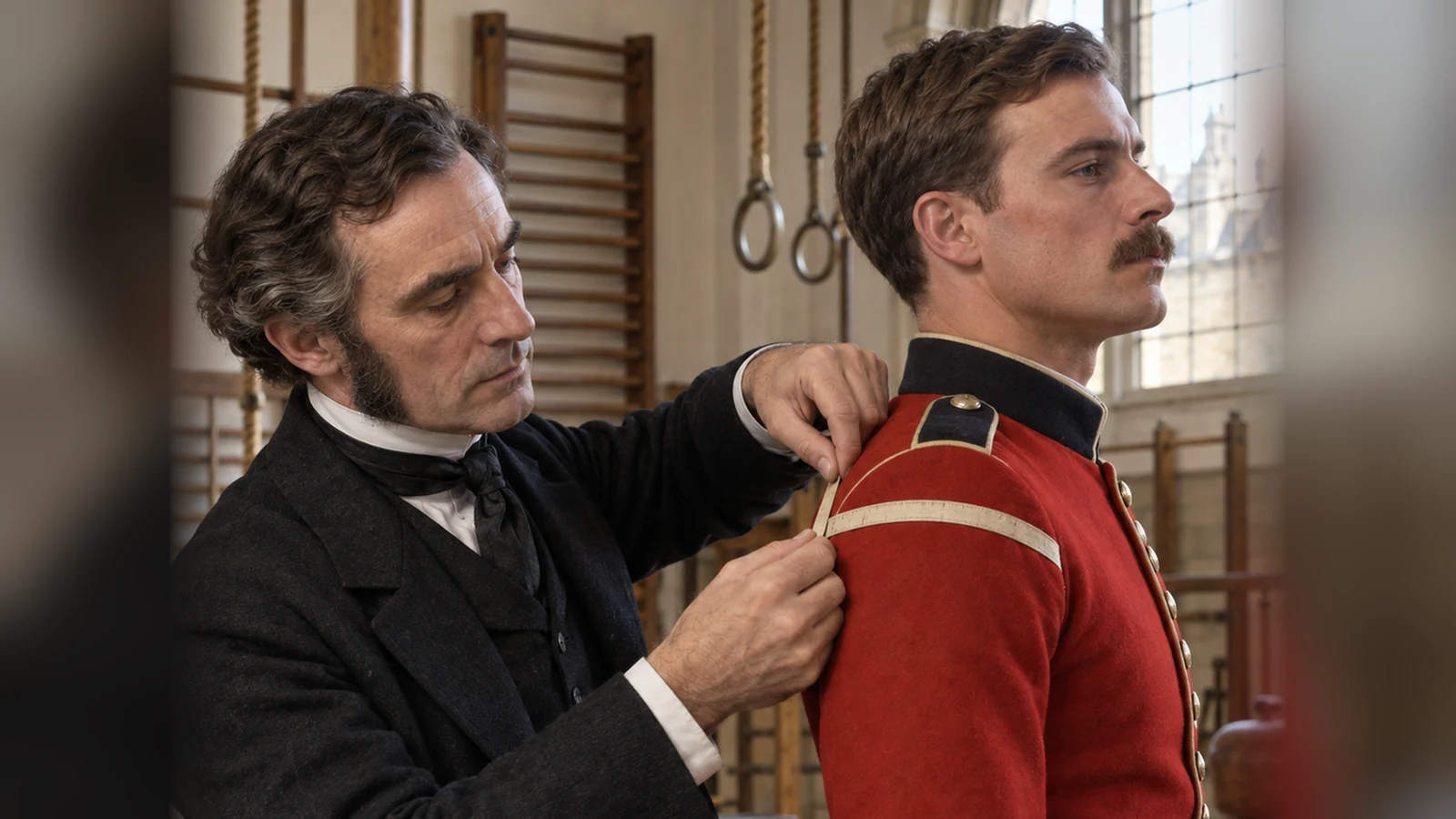
According to Wikipedia’s account, MacLaren charted the physical changes in these men.
Each of the NCOs was photographed before and after training and regularly measured to check their development.
So the tracked group was the instructor candidates, not ordinary new recruits.
MacLaren’s 1869 book, A System of Physical Education, backs up the measuring part.
Its appendix lists a table of measurements before and after the course of instruction.
That table covers the first and second groups of NCOs being trained as military gymnastic instructors.
Another appendix describes a system of taking measurements to track growth and development.
The book also includes illustrations drawn from photographs of different forms of growth.
Gyms at Aldershot, Sandhurst, and other military sites were later built to his design.
What you record, you can judge. What you only remember, you can argue about forever.
Why This Was a Big Deal
It is easy to say a training system works.
MacLaren tried to show results with numbers taken before and after.
He also repeated his measurements during the course, not just at the ends.
That is a basic idea behind evaluating any program today.
Today, researchers call this kind of check a pre and post comparison.
It is simple, but it forces you to define what success looks like before you start.
That habit alone can keep a training plan honest.
It also turns a vague feeling of progress into something you can check and share with others.
What Research Says About Tracking Progress
MacLaren’s habit of recording progress has solid modern support.
A 2016 meta-analysis led by Benjamin Harkin pooled 138 studies with 19,951 participants.
It asked whether monitoring progress toward a goal helps people reach it.
Interventions that prompted progress monitoring made people monitor far more often.
They also improved goal attainment, with an average effect size of 0.40.
Two details stand out.
The effects were larger when progress was physically recorded.
They were also larger when results were reported to others or made public.
MacLaren did both. He wrote the numbers down and published them in a book.
A 2020 consensus statement led by Robert Ross looked at one simple body measurement: the waist.
The authors argued that body mass index alone is not enough to assess the health risks of excess body fat.
They recommended measuring waist circumference routinely alongside it.
They also noted that shrinking the waist through exercise or diet changes can meaningfully improve health.
That makes a tape measure a useful tracking tool, not just a vanity check.
What the Research Does Not Show
The Harkin review covered many kinds of goals, not only fitness.
It did not test progress photos specifically.
The waist statement focused on health risk, not on muscle gain or athletic ability.
Neither paper tells you the best way to track every goal.
Still, both point the same way: regular, written measures help you see what is really happening.
The Limits of Before and After Photos
Photos can mislead.
Lighting, posture, camera angle, time of day, and even a pump can change how a body looks.
MacLaren’s own records had limits too.
The men were soldiers in a year long course, so many other things in their lives could have changed too.
The accounts we found describe no comparison group, so we cannot tell how much change came from the gym itself.
That does not make his work useless. It just means before and after records show change, not always the cause.
How to Track Your Own Progress
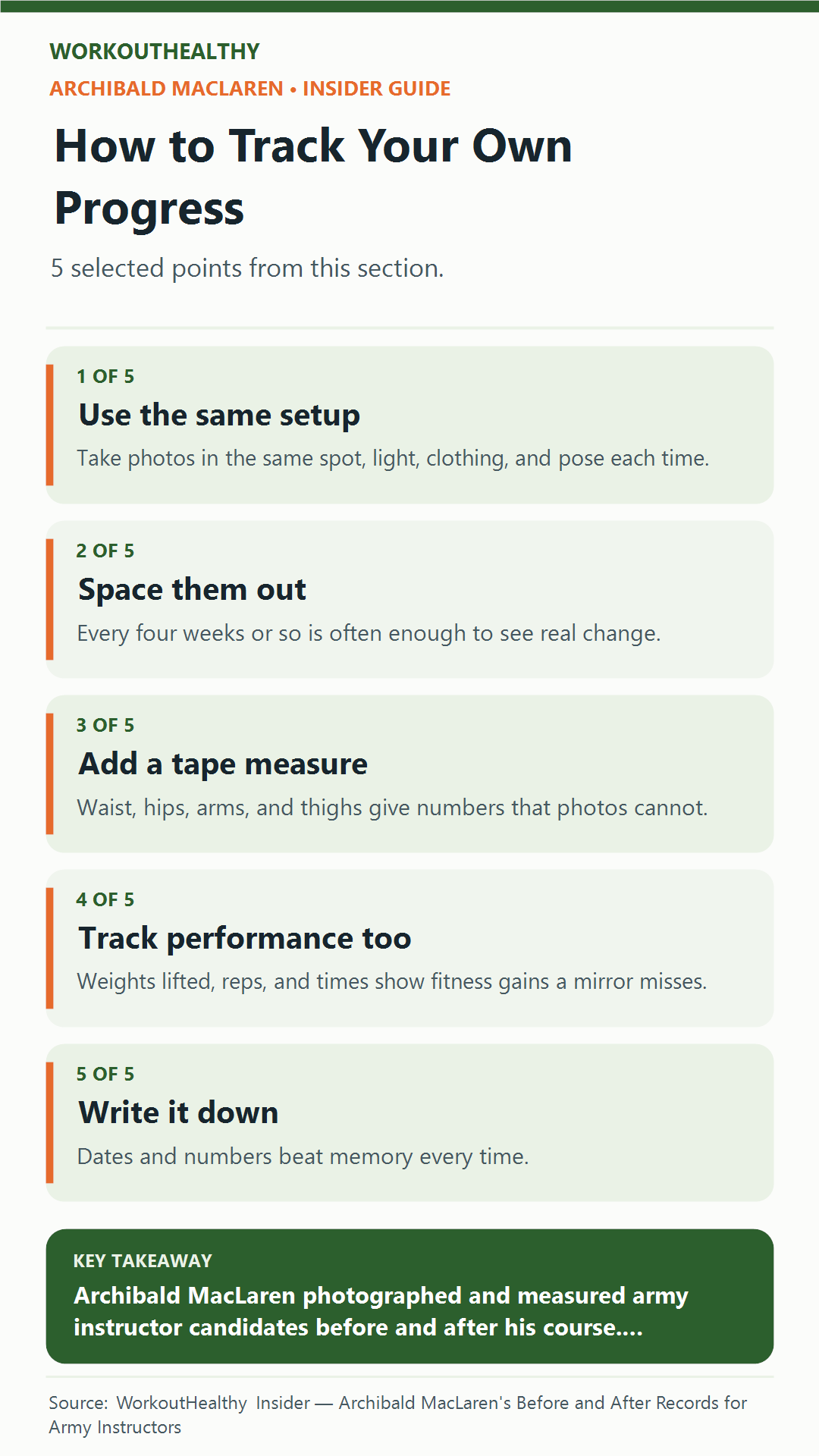
- Use the same setup. Take photos in the same spot, light, clothing, and pose each time.
- Space them out. Every four weeks or so is often enough to see real change.
- Add a tape measure. Waist, hips, arms, and thighs give numbers that photos cannot.
- Track performance too. Weights lifted, reps, and times show fitness gains a mirror misses.
- Write it down. Dates and numbers beat memory every time.
- Look at trends. One bad week of data means little. The long line matters.
For an example of honest self review, see how Morris Chestnut leans on accountability to stay on track.
And if the scale is your only yardstick, read why Mel Rodriguez’s comeback is not about the scale.
Common Mistakes
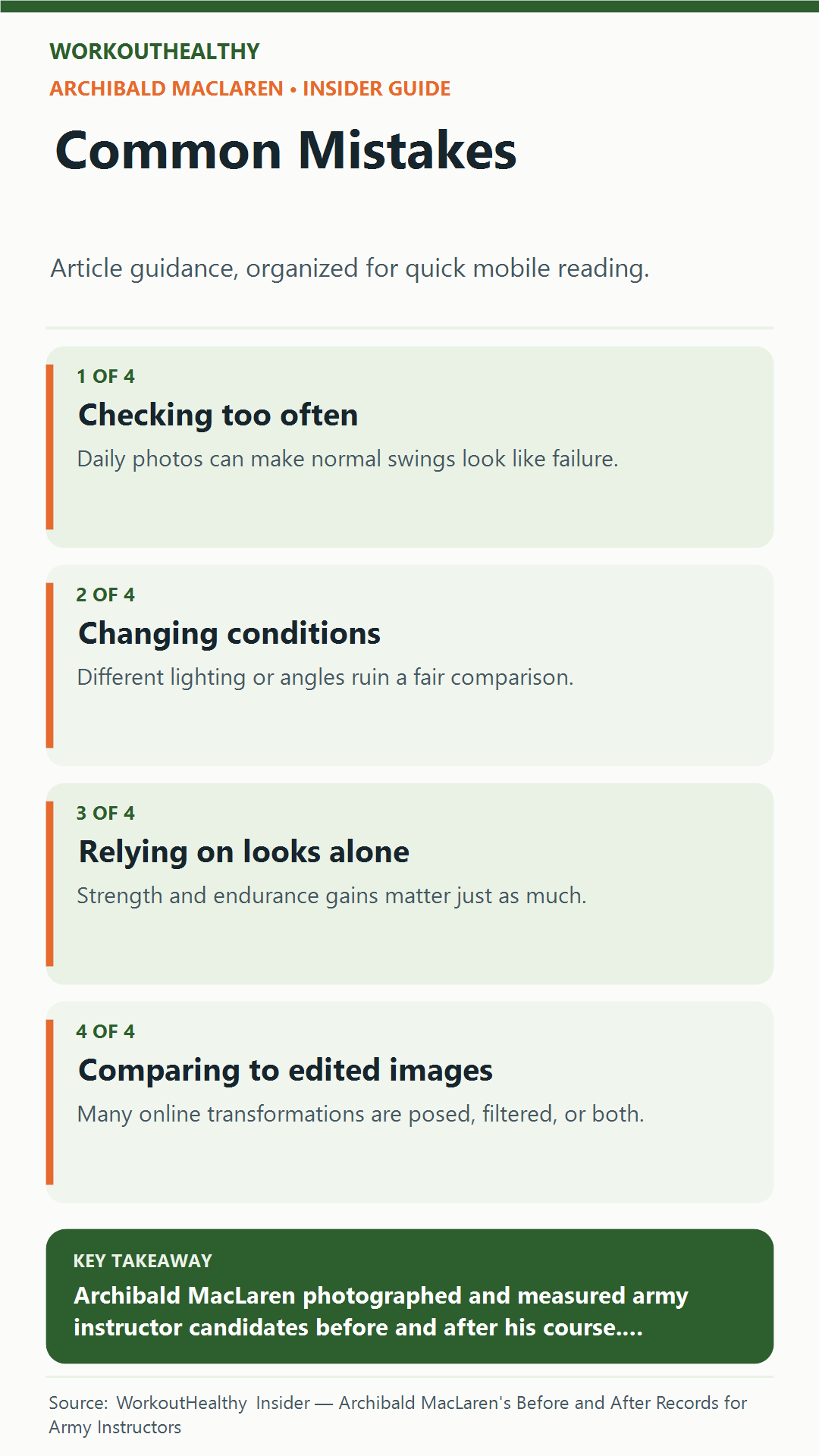
- Checking too often. Daily photos can make normal swings look like failure.
- Changing conditions. Different lighting or angles ruin a fair comparison.
- Relying on looks alone. Strength and endurance gains matter just as much.
- Comparing to edited images. Many online transformations are posed, filtered, or both.
Who Should Be Careful
For some people, frequent body photos and measurements raise anxiety or unhealthy focus on appearance.
If tracking starts to feel stressful, switch to performance goals, or talk with a doctor or counselor.
The Bottom Line
Archibald MacLaren photographed and measured army instructor candidates before and after his course.
It was an early attempt to prove a training program worked with evidence rather than opinion.
Tracking your own progress still helps, as long as you measure the same way each time.
Pair photos with a tape measure and a simple training record.
Together, they give a far clearer picture than any single snapshot.
Want more stories like this? Subscribe to WorkoutHealthy Insider for practical explanations behind popular fitness claims.
References
- Harkin, B., Webb, T. L., Chang, B. P. I., Prestwich, A., Conner, M., Kellar, I., Benn, Y., & Sheeran, P. (2016). Does monitoring goal progress promote goal attainment? A meta-analysis of the experimental evidence. Psychological Bulletin, 142(2), 198 to 229. https://doi.org/10.1037/bul0000025
- Maclaren, A. (1869). A system of physical education, theoretical and practical. Macmillan. https://archive.org/details/systemofphysical00maclrich
- Ross, R., Neeland, I. J., Yamashita, S., Shai, I., Seidell, J., Magni, P., Santos, R. D., Arsenault, B., Cuevas, A., Hu, F. B., Griffin, B. A., Zambon, A., Barter, P., Fruchart, J.-C., Eckel, R. H., Matsuzawa, Y., & Després, J.-P. (2020). Waist circumference as a vital sign in clinical practice: A Consensus Statement from the IAS and ICCR Working Group on Visceral Obesity. Nature Reviews Endocrinology, 16, 177 to 189. https://doi.org/10.1038/s41574-019-0310-7
- Wikipedia contributors. (n.d.). Archibald MacLaren. In Wikipedia. Retrieved September 16, 2026, from https://en.wikipedia.org/wiki/Archibald_MacLaren
This article is for general information only and is not medical advice. If you have an injury, ongoing pain, or a medical condition, talk to a doctor or physical therapist before you change how you train or eat.