
Mel Rodriguez is one of those actors whose face people recognize before they place his name.
He has spent two decades building a career out of supporting roles that stick with viewers, from Nurse Patsy on HBO’s Getting On to Todd on Fox’s The Last Man on Earth to Marco Pasternak on Better Call Saul.
Off screen, Rodriguez has talked about a different kind of long running project. Profiles of the actor describe a weight journey that has gone up and down more than once over the years, along with a more recent shift toward bodyweight training as his main way of staying active.
That shift is worth paying attention to, not because it is flashy, but because it runs against the usual celebrity fitness story.
There is no personal chef here, no transformation photo built around a single event.
There is a much more ordinary pattern: weight that has cycled over time, and a training method built around consistency rather than intensity.
What His Calisthenics-Based Approach Looks Like
Calisthenics is training that uses body weight instead of external equipment as the resistance. Push ups, pull ups, squats, and simple circuit style combinations are its building blocks.
For Rodriguez, that approach has reportedly meant workouts he can do almost anywhere, without needing a gym membership or specialized equipment.
That matters for someone with an unpredictable filming schedule, where a hotel room or a trailer might be the only available space on a given day.
The appeal of calisthenics is often framed around accessibility. A person does not need to buy anything or drive anywhere to start. The barrier to a single session is low, even if building real strength through bodyweight work still takes real effort and real time.
This is different from a strict diet-first approach to weight change. Calisthenics on its own does not control what someone eats. It gives a person a repeatable habit that does not depend on outside conditions being perfect.
A typical circuit style session built around bodyweight work might rotate through push ups, squats, some form of pulling movement, and a core exercise, repeated for several rounds with short rest between them.
That format keeps the heart rate elevated while still building strength.
That is part of why circuits show up so often in travel workouts. There is no equipment to set up and no machine to wait for.
How He’s Talked About the Journey
Rodriguez has described his weight history as something that has not moved in a straight line.
Reporting on his story describes swings of significant weight gain and loss across different periods of his adult life, rather than one clean before and after.
He has pointed to emotional eating as one of the harder patterns to work through.
He has also connected some of his relationship with food back to body image struggles that started in childhood, which is a common thread in how adults describe long term weight cycling.
What stands out in how he frames the current chapter is the language of self acceptance rather than a target number.
He has described measuring progress by whether he stayed consistent, not by a scale reading on any particular day.
He has also talked about staying proud of himself even on days that feel like a step backward.
That framing matters more than it might sound like on the surface, since it changes what counts as success from a single outcome to an ongoing behavior.
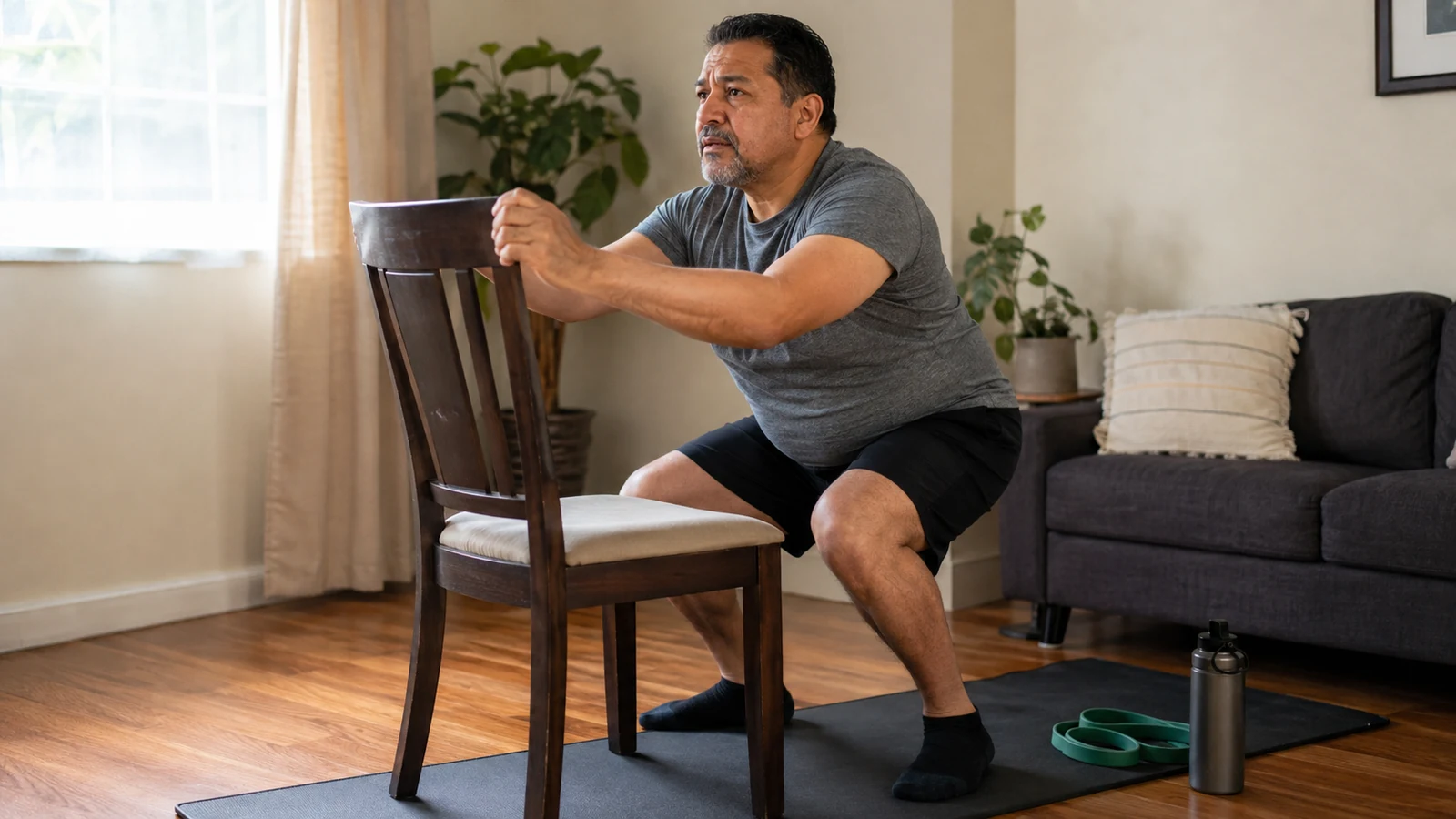
The Science Behind Bodyweight Training
A common assumption is that bodyweight exercise is a lesser version of lifting weights. Research does not support that as a blanket rule.
A controlled study comparing low load bench pressing to push ups found the two produced similar gains in muscle thickness and strength over an eight week program in young men (Kikuchi & Nakazato, 2017).
The muscle did not seem to care much whether resistance came from a barbell or from a person’s own body weight.
The mechanism behind that finding is fairly simple. Muscles respond to tension, fatigue, and enough total volume over time, not to the specific object creating the resistance.
That does not mean calisthenics can replace every goal a barbell can achieve. Building maximal strength for very heavy, low repetition lifts is harder to replicate with body weight alone once someone gets strong enough that basic movements stop being challenging.
For general health, consistency, and moderate muscle maintenance, though, calisthenics holds up as a legitimate training method rather than a fallback option.
Progression still matters in bodyweight training the same way it matters with a barbell. Someone who can already do 20 clean push ups needs a harder variation, not just more repetitions of the same movement, to keep building strength over time.
Slowing the tempo down, adding a pause at the bottom of a movement, or moving to a single limb version are all ways to keep a bodyweight exercise challenging as a person gets stronger.
What Weight Cycling Actually Does to the Body
The pattern Rodriguez has described, losing weight and later regaining it more than once, has a name in research literature: weight cycling.
Researchers have studied weight cycling’s effects on cardiovascular risk factors for years. One influential review proposed that repeated swings in weight create repeated swings in blood pressure, blood sugar, and cholesterol markers, described as a repeated overshoot pattern that puts extra strain on the cardiovascular system over time (Montani et al., 2006).
A later review added an important nuance. The clearest negative effects of weight cycling tend to show up most strongly in people who started at a normal body weight, not necessarily in people who were overweight to begin with (Montani et al., 2015).
That nuance matters for how a story like this gets told. Weight cycling is a real physiological pattern worth understanding, but it is not automatically dangerous for everyone who has experienced it, and the research on exactly who is most affected is still developing.
Why Emotional Eating Resists Simple Willpower Advice
Emotional eating is eating in response to feelings rather than physical hunger. It is one of the most consistently identified predictors of long term weight regain in research on dieting (Frayn & Knäuper, 2017).
A review of the research found emotional eating linked to higher body weight across many different studies, though the relationship is complex and runs in both directions.
Stress and difficult emotions drive eating, and eating patterns can also affect mood and stress over time.
This is part of why advice that boils down to just eat less rarely works long term for people whose eating is tied to emotional regulation.
The behavior is serving a purpose beyond hunger, even when it works against a person’s stated goals.
Self compassion research offers a useful counterpoint to the harsh self talk that often follows a setback.
One study found self compassion functions as a kind of self regulation resource, helping people follow through on health behavior intentions rather than abandoning them after a slip (Sirois, 2015).
That lines up closely with the language Rodriguez has used publicly. Framing a hard day as data rather than failure keeps a person in the process instead of pushing them out of it entirely.
How This Compares to General Fitness Guidance
Most mainstream fitness advice still centers on numbers: pounds lost, calories burned, personal records set.
Rodriguez’s public framing runs in a different direction, prioritizing a repeatable habit over a specific outcome.
That is not a rejection of goals altogether. It is closer to what behavioral researchers call process focused goals, where the target is doing the behavior consistently rather than hitting a specific result by a specific date.
Process focused approaches tend to hold up better over the kind of multi year timeline that weight cycling research describes.
Other celebrities who have shared their own weight journeys publicly describe a similar shift, away from a single dramatic transformation and toward habits that hold up over years.
A single intense push rarely undoes years of an established pattern, but a habit repeated for years has a real chance to.
Common Mistakes People Make Chasing a Comeback
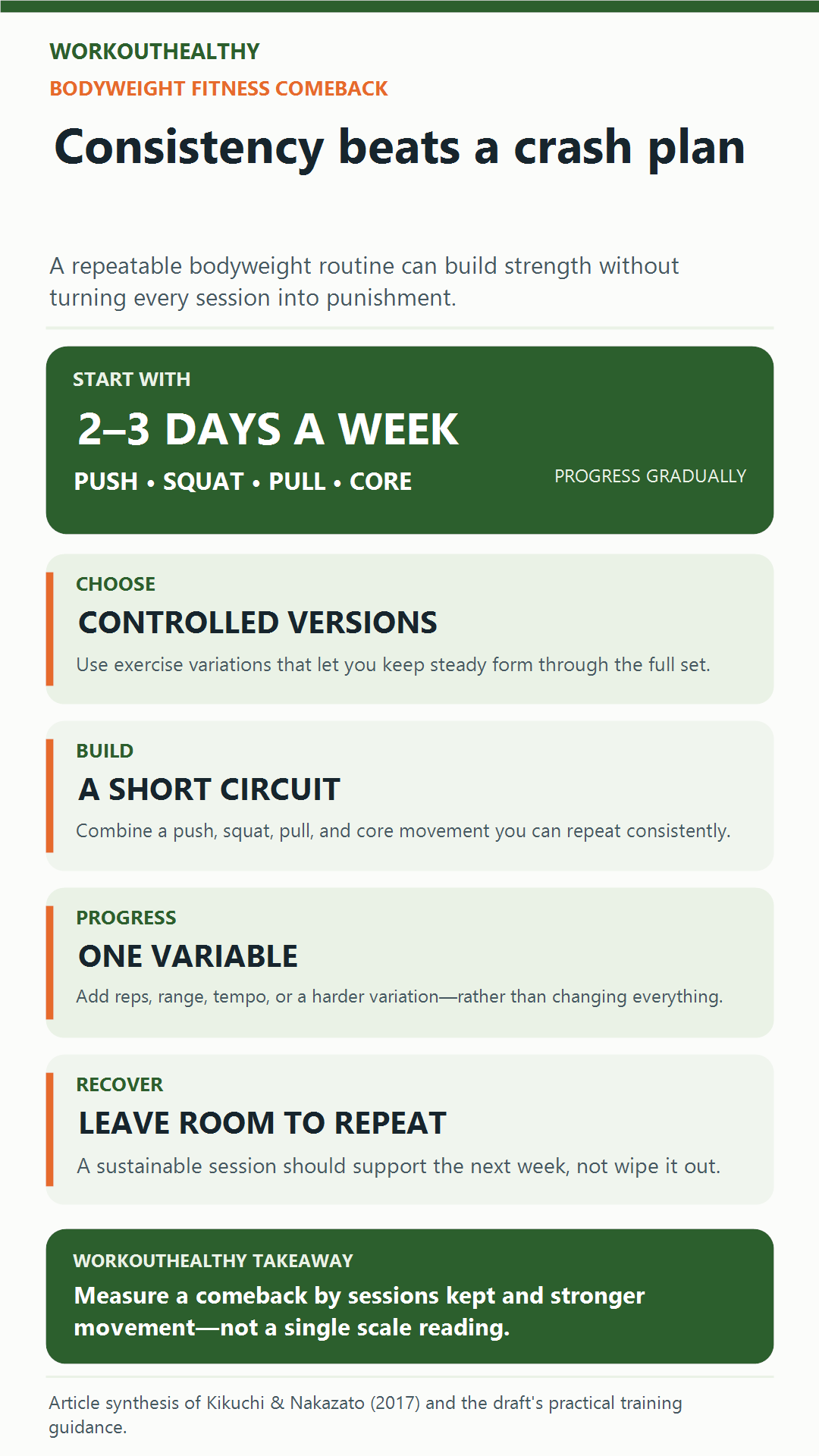
One common mistake is treating a comeback as a single event instead of an ongoing practice.
A person hits a hard reset, trains intensely for a few weeks, and burns out before the habit has time to become automatic.
Another is ignoring the emotional side of eating while only changing the food itself. Swapping meals without addressing the underlying trigger tends to produce short term results that do not last.
A third is treating any single missed workout or setback as proof the whole effort failed.
That kind of all or nothing thinking is exactly what research on self compassion suggests works against long term follow through.
A fourth is assuming bodyweight training has to be easy to be legitimate. Calisthenics can be pushed to a genuinely difficult level through added reps, slower tempo, or harder variations of a movement, and treating it as a lesser workout undersells what it can build.
A Practical Way to Start a Bodyweight Routine
Anyone interested in this style of training can start with a small, honest inventory of current ability rather than copying someone else’s routine on day one.
Working with a qualified personal trainer, even for a single session, can help a beginner learn proper form before adding volume.
Begin with the basics: push ups, bodyweight squats, and some form of pulling movement, even an assisted or modified version if a full pull up is not yet possible.
Train three to four days a week rather than every day at first, giving muscles real recovery time between sessions.
Track effort honestly instead of chasing a number. How a set felt matters more early on than exactly how many reps got completed.
Add difficulty gradually. Slower reps, paused positions, and single limb variations all increase difficulty without needing new equipment.
Separate the training plan from the eating plan, and address both on their own terms rather than assuming one will automatically fix the other.
Notice emotional eating patterns without immediately trying to force them away. Simply naming a pattern, such as eating when stressed rather than hungry, is often the first real step toward changing it.
Give the approach real time before judging it. Research on habit formation generally points to months, not weeks, before a new routine starts to feel automatic rather than effortful.
Rebuild difficulty gradually if returning after time off. Muscle memory can speed strength back up faster than expected, but joints and connective tissue often need a slower runway than muscles do.
Keep a simple written record of workouts completed each week, separate from any food or weight tracking.
A habit log focused only on consistency removes the emotional charge that a scale or calorie count can carry for someone with a history of weight cycling.
References
Kikuchi, N., & Nakazato, K. (2017). Low-load bench press and push-up induce similar muscle hypertrophy and strength gain. Journal of Exercise Science & Fitness, 15(1), 37-42.
Montani, J-P., Viecelli, A. K., Prévot, A., & Dulloo, A. G. (2006). Weight cycling during growth and beyond as a risk factor for later cardiovascular diseases. International Journal of Obesity, 30(S4), S58-S66.
Montani, J-P., Schutz, Y., & Dulloo, A. G. (2015). Dieting and weight cycling as risk factors for cardiometabolic diseases: Who is really at risk? Obesity Reviews, 16(S1), 7-18.
Frayn, M., & Knäuper, B. (2017). Emotional eating and weight in adults: A review. Current Psychology, 37(4), 924-933.
Sirois, F. M. (2015). A self-regulation resource model of self-compassion and health behavior intentions in emerging adults. Preventive Medicine Reports, 2, 218-222.
This article is for general educational purposes and is not a substitute for personalized medical or nutritional advice. Anyone with a history of disordered eating, significant weight fluctuation, or an existing medical condition should talk with a doctor, registered dietitian, or mental health professional before making major changes to diet or exercise habits.