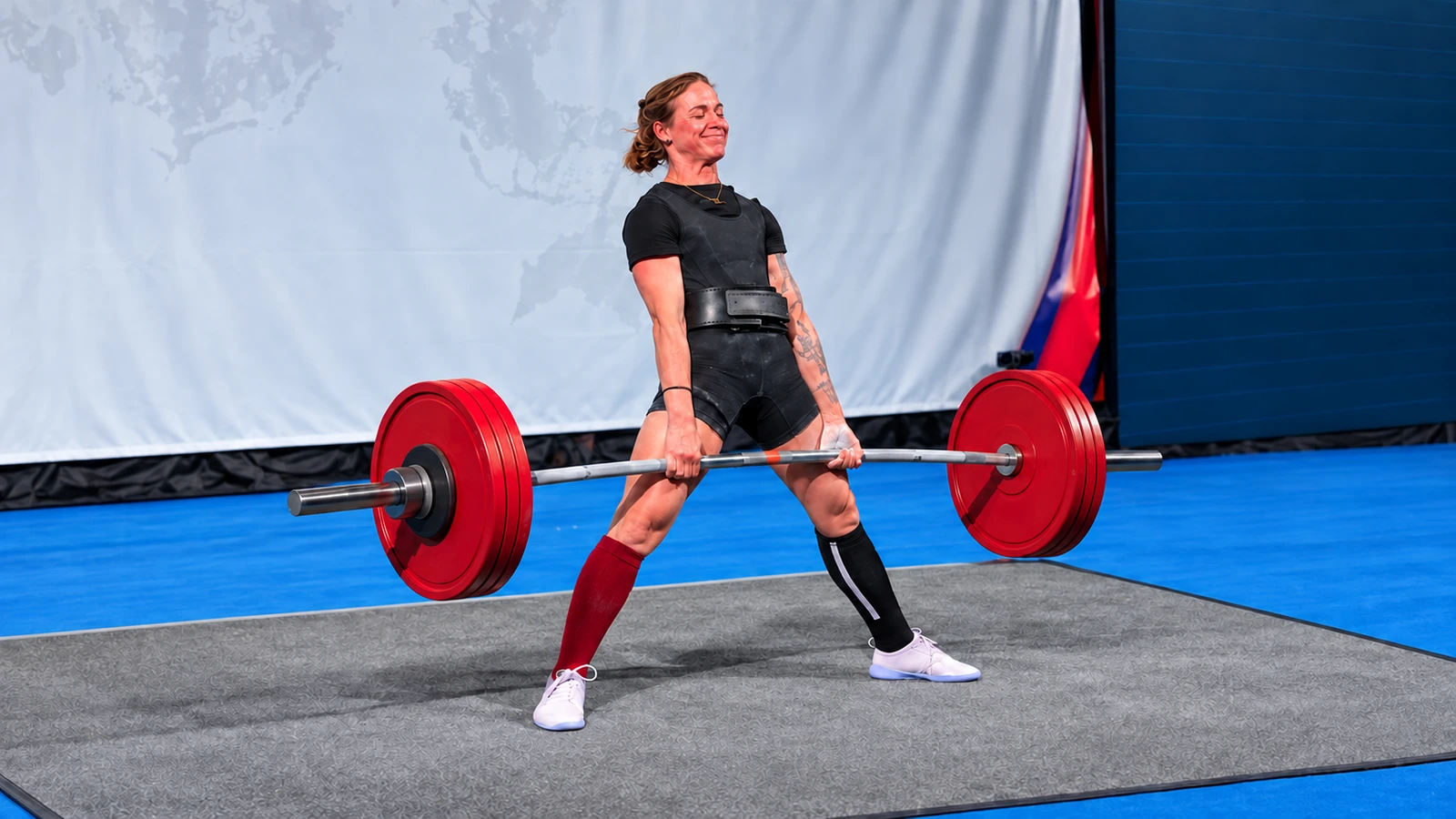

Stephanie Kean’s 180 kg deadlift deserves a precise description: a women’s Masters I, 52 kg, equipped result at the 2026 IPF World Masters Championships.
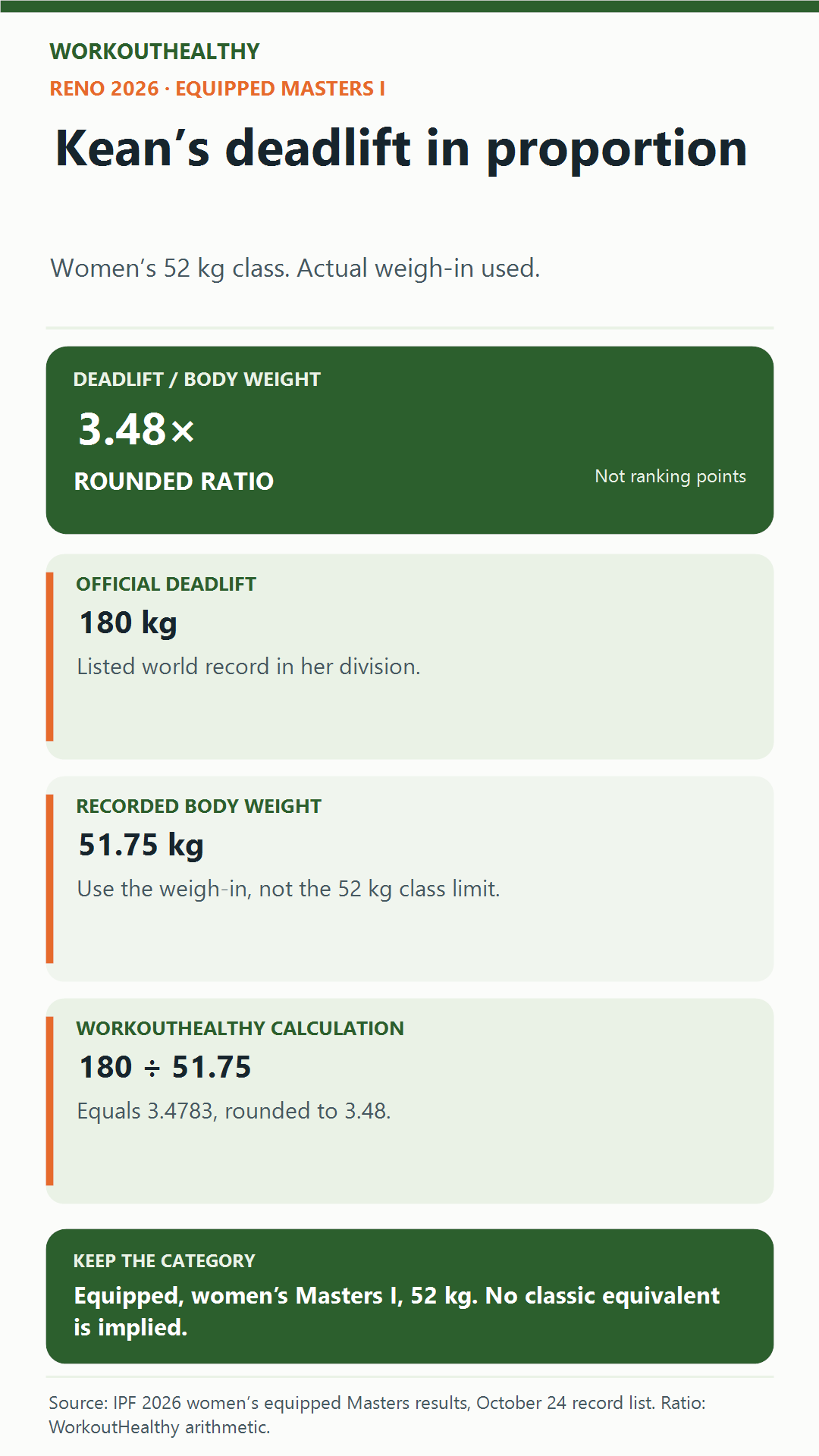
The official results list the Canadian lifter’s body weight as 51.75 kg and mark the deadlift as a world record in that division (International Powerlifting Federation [IPF], 2026a).
Those details make the achievement easier to appreciate, because the category and the athlete’s actual weigh-in answer different questions.
A great lift becomes more meaningful when its category stays attached to it.
What the official result records
Kean’s best lifts were a 145 kg squat, a 90 kg bench press, and a 180 kg deadlift, producing a 415 kg total.
Her listed deadlift attempts were 160 kg, 179.5 kg, and 180 kg; the championship record list dates the 180 kg result to October 24, 2026 (IPF, 2026a).
That is the documented performance behind the social post.
The results sheet provides stronger evidence than a photograph, an enthusiastic caption, or an estimate based on the size of the plates.
Why the division matters
The IPF defines Masters I by the calendar years in which lifters turn 40 through 49.
It also separates competition by sex, body weight, and discipline; equipped and classic results should retain those distinctions (IPF, 2026b).
Calling this simply a world-record deadlift leaves readers without the information needed to compare it fairly.
The complete description celebrates the lift while keeping it separate from open, classic, and other weight-class records.
What equipped means here
Equipped lifting permits approved supportive equipment under the federation’s technical rules (IPF, 2026b).
That description is part of the event’s rules, rather than a reason to dismiss the athlete’s work.
A still image cannot establish exactly how much assistance a garment provided during a particular attempt.
It also cannot justify subtracting a guessed number of kilograms to manufacture a classic equivalent.
For readers asking what made the lift equipped, the official event classification is the decisive starting point.
A ratio using the actual weigh-in
WorkoutHealthy’s calculation divides the recorded deadlift by the recorded body weight: 180 ÷ 51.75 = 3.4783.
Rounded to two decimals, the deadlift was 3.48 times her body weight.
Using the class ceiling instead would give 180 ÷ 52 = 3.46, which explains why the denominator deserves attention.
These are descriptive calculations using IPF inputs, not federation ranking points or a strength percentile.
The same simple ratio does not make different equipment divisions directly interchangeable, and it cannot predict what another lifter should attempt.
How to read the competition footage
The broadcast below covers the women’s Masters I equipped session, including the 47 kg through 84+ kg classes.
It is the full competition session, rather than a short clip isolated to Kean’s final deadlift.
Use the on-screen athlete name, attempt weight, and referee decision together when following the lifting.
A successful-looking lockout in a paused frame does not replace the official result.
The footage and the written result are complementary: one shows the competition unfolding, while the other records the accepted outcome.
Women’s Masters I equipped competition in Reno
Powerlifting America’s full 2026 IPF session provides the competition context for the women’s Masters I equipped results. The player begins with the broadcast, not a timestamped final-attempt clip.
A useful way to watch a heavy deadlift
Watch the whole sequence instead of focusing only on the moment the bar reaches the top.
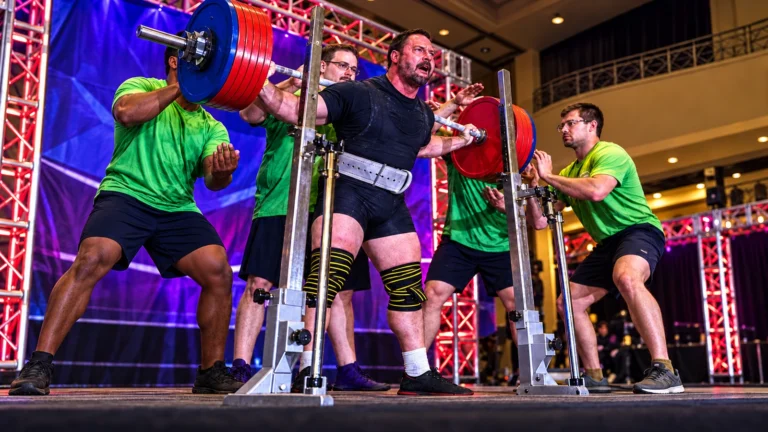
The IPF’s deadlift rules include a completed standing position and a controlled return after the referee’s signal (IPF, 2026b).
For a spectator, following the commands helps explain why judging is more specific than whether the weight moved.
For your own lifting, competition footage is a discussion aid for a qualified coach.
It cannot show your readiness, your practice history, or whether the same stance and equipment suit you.
A record can inspire your training without becoming your next training target.
Bring the lesson back to your log
Record the exercise version, load, repetitions, and conditions when you track your own progress.
That makes a later comparison more useful than treating every gym lift as equivalent to every competition result.
A changed range of motion or a different variation should remain visible in your notes.
Our guide to strength training for longevity offers a broader perspective on why strength can matter beyond a single maximum.
Readers returning after a long break can also review these exercise and progression considerations before choosing a starting point.
Appreciate the record without copying the attempt
Kean’s result is an exceptional competitive performance, not a suggested load for someone inspired by the photograph.
A productive response is to choose a repeatable skill goal and review it with someone qualified to coach that lift.
For example, you might ask whether your setup remains consistent across the manageable work already in your program.
Keep the record’s category attached when you share it, and keep your own next step attached to your present ability.
Read the linked strength guide, then make your next training note specific enough to compare with a future session.
References
International Powerlifting Federation. (2026a). Women’s results: World Masters Equipped Powerlifting Championships.
International Powerlifting Federation. (2026b). IPF technical rulebook (effective March 1, 2026, version 3).
Medical disclaimer: This article is general product information, not medical advice. The equipment described here is not a treatment for any condition. If you have an injury, ongoing pain, or a medical condition, talk to a doctor or physical therapist before using any of it.