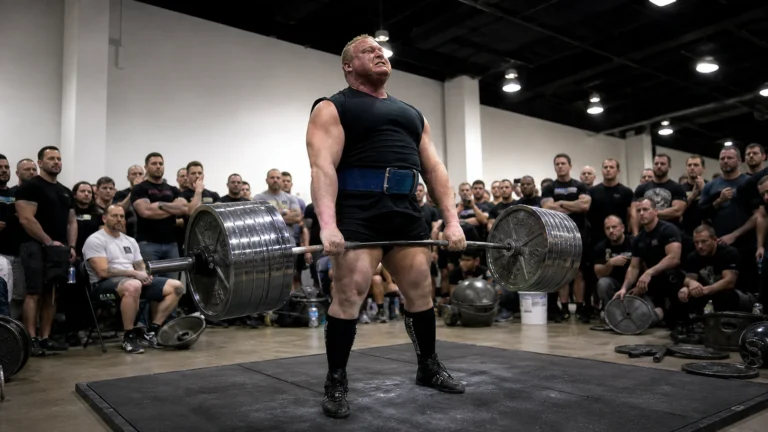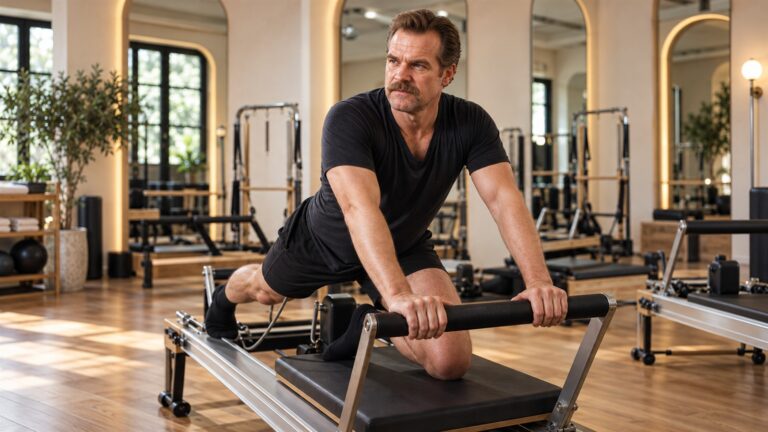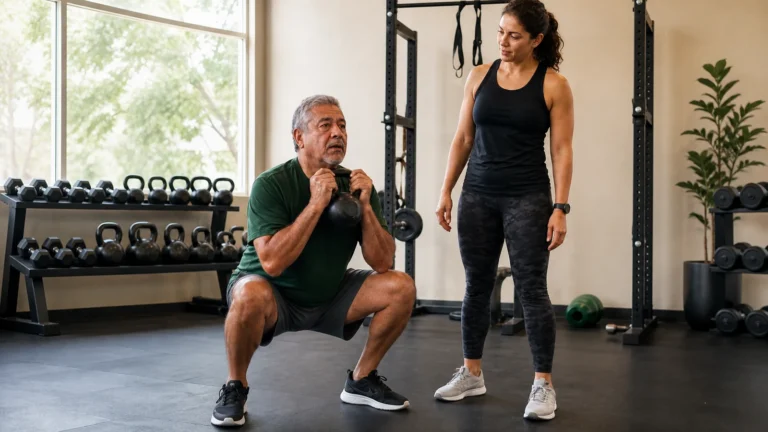

Delayed-onset muscle soreness, or DOMS, often appears after unfamiliar or harder-than-usual exercise and improves over the next several days. Wanting relief is normal. The trick is not confusing “this feels better” with “the muscle has fully recovered” or “I will gain more strength.” The WorkoutHealthy Facebook post names eight options—cold water, heat, massage, foam rolling, caffeine, gentle movement, protein and sleep—and rejects stretching as a reliable DOMS cure. Those options do not have equal evidence or identical goals.
This guide walks through each choice, where research is strongest, where it is thin, and when soreness is a warning sign rather than ordinary training discomfort. A 2018 meta-analysis of post-exercise recovery techniques is a useful starting point, but it mostly compares short-term outcomes in varied protocols. No tool erases the need for sensible training loads, food and time.
What normal soreness looks like
DOMS is an ache or tenderness that typically begins after exercise rather than at the exact moment of an injury. It is common after new movements, more total work, or eccentric actions such as lowering a weight. It can make stairs or sitting down uncomfortable, but should gradually improve. It is not proof that a workout was effective, nor is the absence of soreness proof that nothing happened. Our article on why soreness is a poor progress scoreboard explains how to track strength and function instead.
The recovery literature uses several different outcomes: a rating of soreness, swelling, muscle-damage biomarkers, next-day performance, and long-term training gains. A method may improve one without improving the others. This is why the word “supported” needs context. Some of the eight choices are supported for comfort, some are foundational for adaptation, and some have mixed or indirect evidence for DOMS itself.
Relief is useful—but it is a symptom outcome, not a certificate that every tissue has repaired.
1. Cold-water immersion and 2. heat
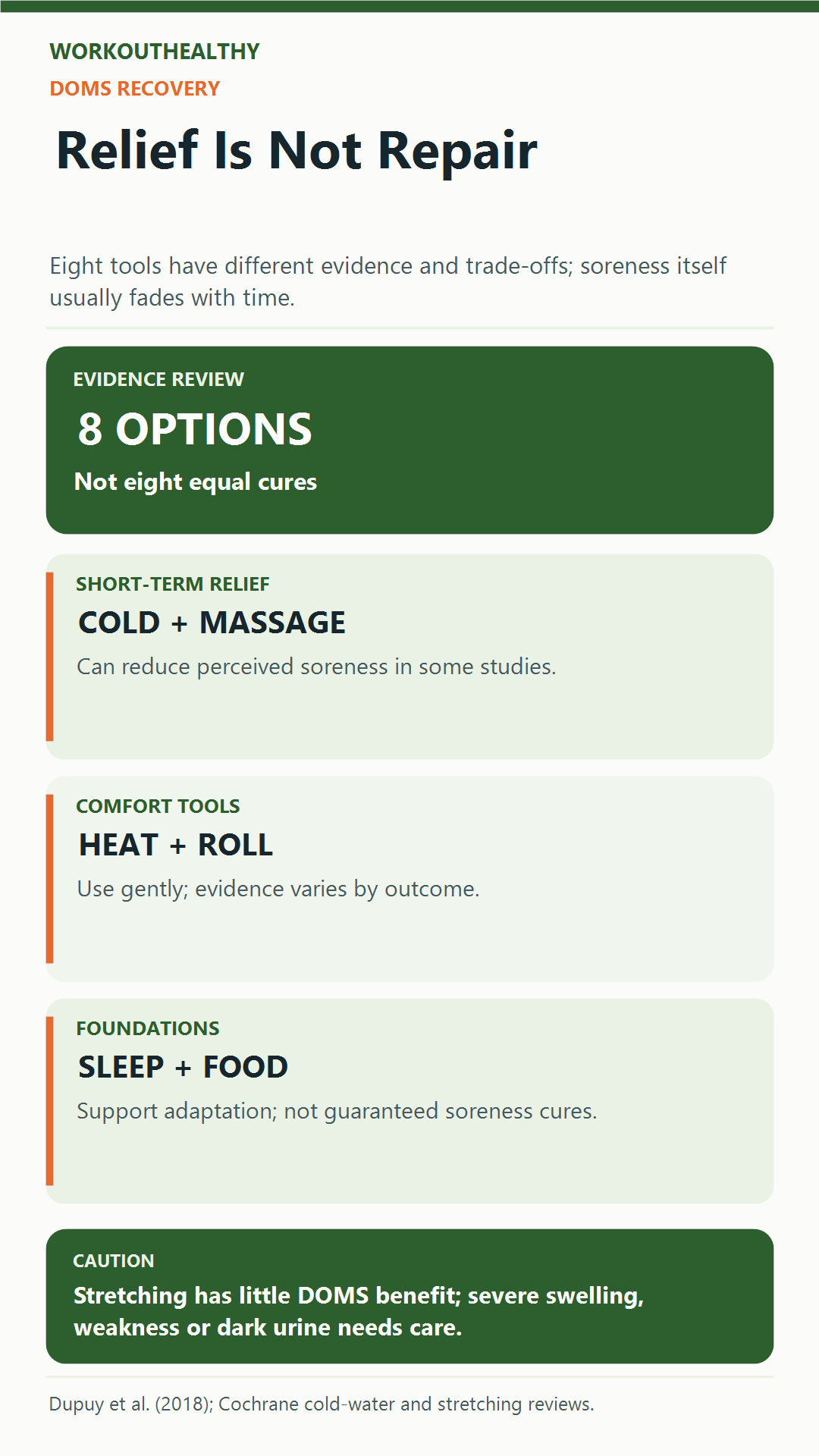
A Cochrane review of 17 small trials involving 366 participants found that cold-water immersion can reduce delayed soreness compared with passive recovery, while noting uncertainty about the best method and safety. The Dupuy and colleagues meta-analysis also found favorable effects for some cold-immersion protocols on soreness and perceived fatigue. That supports cold as a possible short-term comfort tool, not an all-purpose recovery accelerator.
There is an important trade-off for lifters: repeated cold-water immersion immediately after strength sessions may attenuate muscle-growth adaptation. The evidence is most relevant to regular use after lifting, not one cool shower. Our cold-plunge and muscle-growth evidence guide explains why the goal matters. If maximum hypertrophy is your priority, routine immediate plunges are easy to avoid.
Heat may feel good for stiffness or a sore area, and some studies examine heat as a recovery modality. But the evidence is less uniform than a promise that a hot bath “repairs” exercised muscle. Use a comfortable temperature, protect your skin and stop if you feel unwell. Neither cold nor heat should be used to hide pain while continuing a damaging workload. People with circulatory conditions, temperature sensitivity or relevant medical conditions should ask a clinician first.
3. Massage and 4. foam rolling
Massage has comparatively good evidence for reducing perceived DOMS after strenuous exercise. In the Dupuy meta-analysis it performed well for several soreness-related outcomes, and a separate review reported lower soreness ratings across studied protocols. That does not mean the pressure needs to be painful. A gentle, tolerable massage may be more useful than forcing a deep technique on already sensitive tissue.
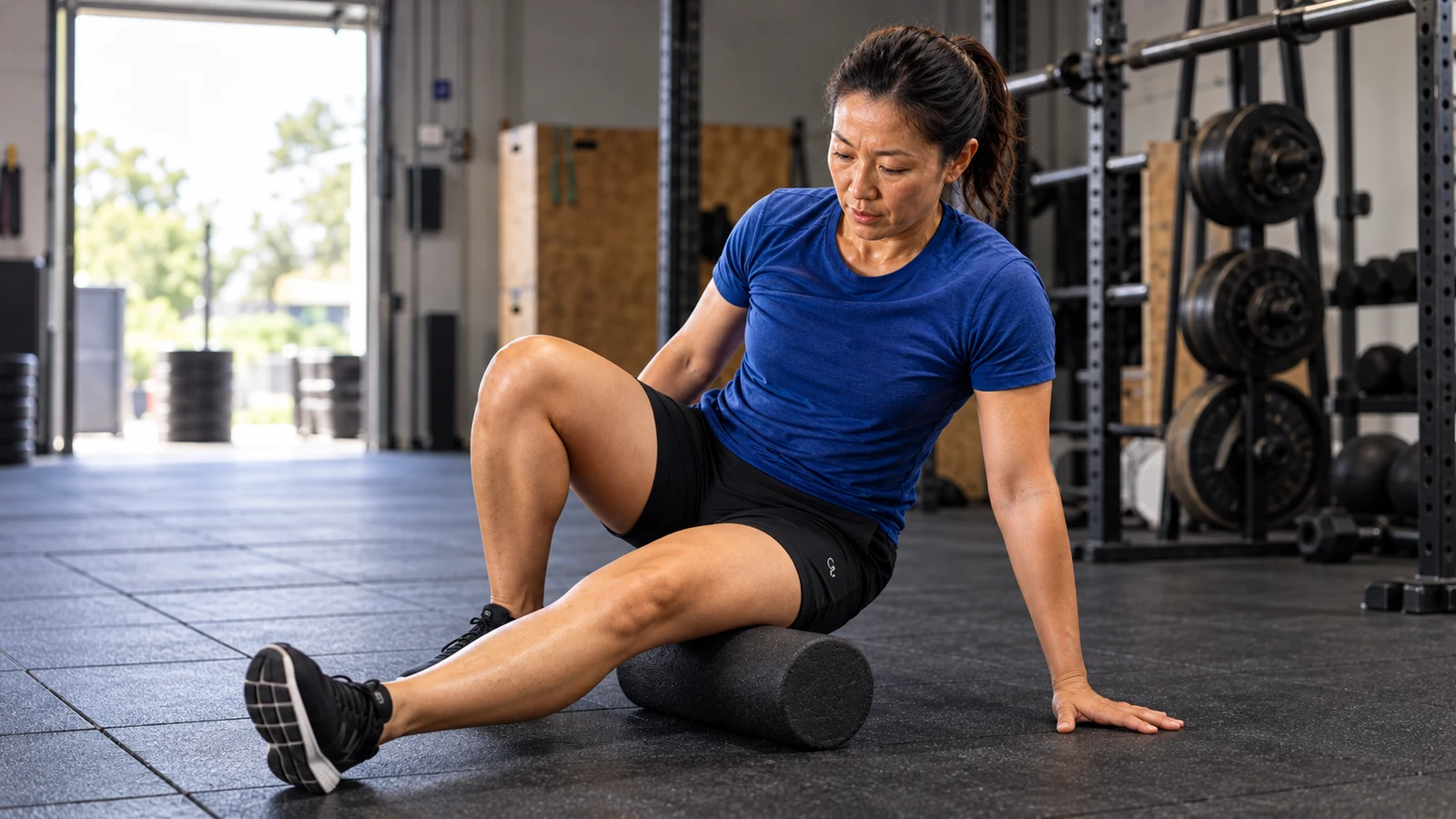
Foam rolling is popular because it is accessible and lets you control pressure. Evidence suggests it can improve short-term range of motion or reduce perceived soreness in some settings, but study methods vary. Avoid rolling directly over bones, joints, bruises or an area with sharp pain. If a roller makes symptoms worse, use less pressure, shorten the session or skip it. A recovery tool does not become more effective simply because it hurts more.
The article hero is an editorial illustration of rolling—not a medical demonstration. A professional can help you adapt pressure and position if you have mobility limits or prior injuries. Both massage and rolling are optional; there is no need to purchase a device to earn recovery from exercise.
5. Carefully timed caffeine and 6. gentle movement
Some human trials report that caffeine lowers pain ratings after exercise, and a review found reduced soreness perception in several of the studies it examined. That makes caffeine a possible symptom-management tool, not a way to fix tissue damage. It may also mask fatigue, cause jitters, worsen anxiety or interfere with sleep. If a late cup disrupts the night, the cost may outweigh a short-term soreness benefit. Avoid adding high-dose supplements because a headline called them “evidence-backed.”
Gentle active recovery—easy walking, cycling or comfortable movement—may temporarily improve how stiff you feel and help you stay active. Evidence for DOMS relief varies by exercise type and timing. The practical test is whether the movement feels easy and symptoms settle rather than escalating. A hard “recovery workout” that adds more damage defeats the purpose. An easy day can be a useful bridge back to training without forcing a heavy session.
Movement also provides a chance to check function. If a muscle simply feels tender but moves more comfortably as you warm up, that differs from sharp joint pain, weakness or a sudden injury sign. You do not need to “flush toxins” or “clear lactic acid” to justify a walk; those common explanations are often biologically inaccurate for next-day soreness.
7. Enough protein and 8. good sleep
Protein supplies amino acids needed to build and maintain muscle, especially when paired with resistance training. But a protein shake is not a guaranteed cure for DOMS, and trials that measure soreness after supplementation have mixed outcomes. The stronger claim is that adequate dietary protein and enough total food support adaptation over time. Extra protein beyond your needs does not necessarily make tomorrow’s ache disappear. Our article on protein needs and excess intake helps put amounts in context.
Sleep is similarly foundational. It supports many physiological and behavioral parts of recovery, and chronic sleep restriction can make training feel harder and disrupt performance. Yet there is no precise “one extra hour equals X% less DOMS” rule. Protecting a consistent sleep opportunity is more defensible than chasing an expensive recovery gadget while sleeping poorly. If pain repeatedly wakes you or sleep is persistently impaired, speak with a healthcare professional.
Food and sleep also help make training sustainable. They are less dramatic than a cold tub, but they influence whether you can return to an appropriate workload over weeks and months. The goal is not to eliminate every trace of soreness; it is to recover well enough to adapt without ignoring signals that something is wrong.
The basics do not make a catchy ritual, but they are the foundation that the optional tools sit on.
Why static stretching is not a reliable DOMS cure
Stretching can be useful for flexibility or for a movement you enjoy. It just should not be sold as a reliable way to prevent or erase delayed soreness. A Cochrane review of randomized studies concluded that stretching before or after exercise produces little or no clinically important reduction in DOMS in healthy adults. You may still choose gentle stretching because it feels pleasant, but do not force a deep position on a sore muscle expecting it to speed repair.
This distinction protects useful practices from false promises. A warm-up and range-of-motion work can have roles in preparing for activity or improving mobility. Those are separate outcomes from next-day soreness. The Facebook post’s “stretching isn’t one of the eight” message refers specifically to DOMS relief, not a claim that all stretching is pointless.
When to get medical help
Ordinary DOMS should not be confused with severe swelling, marked weakness, a sudden sharp pain, fever, numbness, or dark brown urine. These can signal injury or, rarely, a serious condition such as rhabdomyolysis. If symptoms are severe or unusual, stop the workout and seek prompt medical evaluation; dark urine with muscle pain or weakness merits urgent attention. Do not try to massage, roll or heat your way through a potentially serious problem.
The practical choice is to match the tool to the problem. For ordinary mild soreness, reduce training intensity temporarily, move comfortably if it helps, eat enough and sleep. Add a comfort tool if you like it and it does not clash with your training goal or health. If pain is escalating or not following the usual gradual improvement, get assessed. This article is educational and cannot diagnose an injury.
Bottom line
The eight recovery options in the social post are not eight equivalent cures. Cold, massage and perhaps rolling or caffeine can reduce perceived soreness for some people, with important trade-offs; heat and gentle activity may offer comfort; protein and sleep support the broader adaptation process. Static stretching has little clinically meaningful effect on DOMS. Use only what fits your goal, and remember that time and sensible training loads remain central.
References
- Dupuy O, et al. An evidence-based approach for choosing post-exercise recovery techniques: systematic review and meta-analysis. Frontiers in Physiology. 2018. PubMed.
- Cochrane review: cold-water immersion for preventing and treating muscle soreness. Cochrane.
- Cochrane review: stretching to prevent or reduce muscle soreness. Cochrane.
- Massage and delayed-onset muscle soreness: systematic review and meta-analysis. PubMed.
- Caffeine ingestion and exercise-induced muscle damage markers: review of human trials. Full text.