
Why Everyone Is Suddenly Worried About Protein
A YouTube video with a dramatic title has been spreading through fitness circles lately.
It claims a new study proves that most people trying to build muscle are eating far more protein than their bodies can actually use.
That is a bold claim, and bold nutrition claims tend to travel faster than the research behind them ever does.
So what does the real science actually say about how much protein a person needs to build muscle?
This matters because protein supplements and high protein foods are a genuine expense.
If a big chunk of that spending is not actually helping anyone build more muscle, that is worth knowing.
What the Video Claims About Eating Too Much Protein
The video comes from the channel musclemonsters, titled “EXPOSED: New Study Proves You’re Eating Too Much Protein.”
Its core argument is that a lot of gym goers are eating protein amounts that go well past anything their muscles can actually put to use for growth.
We tried to track down the exact new study the video is pointing to.
We could not confirm a single specific paper that matches the video’s dramatic framing, so we are not going to repeat that exact claim as settled fact.
What we can do instead is walk through the real, published research on protein and muscle growth.
That research turns out to support a calmer, more precise version of the same basic idea.
The evidence supports getting enough protein for resistance training, but it does not establish one exact daily cutoff where additional protein stops helping everyone.
What the Real Research Actually Shows About Protein Needs
Several genuine studies have looked at this exact question, and they land in a similar place.
In 2018, researcher Robert Morton and a team of colleagues combined the results of 49 separate trials that included more than 1,800 people doing resistance training (Morton et al., 2018).
This kind of study is called a meta analysis, which just means combining many smaller studies into one bigger picture instead of trusting any single small study on its own.
That approach matters because any one small study can be thrown off by a handful of unusual participants.
Combining dozens of them smooths out those flukes and gets closer to what is actually true for most people.
They were trying to answer a simple question: does adding more protein keep adding more muscle, no matter how much a person already eats?
The evidence does not show a limitless linear benefit, but it also does not identify a precise cutoff for each person.
Morton and colleagues modeled a possible leveling of fat-free-mass gains near 1.62 grams of protein per kilogram of body weight per day, but that estimate was uncertain.
A kilogram is about 2.2 pounds, so for a 170 pound person that works out to roughly 124 grams of protein a day.
Across the included resistance-training trials, protein supplementation produced small average gains in fat-free mass and strength; the modeled intake curve should not be read as an individual threshold.
The breakpoint model’s 95 percent confidence interval ran from 1.03 to 2.20 grams per kilogram per day, and its segmented fit was not statistically significant (p = 0.079).
The authors suggested that about 2.2 grams per kilogram per day may be a cautious upper target for people seeking maximum fat-free-mass gains, given the wide confidence interval.
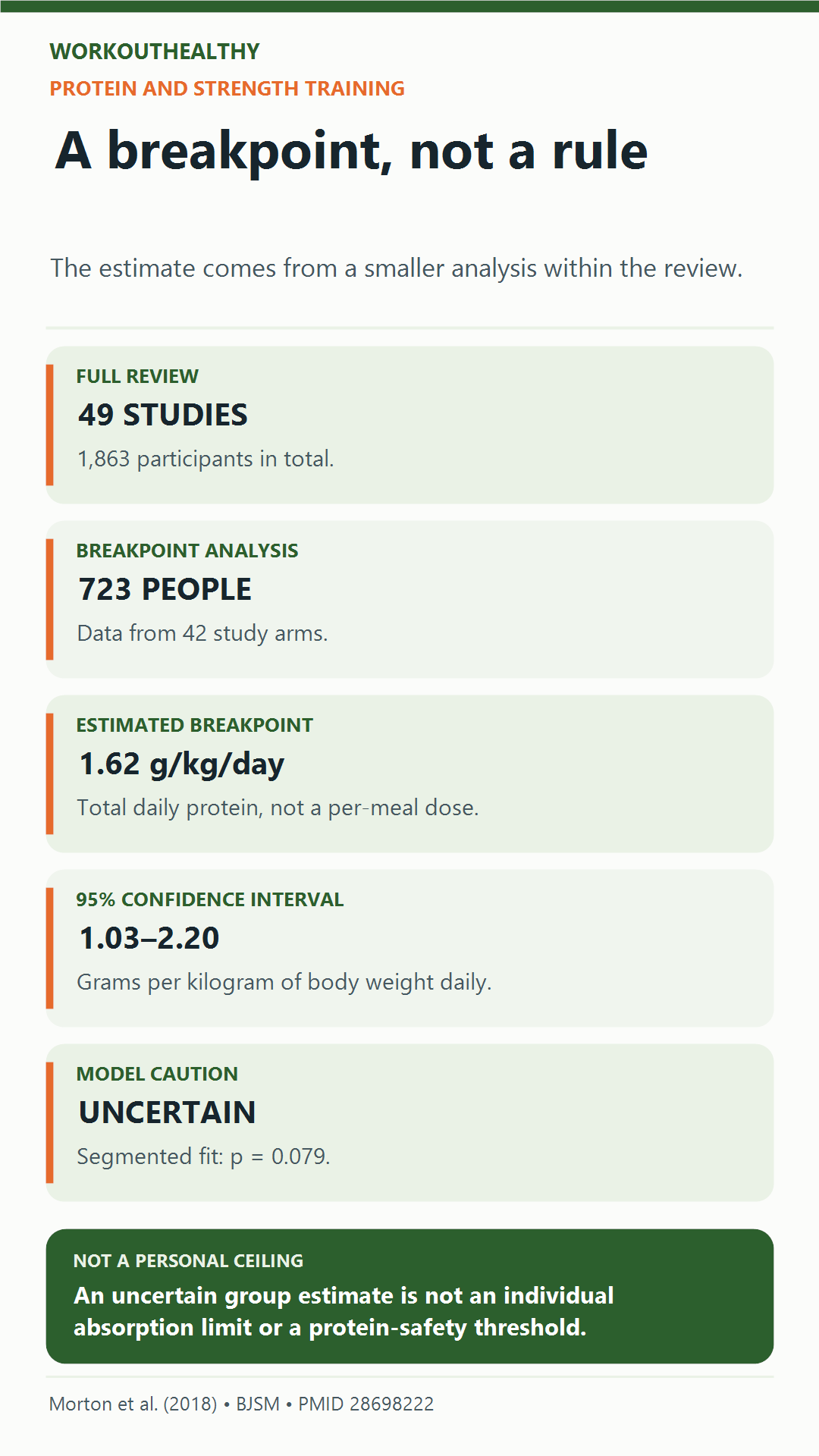
The review did not prove that every intake above 2.2 grams per kilogram is ineffective.
A 2022 review by Nunes and colleagues adds evidence about protein and resistance training, but it did not test the same upper breakpoint.
Everson Nunes and colleagues combined results from 74 randomized trials on protein intake and muscle outcomes in healthy adults (Nunes et al., 2022).
Among the included resistance-training studies of adults under 65, added protein was associated with a small lean-mass benefit in the intake category at or above 1.6 grams per kilogram per day.
In one older-adult subgroup, added protein at 1.2 to 1.59 grams per kilogram per day was associated with a small lean-mass benefit, but that finding was no longer statistically clear after one study was removed.
Those broad intake groups cannot identify the intake at which extra protein ceases to help an individual.
Taken together, the reviews support adequate protein alongside resistance training, while leaving the precise upper point of diminishing returns uncertain.
A practical target can be discussed as a range rather than as a proven ceiling.
What This Evidence Does Not Prove
It is easy to mistake a modeled average for a personal protein limit.
It does not, and the researchers behind these very studies say so themselves.
First, these are averages across large groups, not a guarantee about any one individual.
Body size, training history, energy intake, and individual responses may affect how useful a given protein intake is.
Second, training status matters a great deal.
Someone brand new to resistance training tends to build muscle from almost any reasonable protein intake, simply because their muscles are so new to the stimulus.
A highly trained lifter chasing the last few pounds of muscle is working with a much smaller margin, where small differences may matter more.
That lifter has likely already captured most of the easy gains available to a newer trainee.
Third, none of this research works in isolation from total calorie intake.
A person eating too few total calories will struggle to build muscle no matter how much protein sits on their plate, because the body needs enough overall energy to build new tissue.
Someone eating in a calorie deficit to lose fat generally needs protein on the higher end of the range just to protect the muscle they already have.
Finally, these studies mostly measure changes over eight to twelve weeks in controlled settings, not over years of real, messy life.
The included trials varied in how closely they measured diet, training, and other factors.
Ordinary life rarely stays that tidy for months at a time, let alone years.
Common Mistakes People Make With Protein
The most common mistake is not eating too much protein at all.
It is eating too little, especially among people trying to lose weight while also trying to hold on to muscle.
Our guide to why people lose weight and muscle mass together covers this exact pattern, and low protein intake during a diet is one of the biggest drivers of it.
The opposite mistake also happens, and it usually has nothing to do with actual science.
Some lifters treat huge protein numbers as a badge of seriousness, the same way older bodybuilding folklore once did.
Our look at Jay Cutler’s famously extreme 1993 diet shows just how far outside normal ranges those old legendary numbers actually sit.
Another mistake is assuming protein alone builds muscle, without the training stimulus that actually triggers growth.
Protein supplies the raw material, but the body only has a reason to use it when a workout signals that muscle needs repairing and growing.
Our comparison of the floor press and the bench press is a good example of how much the actual training variables matter to the result, protein aside.
A last mistake is chasing protein timing obsessively, like rushing a shake in within some narrow window after a workout.
Total daily intake matters far more than hitting a precise post workout minute.
One more mistake worth naming is leaning entirely on protein powder and bars instead of whole foods.
Protein-rich foods can also provide other nutrients; beans, lentils, and other plant foods add fiber, while eggs, dairy, fish, and poultry provide different nutrients.
A shake is a convenient top up, not a full replacement for real meals.
Who Should Check With a Doctor or Dietitian First
For most healthy adults, research has been reassuring about higher protein intakes and kidney health.
A 2018 review by Michaela Devries and colleagues combined 28 studies with more than 1,300 healthy participants and found no meaningful difference in kidney function between people eating higher versus normal or lower amounts of protein (Devries et al., 2018).
That finding applies specifically to people without existing kidney disease.
Every study in that review excluded anyone already diagnosed with chronic kidney disease.
Anyone with diagnosed kidney disease, reduced kidney function, or a family history of serious kidney problems should talk to a doctor before raising their protein intake.
The same goes for people with liver conditions, since the liver also plays a role in processing protein.
Pregnant women, people managing diabetes, and anyone on a specialized medical diet should also check with a doctor or registered dietitian before making a big change.
A dietitian can also help translate a general range into an actual daily meal pattern that fits a person’s real life, allergies, and budget.
Anyone who notices swelling in the legs or feet, unusual fatigue, or changes in urination after raising their protein intake should also mention it to a doctor.
Those symptoms are not common, but they are worth a real conversation rather than a guess.
How to Estimate Your Own Protein Target
Start with body weight in kilograms, since that is the unit the research itself uses.
To convert pounds to kilograms, divide body weight by 2.2.
A 150 pound person weighs about 68 kilograms, and a 200 pound person weighs about 91 kilograms.
Most healthy adults doing regular resistance training can aim for somewhere between 1.6 and 2.2 grams of protein per kilogram of body weight each day.
For the 150 pound person, that range works out to roughly 109 to 150 grams of protein a day.
For the 200 pound person, that range works out to roughly 146 to 200 grams a day.
People newer to training, or people not doing much resistance training at all, can comfortably sit at the lower end of that range, or even a bit below it.
People in a calorie deficit while trying to preserve muscle often do better nearer the top of the range.
Spreading that total across three to five meals tends to work better than trying to eat it all in one sitting, mostly because it is simply easier to fit in.
Good sources include eggs, poultry, fish, dairy, beans, lentils, tofu, and protein powder used as a convenient top up rather than a replacement for real food.

People eating mostly plant based protein sources may want to sit slightly higher in the range.
Many plant proteins are digested and used a little less efficiently than animal proteins, so a small buffer helps close that gap.
None of this requires perfect precision.
Landing within a reasonable range most days matters far more than hitting an exact gram count.
Watch the Original Video
Want more like this? Subscribe to WorkoutHealthy Insider for practical explanations behind popular fitness claims.
References
Morton, R. W., Murphy, K. T., McKellar, S. R., Schoenfeld, B. J., Henselmans, M., Helms, E., Aragon, A. A., Devries, M. C., Banfield, L., Krieger, J. W., & Phillips, S. M. (2018). A systematic review, meta-analysis and meta-regression of the effect of protein supplementation on resistance training-induced gains in muscle mass and strength in healthy adults. British Journal of Sports Medicine, 52(6), 376 to 384. https://doi.org/10.1136/bjsports-2017-097608
Nunes, E. A., Colenso-Semple, L., McKellar, S. R., Yau, T., Ali, M. U., Fitzpatrick-Lewis, D., Sherifali, D., Gaudichon, C., Tomé, D., Atherton, P. J., Camprubi Robles, M., Naranjo-Modad, S., Braun, M., Landi, F., & Phillips, S. M. (2022). Systematic review and meta-analysis of protein intake to support muscle mass and function in healthy adults. Journal of Cachexia, Sarcopenia and Muscle, 13(2), 795 to 810. https://doi.org/10.1002/jcsm.12922
Devries, M. C., Sithamparapillai, A., Brimble, K. S., Banfield, L., Morton, R. W., & Phillips, S. M. (2018). Changes in kidney function do not differ between healthy adults consuming higher compared with lower or normal protein diets: A systematic review and meta-analysis. The Journal of Nutrition, 148(11), 1760 to 1775. https://doi.org/10.1093/jn/nxy197
This article is for general information only and is not medical advice. If you have an injury, ongoing pain, or a medical condition, talk to a doctor or physical therapist before you change how you train or eat.