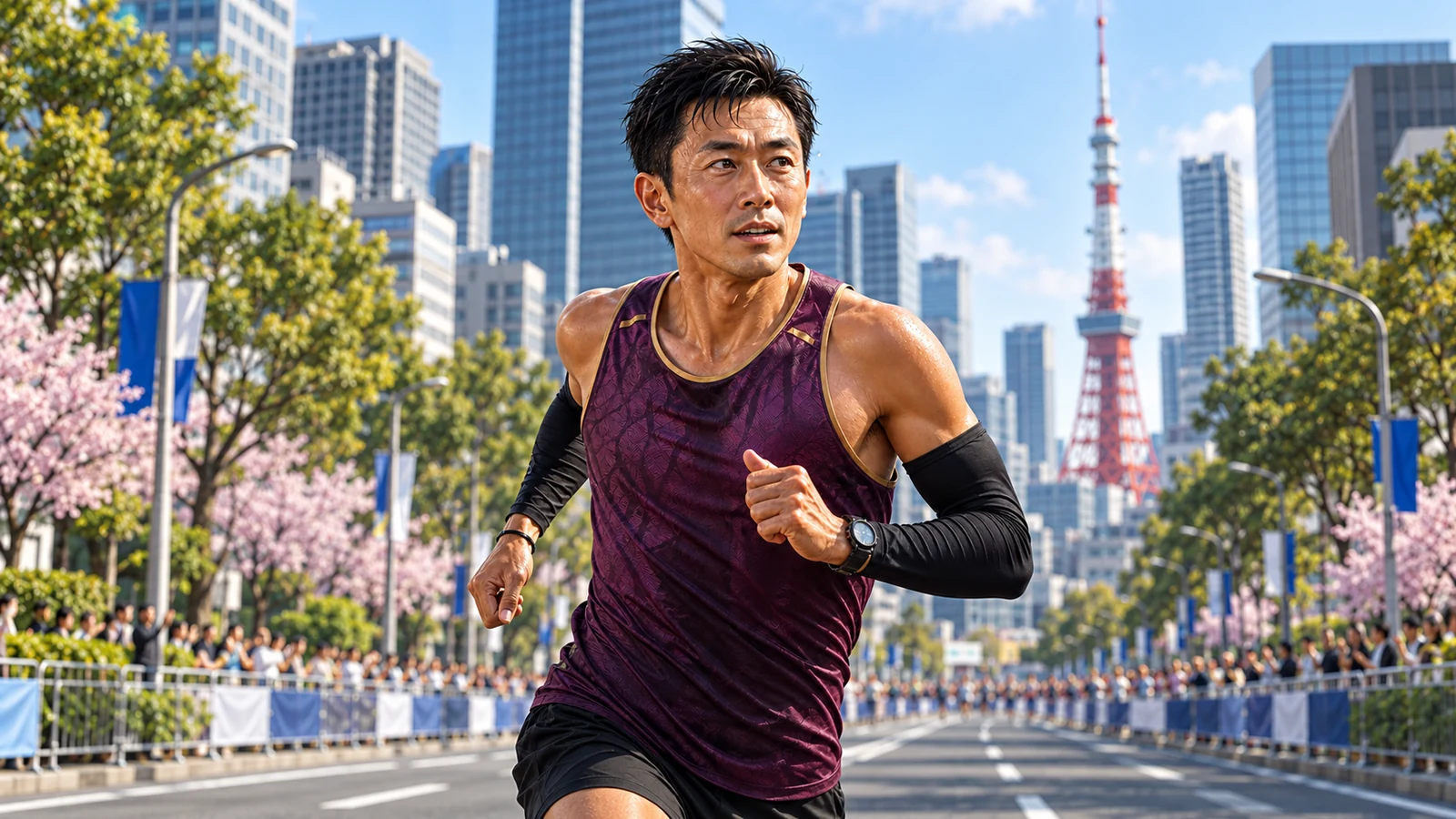

Harry Sugiyama has been named an official supporter of ONE TOKYO GLOBAL, a membership program connected to the Tokyo Marathon Foundation. The program’s own profile says he ran sub-three-hour marathons at Tsukuba and Kumamoto within the preceding year. Those two claims come from an identifiable official source; the details beyond them deserve more care.
It is easy to turn two fast finishes into a story about a secret training schedule or a particular race-day miracle. The public profile does not disclose his training log, exact finishing times, splits, or recovery between those races. His results can motivate runners without pretending that we know those missing details.
Two verified sub-three finishes are a notable result. They are not a published training plan.
What the Official Profile Says
ONE TOKYO GLOBAL describes Sugiyama as a Japanese television personality and model, born in Tokyo and raised in the United Kingdom. It lists him as a newly appointed official supporter of the program and says he will participate in its activities with members.
The same official profile calls him a passionate runner and says he recorded a sub-three marathon in Tsukuba and another in Kumamoto within the past year. The wording supports two races under three hours. It does not provide clock times, dates for each finish, bib numbers, or a detailed competition record.
That distinction matters because an official support role for a membership community is different from being appointed to race staff, entering the elite field, or winning a competitive award. The program presents him as someone who can energize its running community. It does not establish that he held a formal role at the 2026 Tokyo Marathon race itself.
We have not treated a social caption or illustration as a substitute for the program’s description. We also have not filled gaps in the profile with a guessed training schedule or an invented quote from Sugiyama.
The Tokyo Marathon Timeline
The Tokyo Marathon 2026 took place on March 1, 2026, according to the Tokyo Marathon Foundation. ONE TOKYO GLOBAL’s page describes its 2026–2027 membership year. A post published later in 2026 that says Sugiyama was named “Official Supporter for the 2026 Tokyo Marathon” collapses those distinct dates and organizations into one claim.
The accurate short version is that ONE TOKYO GLOBAL lists Sugiyama as an official supporter. The official profile also cites his Tsukuba and Kumamoto sub-three finishes. Neither point by itself proves what happened at the March 2026 Tokyo race or what he might do at a future edition.
Tokyo’s place in the sport is real. It is one of the Abbott World Marathon Majors, alongside Boston, London, Berlin, Chicago, New York City, and Sydney. Sydney joined in 2025, making seven Majors. The familiar Six Star medal still recognizes completion of the original six, which may explain why older descriptions continue to say “six.”
This correction does not diminish the Tokyo Marathon. It puts the event and the support program in their proper context so runners can understand what the recognition actually means.
What Sub-Three Means in Pace
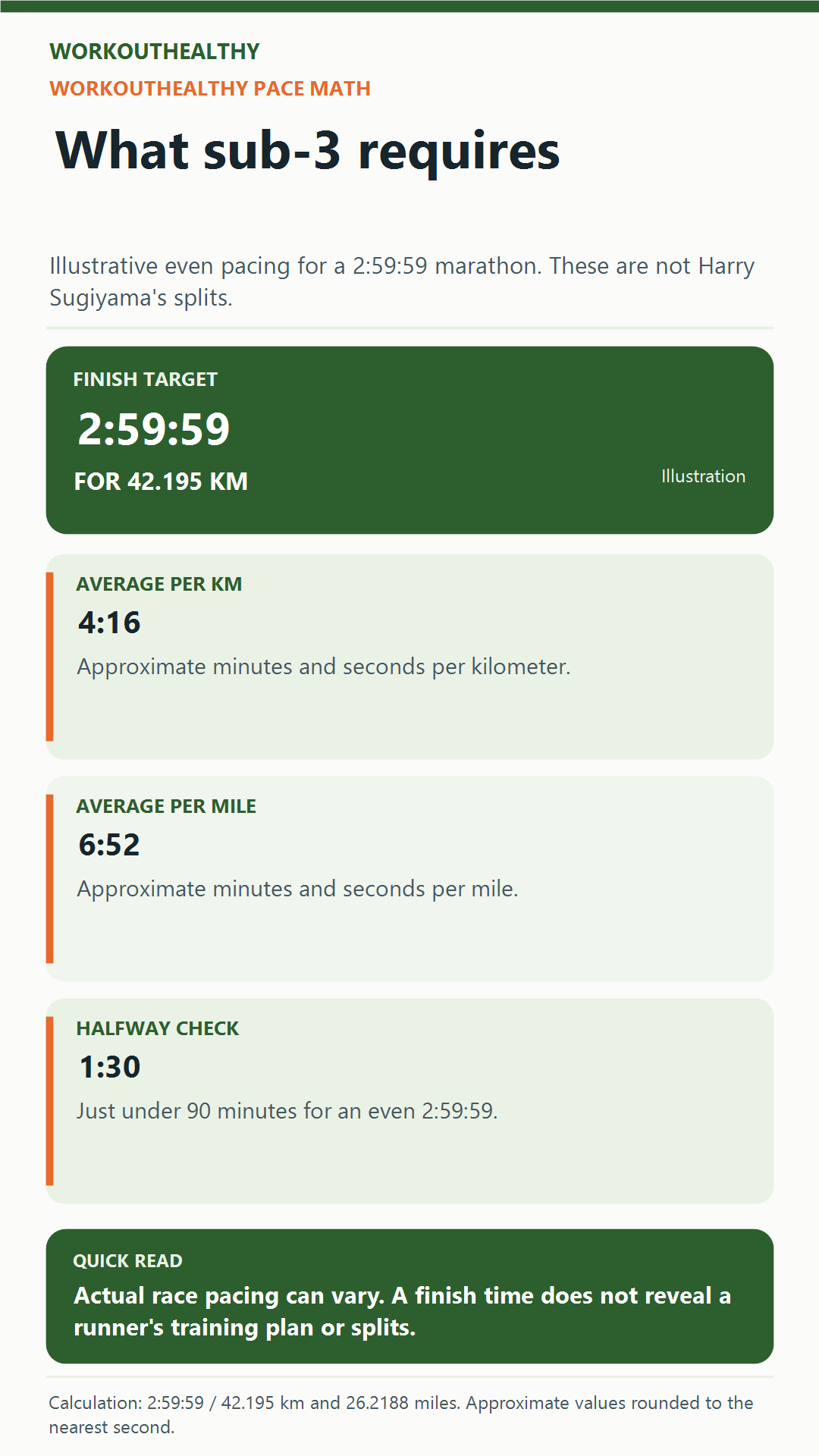
A marathon is 42.195 kilometers, or roughly 26.2 miles. Finishing in less than three hours requires averaging a little faster than three hours divided by that distance. For an illustrative 2:59:59 finish, the arithmetic is about 4 minutes 16 seconds per kilometer, or 6 minutes 52 seconds per mile.
That average is the whole-race number, including slower patches, hills, aid-station turns, and any late fade. A runner who loses time in one part must recover it elsewhere. Someone targeting the mark has to prepare for the effort across the full distance, not just demonstrate the pace in a short workout.
At perfectly even pace, halfway would be just under 90 minutes. Real marathons rarely produce mathematically identical halves. A systematic review of marathon pacing research describes multiple pacing patterns and different results across runner groups. The illustrated calculation is a way to grasp the target, not a prescription for every course or runner.
These are not Sugiyama’s reported splits. ONE TOKYO GLOBAL supplies no split table, so assigning him a kilometer pace for either race would create false precision.
The Repeat-Performance Question
A single sub-three marathon is a demanding result for a recreational runner. The ONE TOKYO GLOBAL profile mentions two, which suggests the first was not merely an isolated finish. Yet the distance between those races, the courses, weather, and official net times are not supplied on that page.
Those omissions change what can fairly be concluded. We can say the official program credits him with two sub-three marathons in its stated period. We cannot infer that he raced them in back-to-back weekends, held identical pace, or trained through injury. Repeat performance can come from a well-developed base and careful recovery, but that is a general training explanation rather than a report of his personal routine.
The more useful question for a reader is what makes fast endurance performance repeatable without treating each attempt as an emergency. That involves enough training over time, appropriately chosen harder work, fueling, sleep, and room to recover. The mixture differs among runners.
Build a Base Before Chasing a Clock
Marathon pace is easier to recognize than marathon readiness. A runner might hold 4:16 per kilometer for one kilometer but be nowhere near sustaining a similar average for 42.195 kilometers. The gap is endurance, durability, pacing judgment, and fuel management.
World Athletics describes the long run as an integral part of distance training for elite and amateur runners. Longer efforts let runners practice time on their feet and the practical details of a race, such as fluid access and a comfortable pace. They are also a substantial load, so the appropriate length depends on a person’s training history and recovery capacity.
Consistency means accumulating training that the body can absorb. There is no credible way to reverse-engineer Sugiyama’s weekly mileage from two race outcomes. Nor does every serious amateur need a professional athlete’s volume. A runner returning from injury or starting from a low base needs a different path from someone with years of durable mileage.
Our look at Arthur Lydiard’s base-first approach explains why easier running had such a prominent place in classic distance training. Its historical lessons are useful when applied with today’s knowledge and an individual’s limits.
Train With Purpose, Not Every Run at Race Pace
Running faster workouts can prepare a person for the demands of a faster race, but every run cannot be a test. Easy days, harder sessions, and recovery serve different purposes. Turning routine training into a daily time trial can make the hard work less productive and harder to recover from.
That principle is broader than Sugiyama’s story. The official profile says nothing about his intervals, tempo runs, strength sessions, or coach. It would be wrong to present a sample workout as “his” or to say his results prove a particular method.
For practical examples, our guide to five running workouts explains how strides, fartlek, intervals, tempo work, and progression runs differ. A reader can use that overview to discuss training choices with a coach rather than copy the social caption’s implied certainty.
A sub-three goal also calls for an honest baseline. Past race results at shorter distances, current mileage, injury history, and available training time all matter. The pace graphic shows the finish-line math; it does not decide whether the goal is appropriate for a given runner.
Recover Between Big Efforts
Finishing one marathon is not the same as being ready to race the next. The first race can leave muscles sore, sleep disrupted, appetite changed, and motivation unusually high or low. The recovery period is individual, and a fast previous result is not permission to skip it.
World Athletics’ guidance on post-race recovery emphasizes food and fluids, sleep, manageable activity, and attention to how the runner feels. Research following runners for the week after a marathon shows that recovery measures can continue changing across several days. Neither source offers a universal day on which every runner is ready for another full effort.
Planning another race starts by separating a gentle return to movement from resuming intense training. Seek medical advice for concerning symptoms, especially chest pain, fainting, severe or worsening pain, or symptoms that do not improve. Avoid trying to “make up” missed training in the first days after a race.

For another verified account of two major marathons close together, see Zdeno Chara’s Tokyo-to-Boston timeline. The named events and dates make that story different from simply assuming two races were close because they appeared in one profile sentence.
What a Reader Can Copy
You can copy a process without copying an imagined personal routine. First, check whether your goal is a finish, a personal best, or a particular time. Those require different tradeoffs. For many runners, a sustainable finish is a more useful next step than an immediate sub-three target.
Second, write down a recent honest baseline and a realistic block of training time. A plan needs room for work, family, sleep, illness, and an occasional disrupted week. Build from a level you can tolerate, not from the mileage of a runner whose full background you do not know.
Third, practice race-day decisions. Long runs can rehearse fueling, clothing, and pacing; shorter races can provide feedback without pretending to be a guaranteed marathon predictor. Conditions on the day still matter, so leave space to adapt.
Finally, treat repeatability as a health question as well as a speed question. A second fast race is impressive, but the best outcome for most readers is to keep running well beyond one target event.
The finish-line clock is visible. The years of preparation and recovery behind it usually are not.
The Takeaway
ONE TOKYO GLOBAL names Harry Sugiyama an official supporter and credits him with sub-three marathons in Tsukuba and Kumamoto. That is the verified core of the story. The public profile does not disclose his exact times, splits, training schedule, or how he recovered between races.
The Tokyo Marathon is one of seven World Marathon Majors, and the 2026 race took place in March. An official support role for ONE TOKYO GLOBAL should not be recast as a new appointment to that completed race. Runners can still take inspiration from Sugiyama’s credited results while keeping the timeline and the training lessons accurate.
Get the next verified fitness story.
Five practical fitness stories worth your time, every Friday.
One email a week. No product pitches. Unsubscribe in one click.
Training disclaimer: This article provides general information, not an individual training or medical plan. Consult a qualified clinician or coach before taking on demanding marathon training if you have health concerns, recent injury, or symptoms with exercise.