
Running workouts to get faster include strides, fartlek, intervals, tempo runs and progression runs. Choose one for its purpose, then check the amount of faster running, the recovery and the complete session time.
A short stride and a long tempo are both faster than easy running, but they are not equivalent doses. Counting every workout labelled speed as the same session can hide a large change in demand.
This guide compares the five formats, gives worked session examples and shows how to compare changes without turning every run into a race. It is written for runners already running comfortably and consistently, rather than as a return-from-injury or first-running plan.
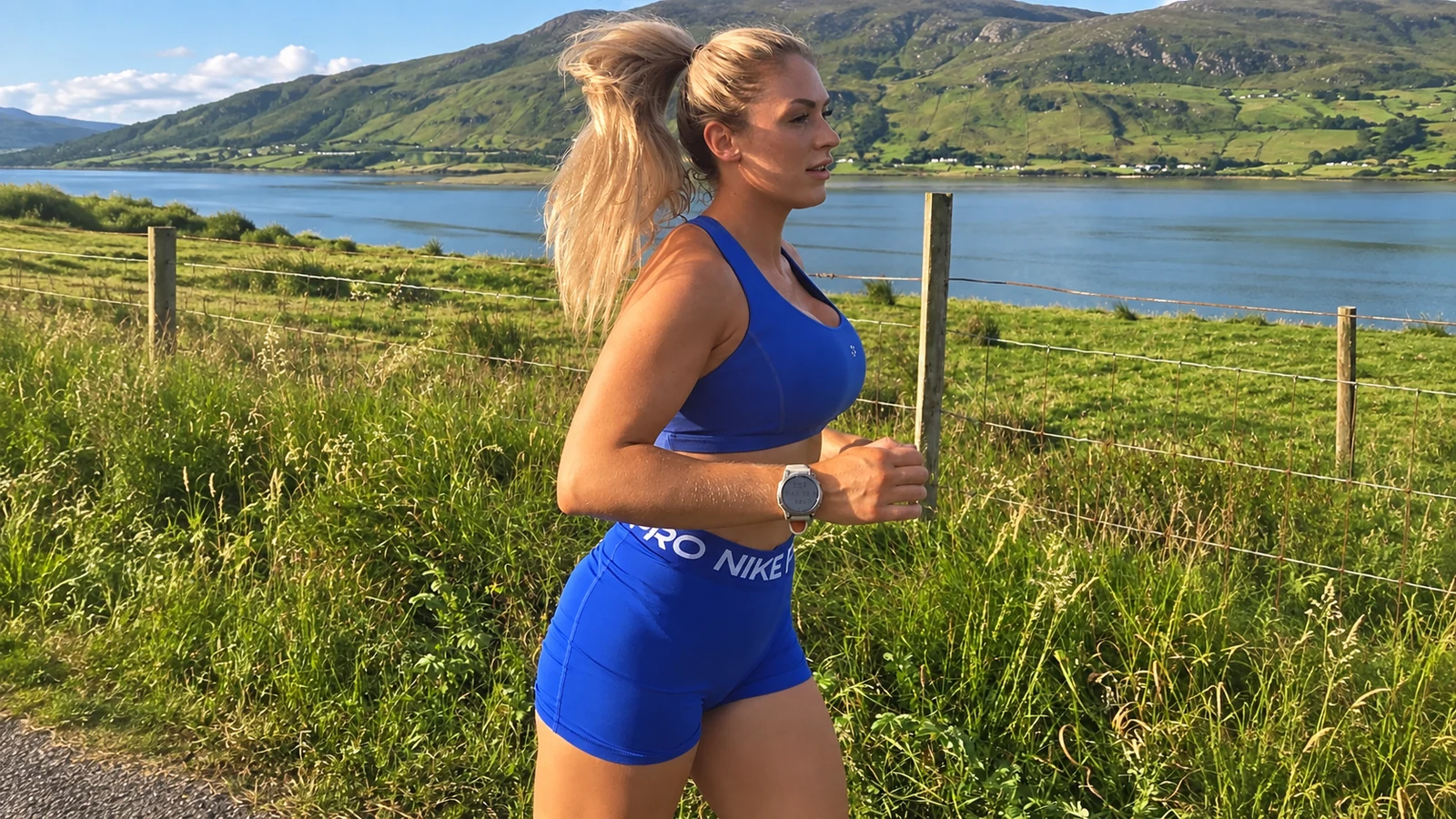
Image context: The featured runner illustrates the activity, not a study participant, a demonstrated technique or a promised training result.
Choose a format before choosing a pace
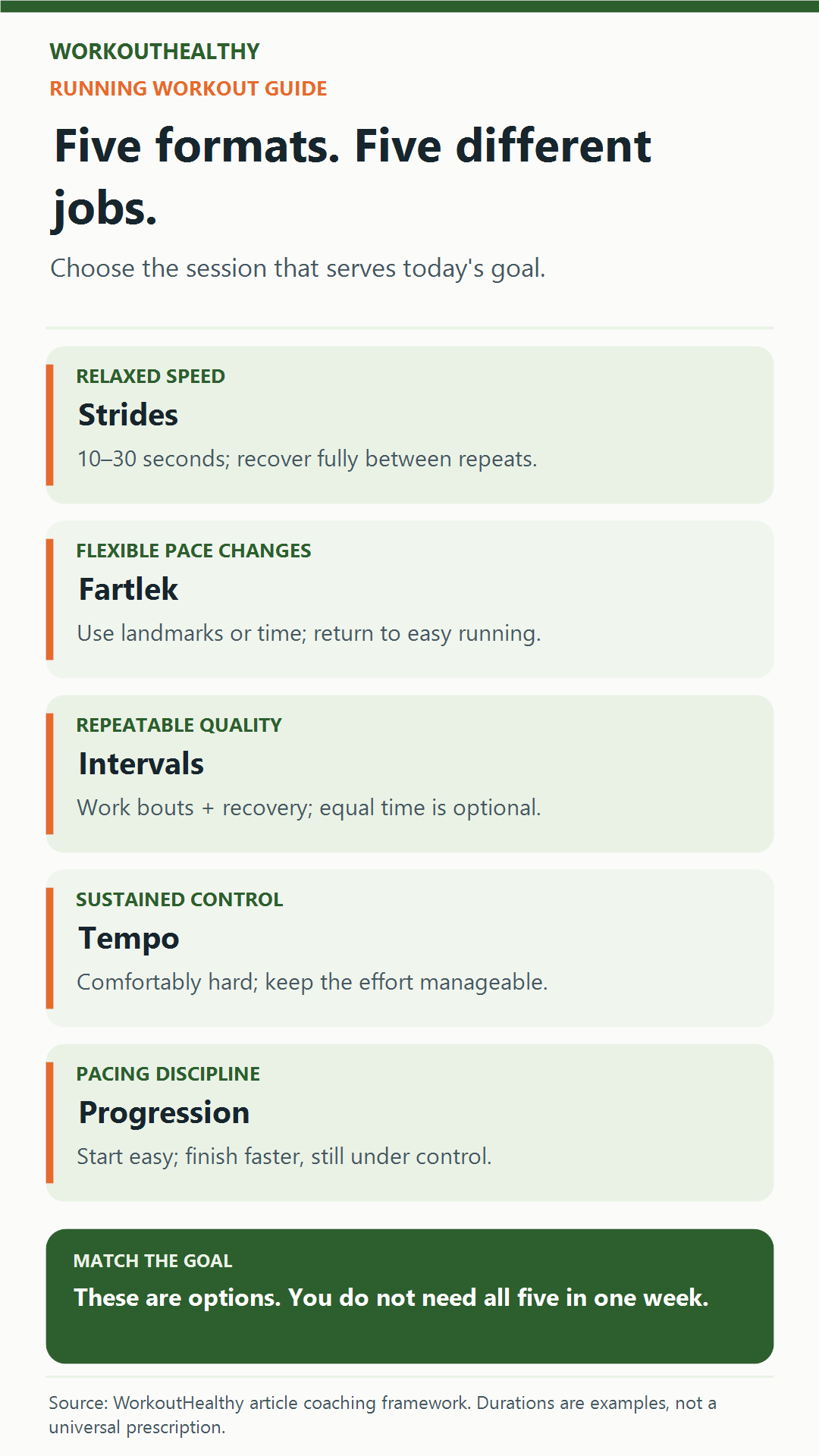
Use strides for brief, relaxed accelerations; fartlek for flexible pace changes; intervals for repeatable work and recovery; tempo for sustained control; and progression runs for a gradual increase in effort. These are overlapping ways to organize running, not five separate energy systems or five weekly requirements.
A timed fartlek can look much like an interval session. Its name matters less than how fast you run, how long you sustain it and what happens between efforts.
If regular easy runs are not yet repeatable, work on an appropriate easier plan before adding demanding sessions. If you have pain or need a personal return-to-running progression, seek guidance for that situation.
Prepare for faster running and leave time to finish easily
The American Heart Association recommends warming up for five to 10 minutes, with more preparation for more intense activity. Start with slower movement and increase gradually.
The worked examples below allocate 10 minutes to easy preparation and eight minutes to an easy finish. Those fixed numbers make the arithmetic visible; they do not establish the preparation every person needs.
Choose a clear, predictable surface with room to accelerate and slow down, away from traffic. Begin the first faster effort under control rather than using it to find your maximum speed.
Easy running should feel manageable for you. CDC’s intensity guidance explains that relative effort depends on the person and that speech becomes more limited during vigorous activity.
Conversation is a useful check, not a laboratory threshold test. A pace that worked on a cool flat route may require a different effort in heat, wind or on hills.
Five running workout examples
The timings here are editorial examples of organizing the existing formats, not a trial-tested five-workout program or a personal prescription. Choose a suitable session rather than trying to complete all five.
1. Strides: practice relaxed acceleration
After the easy preparation, accelerate smoothly for about 20 seconds, then slow down under control. Stay coordinated and relaxed instead of sprinting all-out.
For the worked example, repeat four times and allow 100 seconds of walking or very easy movement after each effort, including the last. Extend that recovery or end the faster work if you cannot repeat the movement comfortably.
Finish with the separate eight easy minutes. The goal is brief rehearsal of faster running, not making the recovery increasingly hard.
2. Fartlek: change pace with room for flexibility
After preparation, alternate one minute of brisk, controlled running with two minutes easy, four times. The final two easy minutes are included before the separate easy finish.
You can also use safe landmarks, but distance between landmarks changes the duration of each effort. Keep a boundary on the number of changes instead of continuing every time another lamppost appears.
Fartlek means speed play, not unlimited fast running. Adjust the pace to the route while keeping the easier portions genuinely easier.
3. Intervals: repeat the same work and recovery
Use six repetitions of one minute faster and one minute easy, following the preparation. Include the sixth easy minute before the separate eight-minute finish.
Choose a faster effort you can repeat with control, rather than your best possible first minute. Walk or jog during recovery as appropriate; changing the recovery movement also changes the session.
This example has more faster-running time and shorter recoveries than the fartlek example. Their similar names and 30-minute totals do not make them interchangeable.
For the specific research protocol with three pace changes per minute, see our 10-20-30 training guide. That named method has its own studied cycles and blocks.
4. Tempo: hold a demanding but controlled effort
Tempo has several meanings in running, so define the effort before using the label. Here it means a steady, comfortably hard effort that stays controlled rather than becoming a time trial.
One broken-tempo example is three four-minute efforts with two minutes easy only between them. Add the same preparation and easy finish, without inserting another two-minute recovery after the third effort.
The faster portions total 12 minutes, but the session lasts 34 minutes. Three separated efforts are not identical to a continuous 12-minute tempo, even if the faster-running totals match.
5. Progression: increase effort gradually
Start with 10 minutes easy, then five minutes steadier and five minutes at a controlled faster effort. Finish with eight minutes easy, making 28 minutes altogether.
The two middle blocks are different efforts, so do not record all 10 minutes as one precise physiological zone. The final faster block should remain planned and controlled rather than becoming a finishing sprint.
A progression teaches patience within the session. It does not require adding a hard finish to every usual easy run.
Compare faster time, recovery time and whole-session time
Use the same counting convention when comparing two sessions. In the repeated stride, fartlek and interval examples, a recovery follows the last repetition; in the tempo example, recovery occurs only between efforts.
| Worked example | Faster portions | Recovery within the main section | Main section | Whole session, adding 18 easy minutes |
|---|---|---|---|---|
| Four strides | 4 × 20 seconds = 1 minute 20 seconds | 4 × 100 seconds = 6 minutes 40 seconds | 8 minutes | 26 minutes |
| Four fartlek cycles | 4 × 1 minute = 4 minutes | 4 × 2 minutes = 8 minutes | 12 minutes | 30 minutes |
| Six interval cycles | 6 × 1 minute = 6 minutes | 6 × 1 minute = 6 minutes | 12 minutes | 30 minutes |
| Three broken-tempo efforts | 3 × 4 minutes = 12 minutes | 2 × 2 minutes = 4 minutes | 16 minutes | 34 minutes |
| Progression | 5 minutes steadier + 5 minutes faster | No inserted recovery; effort rises through the main section | 10 minutes | 28 minutes |
These are clock calculations, not measured training loads or equal doses. They exclude extra preparation, stops and any recovery you extend.
Twenty seconds of acceleration and four minutes of sustained running place different demands on a runner. Multiplying seconds can describe a session without predicting its benefit, fatigue or injury risk.
Why two intensity percentages can describe the same week
Consider a fictional week of three 30-minute runs: two easy runs and the six-cycle interval example above. Total running-session time is 90 minutes, with six planned faster minutes.
| What you count | Calculation | What the answer means |
|---|---|---|
| Sessions containing a quality component | 1 ÷ 3 = about 33% | One run included the faster work. |
| Planned faster-running minutes | 6 ÷ 90 = about 6.7% | Six minutes were assigned to the faster segments. |
| Measured time in a physiological zone | Not supplied by this example | Requires a defined measurement method; the recipe alone does not provide it. |
The runner did not secretly change programs between the first two rows. The denominator changed, and neither row proves an 80/20 intensity distribution.
A 20-article systematic review found that intensity distributions differed with methods including heart rate, pace and session effort ratings. Its preference for substantial low-intensity volume does not turn one counting method into a universal rule.
There is another distinction: a watch’s heart-rate trace does not instantly follow every pace change. A review of interval programming describes response delays and the limitations of heart rate during short intervals.
Do not sprint harder during a short stride just to make a display reach a zone. Use the intended movement and effort, with appropriate individual guidance when needed.
Changing repetitions is different from shortening recovery
Keeping the same pace does not mean you kept the same workout. The comparison below changes one component of the six-cycle example at a time.
| Illustrative change | Faster time | Recovery time | What changed |
|---|---|---|---|
| Original: six 1-minute efforts, each followed by 1 minute easy | 6 minutes | 6 minutes | 12-minute main section |
| Eight efforts with the same recovery | 8 minutes | 8 minutes | More faster running and a 16-minute main section |
| Six efforts, each followed by only 30 seconds easy | 6 minutes | 3 minutes | Same faster time packed into a 9-minute main section |
These are comparisons, not an instruction to progress to either variation. A shorter session can be more demanding, and a longer recovery can help preserve repeatable work.
In a small study of nine well-trained male runners, increasing recovery from one to two minutes slightly increased self-selected speed during repeated four-minute efforts; four minutes did not increase it further. This acute treadmill experiment did not determine the best recovery for every runner or prove a long-term race improvement.
Decide which component serves the goal before changing it. Record pace or effort, work duration, repetition count, recovery duration and recovery movement so two sessions can be compared honestly.
What getting faster means in the research
Running performance depends on more than one measurement. A higher maximal oxygen uptake, a lower oxygen cost at a given speed and a faster race result are related but distinct outcomes.
| Evidence | What it examined | Useful limit |
|---|---|---|
| Helgerud and colleagues, 2007 | Eight weeks of work-matched running in 40 moderately trained men; interval groups improved maximal oxygen uptake more than the continuous groups. | This does not validate the five editorial examples above or prescribe a beginner’s weekly schedule. |
| González-Mohíno and colleagues, 2020 | Six studies, seven trials and 295 participants comparing running oxygen cost; the pooled result favored continuous training. | A result for economy does not declare every interval session ineffective or predict every race time. |
| Seiler and Hetlelid, 2005 | Immediate responses to different recoveries during demanding treadmill intervals. | Maintaining speed within one workout is not the same outcome as getting faster over months. |
For a deeper discussion of the aerobic-capacity endpoint, our guide to raising VO2 max through running separates workouts, measurements and study populations.
Fit one suitable session into your existing running
Start the scheduling decision with the demanding running, hills and strength work already in your week. Replacing a session and adding another one are different changes.
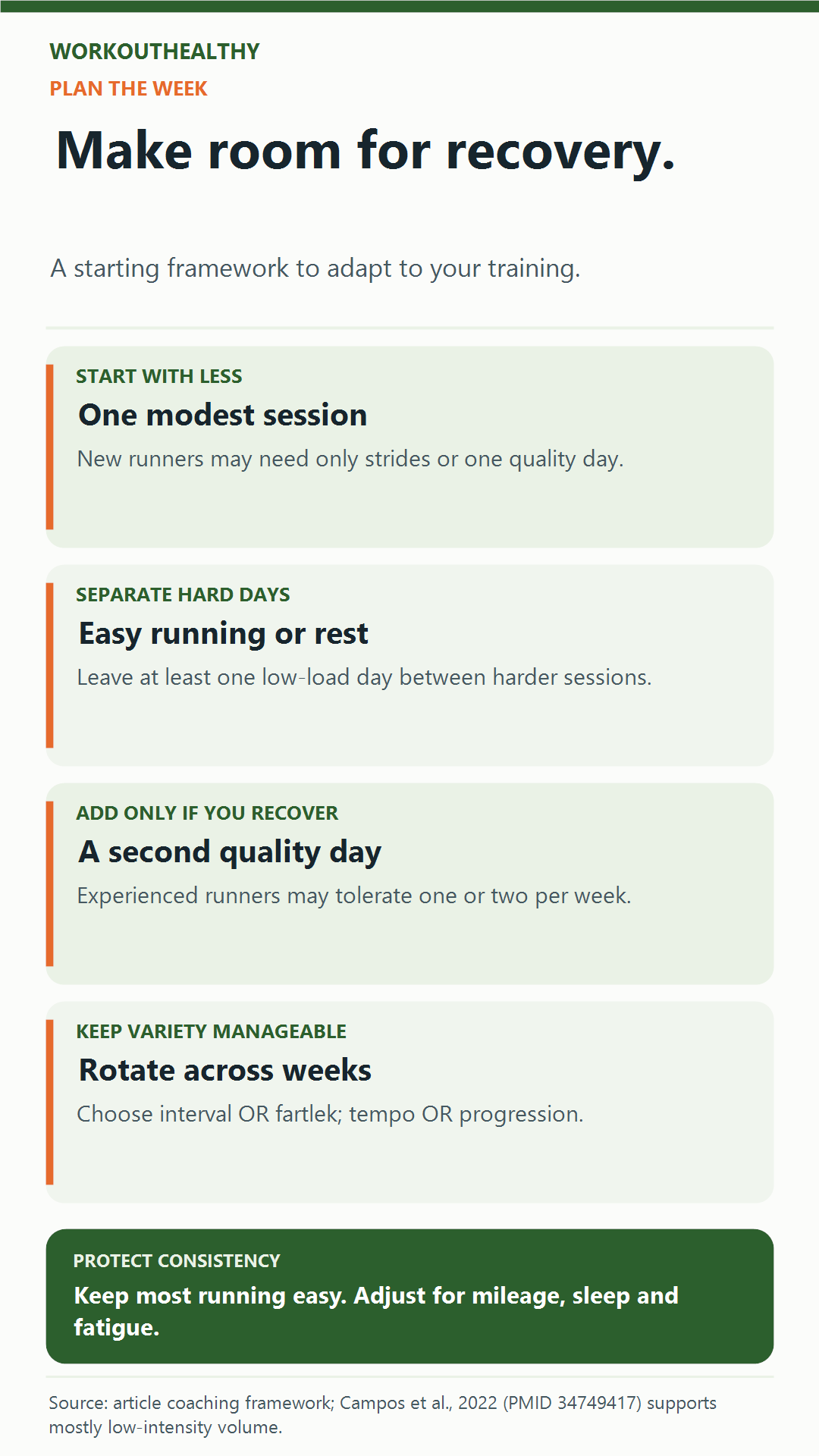
The fictional three-run week illustrates one quality session, not a requirement to run exactly three times or to add speed immediately. Separate harder days with easy running or rest and assess whether your usual running remains repeatable.
If an effort becomes unrepeatable or your movement deteriorates, finish the faster work instead of forcing the planned count. Persistent pain, limping or worsening symptoms need appropriate assessment.
The American Heart Association’s exercise statement emphasizes gradual progression and medical review of warning symptoms. Stop for chest discomfort, faintness or unusual severe breathlessness, and seek medical help.
People with known or suspected cardiovascular disease or exercise-related symptoms need individualized guidance before demanding intervals. A public workout list cannot supply that assessment.
Keep the session that fits your current training repeatable before searching for a more impressive name. Consistency, suitable recovery and a clear goal matter more than collecting all five formats.
Sources and example boundaries
- Campos and colleagues, 2022: 20-article intensity-distribution review; published abstract reviewed.
- Buchheit and Laursen, 2013: interval programming review; abstract and relevant work/recovery and heart-rate sections reviewed.
- Seiler and Hetlelid, 2005: nine-runner recovery experiment; published abstract reviewed.
- Helgerud and colleagues, 2007: 40-man running trial; published abstract reviewed.
- González-Mohíno and colleagues, 2020: oxygen-cost meta-analysis; published abstract reviewed.
- American Heart Association and CDC: preparation, intensity and exercise-risk guidance.
The session clocks and fictional week are transparent calculations, not original participant data. Their examples do not establish an optimal dose, an injury-prevention guarantee or a deadline for improvement.
Get the next practical training guide.
Five useful fitness stories, every Friday.
One email a week. No product pitches. Unsubscribe in one click.
Medical disclaimer: This article provides general fitness information, not medical advice or an individualized training plan. If you have an injury, medical condition or symptoms with exercise, seek appropriate professional guidance before changing how you train.