

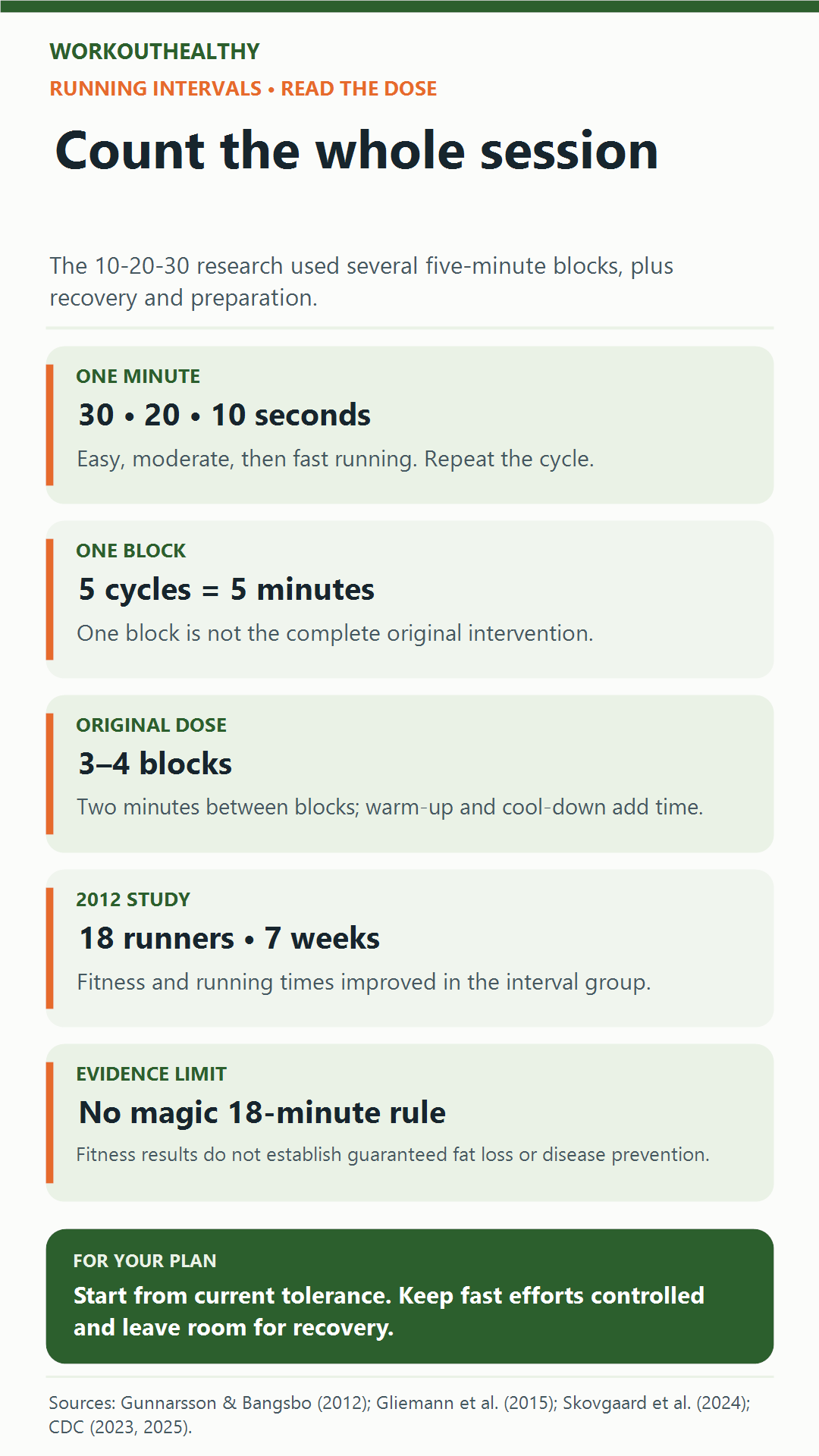
10-20-30 training alternates 30 seconds of easy running, 20 seconds at a moderate pace and 10 seconds fast. The name runs in the opposite order to the workout, and five consecutive cycles make one five-minute block.
The useful question is how those minutes fit together. A three-block version includes 19 minutes of intervals and between-block recovery, before a warm-up and cool-down.
Set the timer for the whole session. The easy seconds and the recovery between blocks are part of the workout.
The original 10-20-30 running session
The original study involved moderately trained runners, rather than people starting exercise from scratch. The following is its published structure, with general cool-down advice added separately (Gunnarsson & Bangsbo, 2012).
- Warm up: About 1.2 kilometers at low intensity.
- Run one cycle: 30 seconds easy, 20 seconds moderate, then 10 seconds near-maximal.
- Finish the block: Complete five cycles continuously, without adding a rest after each minute.
- Recover: Rest for two minutes between blocks.
- Complete the session: Three blocks in weeks one to four; four blocks in weeks five to seven.
Participants trained three times weekly, replacing their usual running. That seven-week research schedule describes what was tested; it is not an individualized prescription to replace every reader’s current program.
After the final block, reduce your effort gradually. The American Heart Association advises slowing your walking pace for five to 10 minutes during a cool-down; this general guidance is separate from the original trial’s dose (American Heart Association, 2024).
A timer card that counts every minute
For three five-minute blocks, the interval section starts at zero after the warm-up. The clock below includes recovery only between blocks, so it does not add an unnecessary third recovery before the cool-down.
| Elapsed time | Action |
|---|---|
| 0:00 to 5:00 | Block 1: five 30/20/10 cycles |
| 5:00 to 7:00 | Recovery |
| 7:00 to 12:00 | Block 2: five cycles |
| 12:00 to 14:00 | Recovery |
| 14:00 to 19:00 | Block 3: five cycles |
In each minute, change effort at 0:30 and 0:50, then return to easy running when the next minute starts. An interval timer needs three successive segments, rather than a separate recovery after the fast segment.
There are 15 fast segments across three blocks, totaling two minutes and 30 seconds. That is the fast-running time, while 19 minutes is the interval-and-recovery time; neither includes preparation or the cool-down.
Four blocks contain 20 minutes of cycles and six minutes between blocks, totaling 26 minutes. Adding a warm-up measured by distance means the complete appointment takes different amounts of time for different runners.
This arithmetic helps distinguish a cycle, a block and a session when two guides appear to describe the same workout. Four one-minute cycles total four minutes; a five-minute block requires five.
What easy, moderate and fast mean
Bangsbo’s review describes the easy phase as jogging and the moderate phase as the runner’s usual continuous running pace. The fast phase is a sprint, which makes this a demanding session despite the brief accelerations (Bangsbo, 2024).
These are running-speed instructions, rather than a command to make your heart rate reach three percentages every minute. A watch’s heart-rate display should not turn a short change in pace into a frantic chase for a number.
The featured illustration shows a runner on a track; it is not a study participant or a frame-by-frame demonstration. Use the timing instructions to understand the sequence, rather than copying a still image as a personal sprinting technique.
The later submaximal version used a different dose
A later six-week trial compared maximal and submaximal fast efforts in 19 male recreational runners. It changed more than the final segment’s speed (Skovgaard et al., 2024).
| Component | Maximal, 8 runners | Submaximal, 11 runners |
|---|---|---|
| Cycles per block | Five | Six |
| Rest between blocks | 3 minutes | 2 minutes |
| Fast segment | Maximal effort | About 75% of measured maximum speed |
| Shared structure | 10-minute warm-up; three sessions weekly; first sessions build from two to four blocks, then alternate three and four | |
The extra submaximal cycle was intended to match fast-running volume. Both groups improved 5K performance and maximal oxygen uptake, with no statistically detected difference in those changes; measured muscle oxidative proteins increased only in the maximal group.
Submaximal therefore did not mean a casual one-block beginner workout. The study compared two structured programs, rather than isolating a speed change in otherwise identical sessions.
For three blocks, those methods give 21 minutes for maximal work and rests, versus 22 minutes for submaximal work and rests. With their 10-minute warm-up, the totals are 31 and 32 minutes before any cool-down, respectively.
What the running studies support
In the original seven-week study, 10 runners used the interval program and eight continued normal training. The interval group’s maximal oxygen uptake rose 4% and its 5K time improved by 48 seconds despite 54% less weekly distance (Gunnarsson & Bangsbo, 2012).
A larger eight-week study included 132 interval runners and 28 controls. The intervention replaced two of three weekly sessions and improved 5K performance by an average of 38 seconds (Gliemann et al., 2015).
That study also reported lower systolic blood pressure, while oxygen-uptake and muscle-biopsy testing involved an 18-person subgroup. A result measured in that subgroup should not be described as a test performed on all 160 runners.
The practical evidence concerns particular runners following particular programs. It cannot tell you that reducing your own mileage by half will produce the same race improvement.
Bangsbo’s narrative review also covers cycling studies and clinical populations, and acknowledges the limited research within individual groups. A supervised cycling intervention in patients does not establish that an unscreened runner should copy a maximal outdoor session.
Fitness, race time, blood pressure and fat loss are different outcomes. None of these results creates a guarantee of weight loss or establishes that steady running has become unnecessary.
Where it fits in a running week
Start the scheduling decision with the demanding work already in your calendar. Adding this session on top of every existing hard run is a different intervention from replacing sessions as the studies did.
Write down the protocol you actually intend to use: cycle count, block count, between-block rest and preparation. If those change, record the change rather than comparing the session with a previous entry that used a different dose.
An honest log can be short: date, chosen version, blocks completed, any change in movement or symptoms, and how the next usual run felt. That makes repeatability visible without requiring a maximal race test after every workout.
Keep this named protocol separate from the broader choice between strides, fartlek and longer intervals. Our guide to five running workouts to get faster compares those formats.
General adult activity guidance includes aerobic exercise plus strength work, so a compact interval session does not account for every part of a training week. CDC provides examples combining moderate or vigorous activity with two strength-training days (Centers for Disease Control and Prevention, 2025).
Readiness and reasons to stop
This is a guide to a demanding running method, rather than a return-to-running rehabilitation plan. When you need a personal progression because of an injury or a long interruption, choose that progression before adopting the trial schedule.
CDC advises people with chronic health conditions to discuss suitable activity with their doctor. It also recommends that discussion before vigorous activity for people who have been inactive, have a disability or have overweight.
The review advises stopping intense exercise immediately if pain or dizziness occurs (Bangsbo, 2024). A short fast segment is still intense exercise, so its duration does not cancel those symptoms.
Common questions
Is 10-20-30 training an 18-minute workout?
A three-block session has 15 minutes of cycles and four minutes of recovery, totaling 19 minutes. Warm-up and cool-down add time, and other versions have different clocks.
Do I rest after every sprint?
The original block uses consecutive cycles, so the next 30 seconds of easy running follow the 10-second fast segment. The separate two-minute recovery comes between complete blocks.
Can I simply make the final 10 seconds slower?
You can change a workout, but the resulting session should be described as a modification. The studied submaximal version included an additional cycle per block and a different recovery period.
Does this replace all easy running?
The trials do not establish one ideal program for every runner or race distance. Treat the named method as one option whose demands must fit your existing training and recovery.
Get the next practical training guide.
Five useful fitness stories, every Friday.
One email a week. No product pitches. Unsubscribe in one click.
References
American Heart Association. (2024, January 16). Warm up, cool down. Warm-up and cool-down guidance.
Bangsbo, J. (2024). 10-20-30 exercise training improves fitness and health. European Journal of Sport Science, 24(8), 1162 to 1175. https://doi.org/10.1002/ejsc.12163
Centers for Disease Control and Prevention. (2025, December 4). Adding physical activity as an adult. Adult activity examples and medical guidance.
Gliemann, L., Gunnarsson, T. P., Hellsten, Y., & Bangsbo, J. (2015). 10-20-30 training increases performance and lowers blood pressure and VEGF in runners. Scandinavian Journal of Medicine & Science in Sports, 25(5), e479 to e489. https://doi.org/10.1111/sms.12356
Gunnarsson, T. P., & Bangsbo, J. (2012). The 10-20-30 training concept improves performance and health profile in moderately trained runners. Journal of Applied Physiology, 113(1), 16 to 24. https://doi.org/10.1152/japplphysiol.00334.2012
Skovgaard, C., Christiansen, D., Martínez-Rodríguez, A., & Bangsbo, J. (2024). Similar improvements in 5-km performance and maximal oxygen uptake with submaximal and maximal 10-20-30 training in runners, but increase in muscle oxidative phosphorylation occur only with maximal effort training. Scandinavian Journal of Medicine & Science in Sports, 34(1), e14493. https://doi.org/10.1111/sms.14493
Medical disclaimer: This article is general fitness information, not medical advice. If you have an injury, ongoing pain or a medical condition, talk to a doctor or physical therapist before changing how you train.