
Zdeno Chara did not earn his Six-Star medal by finishing the 2026 Boston Marathon. The former Boston Bruins captain completed the original six World Marathon Majors in Tokyo on March 1, 2026. About seven weeks later, he returned to Boston and ran a personal-best 3:18:00 on April 20. Both achievements deserve attention, but combining them into one moment obscures the more interesting story: a retired hockey player steadily building a second athletic chapter.
What happened in Tokyo—and what happened in Boston
The Six-Star Finisher award recognizes runners who complete the original six Abbott World Marathon Majors: Tokyo, Boston, London, Berlin, Chicago, and New York City. Canadian Running reported that Chara earned the award at the Tokyo Marathon in March 2026. Boston was not the final race in his Six-Star sequence; he had already run it. The distinction matters because the scheduled social post attached to this article originally said Boston was the medal-winning finish.
On April 20, Chara ran the 130th Boston Marathon. NHL.com reported his 3:18:00 finish, his third Boston and his fastest there. His earlier Boston finishes were 3:38:23 in 2023 and 3:30:52 in 2024. The NHL also reported that he fired the race’s starting gun. Taken together, those three Boston results show improvement across years, not merely a quick six-week transformation.
Why the timeline is easy to misunderstand
Tokyo and Boston are both World Marathon Majors, and in 2026 they fell only 50 days apart. It is tempting to turn that proximity into a dramatic “he became a Six-Star finisher in Boston” headline. But a race result, an award milestone, and a later race are separate events. When several milestones happen in one season, chronology is part of accuracy.
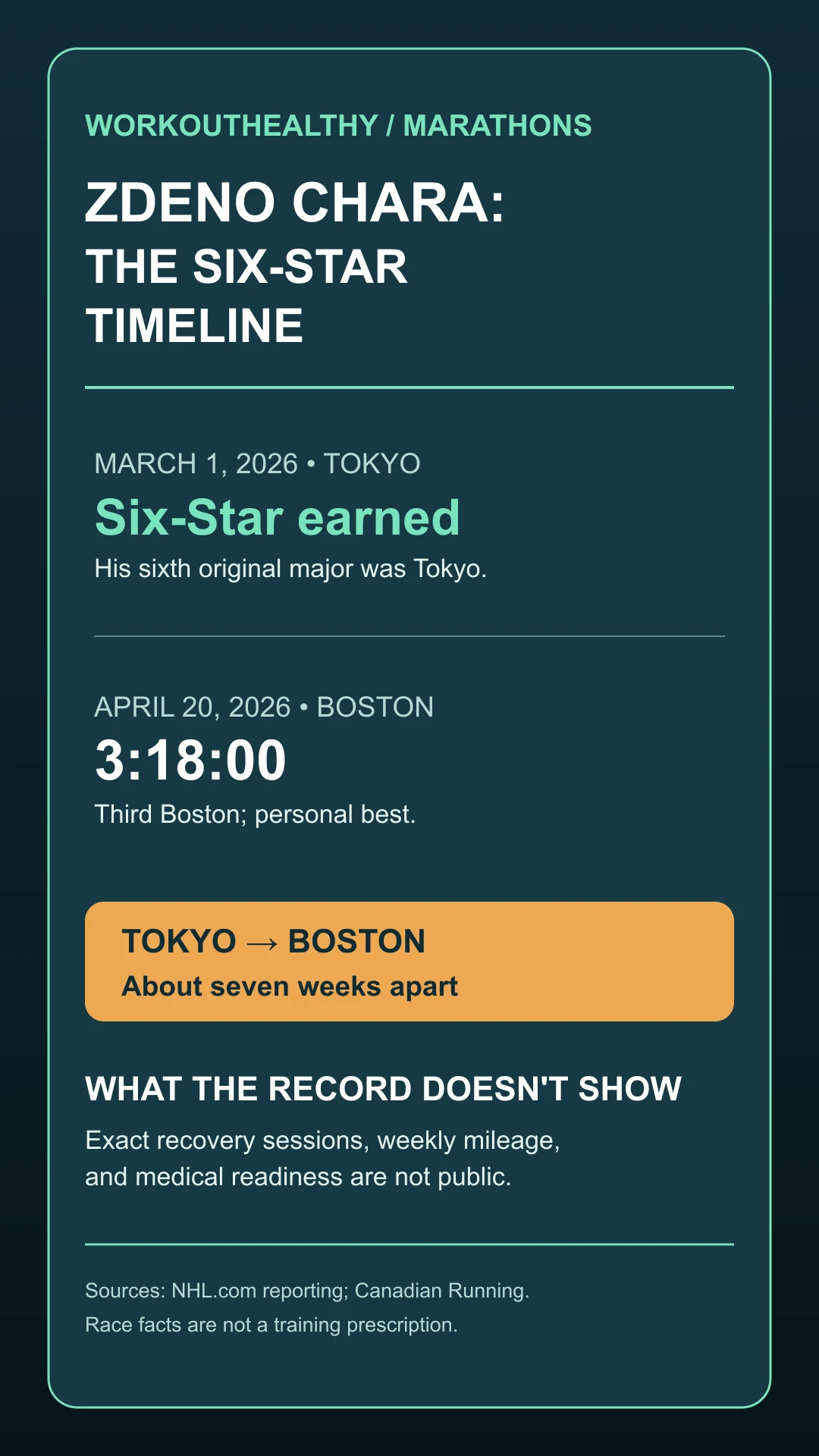
The infographic deliberately leaves out a purported exact recovery plan. Public sources establish his race dates and results, not his private training log or medical readiness. Claiming that a particular supplement, recovery session, or weekly mileage made the turnaround possible would be an invention.
From hockey’s demands to endurance sport
Chara’s hockey career lasted 24 NHL seasons. As an NHL defenseman, he trained for a sport built around bursts of skating, contact, and repeated changes of direction. A marathon requires sustained pacing, months of endurance preparation, and the ability to manage fatigue over 26.2 miles. Being elite in one sport does not automatically provide the specific preparation for the other.
In a January 2026 NHL.com interview, Chara described how he moved from a little running and biking to swimming, smaller triathlons, and eventually full-distance IRONMAN training. He said the training volume for endurance events was greater than for hockey and spoke about the satisfaction of preparing, completing a difficult event, and meeting people along the way. Those are his own reflections, not a universal recipe for former athletes.
That sequence also counters a misleading impression that he abruptly switched from retirement to back-to-back major marathons. His progression involved years of exercise and racing. The Boston times documented by NHL.com likewise span 2023, 2024, and 2026. This is a long arc of adaptation with an unusually high-profile 2026 chapter.
What two majors seven weeks apart can—and cannot—teach
Finishing Tokyo and Boston in the same spring shows that Chara was able to complete two demanding races on a relatively tight calendar. It does not establish that seven weeks is sufficient recovery for every runner, that his training was injury-free, or that a novice should copy his schedule. Race completion cannot reveal soreness, sleep, illness, training adjustments, or clinical advice between events.
Marathon recovery is not a single number on a calendar. The first question is whether normal daily movement returns comfortably. Then training can resume according to symptoms, race effort, prior fitness, and any injury history. A runner who struggles to walk normally, has focal pain, or develops unusual symptoms needs a more conservative approach and, where appropriate, medical assessment. The fact that Chara finished Boston faster than in prior years cannot substitute for those checks in someone else’s body.
For readers planning two races close together, the safest lesson is planning rather than mimicry. Discuss ambitious schedules with a qualified coach and clinician if you have an injury or health condition. Resist the urge to “make up” fitness in the narrow gap between races. One marathon is already a considerable training stress; the next start line does not erase the first finish line.
A practical framework for your own running goal
Build a base before you add a deadline. Consistent, tolerable running matters more than one heroic workout. If your usual weeks are inconsistent, two spring marathons are not the logical next step. Start with a distance you can train for steadily, then let your response to training guide the next goal.
Separate the event goal from the training goal. Chara’s Six-Star award reflects completion of six named events; his 3:18 Boston reflects one day’s performance. Those are different objectives. A personal best, a healthy finish, and completing a series may require different pacing and risk decisions. Be explicit about which one you are pursuing.
Use feedback, not a celebrity timeline. Persistent pain, falling performance, poor sleep, and unusual fatigue can all be reasons to revise a plan. If your recovery is not on track, a later race date is not failure. Chara’s public result is inspiration, but your own training and health signals should decide your calendar.
What the race record actually proves
Three Boston finishing times allow a narrow but meaningful conclusion: Chara covered the same event faster in 2026 than in his documented 2023 and 2024 appearances. They do not tell us whether his training was identical across those years, how the weather compared, whether the courses felt the same to him, or whether he targeted an all-out effort every time. A finish-time trend can be real without explaining its cause.
The Six-Star achievement answers a different question. It shows that Chara completed the original six majors over time, requiring travel, planning, and the persistence to reach six separate finish lines. It is not a ranking of who ran the fastest cumulative time. Marathon communities often celebrate both completion and speed; neither should be used to erase the other. In this case, Tokyo marks the completion milestone while Boston provides a clear performance marker.
There is also a useful distinction between “possible” and “recommended.” Chara demonstrated that he could finish Tokyo and Boston on this calendar. His result does not reveal whether the schedule was optimal for him, and no public interview lets us audit the trade-offs he accepted. For a recreational runner choosing races, the sensible comparison is not with a Hall of Fame professional athlete but with that runner’s own current mileage, previous race recovery, and willingness to adjust a goal. The takeaway is more modest—and more actionable—than a viral claim about a miraculous recovery window.
The overlooked part of Chara’s story
The headline is a Hockey Hall of Famer who can also run a strong marathon at 49. The quieter point is that his endurance identity was built gradually after hockey. In the NHL interview, he described not wanting to sit still and finding satisfaction in the process of training and racing. That explains motivation better than a fabricated secret recovery protocol.
His progress also illustrates why a new sport can offer a different challenge after a first athletic career. Marathon running is measurable, communal, and difficult in ways that hockey is not. A former professional athlete may bring discipline and experience with training, but still has to respect the specific demands of long-distance running.
Bottom line
Chara became a Six-Star Finisher at the 2026 Tokyo Marathon, then ran the 2026 Boston Marathon in 3:18:00 about seven weeks later. His Boston result was a personal best and his third finish there. It is fair to admire both milestones. It is not accurate to say Boston gave him the Six-Star title, or to present his short race gap as proof that everyone can safely do the same.
For everyday runners, the transferable idea is a patient, personally meaningful progression. Build the base, choose a race calendar that matches your circumstances, and treat recovery as a decision informed by your own body—not a date copied from someone else’s résumé.
Sources and editorial note
- Canadian Running: Chara completes Six-Star marathon challenge in Tokyo.
- NHL.com: Chara’s 2026 Boston result and prior Boston times.
- NHL.com interview: Chara discusses post-hockey endurance training.
- Abbott World Marathon Majors: Six-Star Finisher program.
The featured image is an illustrative recreation, not a photograph of the actual Tokyo or Boston race. This article reports public race facts and general training considerations; it does not disclose Chara’s private recovery regimen or offer individualized medical advice.