
At the 1960 Rome Olympics, three runners from New Zealand reached the medal podium.
Their coach was Arthur Lydiard, a New Zealander with his own ideas about how runners should train.
A popular post says Lydiard proved that building a big base of easy mileage first makes later speed work more effective.
The core idea is accurate and still shapes running programs. The word “proved” deserves a closer look.
Who Arthur Lydiard Was
Lydiard was born in Auckland, New Zealand, in 1917. He died in 2004 at age 87.
At the 1960 Olympics, his athletes Murray Halberg, Peter Snell, and Barry Magee all won medals.
Snell later won two gold medals at the 1964 Tokyo Olympics.
Lydiard also helped start the Auckland Jogging Club in 1961.
That was early for a jogging club, at a time when distance running was often seen as risky for ordinary people.
He wrote several books, including Run to the Top in 1962 and Run, the Lydiard Way in 1978.
How His System Was Built
Lydiard’s plan moved through phases in a set order.
It began with base training, which he treated as the foundation for everything that followed.
During this phase, his runners famously covered around 100 miles, or 160 kilometers, per week.
Next came hill training.
After that, athletes did a maximum of about four weeks of hard anaerobic work.
Then came a coordination phase, where the athlete raced each week to sharpen up.
The logic was simple. Build the engine first, then tune it for racing.
The phases were not a promise that every athlete should run the same weekly distance.
Lydiard’s own training-system guide describes aerobic conditioning as the foundation, followed by hills, anaerobic work, coordination, and sharpening.
It presents the order as a way to prepare for a target race, not as a rule that speed is forbidden forever.
The famous 100-mile weeks were undertaken by elite runners who had already built substantial capacity.
For a newer runner, the transferable principle is to make a sustainable amount of mostly easy running repeatable before adding demanding sessions.
Copying an elite mileage figure without the years of adaptation behind it misses the point and increases the chance that fatigue or pain stops the plan.
Speed work sharpens fitness you already have. It cannot replace the months of easy miles that build it.
Did He Prove It?
Lydiard’s results were real and striking. But results from one coach’s athletes are not the same as a controlled experiment.
His runners were talented, and many things besides the training order affected their success.
His main evidence was what happened on the track, not data from a lab.
What he did do was organize the pieces into a clear sequence and show that it could produce champions.
That sequence made the idea hard to ignore.
It is still important to separate three kinds of evidence.
The Olympic results demonstrate what his athletes achieved, but cannot isolate which part of their training caused it.
His own lecture documents the sequence he advocated, but a coaching manual is not a randomized test.
Later research on other athletes can test related principles, yet it cannot rerun the 1960 program with identical people and conditions.
So the strongest conclusion is narrower than the viral “proved it” line: Lydiard developed an influential sequence, his athletes succeeded, and modern practice retains much of its aerobic emphasis.
A 2022 review by Haugen and colleagues noted that since Lydiard introduced his periodization system in the late 1950s, top coaches have usually split the training year into distinct, ordered phases.
What Research on Elite Runners Shows
The same 2022 review looked at how world class distance runners actually train.
It reported that at least 80 percent of their running volume is done at low intensity throughout the year.
In the middle of the preparation period, marathoners ran about 160 to 220 kilometers per week.
Track runners covered about 130 to 190 kilometers.
That lines up with Lydiard’s emphasis on large amounts of easy running.
A 2014 study by Stöggl and Sperlich tested four training styles in 48 well trained endurance athletes for nine weeks.
The four groups used high volume, threshold, high intensity interval, or polarized training.
The polarized group did mostly easy work plus some very hard work, with little in between.
That group improved peak oxygen uptake by 11.7 percent and time to exhaustion by 17.4 percent.
Peak speed or power rose by 5.1 percent in that group as well.
The high volume group and the threshold group showed no further gains in the measured endurance markers.
This was a short study in athletes who were already fit, so the results may not apply to beginners.
Where the Modern View Differs
The research supports lots of easy running. It does not support avoiding all hard running for months.
In the 2014 study, easy volume alone was not the winning formula. The group that mixed easy and hard work improved most.
The 2022 review also describes a common pattern of two to three interval sessions per week, one long run, and easy running for the rest.
So most modern plans keep a small amount of faster work even during the base period.
The review’s authors also noted that much of their data came from coaching practice, not peer reviewed trials.
That distinction matters when applying elite evidence to ordinary runners.
A program that works for athletes training more than ten times a week does not transfer intact to someone running three times.
Intensity, recovery, work schedules, and injury history change what is practical.
The sensible takeaway is to borrow the sequence and the emphasis on easy volume, then scale the absolute workload to the runner in front of you.
How to Use a Base First Approach
- Make most runs easy. You should be able to talk in full sentences on most of your runs.
- Build volume slowly. Add mileage over weeks and months, not all at once.
- Scale the mileage to you. Lydiard’s 100 miles per week was for elite athletes, not beginners.
- Add hills before hard intervals. Hill running builds strength and eases you toward faster work.
- Keep a little speed. Short strides or a weekly faster session can fit into a base phase.
- Plan the order. Save the hardest race specific sessions for the final weeks before your goal event.
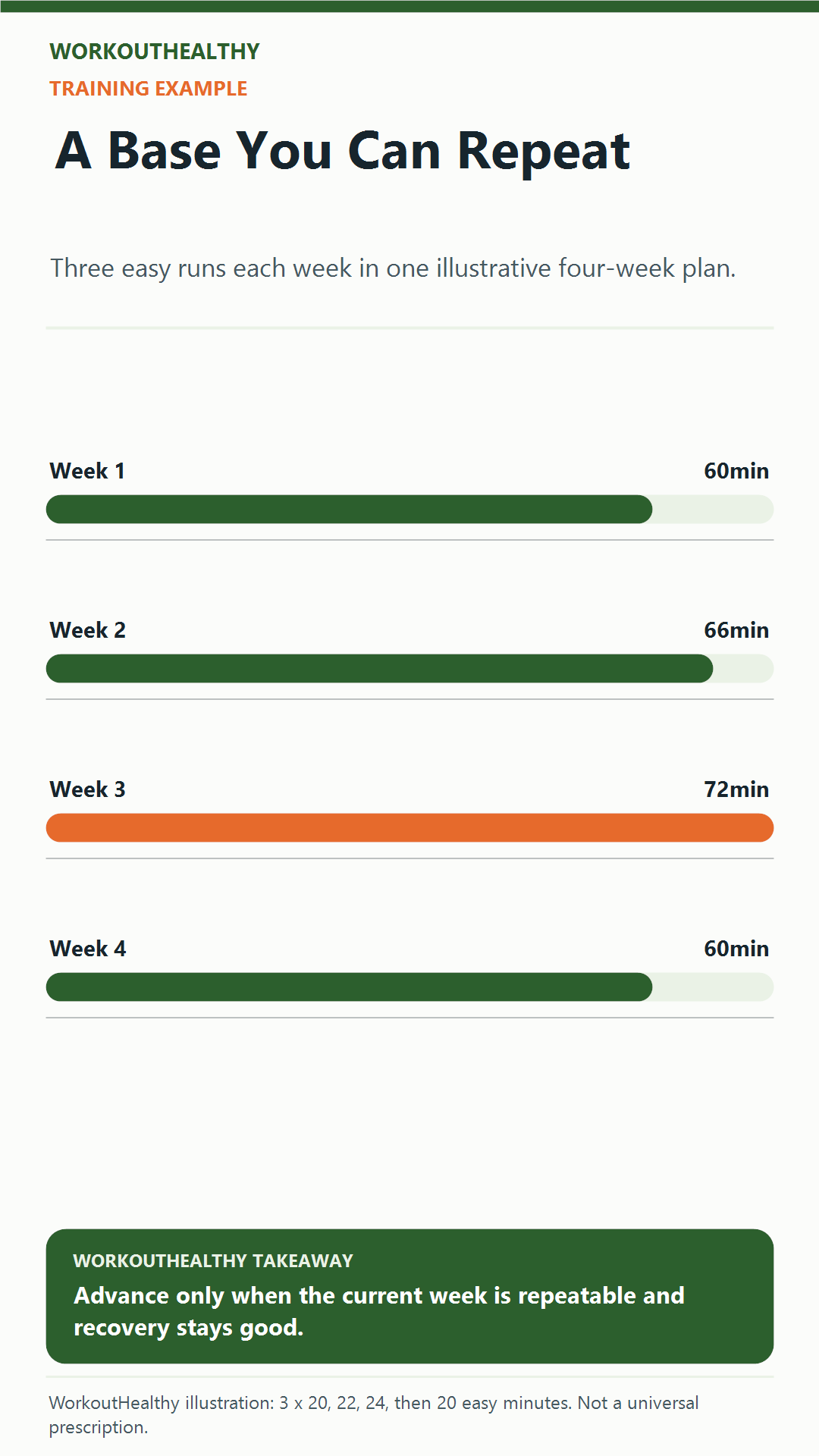
Consider an illustrative four-week base block for a healthy adult already comfortable running three times a week.
It is WorkoutHealthy’s scaled example, not one of Lydiard’s elite schedules.
Assume the runner can complete three easy 20-minute runs without lingering pain.
Week one therefore totals 60 easy minutes: three runs multiplied by 20 minutes.
If recovery is good, week two might use three 22-minute runs, for 66 minutes total.
Week three could use three 24-minute runs, for 72 minutes.
Week four could return to three 20-minute runs, for 60 minutes, as a lighter week.
The arithmetic is intentionally simple so the runner can see the change: 60, 66, 72, then 60 minutes.
That is not a validated universal progression rate or a guarantee of better race times.
Some runners will need to stay at 60 minutes longer; others will already have a much bigger base.
The decision to add time should depend on whether the current week feels sustainable and leaves the next session intact.
If pain worsens, if sleep or daily energy deteriorates, or if pace drops sharply at the same easy effort, hold the volume or scale it back.
A short set of relaxed strides can be added after an easy run for runners who already tolerate them, but there is no need to turn every base session into intervals.
When a repeatable base is established, a runner can introduce a controlled hill session or faster workout while preserving easy days.
That is the practical balance: build consistency first, then add specificity without discarding the aerobic work.
The useful base is the amount of easy running you can repeat and recover from.
For a practical look at hard sessions, read the simplest way for runners to raise their VO2 max.
And for what elite distance running looks like, see Letesenbet Gidey’s half marathon world record.
Common Mistakes
- Running easy days too fast. This turns base miles into moderate efforts that add fatigue.
- Copying elite mileage. Big weekly totals take years to build.
- Skipping the base entirely. Jumping straight into intervals often leads to burnout or injury.
- Never getting faster. A base with no later sharpening leaves race performance on the table.
Who Should Be Careful
Big jumps in mileage are a common path to overuse problems like shin pain and stress injuries.
New runners, older adults, and anyone coming back from injury should build up more slowly.
If you have heart or lung conditions, check with a doctor before adding long runs or hard intervals.
The Bottom Line
Arthur Lydiard made base training the first step of a planned running year, and his athletes won big.
Research on elite runners shows most training is still easy, just as he taught.
Modern evidence adds one tweak: a little hard running alongside the easy miles seems to help.
Build your base patiently, keep most runs easy, and save your sharpest work for last.
Want more stories like this? Subscribe to WorkoutHealthy Insider for practical explanations behind popular fitness claims.
This article is for general information only and is not medical advice. If you have an injury, ongoing pain, or a medical condition, talk to a doctor or physical therapist before you change how you train or eat.