
Powerlifting does not require you to look like a competitive lifter before you begin. You need a safe way to practice the squat, bench press, and deadlift, a repeatable schedule, and a plan that lets technique improve while loads rise gradually.
The WorkoutHealthy Facebook post suggests a 16-week starting point. That is a useful planning horizon, but it is not a universal prescription. The example below explains what to practice in each block, how to adjust when recovery lags, and which competition rules are worth learning early.
Start with loads you can control. A first meet is optional, and a good first training cycle can succeed even if you never compete.
What powerlifting actually measures
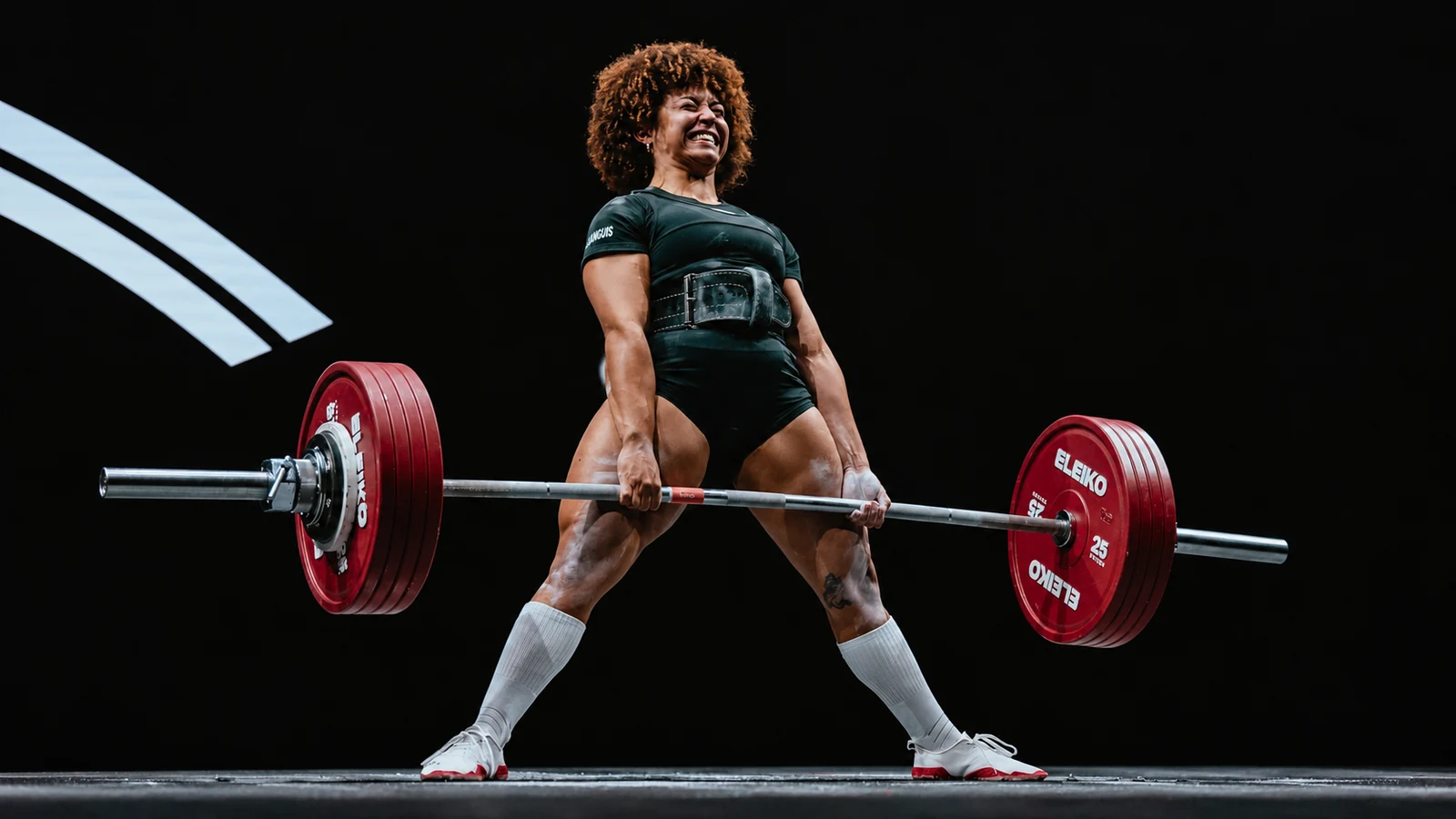
A full powerlifting meet tests one-repetition strength in the squat, bench press, and deadlift. Each lift has a prescribed setup, movement, referee commands, and reasons an attempt can be rejected. The exact standards depend on the federation and division, so read the current rulebook for the meet you might enter.
For example, the International Powerlifting Federation (IPF, 2026) requires a squat to reach a specified depth and finish upright before the rack command. Its bench press includes start, press, and rack signals. The deadlift is held motionless at lockout until the down command. A strong gym rep can still be a missed meet attempt if it ignores those rules.
This is why early practice should prioritize repeatable positions over a dramatic personal record. Video from the side and front quarter can help you review depth, bar path, foot pressure, and lockout. A qualified coach or experienced referee can spot details a camera angle misses.
Do not confuse one federation’s standard with every meet’s standard. Equipment rules, commands, and judging details can change. Check your actual federation’s current rules before preparing attempts.
The minimum setup and weekly schedule
A basic barbell, appropriate plates, a sturdy rack with safeties, a bench, and a clear deadlift area cover the three main lifts. Arrange a spotter for heavy bench sets and set rack safeties before squatting. If you are not sure how to set them, ask staff for a demonstration.
You do not need specialty bars, a lifting suit, or a collection of accessories to learn. Shoes that feel stable, a training log, and the ability to repeat a session matter more. Meet equipment rules become relevant only if you decide to compete.
Three focused sessions per week are a practical starting structure. Leave at least a day between hard sessions when possible, then add a fourth short technique day only if the first three are recovering well. This is an illustrative schedule, not a promise that every beginner needs three or four days.
The American College of Sports Medicine’s 2026 resistance-training position stand draws on a large evidence base and emphasizes matching the training prescription to the desired outcome and the person. It does not make one elaborate program mandatory for everyone (American College of Sports Medicine [ACSM], 2026).
An adaptable 16-week beginner plan
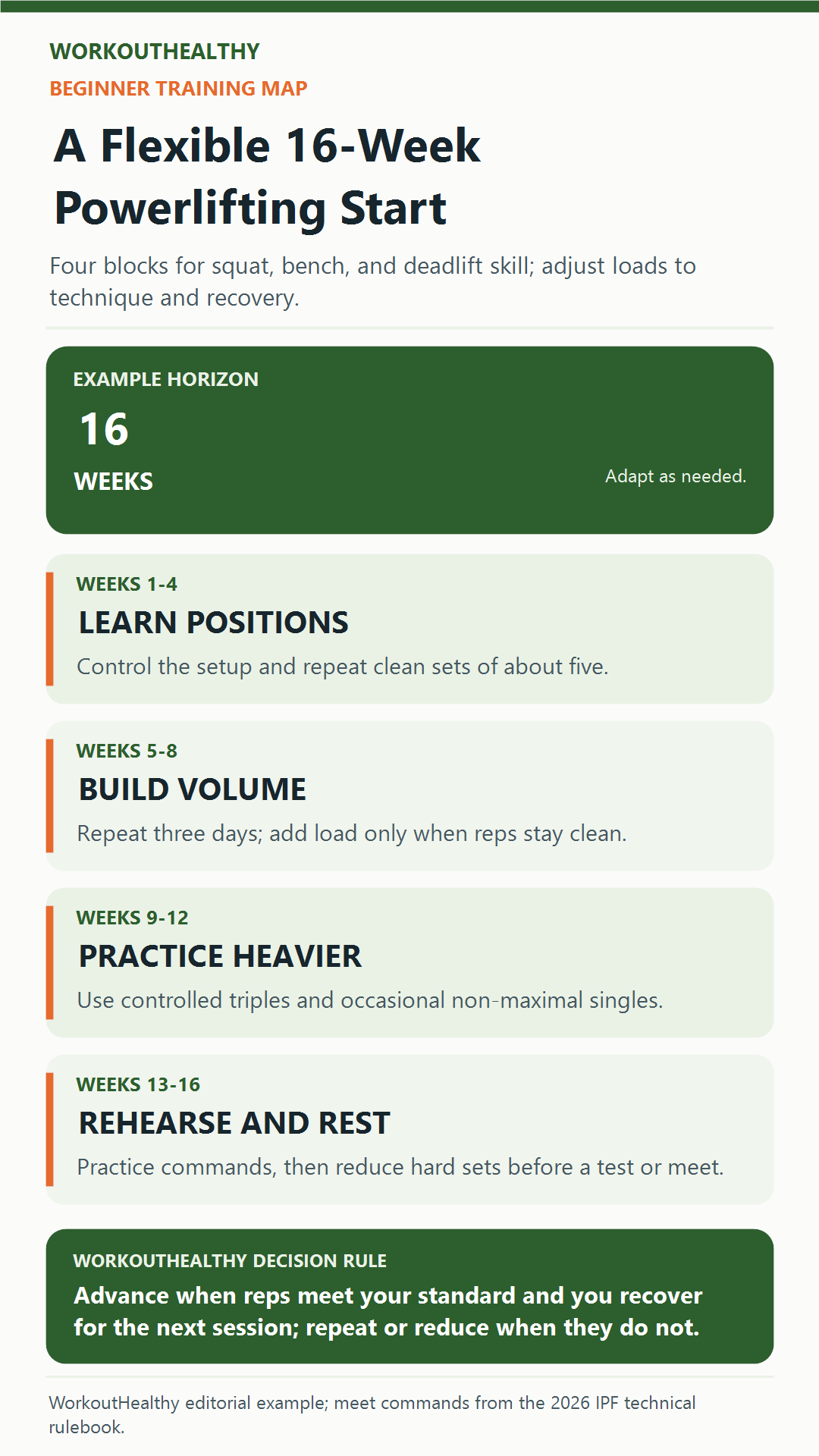
Use four blocks. The goal is to arrive at the end with more reliable lifts, not to force a 16-week peak onto an injured or exhausted body. If you are new to barbell lifts, spend more time in the first block. If a set changes your technique sharply, reduce the load before adding another week of weight.
Weeks 1 to 4: learn positions
Practice the three lifts with several controlled sets of about five repetitions. Keep most working sets comfortably below failure. Learn where the rack safeties go, how to brace, and how to repeat the same setup. Record one or two main sets to compare your own technique, not to chase social-media approval.
In week four, keep the movements but reduce the number of hard sets if fatigue or soreness is accumulating. You do not need a fixed percentage cut when the preceding weeks were already easy.
Weeks 5 to 8: build repeatable volume
Keep the same three-day rhythm. Use a main squat, bench, or deadlift each day, then one lighter variation or supporting movement. Add small amounts of weight only when all prescribed repetitions retain the intended range, pause, and lockout.
Many lifters benefit from benching twice weekly because the lift takes frequent practice. A second squat exposure can be lighter. One heavy deadlift exposure plus a manageable hinge variation is enough for this example.
Weeks 9 to 12: practice heavier, clean reps
Shift some main-lift work from sets of five toward sets of three while keeping effort controlled. An occasional technically sound single can teach the feel of a heavier weight. It should not become a weekly maximum test.
Introduce commands on selected sets. Pause the bench when asked. Wait for the down command on a practice deadlift. Use your video to check whether the heavier load changed depth or the finish position.
Weeks 13 to 16: rehearse, then reduce fatigue
In weeks 13 to 15, rehearse competition-style singles at loads you can lift without a fight. Keep enough lighter work to maintain skill, but do not add fatigue just to fill a spreadsheet. In week 16, use fewer total hard lifts before a test day or meet.
If you are not competing, week 16 can simply be a review week. Compare controlled sets with those from week one. Better technique and a modest increase in usable load are meaningful progress.
WorkoutHealthy’s decision rule: advance a load only when the previous session’s reps met your chosen technique standard and you recovered for the next scheduled session. Repeat or reduce a load when form, symptoms, or recovery say otherwise. This rule is an editorial planning tool, not a tested clinical protocol.
What the three training days look like
Day one: squat first, bench second, then one row and one trunk exercise. The main squat receives the most attention. Bench volume can use a lighter load and more total practice repetitions.
Day two: deadlift first, then a bench variation with a deliberate pause. Finish with hamstring or upper-back work that does not interfere with the next session.
Day three: use a lighter squat variation or fewer squat sets, then another bench exposure and one or two accessories. The week repeats the competition movements without requiring every day to be maximal.
A fourth day, if you want one, should solve a clear problem. It might be short technique work, light rows, or a movement you cannot fit elsewhere. If it worsens your main-lift quality, remove it.
Most accessories should answer a specific question: Can you keep the bar close? Can you maintain upper-back tension? Can you control your trunk under a light front load? If an exercise has no purpose beyond making a workout longer, it can wait.
How to choose loads and deload
The Facebook post uses RPE 6 to 8 as a guardrail. In plain language, most work should finish with roughly two to four technically clean repetitions left. That estimate gets easier with practice and is less precise when you are very new.
Begin lighter than you think you need. Increase only when the last rep looks like the first and the next session remains manageable. You can add a small plate, keep the same load for another week, or reduce a set. Those are all forms of progression when they help you accumulate better training.
A deload is a planned reduction in training stress, not a magic calendar event. The post suggests every four to six weeks, but a beginner’s need depends on accumulated fatigue, sleep, life stress, and how hard the work actually was. You might cut a few hard sets while keeping the lift pattern, then return to normal training when performance and recovery stabilize.
For a related discussion of why training volume and frequency interact, see our volume and frequency guide. The central lesson is that adding more days does not automatically mean better training.
Practice the rules without rushing a meet
For the squat, learn the depth and start or rack commands used by your federation. For the bench, practice a clear pause and the relevant start, press, and rack commands. For the deadlift, finish in control and wait for the down signal.
The current IPF rulebook is the source for the examples in this article (IPF, 2026). Do not treat a caption checklist as the full rulebook. Bench foot position, clothing, equipment, and movement criteria can be more specific than a short post can show.
Pick one technical target at a time. If squat depth is inconsistent, film from a useful side angle and work with a load that lets you hit it. If the bench pause disappears when the weight rises, lower the weight and rehearse the command. Good standards make training more measurable even if you never enter a meet.
Squats and deadlifts are not inherently incompatible with athletic performance. The dosage and context matter, as we explain in our article on squats, deadlifts, and athletic performance.
Recovery, food, and coaching
Sleep, enough total food, and a workable schedule support consistency. A missed training day is not a crisis. Repeating poor sleep while demanding a harder week from yourself is more likely to make the plan frustrating.
The Facebook caption’s protein target of roughly 0.8 to 1.0 grams per pound is higher than many beginners need. The International Society of Sports Nutrition’s position stand gives 1.4 to 2.0 grams per kilogram of body weight per day as sufficient for most exercising people seeking muscle gain or maintenance (Jäger et al., 2017). That is roughly 0.64 to 0.91 grams per pound. You do not need a special shake immediately after every session if your daily intake is adequate.
Carbohydrates can help fuel demanding sessions, but the exact timing and amount depend on the person and the overall diet. A balanced meal you can digest before training and a normal meal afterward are sensible starting points. Avoid turning the post’s fat-percentage suggestion into a rigid rule.
Get a coach or qualified professional involved when persistent pain, uncertainty about safe setup, or an upcoming competitive goal exceeds what you can confidently manage. Sharp pain and repeated loss of control are reasons to stop a set, not opportunities to prove toughness.
Your first meet week and attempts
Before registering, confirm the federation, division, entry deadline, equipment requirements, weigh-in rules, and schedule. Practice the actual commands during training. Ask the meet director about any rule you cannot resolve in the rulebook.
An opener should be a weight you can perform under the rules on an ordinary day. It is not the lift you hope to achieve on your best day. If the opener succeeds, choose a second attempt that builds your total; use the third to pursue a sensible improvement rather than rescue a risky opening choice.
Bring simple food and water you tolerate, and know when you must submit attempt selections. The 2026 IPF rulebook explains attempt procedures, but your local meet may operate under another federation’s rules. Good logistics make it easier to focus on lifting.
Whether you compete or not, the cycle should leave you with a clearer record of your own strength. A reliable squat, paused bench, and controlled deadlift are worth more than a single gym lift that would never pass judging.
The bottom line
A beginner can use 16 weeks to learn the three lifts, build repeatable volume, practice heavier clean reps, and decide whether a meet sounds enjoyable. Keep the schedule simple enough to repeat. Let technique and recovery decide when the load rises.
The purpose is not to become a powerlifter in exactly 16 weeks. It is to make your next set more controlled and your next training decision more informed.
Get the next evidence check.
Five practical fitness stories worth your time, every Friday.
One email a week. No product pitches. Unsubscribe in one click.
References
American College of Sports Medicine. (2026, March 18). Science spotlight: ACSM releases new position stand on resistance training.
International Powerlifting Federation. (2026). Technical rulebook (effective March 1, 2026; version 3).
Jäger, R., Kerksick, C. M., Campbell, B. I., Cribb, P. J., Wells, S. D., Skwiat, T. M., Purpura, M., Ziegenfuss, T. N., Ferrando, A. A., Arent, S. M., Smith-Ryan, A. E., Stout, J. R., Arciero, P. J., Ormsbee, M. J., Taylor, L. W., Wilborn, C. D., Kalman, D. S., Kreider, R. B., Willoughby, D. S., … Antonio, J. (2017). International Society of Sports Nutrition position stand: Protein and exercise. Journal of the International Society of Sports Nutrition, 14, Article 20. https://doi.org/10.1186/s12970-017-0177-8
Medical disclaimer: This article is for general information only and is not medical advice. If you have an injury, ongoing pain, or a medical condition, talk to a doctor or physical therapist before you change how you train or eat.