

Could adding seven grams of fiber to your daily diet lower your heart-disease risk by nine percent? That number comes from a real analysis, but it is an association across groups, not a personal risk calculator or a promise. The more useful question is what the research actually measured and how to make a manageable change in ordinary meals.
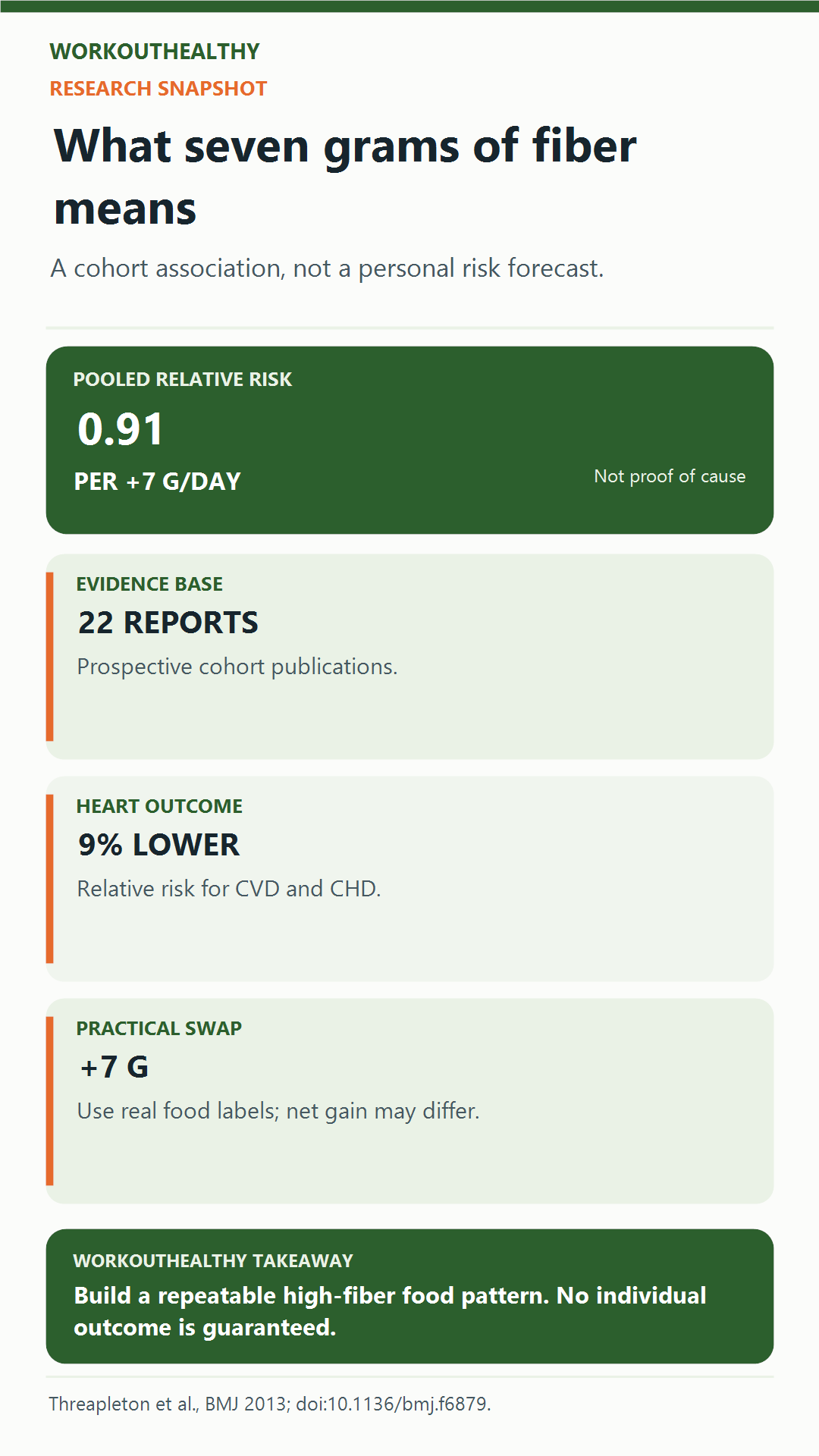
In a systematic review of prospective studies, every additional seven grams of total fiber per day was associated with a relative risk of 0.91 for cardiovascular disease and coronary heart disease. The researchers followed patterns of eating and later outcomes; they did not assign people to eat precisely seven more grams for decades (Threapleton et al., 2013).
The seven-gram finding is a useful reason to improve a food pattern, not a coupon for a guaranteed nine-percent discount on disease.
What the seven-gram study found
Threapleton and colleagues pooled prospective cohort publications available through August 2013. Twenty-two publications contributed data on total fiber, fiber subtypes, or food sources and later cardiovascular events. The dose-response estimate for total fiber was a nine-percent lower relative risk per additional seven grams a day (Threapleton et al., 2013).
A prospective cohort records what participants report eating and observes outcomes over time. This design avoids asking anyone to follow a deliberately poor diet, and it can study large populations over many years. It cannot prove that the fiber itself caused every observed difference.
People who eat more fiber may also eat more whole grains, beans, fruit, and vegetables. They may differ in smoking, activity, income, medical care, and other factors. Researchers statistically adjust for measured differences, but unmeasured ones can remain.
The pooled risk ratio was 0.91 for cardiovascular disease and 0.91 for coronary heart disease. A value below one means lower observed risk in the higher-fiber comparison. The reported confidence intervals did not cross one for these total-fiber findings, yet that statistical precision does not turn an observational association into an individual guarantee (Threapleton et al., 2013).
Why relative risk is not your personal forecast
The nine percent refers to relative risk, not nine percentage points. If a hypothetical group had a ten-percent event risk over a defined period, multiplying that risk by 0.91 would yield 9.1 percent. That illustration is arithmetic, not a prediction for any person or a result reported by the study.
Your starting risk depends on age, blood pressure, cholesterol, diabetes status, smoking, family history, and other factors. The same relative change therefore corresponds to different absolute differences for different people. An article about fiber should not substitute one population average for a clinician’s risk assessment.
Nor can the estimate be multiplied indefinitely. Moving from very little fiber toward an adequate food pattern may be worthwhile, but the pooled data do not establish that every additional seven grams produces an identical benefit at every intake level. Food choices also change more than one nutrient at a time.
The social image says extra fiber was “tied to” lower risk. That cautious wording matters. A later broad review of carbohydrate-quality studies also associated higher fiber and whole-grain intake with favorable health outcomes, while combining observational evidence with shorter clinical trials for risk factors (Reynolds et al., 2019).
How fiber may help the heart
Some soluble fibers form viscous gels in the digestive tract. That can interfere with reabsorption of bile acids, prompting the liver to use cholesterol when replacing them. The mechanism provides a plausible route to lower LDL cholesterol, a cardiovascular risk factor; it does not mean every fiber works identically.
Randomized trials provide a separate test of this mechanism. A meta-analysis of oat beta-glucan trials found reductions in LDL cholesterol compared with controls, supporting an effect on a measured risk factor rather than a direct proof that one bowl of oats prevents heart attacks (Whitehead et al., 2014).
Fiber-rich foods can also change the rest of a meal. Beans can replace refined starch or processed meat; oats can replace a low-fiber sweet breakfast; fruit can replace a dessert with little fiber. The health effect of a swap depends partly on what it displaces.
Fiber may influence fullness, post-meal glucose response, and the gut environment. Those pathways are biologically interesting, but they should not be compressed into a claim that all fiber “cleans arteries.” A heart-health plan still needs attention to blood pressure, lipids, physical activity, sleep, and smoking.
Why food source and fiber type matter
“Fiber” is an umbrella term for many plant components that resist digestion in the small intestine. Viscous soluble fiber, less-viscous soluble fiber, and insoluble fiber behave differently in food and in the gut. Processing changes texture and sometimes the amount remaining in a serving.
In the 2013 cohort review, total fiber carried the clear seven-gram dose-response result. Subtype and food-source analyses differed, and some confidence intervals included no effect. It would be an error to treat the total-fiber estimate as proof that any isolated supplement produces the same clinical outcome (Threapleton et al., 2013).
Oat beta-glucan is a useful example because randomized studies measured LDL cholesterol. Those trials do not mean that every high-fiber bar has the same effect. Whole foods also deliver other nutrients and can help build a more balanced eating pattern (Whitehead et al., 2014).
Beans and lentils provide fiber plus protein. Whole grains contribute fiber along with the original grain structure when minimally refined. Fruit and vegetables offer varied fibers and micronutrients. No single item has to carry the entire daily total.
For a wider look at how a plant-forward pattern fits real life, see our account of Arnold Schwarzenegger’s plant-forward diet. That story is not evidence for a specific fiber dose, but it illustrates that a dietary pattern is broader than one nutrient.
A practical seven-gram food-swap plan
Here is a WorkoutHealthy planning framework, not a prescribed menu. Choose one ordinary meal and identify a lower-fiber item you can replace or supplement. Use the Nutrition Facts label or a reliable food database for the actual product and portion you eat.
Step one: record your current daily fiber from a representative day. This is a rough baseline, not a diagnostic test. If your breakfast cereal lists two grams per serving and your lunch and dinner together add twelve, your example baseline would be fourteen grams.
Step two: add a food combination whose labels total roughly seven additional grams. For example, a bean serving labeled five grams plus a fruit serving labeled two grams gives five plus two equals seven. Those values are illustrative label inputs; brands, varieties, preparation, and portions vary.
Step three: check whether the swap actually raised your total. If the beans replaced another food that already supplied three grams, the net increase is five plus two minus three equals four grams, not seven. This simple subtraction prevents a common mistake in “add seven grams” headlines.
Step four: repeat the new pattern for several weeks and reassess whether it is comfortable and affordable. There is no reason to force exactly seven grams on day one. Consistency matters more than matching a study increment with laboratory precision.
The National Academies’ adult fiber guidance is commonly expressed as about fourteen grams per thousand calories, which corresponds to roughly twenty-eight grams for a two-thousand-calorie eating pattern. Needs vary with energy intake and individual circumstances; the number is a planning reference, not a treatment target (National Academies of Sciences, Engineering, and Medicine, 2005).
The most useful seven grams are the ones that arrive in foods you will still choose next month.
How to increase fiber without overdoing it
A sudden jump can cause bloating, gas, or changes in bowel habits, especially if your usual intake is low. Increase food fiber gradually and drink fluids as appropriate for your health situation. A comfortable progression is more sustainable than forcing a large overnight change.
Some people need personalized advice. Digestive conditions, recent surgery, swallowing problems, and certain medical treatments can change which fibers or textures are suitable. If a clinician has told you to follow a low-fiber diet, do not use a general heart-health article to override it.
Check packaged-food labels rather than assuming “whole grain” or “high fiber” means the same amount in every serving. Watch for a product that adds fiber while also adding substantial saturated fat, sodium, or sugar. The overall food choice still matters.
Fiber supplements can be useful for some people, but the cohort estimate came from patterns of dietary intake, not a trial assigning one supplement to prevent heart disease. Ask a clinician or pharmacist about timing if you take medicines that have specific spacing instructions.
The bigger heart-health picture
A higher-fiber pattern can be one part of cardiovascular prevention. The American Heart Association’s dietary guidance emphasizes the whole eating pattern, including plant foods, whole grains, and appropriate energy balance, rather than a single nutrient acting alone (American Heart Association, 2026).
Movement matters alongside food. Our guide to weekly exercise for heart health explains the activity side without suggesting exercise can erase every dietary risk. People managing hypertension may also find our blood-pressure exercise claims check useful.
These are complementary habits, not competing hacks. A person can improve fiber intake and still need prescribed medication, screening, or treatment. Do not stop a medicine because a social graphic mentions a relative-risk estimate.
For many households, the practical barrier is not knowing that fiber exists. It is cost, cooking time, food access, and taste. Frozen vegetables, canned beans rinsed when appropriate, oats, and familiar fruit can make a pattern more workable than a list of expensive specialty products.
Bottom line
The seven-gram, nine-percent figure is a real pooled association from prospective cohort research. It does not mean that adding seven grams tomorrow lowers your personal risk by exactly nine percent or that any single fiber product prevents heart disease (Threapleton et al., 2013).
Clinical trials of oat beta-glucan support a plausible LDL-cholesterol benefit for one type of fiber. The strongest practical move is to build a varied, fiber-containing food pattern that you can maintain, while keeping the rest of cardiovascular care in view (Whitehead et al., 2014).
For more evidence-grounded nutrition and training stories, explore WorkoutHealthy Insider’s nutrition coverage.
References
American Heart Association. (2026). 2026 dietary guidance to improve cardiovascular health: A scientific statement.
National Academies of Sciences, Engineering, and Medicine. (2005). Dietary reference intakes for energy, carbohydrate, fiber, fat, fatty acids, cholesterol, protein, and amino acids. National Academies Press.
Reynolds, A., Mann, J., Cummings, J., Winter, N., Mete, E., & Te Morenga, L. (2019). Carbohydrate quality and human health: A series of systematic reviews and meta-analyses. The Lancet, 393(10170), 434 to 445.
Threapleton, D. E., Greenwood, D. C., Evans, C. E. L., Cleghorn, C. L., Nykjaer, C., Woodhead, C., et al. (2013). Dietary fibre intake and risk of cardiovascular disease: Systematic review and meta-analysis. BMJ, 347, f6879.
Whitehead, A., Beck, E. J., Tosh, S., & Wolever, T. M. S. (2014). Cholesterol-lowering effects of oat beta-glucan: A meta-analysis of randomized controlled trials. American Journal of Clinical Nutrition.
This article is for general education, not individualized medical advice. Discuss personal cardiovascular risk, diet changes, symptoms, and treatment with a qualified clinician.